Health & Medicine, Medicine, Pop Culture

Rhonda Hunter’s Cancer Journey.

Original Publish Date: August 21, 2025.

https://weeklyview.net/2025/08/21/rhonda-hunters-cancer-journey/
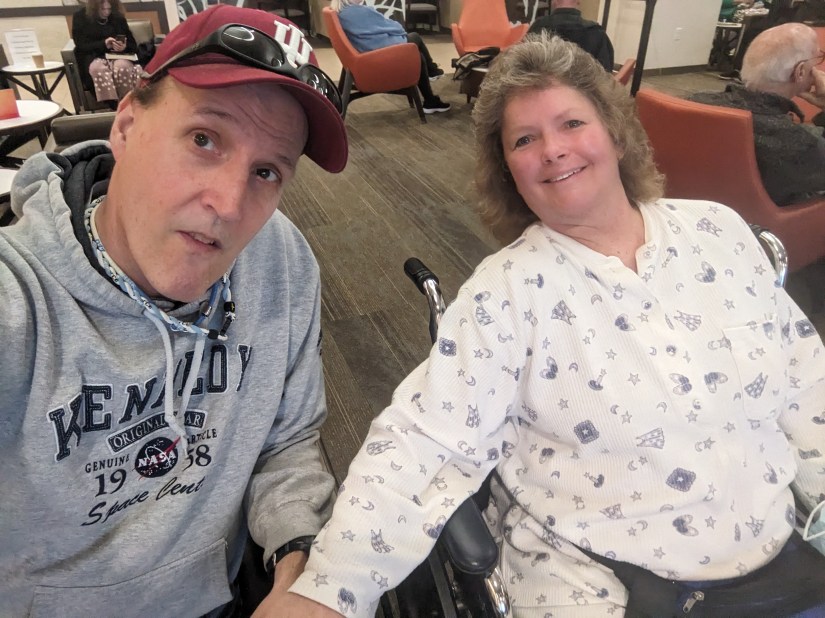
Alan & Rhonda Hunter at MD Anderson Cancer Center.

Warning. This is a self-serving article about my hero (my wife, Rhonda) and her year-and-a-half-long cancer ordeal. During our 2023 Irvington ghost tour season, she discovered a bad spot on one of the toes on her left foot. The ring toe to be specific (the little piggy that got no roast beef). At first, she thought it was a bad case of athlete’s foot. Rhonda called around the Indy area searching for a dermatologist: no openings anywhere until Christmas. She found her savior in the form of Megan Rahn, nurse practitioner at Pinnacle Dermatology in Crawfordsville, Ind. Within two days, they got her in and diagnosed it as one of the worst cases of melanoma they had ever seen. Rhonda recalls, “Megan asked if I wanted her to tell me the truth. I said, yes, and she said, ‘It’s cancer.'” We got that news on the Friday of Halloween festival weekend. Rhonda recalls, “During that weekend, longtime regular tour guests kept coming up to me and asking, ‘What’s the matter with Al? He’s not himself tonight.’ Needless to say, it was a rough weekend.

Patti LaBelle holding the white lillies.

After the tours concluded, we traveled down to our little Ricky and Lucy Ricardo efficiency time share in Daytona Beach, Florida, a luxury we bought ourselves over thirty years ago when we didn’t have two nickels to rub together. Over the years, we discovered that soaking anything in salt water cured almost everything. But this time, it didn’t work. Our trip concluded with a live concert by Patti LaBelle. At the end of the show, Patti walked over to Rhonda and handed her a bouquet of white lilies from a vase on her piano. Traditionally, white lilies symbolize purity and rebirth. Little did we know, it was an omen.
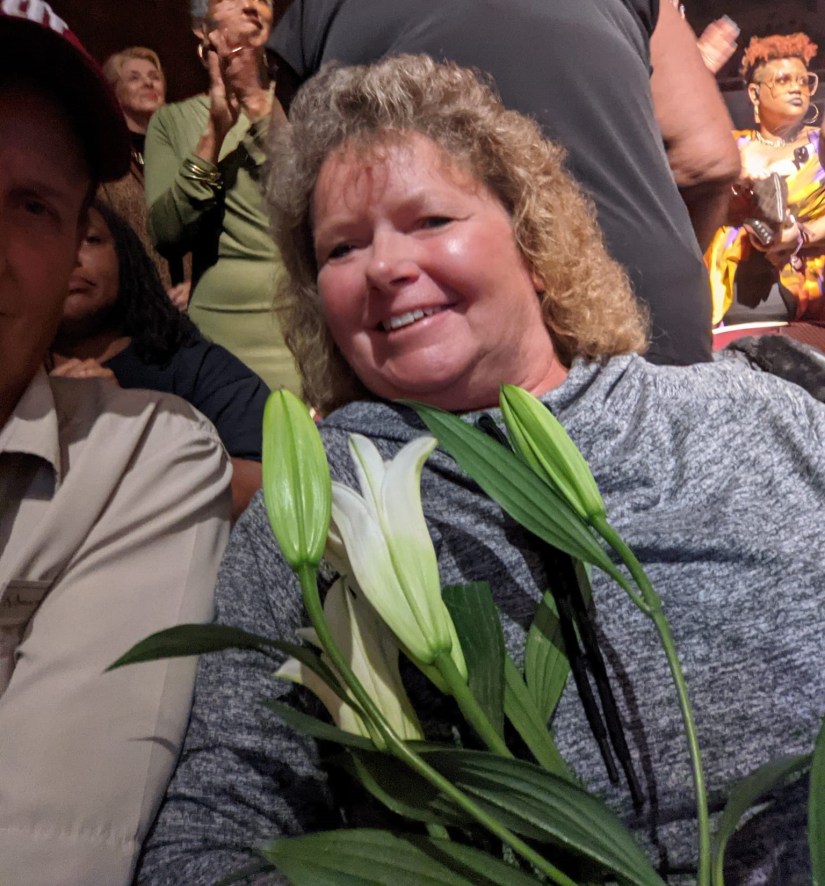
Rhonda with Patti’s gift.

Returning to Indiana, we learned that the good folks at Pinnacle Dermatology had secured an appointment with Dr. Jeffrey Wagner, melanoma reconstruction surgeon at MD Anderson Cancer Center Community North in Indy. By now, the toe was black. Dr. Wagner, who has seen over 20,000 melanoma cases in his decades-long career, said the toe’s gotta go. Her skin cancer was now categorized as a very aggressive form of malignant melanoma, the fastest spreading of all cancers (it can spread to dangerous levels in a month). She went under the knife, and they removed the toe and carved out three more spots, two on the top of her foot and one deep patch on the back of her calf.
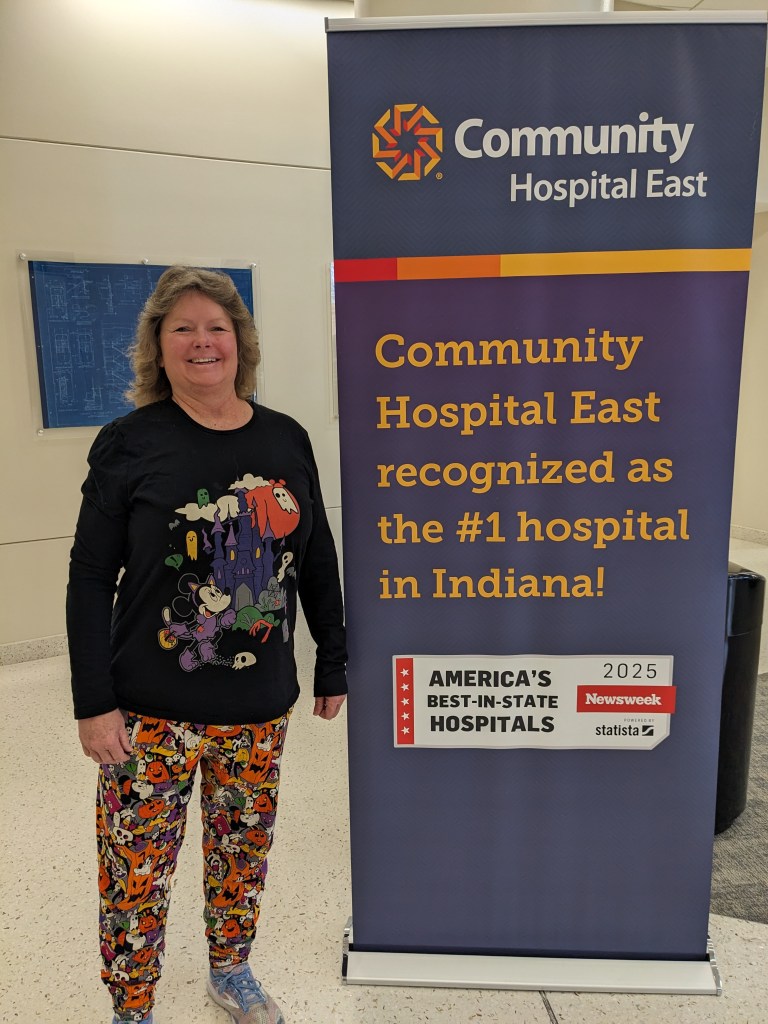
Rhonda at Community East.

They also removed a leaking Lymph Node in the groin. The result was two months in bed and a very uncomfortable Christmas season. We quickly learned that being diagnosed with melanoma is not unlike being an alcoholic, a drug addict, a diabetic, or bipolar: it’s a life sentence. It means a lifetime of treatment, scans, and medical supervision. We are now regulars at Pinnacle Dermatology, where we discovered that more than a few folks from Irvington are regulars. They now refer to Rhonda as “the lady with the toe.”
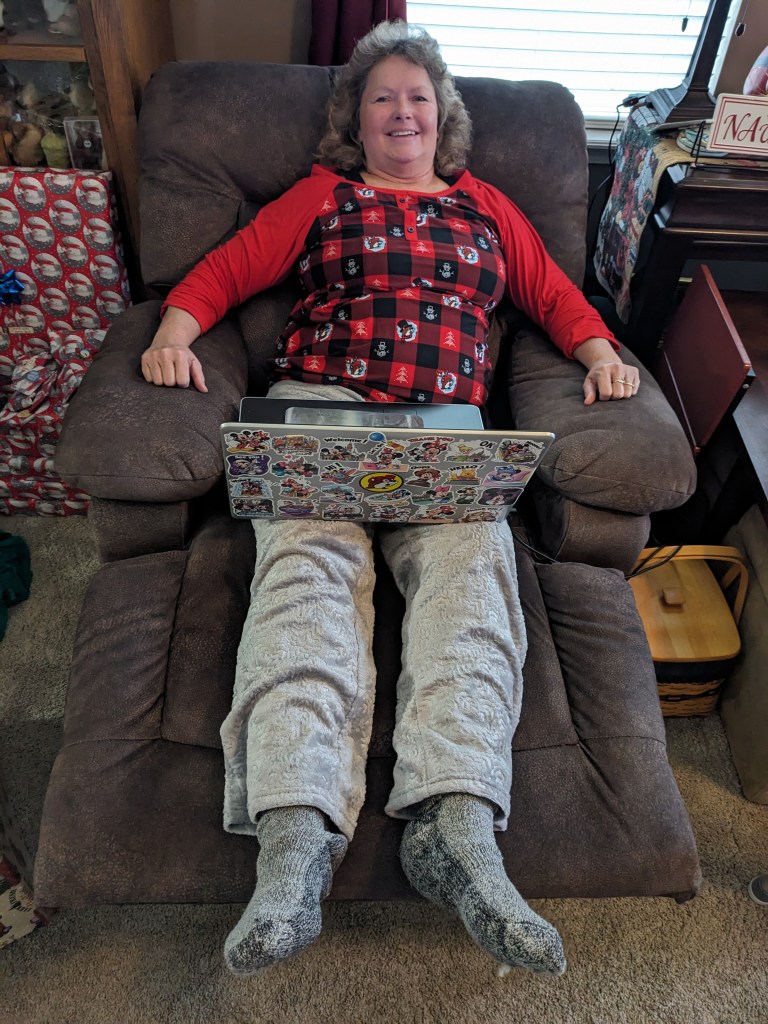
Rhonda at Christmas sans toe.

As pilgrims on this journey, we quickly learned that everyone has a skin cancer story. And, sadly, because of that, skin cancer is often minimized as a passing ailment that elicits a dismissive rejoinder. In our case, nothing could be further from the truth. Once everything was removed, we thought that was the end of it. That is, until we learned that a leaking Lymph Node had been detected and Rhonda needed to see Oncologist Dr. Sumeet Bhatia at MD Anderson. Coming a mere three days before Christmas, this was a devastating surprise; Rhonda wasn’t even out of a wheelchair yet. She was placed on Keytruda, a relatively new medicine used to treat melanoma. These monthly treatments, administered intravenously, were accompanied by endless blood work (that alone will make most readers cringe), and regular scans: PET Scans, CT scans, and MRIs. For all of 2024, we became accustomed to bi-weekly visits to MD Anderson, Community North, and Community East.
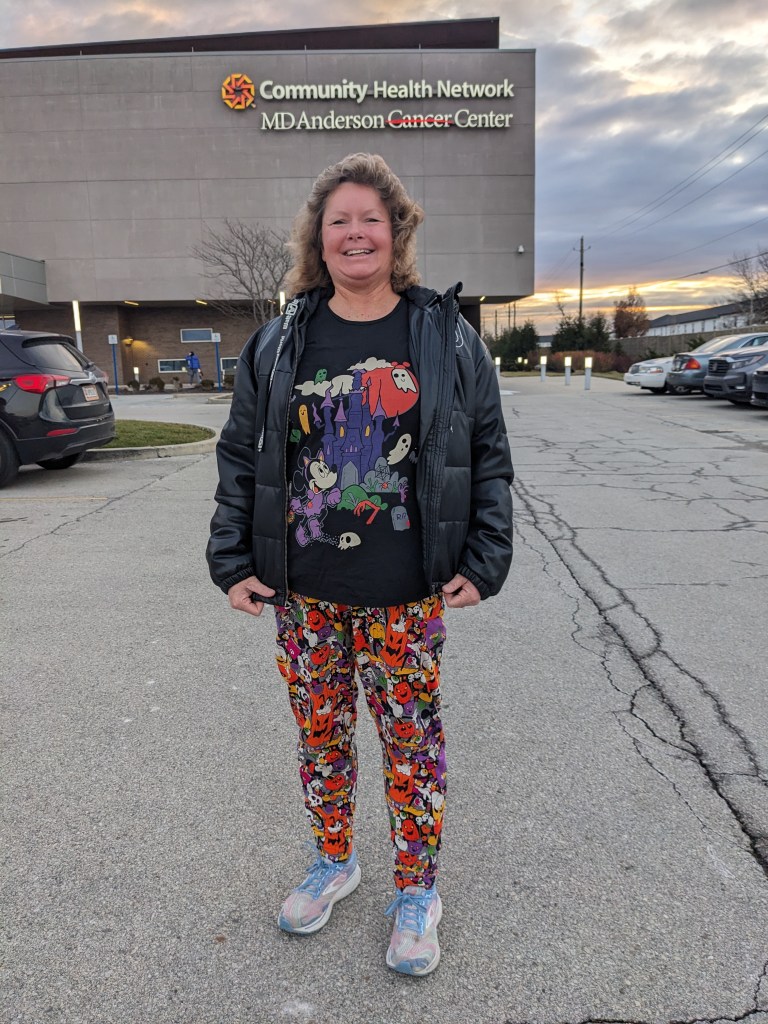
Rhonda at MD Anderson.

Sometimes with Oncology nurse Jennifer Chapman, sometimes with cancer navigator & advocate Andrea Oliver, and sometimes with Dr. Bhatia. As her last treatment concluded, we expected to walk out and ring the cancer-free bell. Suddenly, the treatment room door swung open, and in walked her entire team. The melanoma had now spread to her brain. Game changer.

Within moments, the nurse was crying, the advocate was crying, Rhonda was crying, and the doctor was crying. Surprisingly, the only person not crying was me, which is odd, because I’m the guy who tears up at Bambi, Old Yeller, and Steve Hartman stories. The doctor told us he’d give us time to decide whether we wanted to continue with a new treatment, with the warning not to wait too long because it could be too late. I had only two questions: Are they going to cut her and will she lose her hair? The answer was no. Long story short, our 10:30 checkup turned out to be an 11:30 fitting for a Radiation Therapy Thermoplastic Mask. Whenever I saw that mask, I couldn’t help but think of Boston Bruins goalie Gerry Cheevers. Google his mask and you’ll see what I mean.
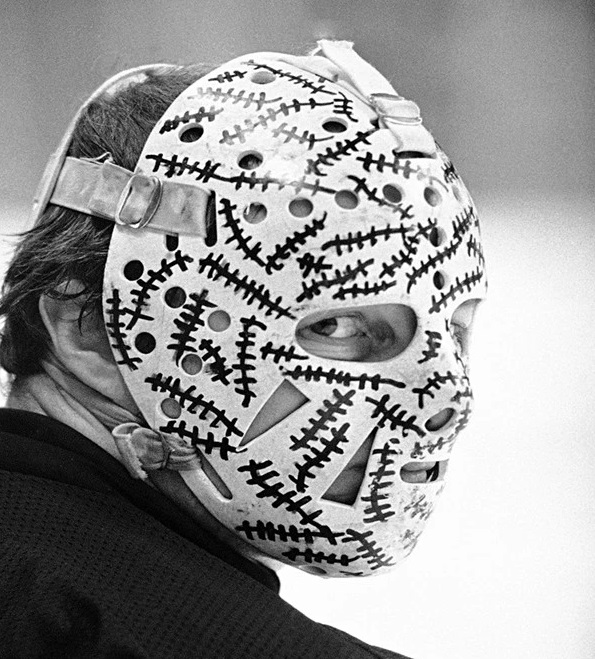
Gerry Cheever’s mask.

Within 1 week, she underwent radiology for one spot on the brain. I expected her to be zapped (pardon the pun) of energy and looking for a long nap. Instead, she came bouncing off that table and insisted on heading to Jockamos Pizza and Midland Antiques Market for the afternoon. A few months later, after another MRI discovered she had three more spots on the brain, she underwent another radiation treatment. This time, she had to be helped off the table and out the door. It was a long procedure extending past regular business hours. I was eerily alone in the cancer center and managed to lock myself out of the office, but that’s another story. She still came out smiling, though.
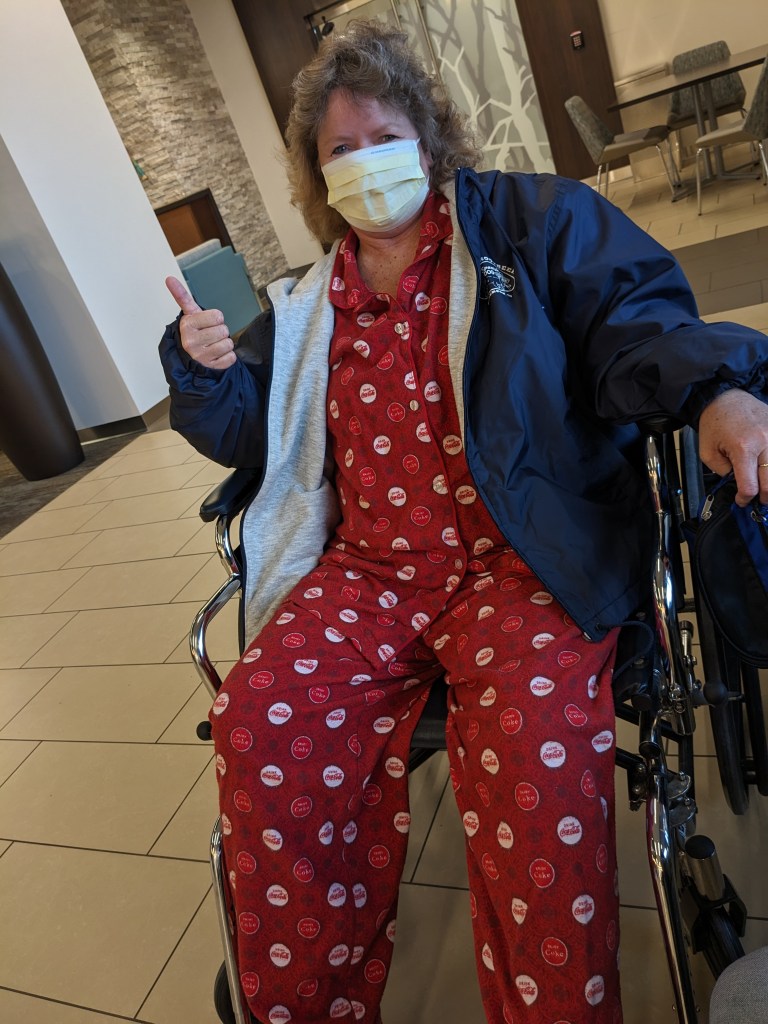
Early summer 2025 was rough as we nervously anticipated a four-month wait for new scan results. Faith & Begorra, the scans were clear! There were other challenges, including an emergency weekend hospitalization for internal bleeding, but it was not cancer-related. Now you know the details of one person’s cancer journey from an observer’s viewpoint. But how about the patient’s view?
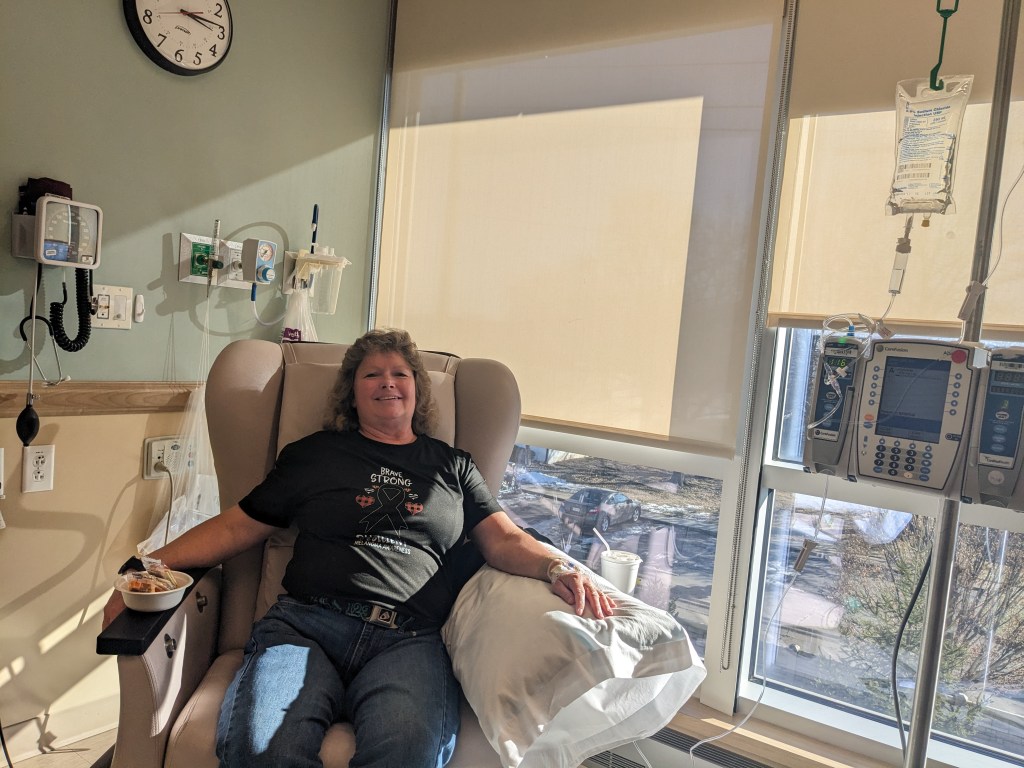
“This is the same cancer that killed Bob Marley, and it started on his toe. It got Jimmy Buffett, too. Jimmy Carter was diagnosed with melanoma on his head and neck at the age of 90 in 2015. It spread to his brain, but after a year of treatment, the spots disappeared.

Bob Marley, Jimmy Buffett, & Jimmy Carter.

He died last year at the age of 100, but he didn’t die of melanoma; he died from bleeding in the brain caused by falls.” Rhonda says. “If you get skin cancer, take it seriously. And above all else, stay out of tanning beds. Tanning beds have been labeled as “carcinogenic to humans” by both the World Health Organization and the International Agency for Research on Cancer (IARC). So, if you must have those tan lines, spray tanning is safer. Or, just rock that Disney Princess skin!”

My wife is a Disco girl and a creature of the eighties (No lie: her office has a mirrored disco ball, movie posters from Grease and Saturday Night Fever, and a velvet painting of Donna Summer). Like most young people of that era, especially girls, she spent a lot of time (and no little money) in tanning beds.
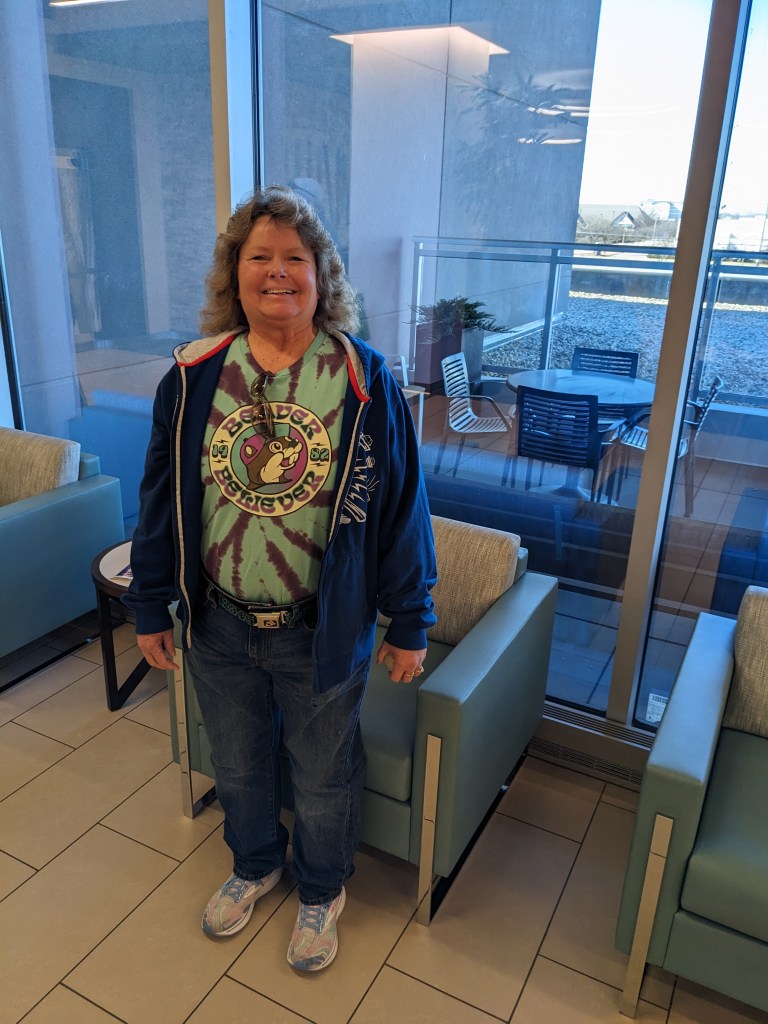
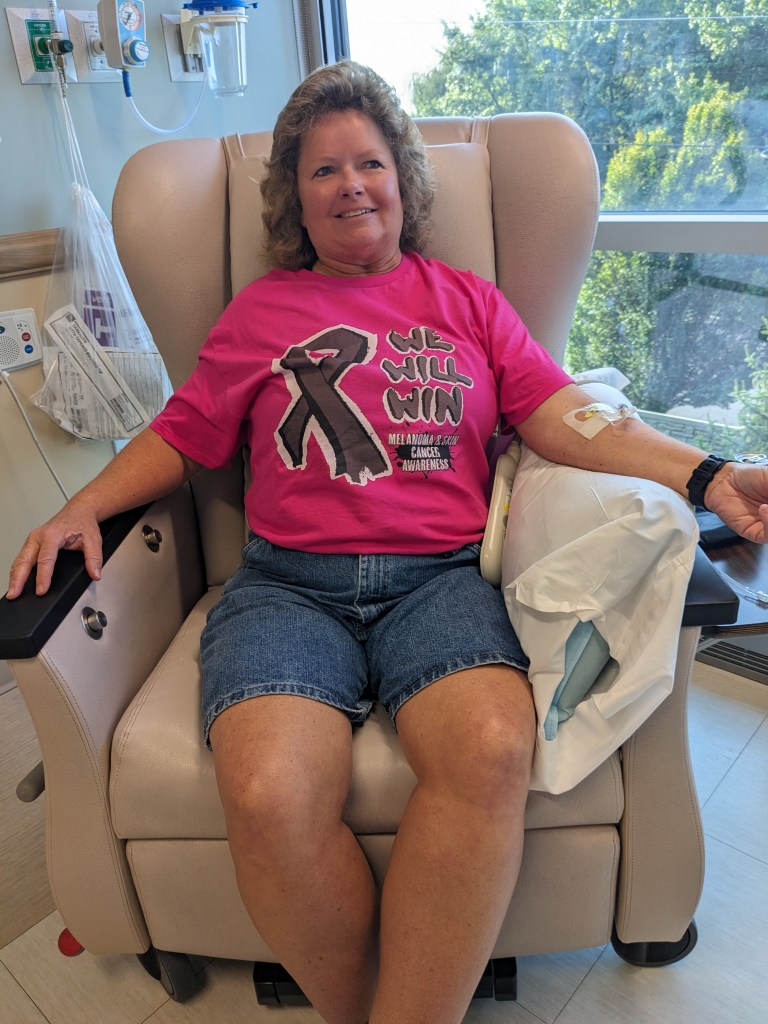
When I point out that I doubt Marley, Buffett, or Carter ever saw a tanning bed their entire lives, she answers, “Very true. Proof that the sun can damage you, too. Additionally, IARC studies show that if you’ve ever had a severe sunburn before the age of 18, you are 60% more likely to have melanoma, and that tanning-bed use before the age of 35 drives up the risk of melanoma by 75%. Worse, 70% of all melanoma travels to the brain. I never knew how aggressive this type of cancer was until I got it. Back then, not only were there tanning huts in every strip mall, but people of our generation remember using baby oil, cocoa butter, and tanning oil with no SPF whatsoever, straight up turkey basting! Even with all the bad publicity about the dangers of tanning bed use over the past quarter century, the Journal of the American Medical Association reports that 30% of white, female high school students and women ages 18 to 34 have used a tanning bed in the past year.”
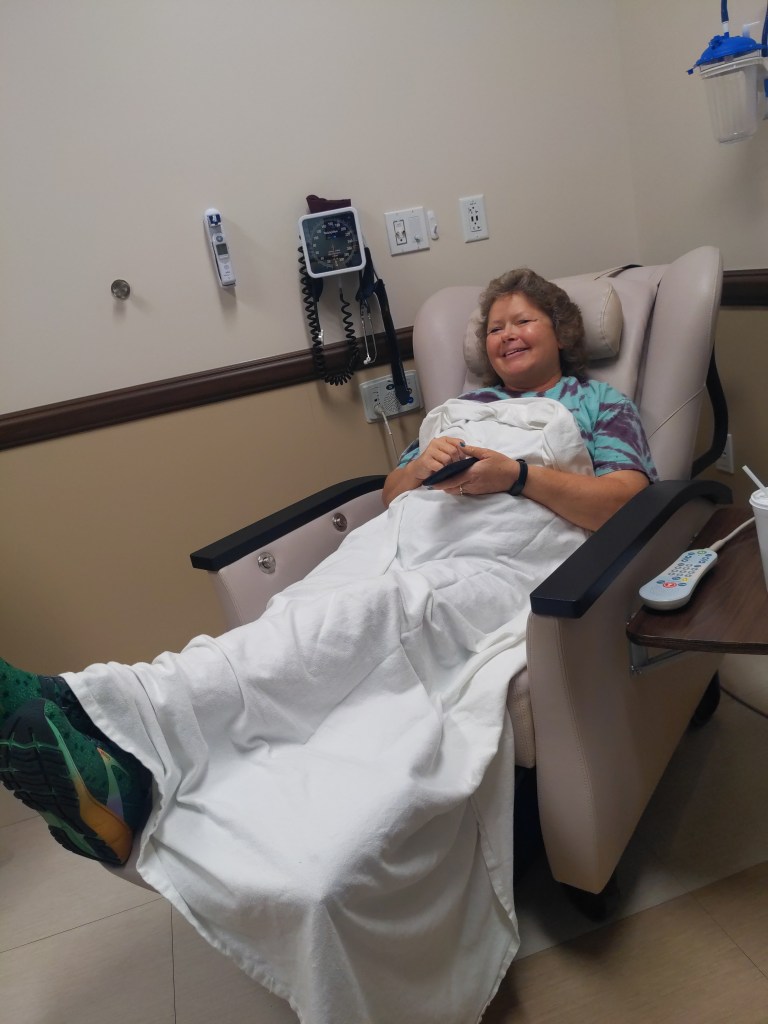
I asked Rhonda to retrace her cancer journey, both highs and lows. She answered, “The lows are pretty much what you would expect: fear, discomfort, and pain. I never smoked. I never did drugs, not even when they were prescribed to me. I don’t drink, so I went through a “Why me?” phase. But you get over all that in time. As for the medications, I did very well on Keytruda for the year I was on it. I was worried about it since I’d heard stories about people doing poorly on it and lasting for only one or two treatments. The Keytruda worked on my body, but not on my brain. So they switched my medication twice. They put me on Opdivo and Yervoy for two months (Jan.-Feb.), but it kicked my tail. I lost feeling in my hands and feet and experienced shortness of breath, flu-like pain all over, and I couldn’t even walk up a short flight of stairs.
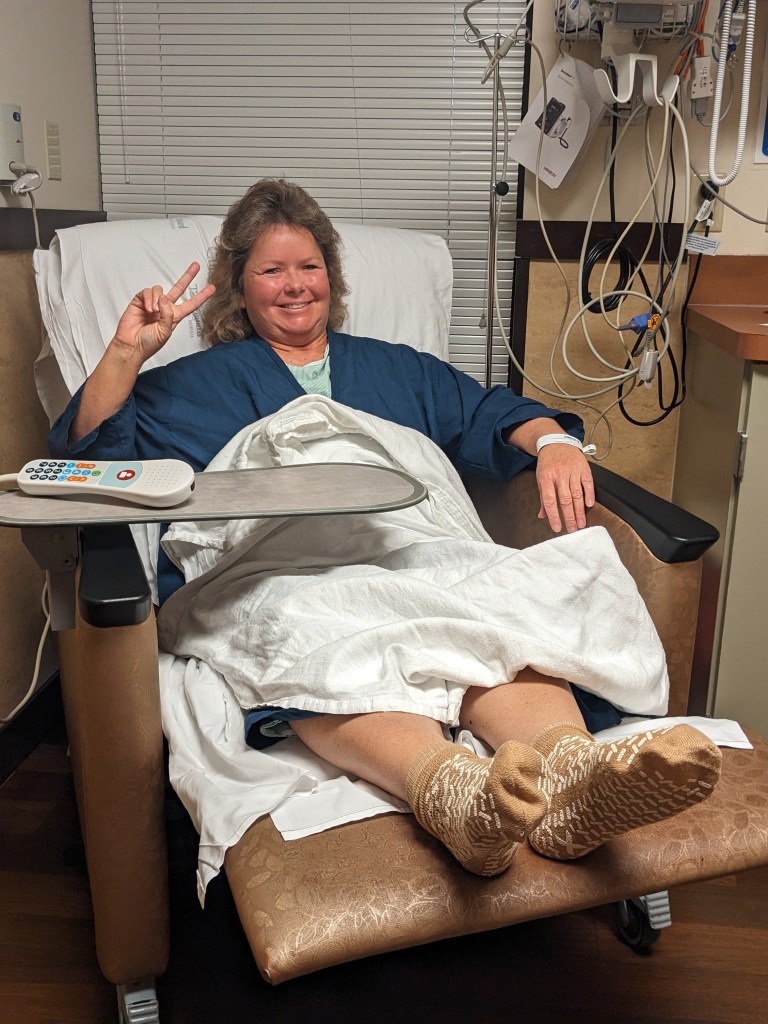
They put me on steroids, which alleviated the pain but pumped me up like the Michelin Man. They weaned me off of them slowly, but it came with an unfortunate side effect. I was tired all the time, with abdominal pain, muscle soreness, nausea, and vomiting. Worse, when I quit steroids, I went through wicked withdrawals; I was dope sick, like an addict. It’s starting to go away, but now the pain and discomfort are coming back. I am now on Braftovi and Mektovi. It makes me nauseous, weak, and tired. I don’t have many good days anymore, and even the good days aren’t great (It hurts to brush my hair). But I know there are many patients in much worse shape than me, so I’m going to keep fighting.”
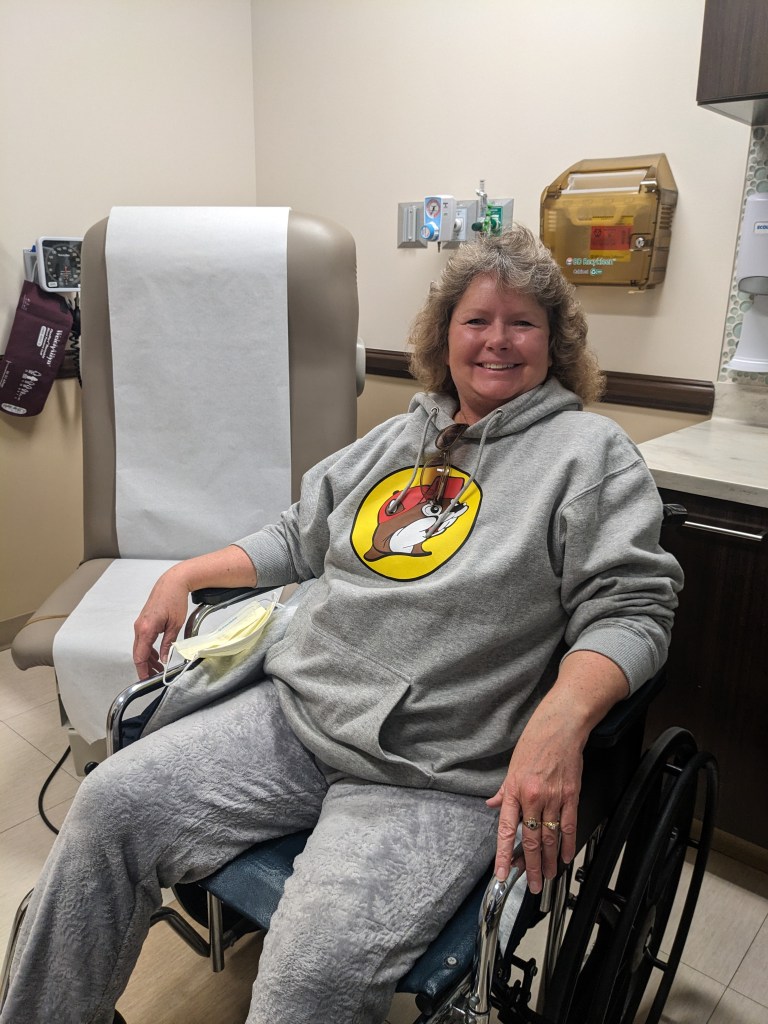
“I have been blessed with friends and family who love and support me. The value of those connections can’t be understated. My mom, Kathy Hudson, has been there from the beginning; diagnosis, treatment, and home-care. My dad, Ron Musick, has been a constant support, both by phone and in person. My children, Jasmine and Addison, have been better than I ever could have imagined. Addison, my mom, and you were the first faces I saw coming out of surgery. Jasmine, a former IU Med student, has made researching melanoma her new hobby. She discovered a web community on Reddit called “Melahomies” which has been quite helpful and informative. My sister Rennee, who works in the medical industry, has been a fountain of youth and support from Florida. I am equally blessed to have friends to lean on as well.
Thanks to Becky Hodson, Kris Branch, Cindy Adkins, Tim Poynter, Karen Newton, Kathleen Kelly, and Jodie Hall for being there. I am grateful for the continued support of Irvingtonians like Jan and Michelle at the Magick Candle, Adam and Carter at Hampton Designs, Dale Harkins at the Irving Theatre, and, of course, the girls at the Weekly View. Not to mention the support of your friends in the historic field. Barb Adams, Bruce & Deb Vanisacker, our Gettysburg friends and friends in the Lincoln community: Doc Temple (who passed earlier this year), Dr. James Cornelius, Bill and Teena Groves, and Richard Sloan. People like them rarely get the praise they deserve. If you ever find yourself in my position, or any traumatic medical condition for that matter, don’t be afraid to lean on your friends and family. They are as important to your healing process as the doctors and nurses. And of course, you Al, you are my rock.”
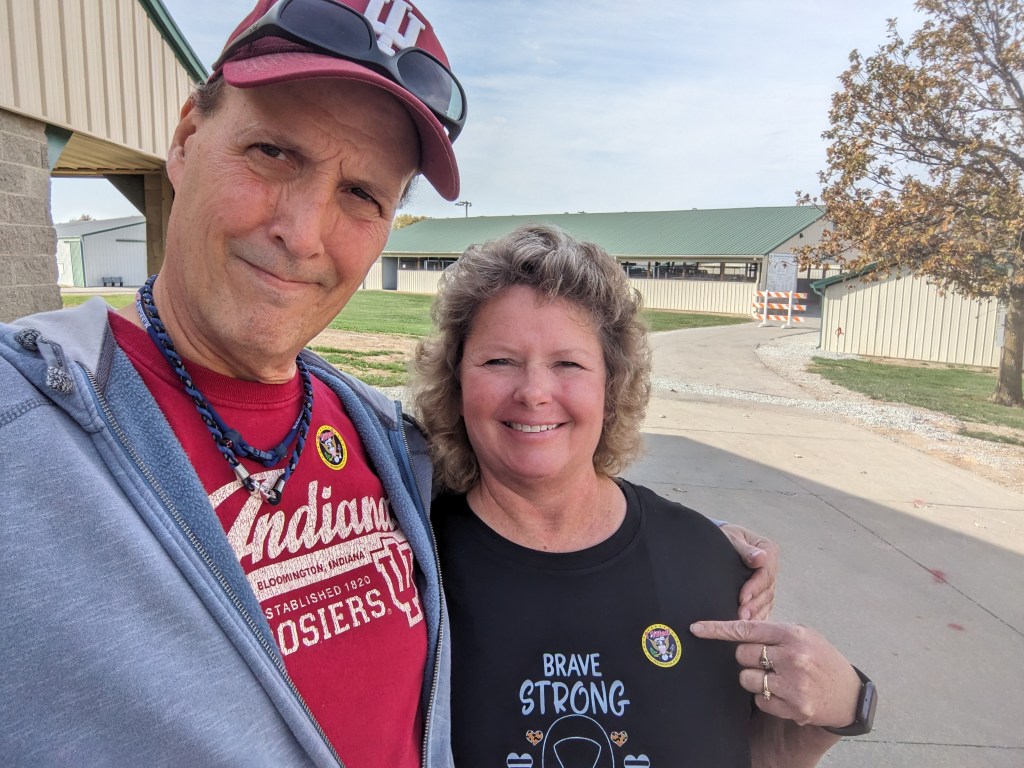
My first introduction to skin cancer came from our longtime friend, former ABA Pacers legend Bob Netolicky, and his family in Austin, Texas. Bob, Elaine, and Nicole have offered support and counsel throughout this journey. Neto has been battling skin cancer since being diagnosed during our first ABA reunion in 1997. Neto says, “I spent a lot of time in the sun when I was younger. Annual checkups are now a part of my routine.” Longtime readers of my column might recall that rocker Warren Zevon has been a constant in our relationship since the beginning. On his last appearance on David Letterman’s Late Show, Zevon, who passed away from cancer in 2003, advised his fans to “Enjoy every sandwich.”
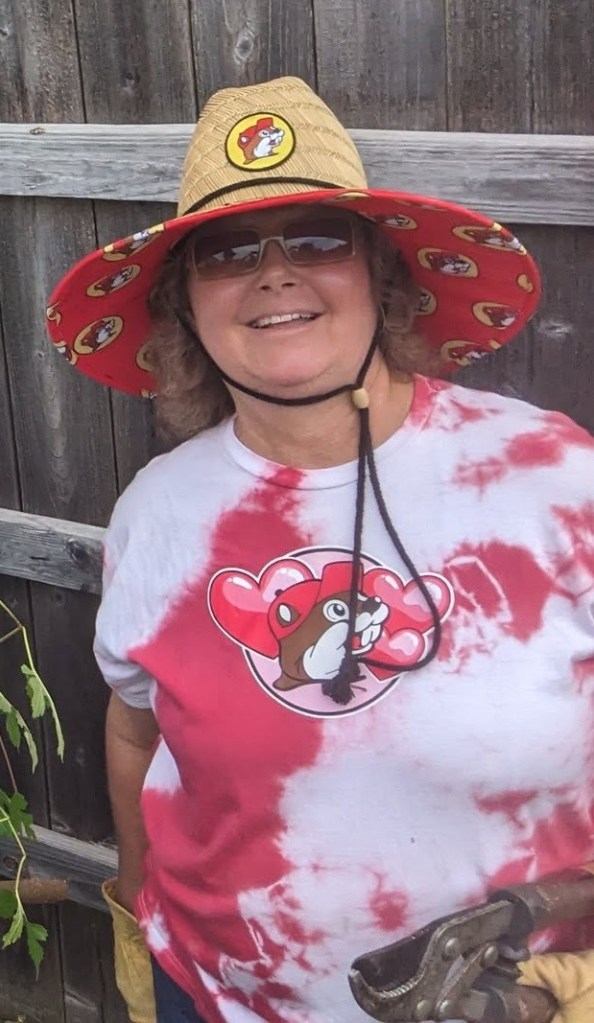
So, I asked Rhonda if she had any advice of her own. “I worry about people like me who had no idea how serious this thing is. Joggers, walkers, golfers, bicyclists, people who work or spend time outdoors professionally or recreationally. Skin cancer can sneak up on you, and it is serious. Don’t take it for granted. If you’re outside, wear a hat and make sunscreen a part of your daily routine. My Buc-ee’s straw hat is now a part of my regular gear. And it looks pretty cool.”

Rhonda’s white lillies presented to her by Patti LaBelle are now framed and hanging in her office alongside an autographed microphone from Ms. LaBelle.
Creepy history, Health & Medicine, Indianapolis, Medicine

The Hilton Sisters-Vaudeville’s Beautiful Siamese Twins. PART I

Original publish date May 22, 2025.

https://weeklyview.net/2025/05/22/the-hilton-sisters-vaudevilles-beautiful-siamese-twins/

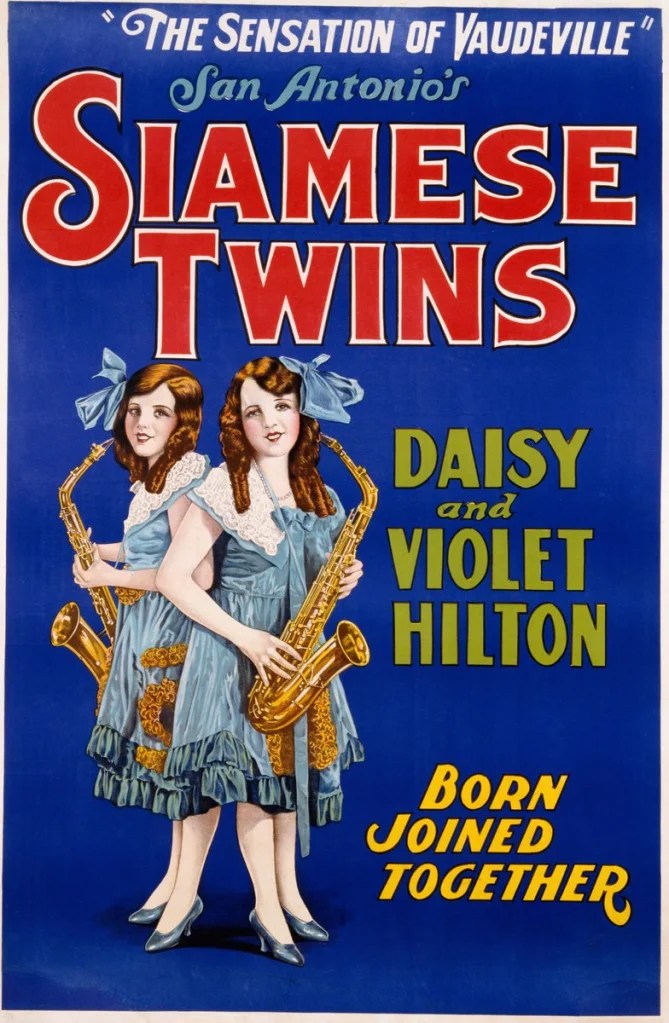
The Hilton Sisters Sheet Music.

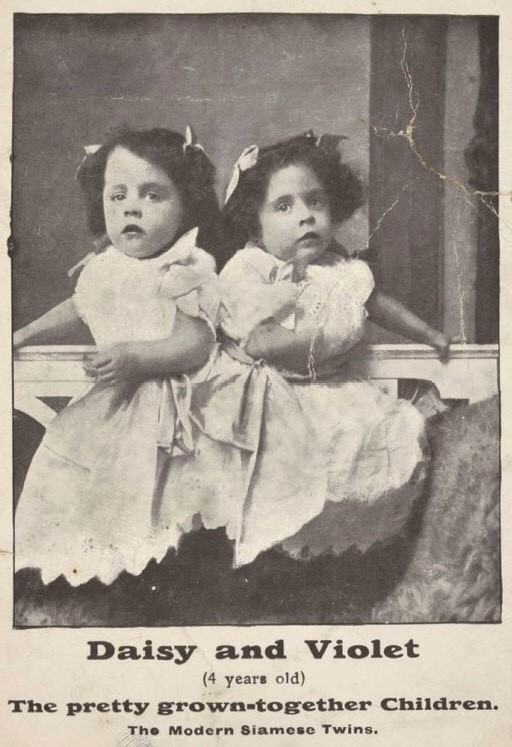
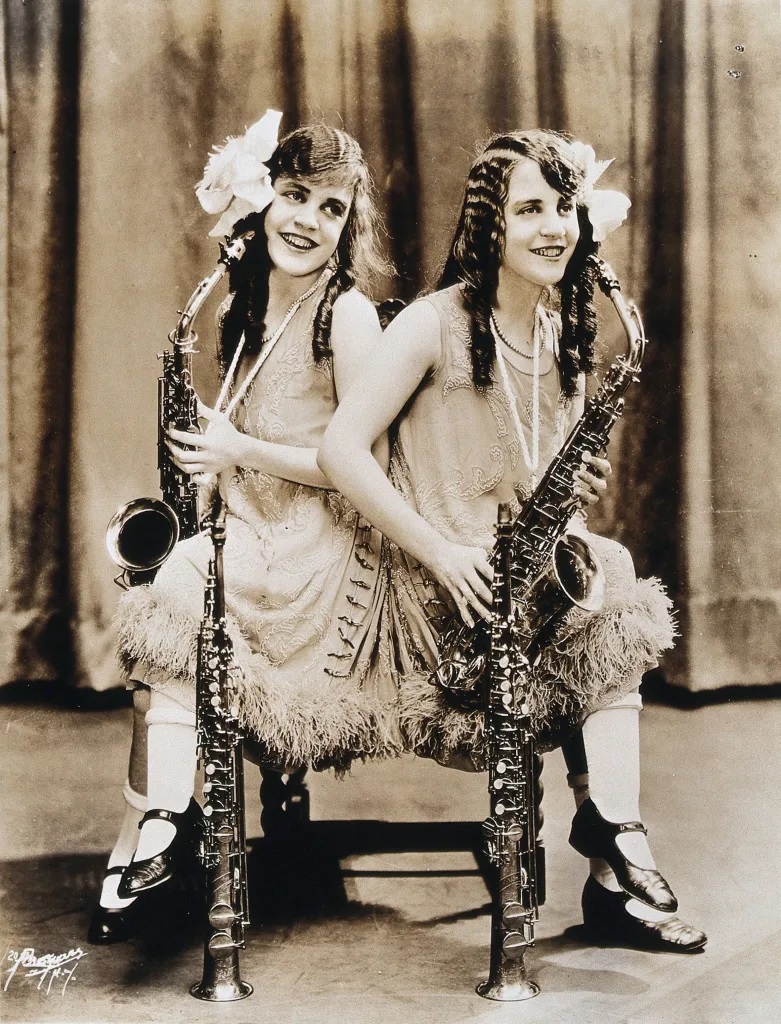
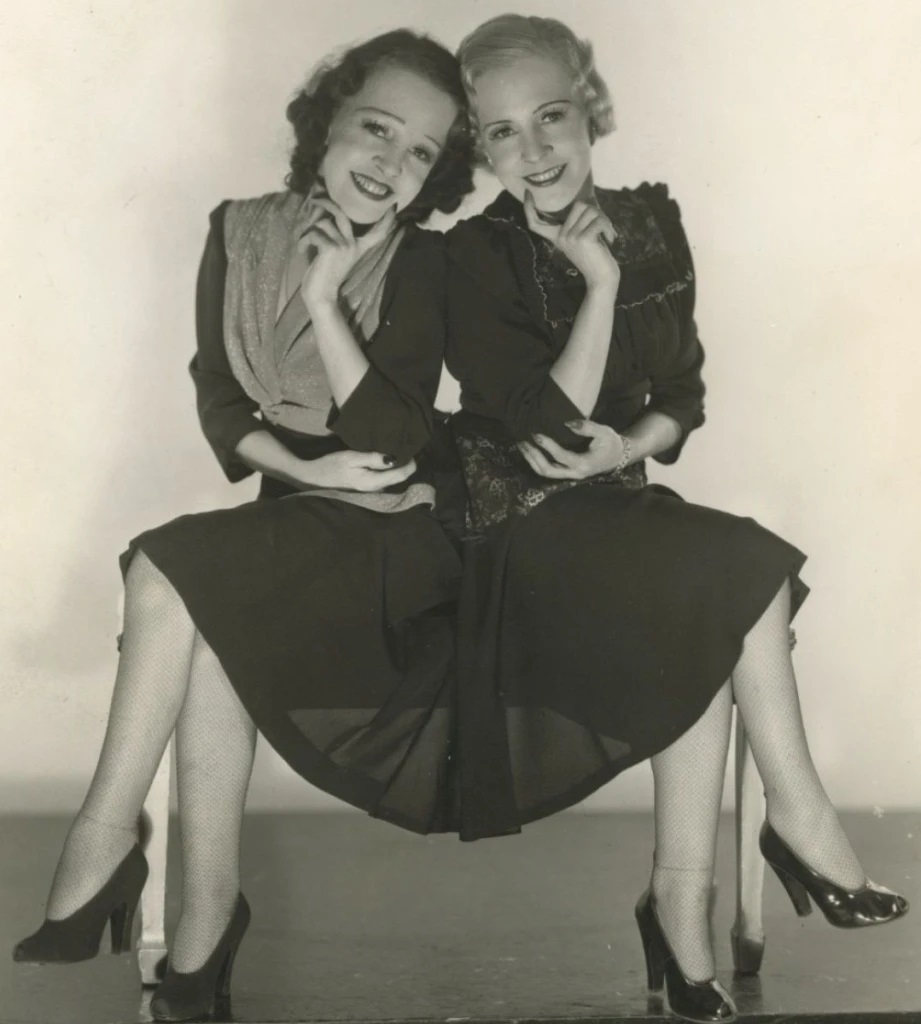
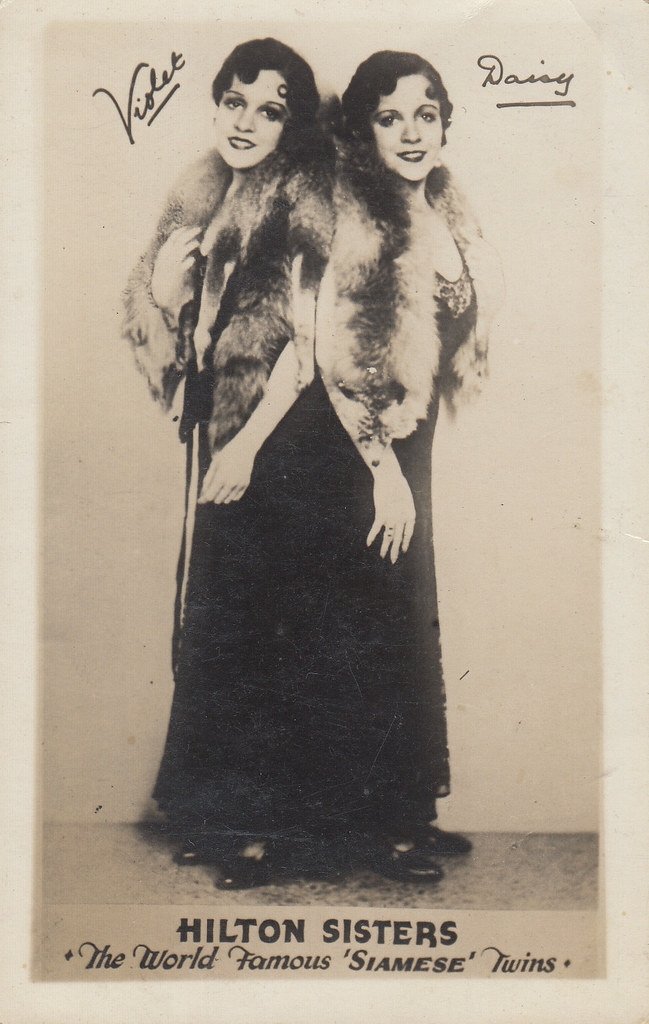
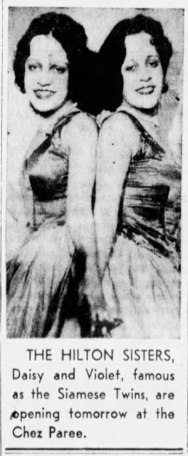
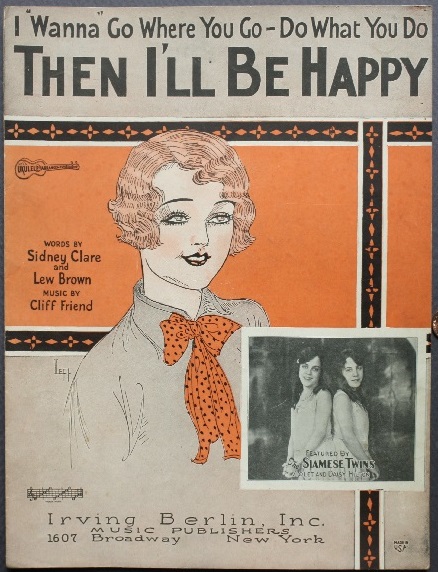
I recently ran across a five-dollar box of sheet music at an antique show. It seems like nobody wants sheet music anymore. I suppose, like recipe books, almanacs, TV guides, and car manuals, they are seen as obsolete nowadays. It turned out to be a fun, if not very valuable, box of paper. One was from the 1952 Marilyn Monroe film Niagara, along with a bunch of 1920s-40s songbooks and “how to” manuals for the Hawaiian guitar. The one that caught my eye was a piece of ukulele sheet music for the 1925 Irving Berlin song “I Wanna Go Where You Go—Do What You Do. Then I’ll Be Happy,” performed by a pair of lovely young ladies known as the “Hilton Sisters.” These beautiful young girls are pictured side by side on the cover in a pose that suggests that they were joined at the hip. A closer examination reveals a caption proclaiming the duo as a pair of conjoined “Siamese Twins,” and it turns out, during the Vaudeville era, Daisy and Violet Hilton were the biggest stars of their day.
Daisy and Violet Hilton were born on February 5, 1908, in Brighton, Sussex, England, birthplace of authors Charles Dickens and Rudyard Kipling. The twins were born to an unmarried barmaid named Kate Skinner. After seeing her babies, Kate was horrified, thinking that her children’s birth defects were a punishment from God for her unmarried status. She refused to look at them, let alone hold them, so she sold the girls to the midwife who had delivered them, Mary Hilton. Hilton looked at those baby girls and saw dollar signs. Hilton immediately began displaying the girls in the backroom of the Queen’s Arms pub on George Street, which she ran with her husband. As they grew, she taught the girls how to sing, dance, and play musical instruments. The Hilton sisters toured first in Britain in 1911 (aged three) as “The Double Bosses” and from then on, the twins were on the road touring the United Kingdom, Europe, and Australia. The twins were the first set of conjoined twins born in Britain to survive more than a few weeks. The girls were connected at the hip and pelvis by a fleshy appendage and shared no organs. Doctors stated that they could have easily been separated at an early age and would have lived independent lives. But the girls were seen as piggybanks in those formative years, so “fixing” them would kill the golden goose.

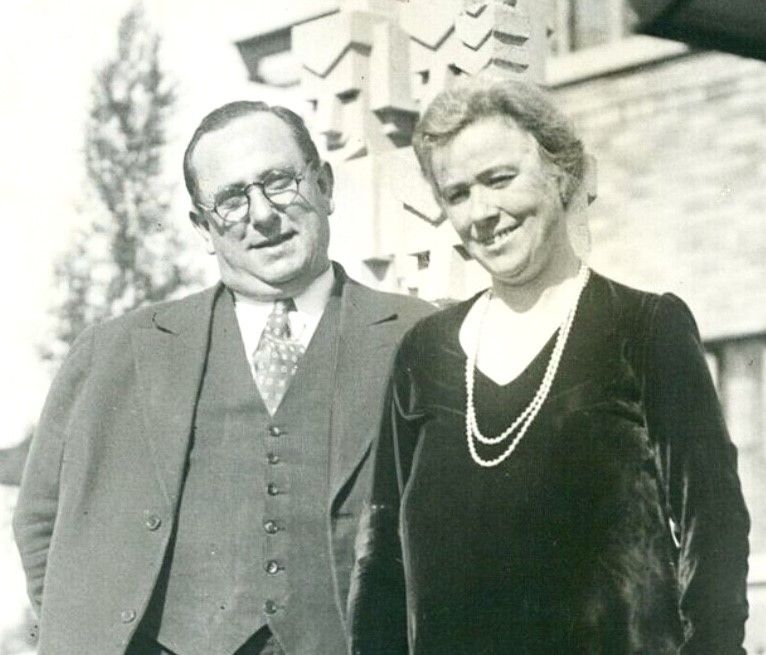
In 1913, rebranded as the “Famous Brighton United Twins”, they toured Australia, where they made their debut at Luna Park in Melbourne on Friday the 13th of December, 1912. Despite a massive advertising campaign, the novelty of their act quickly wore off. The show closed after only a week, and the twins, their mother Mary, and sister Edith were abandoned down under by the show’s promoter. Somewhere along the line, the Hilton family came into contact with Myer Myers, a traveling circus balloon and candy seller. Myers formed a romantic interest in the twins’ older sister Edith, and the couple was married. The marriage was not based on love, it was based on financial gain. While the twins were fond of their older sister, they never liked Myer.

Myer & Edith Myers.

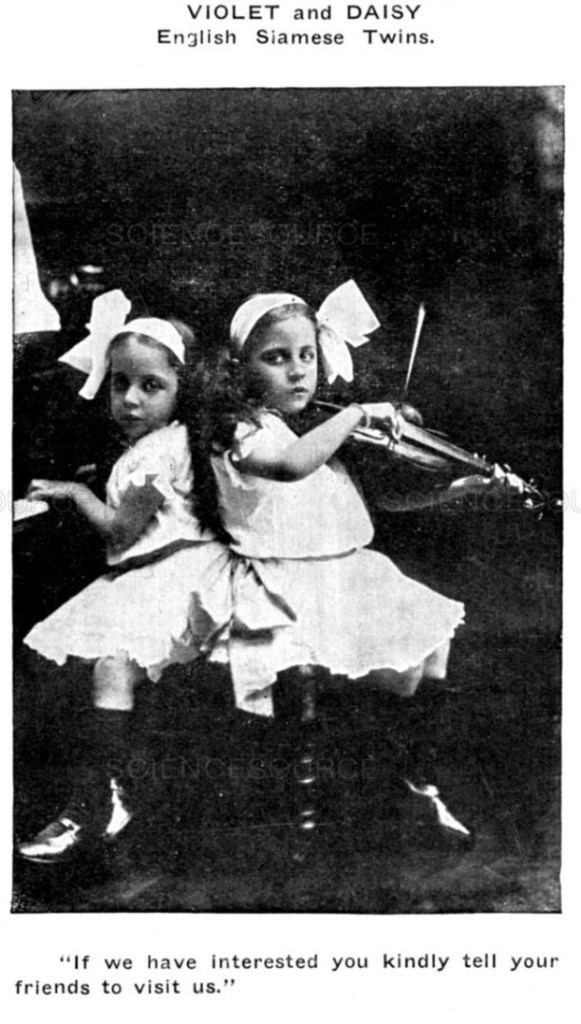
In June 1916, Myer brought the girls to the United States via San Francisco. But immigration officials had never seen anything like Violet & Daisy before, so they were detained and quarantined at Angel Island (next to Alcatraz) in the San Francisco Bay for months until they were finally cleared for entry. By 1918, the 10-year-olds were traveling the Orpheum Circuit of Vaudeville Theatres across the country. The adorable little girls were extremely popular, although still categorized as medical oddities and relegated to the sideshow carnival “Freak Show” class. But the Hilton sisters were different, they weren’t just an act, they were talented. The girls were trained in singing and dancing and eventually learned to play the piano, violin, and saxophone. The twins made huge amounts of money in Vaudeville, but regardless of who was managing them, they retained very little of it.

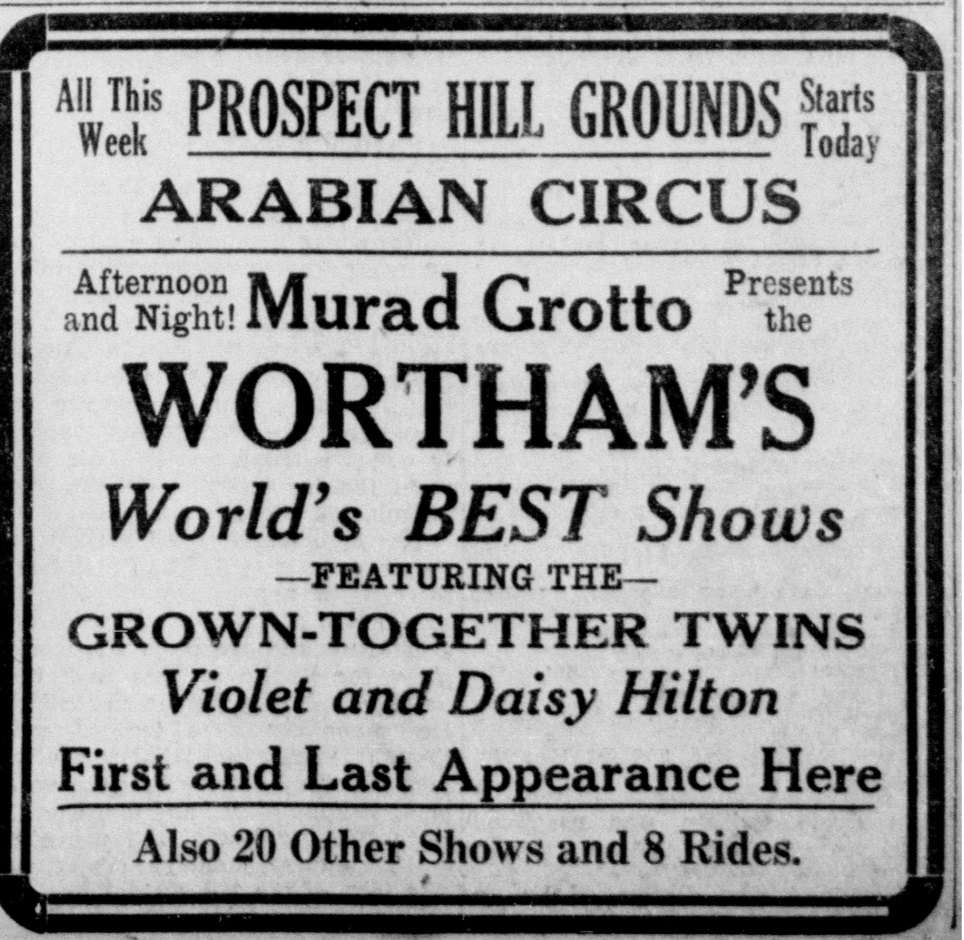
Throughout their lives, Violet and Daisy often voiced their dislike of Myer Myers and how he exerted complete control over every aspect of their lives. Myers insisted that the twins call him “Sir,” that the girls sleep in the same bedroom with their parents, and when they were not performing in the circus, that they spend their days doing school lessons and practicing their musical instruments. The twins were also forbidden to play with other children. Myer Myers promoted the twins unscrupulously and toured them mercilessly. In time, the twins became the star attraction of the “Great Wortham Show”, a traveling carnival that toured the United States. People around the country flocked to see these beautiful, mysterious young girls. In 1917, while performing at the San Jacinto Fiesta in San Antonio, Myers built a castle-like pavilion directly across from the Alamo. Now, every visitor to the shrine of Texas independence made the trip across the street to see the twins. Myers continued to tour the twins across the USA, and whenever he entered a city or town, he ensured that the first stop was a visit to the mayor or, if it was a state capital, the governor.

The Hilton Sisters exploded onto the American scene at precisely the right time, for the years between World War I and World War II were considered the heyday of vaudeville side shows. On stage, the adorable twin girls sang, danced, and played saxophone & piano. They were exhibited as children as sideshow curiosities, but now they toured the United States in vaudeville theatres and American burlesque circuits in the 1920s and 1930s. Myers reinvented the twins’ biographies, saying their “Mother died at their birth and their father, a soldier, was killed a short time afterward in an accident. Firmly joined together at the base of their spines, the Hilton girls present a curious spectacle, especially so as the odd grafting of nature has materialized into a seemingly uncomfortable back-to-back, half-diagonal position. Despite this, the girls move about with an ease and freedom and movement that is nothing less than astonishing.”

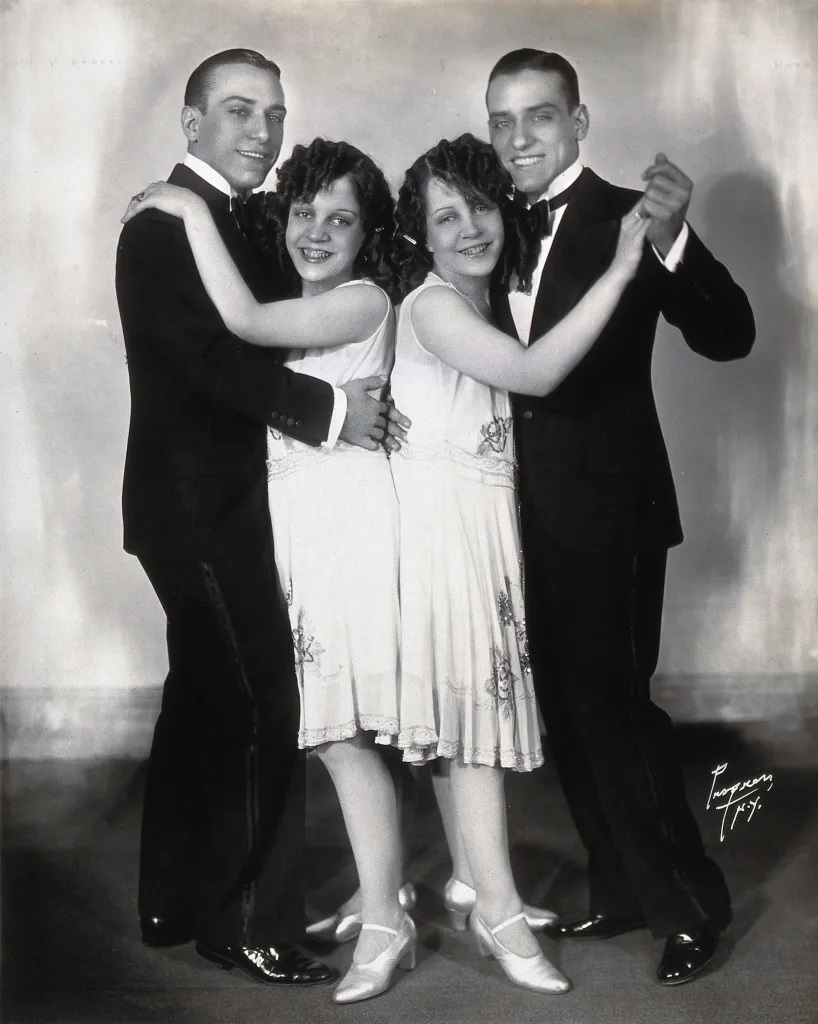
The Indianapolis News for Saturday, March 28, 1925, touted the twins’ first appearance at the Globe Theatre, reporting that the performance got out of hand. Their appearance caused traffic jams, and police were called to control the lines of rowdy curiosity seekers on the streets outside trying to get into the theater. During their act, the girls sang songs, played music, and always concluded in the same fashion: a waltz. Two young men were waiting in the wings offstage. On cue, the men would glide out and dance with the sisters in rythm to an orchestra posed behind them. One of those young men was an unknown vaudevillian named Lester Townsend, soon to be known to the world as Bob Hope. In 1926, the sisters teamed up with up-and-coming comedian Bob Hope, who formed a new vaudeville act he called “Dancemedians.”

The twins appeared onstage with other luminaries like George Burns & his wife Gracie Allen, Sophie Tucker, and Charlie Chaplin. The Twins’ songwriter during their vaudeville years was Bart Howard (then known as Howard Joseph Gustafson), who wrote “Fly Me To The Moon.” That same Star newspaper article reported that the girls were like any other pair of sisters. Sometimes they would fight, and one sister would not speak to the other for days offstage. The article noted that the “girl’s fingerprints were different, one would read while the other slept, one sister may prick her finger, but the other is unaware of it, but,if one has a headache, the other will feel it. Daisy sews, but Violet is not particularly fond of sewing. Daisy enjoys housework while Violet prefers to arrange the furniture and decorate the house. There seemed to be a subtle telepathy between the twins.”

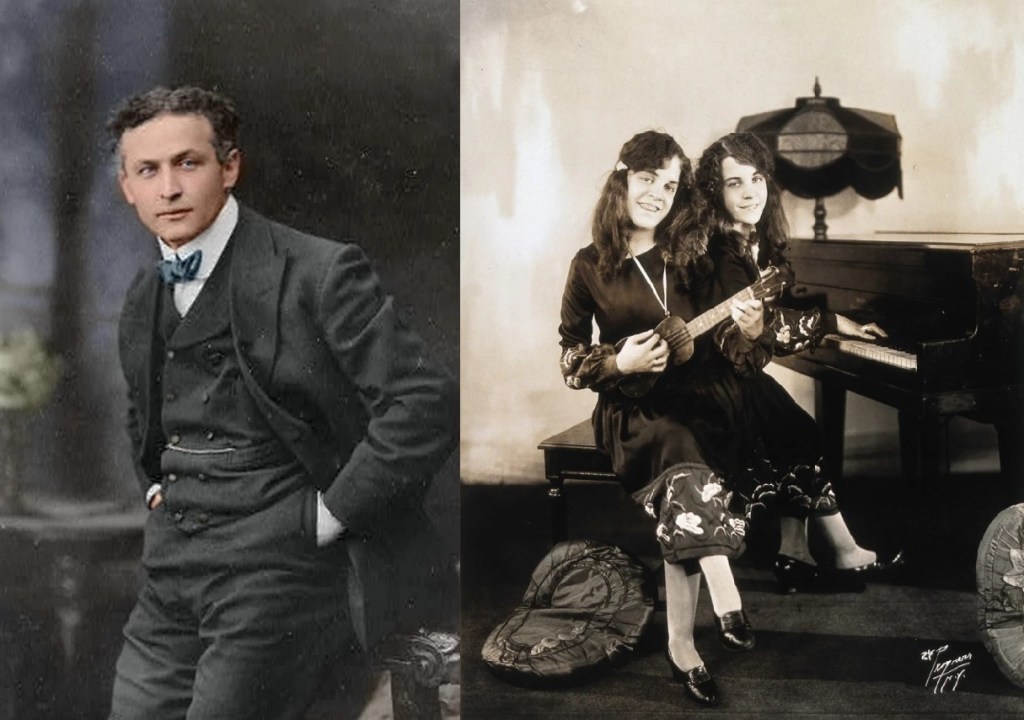
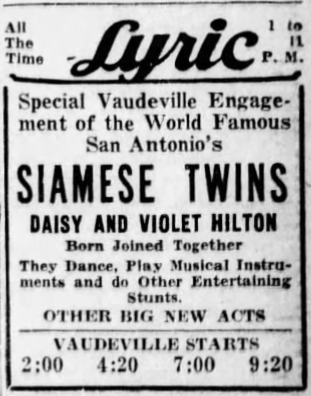
Throughout the 1920s, the twins earned $5,000 per week for 44 weeks on the Orpheum Circuit, over $91,000 weekly in today’s money. They were the highest-paid vaudeville act in America. Myer Myers was their manager, and the girls never saw a dime of that money. The Hilton Sisters were befriended by escapologist Harry Houdini, who taught them how to “mentally separate from each other.” Learning of the twins’ disadvantageous financial arrangement with Myer Myers, Houdini strongly advised the girls to emancipate themselves from their legal guardians and hit the road on their own. In his book Very Special People, author Frederick Drimmer quoted Houdini as telling the twins, “You must learn to forget your physical link. Put it out of your mind. Work at developing mental independence from each other.” Houdini died on Halloween night of 1926 and was never able to help the twins achieve that goal in his lifetime. The girls appeared in Indianapolis many times during their career. Indianapolis had a strong vaudeville, burlesque, and theatre district. The Hilton Sisters appeared at the Lyric Theatre on March 6, 1928, and again on September 6, 1928. Before that appearance, Chicago Commissioner of Health Herman Bundersen declared them healthy and described them as: “Two souls with but a single thought.” While the girls received a clean bill of health, both physically and spiritually, could the same be said of their industry?

PART II

The Hilton Sisters-Vaudeville’s Beautiful Siamese Twins.

Original publish date May 29, 2025.

https://weeklyview.net/2025/05/29/the-hilton-sisters-vaudevilles-beautiful-siamese-twins-part-2/

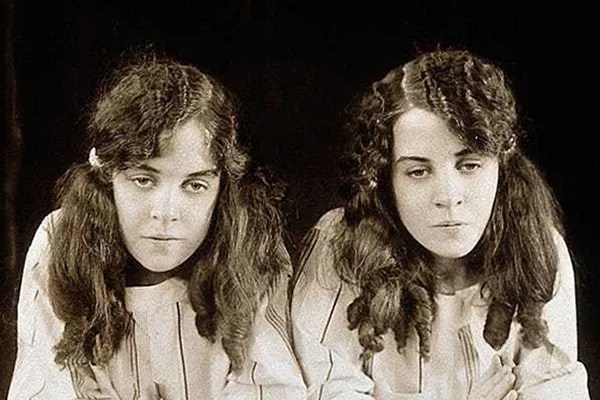
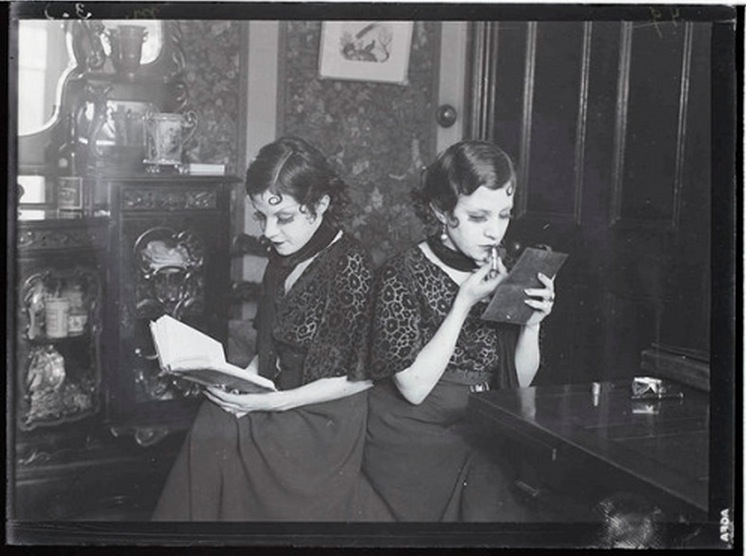
Violet and Daisy Hilton.

In the Roaring Twenties, the Hilton Sisters were the darlings of Vaudeville. That circuit ran straight through the heart of Indianapolis. Violet and Daisy Hilton were conjoined twins who were abandoned by a single mother and sold to a Brighton, Sussex, England, saloon matron who subjected them to years of exploitation, only to be adopted by a corrupt manager on the fringes of the sideshow circus & show-business circuits. Despite those obstacles, the twins managed to strike out on their own and become hugely successful stars of stage, vaudeville, and film in the United States.

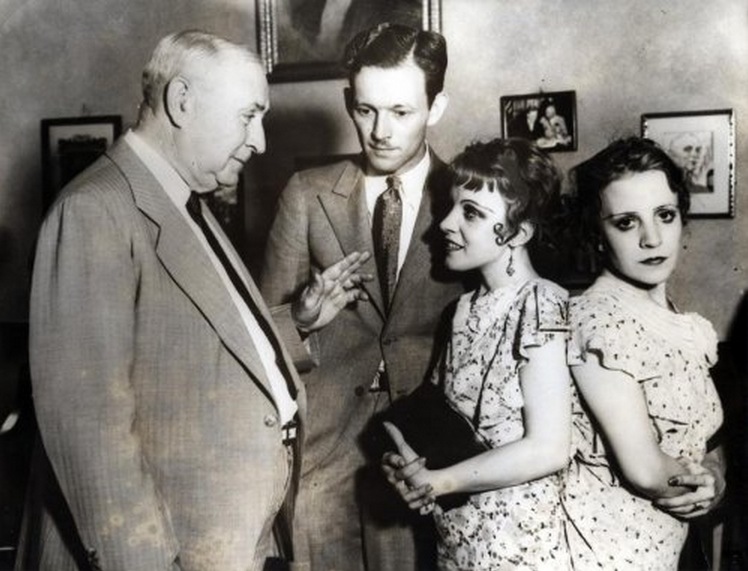
Lawyer Martin J. Arnold with Violet and Daisy Hilton after emancipation.

These personal appearances would most often last for a week or more. Since the Hilton Sisters traveled 52 weeks a year, wherever they laid their suitcase was their home. Five years after his death, their mentor Harry Houdini’s wish for the sisters was realized. The Indianapolis Times of Saturday, April 25, 1931, reported “Verdict Frees Siamese Twins From Bondage. Texas Pair Wins $99,000 in ruling releasing them from Guardian.” The sensational trial made headlines all over the country. After the verdict, the girls told reporters, “It is so wonderful to be free to go wherever we please, choose our own friends, and appear in public as humans rather than as freaks.” However, even though the twins received a boatload of money (over $1.8 million in today’s world), the rigid structure of Myer Myers disappeared, and the girls ran through that money in a relatively short time.

The twins, now aged 24, appeared in the 1932 exploitation movie “Freaks”, which led to another promotonal appearance at the Lyric theatre in Indianapolis (June to July 1932). The Indianapolis Times of July 31, 1932, reported: “The Hilton Sisters, Siamese Twins, were seen going into a subway station recently and a crowd of nearly one hundred people followed them to see if they would pay one fare or two. They paid two.” “We may seem like one, but everything costs us for two,” Daisy explained. “We pay insurance for two, but could only collect for one. The only bargain we get is our weight for a penny.” (For the record, the twins stood four feet six inches tall and weighed 166 pounds, or 83 pounds each.)

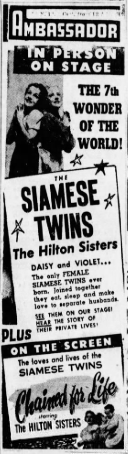
The twins came back to the Circle City in May to June 1936, at the “Chez Paree nightclub downstairs at the Apollo Theatre”, Dec 22-28, 1946, at the “Murat Theatre”, March 26, 1947 at the “Fox Burlesk Theatre”, and from May to June, 1952 at the “Ambassador Theatre.” These appearances all coincided with the slow downward spiral of the Hilton Sisters’ career. The first talkie movie (Al Jolson’s The Jazz Singer on Oct. 27, 1927) signaled the end of the Vaudeville Era.

During those years, as Great Depression Era America watched these unique beauties mature to adulthood, the Hilton Sisters remained in the news. The twins resumed their vaudeville careers as “The Hilton Sisters’ Revue”. Daisy dyed her hair blonde, and they began to wear different outfits to distinguish each other. After vaudeville lost popularity, the sisters performed at burlesque venues. But Burlesque reviews were risque, and while the attending patrons were interested in women, they were not necessarily interested in women wearing clothing, talented or not.

After gaining independence from Myer Myers, the Hiltons sailed to the UK, where they spent most of 1933, returning to the States in October 1933. Violet began a relationship with musician Maurice Lambert, and they applied in 21 states for a marriage license, but were always refused. The Indianapolis Star Fri, Jul 06, 1934, reported on the prospect of marriage: “The very idea is quite immoral and indecent. No, there is no law against it, but it just seems indecent.” Maurice grew tired of the newsreel life and one day, simply walked away from the relationship. Afterward, Violet became briefly engaged to Jewish boxer Harry Mason, who later went on to have a relationship with Daisy. In 1936, Violet married actor James Moore at the Cotton Bowl during the Texas Centennial Exposition as a publicity stunt. The marriage lasted ten years on paper, but the couple never lived as husband and wife. It was discovered that Jim Moore was gay, so the marriage was eventually annulled.

Cook County Illinois Clerk Robert Sweitzer. informs Violet and Maurice Lambert that they can not get married.

At the time of Violet’s wedding, the press noted that Daisy was visibly pregnant. Daisy gave birth, but the child, a boy, was put up for adoption immediately. In 1941, Daisy married Harold Estep, better known as dancer Buddy Sawyer. The marriage lasted ten days when it was discovered that Buddy, like Violet’s husband Jim Moore, was gay.

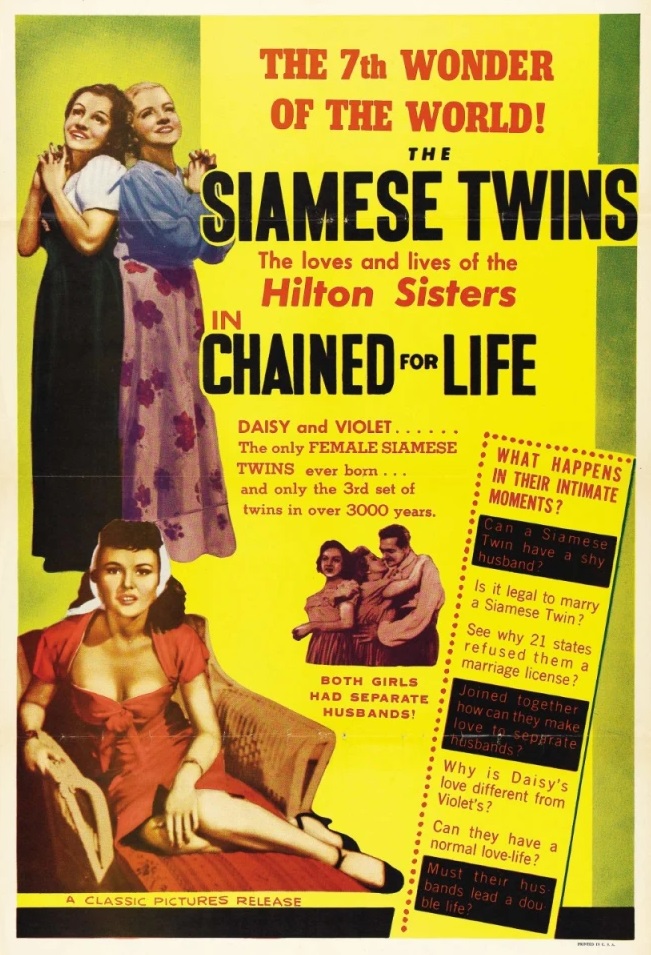
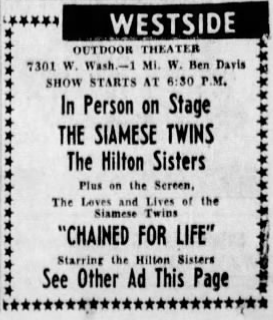
In 1952, the twins starred in a second film, Chained for Life, an exploitation film loosely based on their lives. The film’s producer ran off with all the money and left the Hilton Sisters holding the bag. They paid the bills out of their own pockets and undertook a grueling series of personal appearances at double-bill screenings of their two films in theatres and drive-ins across the country. Sadly, the entertainment world had moved on, and few people were interested in the aging vaudevillians, curiously conjoined or not. Afterwards, their popularity faded, and they struggled to make a living in show business. Violet once told a reporter, ‘We fooled ourselves that by entertaining others we were making ourselves happy.’

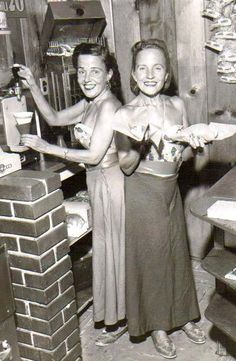
The Hiltons’ last public appearance was in 1961 at a drive-in theater in Charlotte, North Carolina. Without warning, their tour manager abandoned them there with no means of transportation or income. Charles Reid, owner of the Park-N-Shop grocery store in Charlotte, hired the twins for a commercial advertising “Twin-pack” potato chips. Afterward, they applied for a job at the store, stating they would work for one salary if necessary. Reid, ever the savvy businessman, realized he was getting four hands on one body and hired them as produce handlers and checkout girls. He paid them each a salary. The twins worked at a specially designed and constructed checkout station that looked no different than the others. The only way anyone would know the difference was if they looked back over their shoulder as they walked out the door.

The Hiltons rented a small two-bedroom home courtesy of Purcell United Methodist and settled into a quiet life centered around work and church. Daisy learned how to drive a car because she was the twin who could sit in the left-hand driver’s seat. Later, the twins bought a former driving instructor’s car with dual controls, so Violet could also drive.

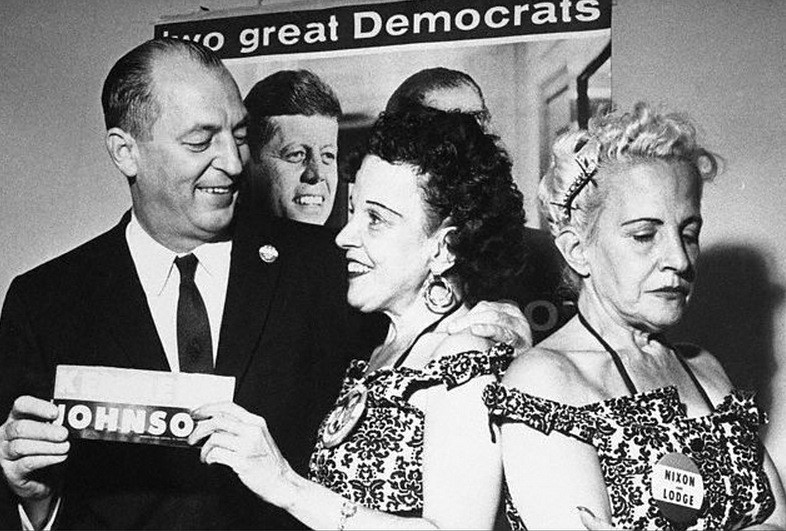
Violet, the Democrat, under a John F. Kennedy for President poster, while her sister Daisy frowns while wearing a Nixon / Lodge campaign pin.

Violet and Daisy had very different political views: Violet was a staunch Democrat, while Daisy supported the Republican Party. During the holidays, they remembered fellow employees and favorite customers with small, inexpensive Christmas gifts. One neighbor recalled that the girls had a phone booth installed in the home to allow for private conversations for each twin when needed and that the twins kept an array of purses around the house, each one containing two or three dollars for cab fare. Later in life, a doctor visited them and declared that they could be separated if they so desired, but they said no. Daisy contracted Hong Kong flu, but Violet refused medical intervention.

Charles Reid (LEFT) With the Hilton Twins.

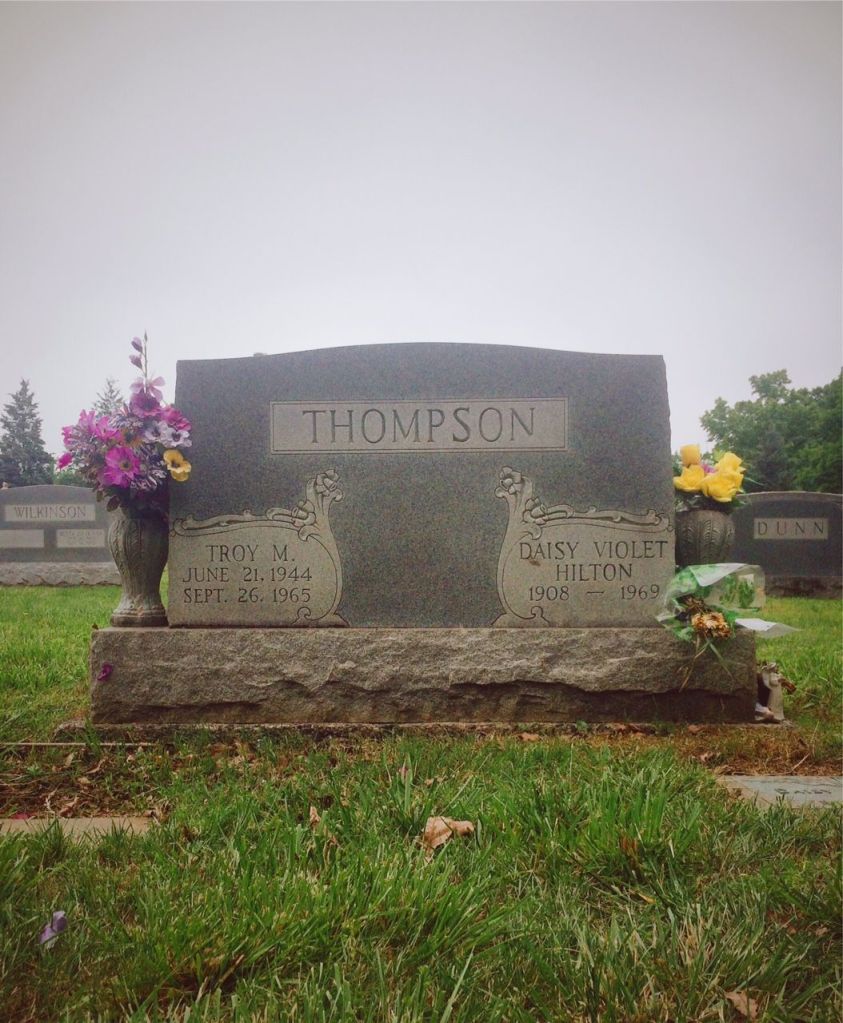
On January 4, 1969, after failing to report to work and unable to reach them by telephone, the store manager called the police to investigate. The twins were found dead in their home, victims of the Hong Kong flu. Their bodies were found on the heat grate in the hallway. Daisy’s decomposition was worse than Violet’s, which presents a nightmare scenario. The autopsy determined that Daisy died first and Violet died two to four days later. It was speculated that during those final few days, freezing cold from the Hong Kong flu, Violet dragged her sister to the heat grate and slumped to the floor where she drank heavily and chain-smoked cigarettes while waiting for the end to come. The house was adorned by carefully wrapped Christmas presents, all identified and tagged to go to their friends. They had spent every second of their lives together and had made a pact that they were going out together.

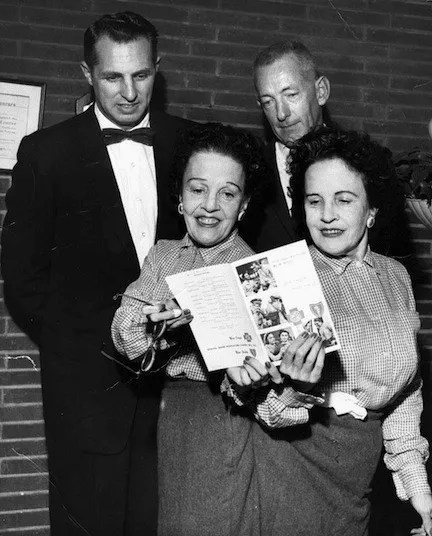
The Hilton Sisters were buried together in one casket in a donated plot at Forest Lawn Cemetery in Charlotte, NC. At their funeral service, the Reverend Jon Sills said, as he stood next to the sisters’ wide coffin: “Daisy and Violet Hilton were in show business for all but the last half dozen years of their life. In the end, though, they were cast aside by the glittery and glamorous world they had been part of for so long. In the end, it was only ordinary people who showed they cared about them.”

In May 2018, it was announced that Brighton and Hove City Council in Sussex, England, and the current owner of the house in which the twins were born had agreed that a commemorative plaque could be erected at the property. On May 26, 2022, a commemorative blue plaque was unveiled at 18 Riley Road, dedicated to them. Additionally, the Brighton & Hove Bus and Coach Co. honored the twins by naming a bus after them. Upon their death in 1969, Mrs. Luther E. Mason, a longtime friend of the twins and secretary to the lawyer who represented them at their trial, said that they wanted nothing more than to “live normally.”

Creepy history, Health & Medicine, Medicine, Weekly Column

The Last of the Radium Girls

Original Publish Date January 2105. Republished January 2, 2025.

https://weeklyview.net/2025/01/02/the-last-of-the-radium-girls-2/

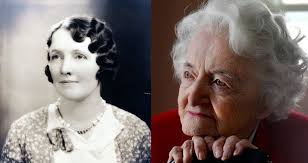
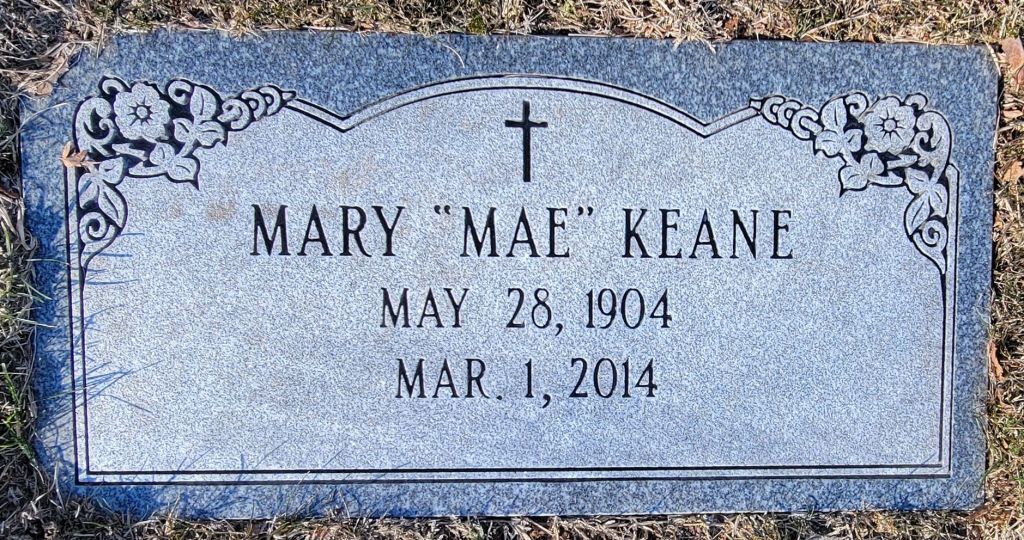
The year 2014 has come and gone, and along with it, the passing of many notables whose time on this earth has run out. Lost among them is a woman you may have never heard of. Mae Keane died this year. She was the last of the radium girls.

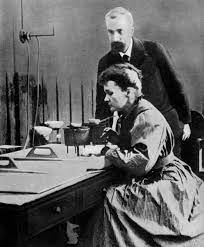
Marie and Pierre Curie.

Radium was soon all the rage: bottled Radium water was used as a health tonic, Radium-filled facial creams were used to “rejuvenate the skin”; the Radium Institute in New York City was giving Radium injections to all who could pay for them; some toothpaste started to include Radium; high-end spas began adding radium to the water of their pools and some hospitals were using Radium as a treatment for those who had cancer after it was observed that exposing tumors to Radium salts would shrink them. Although the latter sounds admirably feasible, the former should sound shocking when you consider that radium is highly radioactive.

Radium Clock.

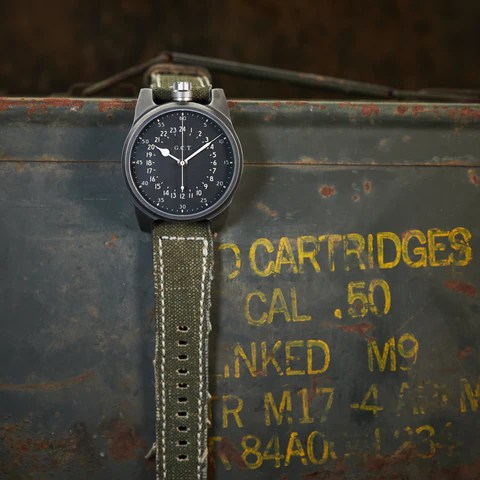
Additionally, it was found that when Radium salts were mixed with zinc sulfide and a glue agent, the result was a glow-in-the-dark paint. During World War I the advent of trench warfare necessitated the invention of many things. The trenches were dark, damp, and dirty. A single match lit by a soldier hunkered down in a pitch-dark trench might be the spark to draw enough enemy fire to wipe out an entire company of soldiers. Time dragged on endlessly; when you couldn’t see your own hand in front of your face, you had no hope of seeing the hands of a clock face.

Not only were soldiers crawling and wading around in the mud unable to see their watch dials at night, their pocket watches weren’t suitable for this environment. Soon, watchmakers created men’s watches with straps designed to be worn on a wrist rather than placed in a pocket. Before the Great War, wristwatches were primarily worn only by women, with men favoring pocket watches. By November 1915, British soldiers were putting dots of Radium paint next to the hour numerals to make them visible at night. The dimness of the glow was beneficial as they could tell the time without giving away their position.

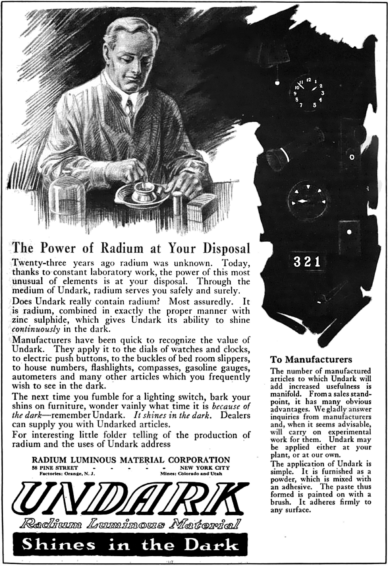
1921 Magazine ad for Radium.

Of course, at this time, the dangers of radioactivity were not fully understood. Enter Mary “Mae” O’Donnell Keane and the Radium girls. In the early 1920s, the hot new gadget was a wristwatch with a glow-in-the-dark dial. Their ads extolled “the magic of Radium!” And according to some, Radium was magic. Salesmen promised that it could extend your life, pump up your sex drive, and make women more beautiful. Doctors used it to treat everything from colds to cancer. In the Roaring Twenties, women earned the right to vote, got the urge to smoke, and marched to work in factories alongside their male counterparts.

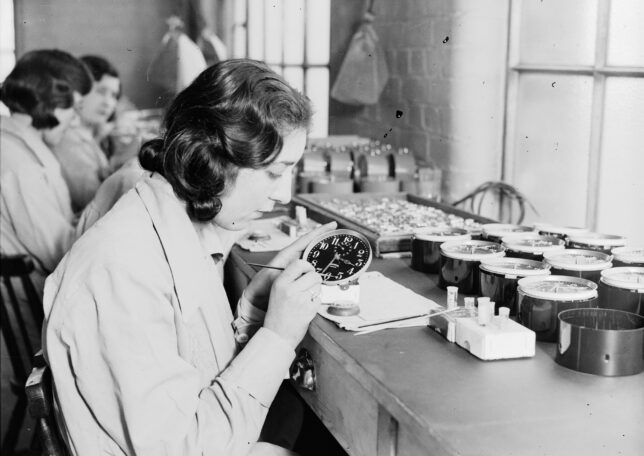
Radium Girls painting an Ingersoll clock face in 1932.

Young women ranging in age from the mid-teens to the early 20s were employed to apply the paint to clock dials and watch faces. The job was promoted as ideally suited for delicate female hands. The work was easy, the wages high and most dial painters were typically single and living with their parents. Over the first 10 years, about 4,000 women were employed at 3 locations: Orange, New Jersey, Waterbury, Connecticut, and Ottawa, Illinois.

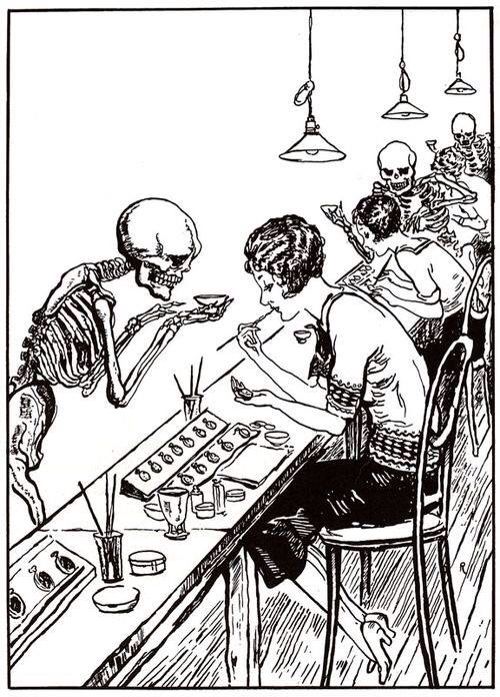
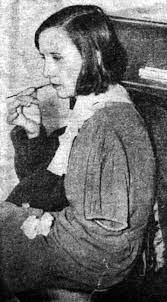
Workers would often lick the paintbrush to achieve a finer point — directly ingesting the Radium. 

The first dial painters came from the china painting industry. These seasoned workers used a technique called lip-pointing which involved wetting their camel hair paintbrushes between their lips to bring it to a sharper point. The practice was passed on to the Radium painting industry whose products required fine brushwork. In 1924, 18-year-old Mae Keane was hired at the U.S. Radium Corporation factory in Waterbury Connecticut. The pay was $18 a week for a 40-hour work week, and 8 cents a dial — a pretty good salary for a woman back then.

Twelve numbers per watch, 200 watches per day — and with every glowing digit, the Radium girls swallowed a little bit more poison. Mae said that on her very first day, she decided that she didn’t like the taste of the gritty Radium paint. “I wouldn’t put the brush in my mouth,” she recalled years later. During breaks and at lunchtime, it was a popular pastime of the Radium girls to paint comic faces on each other, and then turn out the lights for a laugh. “The girls sneaked the Radium out of the factory to paint their toenails and teeth to make them glow,” Keane said.

Mae Keane.

Mae couldn’t remember what led her to work at the watch & clock factory but did remember that she disliked the work more than she liked the paycheck. Luckily, she was not as fast as her supervisor wanted her to be. “I made 62 cents one day,” Keane once said, which translates to a high of 8 watches per day. “That’s when my boss came to me and said I better find another job.” That poor performance probably saved her life. She worked in the dial painting room for eight to nine weeks, then transferred to another job at the company. “I often wish I had met him after to thank him,” Keane said, “because I would have been like the rest of them.”

Worcester Democrat and the Ledger-Enterprise (Pocomoke City, MD), March 4, 1938, p. 9.

The dial painters would become some of the earliest victims of radioactive poisoning. By the late 1920s, they were falling ill by the dozens, afflicted with horrific diseases. The Radium they had swallowed was now slowly eating their bones away from the inside out. “We were young,” Mae told The Hartford Courant in 2004. “We didn’t know anything about the paint. I don’t think the bosses even knew it was poison. The foreman would tell us it was very expensive, and to be careful. We had no idea. But when they did find out, they hid it.”

Reports of maladies afflicting the Radium girls began to bubble up to the surface. Dial painters began to suffer from a variety of illnesses, often crippling and frequently fatal as a result of ingesting Radium paint. One account describes a woman (Frances Splettstocher) visiting her dentist to have a tooth pulled only to have her entire jaw yanked out in the process. Soon, her gums and cheek rotted away, ultimately resulting in a hole in her cheek. Her health continued to deteriorate and she died within the month.

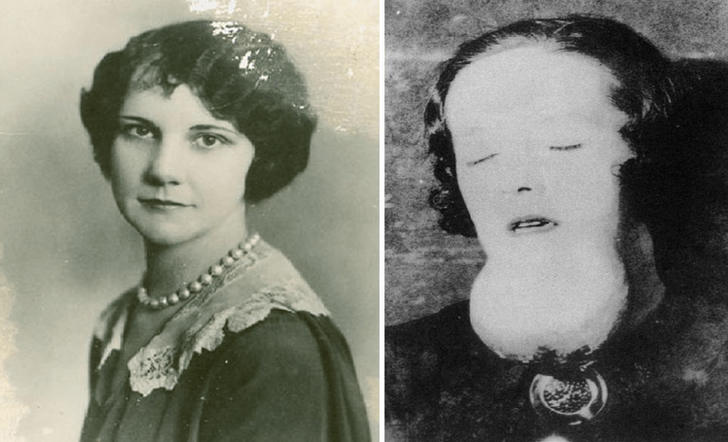
Radium Girl Grace Fryer before and after suffering from radium-induced sarcoma.

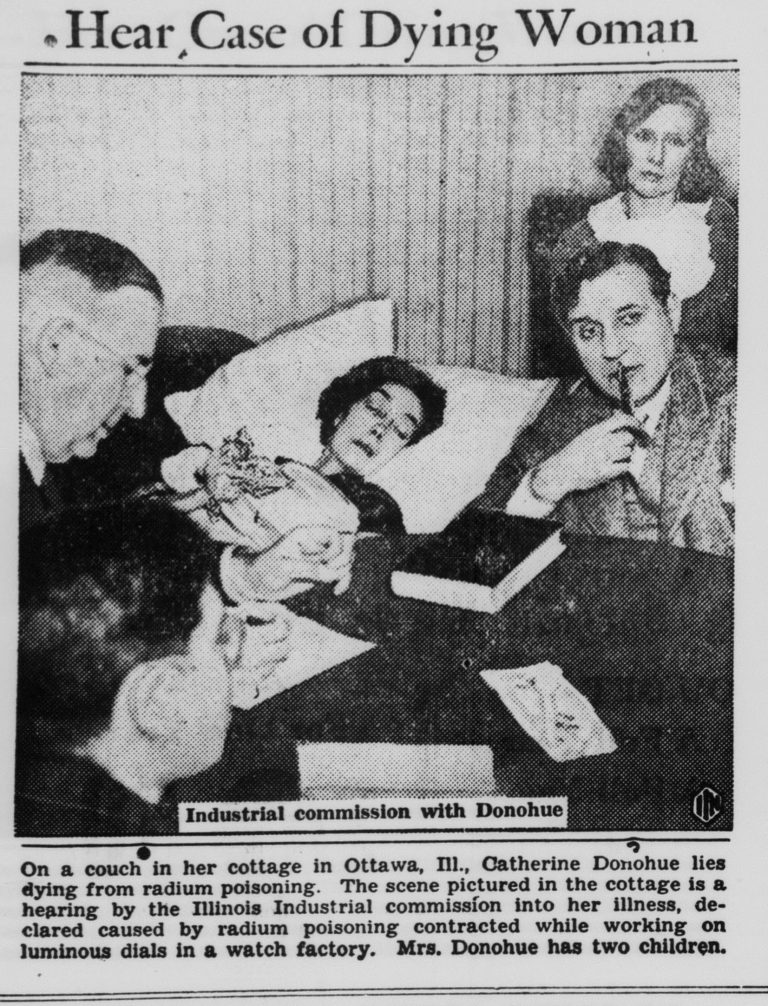
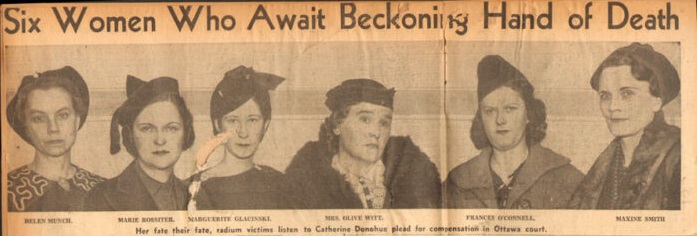
Other radium girls had their legs snap underneath them and more still had their spines collapse. Dozens of women died, many while still in their 20s. Ingested Radium is known to deposit permanently in bone structures damaging bone marrow. In all, by 1927, more than 50 women had died as a result of Radium paint poisoning. Many of them developed cancerous tumors, honeycombed and fragile bones, and suffered painful amputations. At a factory in New Jersey, five of the women sued the U.S. Radium Corporation for poisoning. The trial would have a profound impact on workplace regulations.

Radium Girl Mollie Maggia’s Radioactive Jawbone After Removal.

Ironically, many in these factory towns blamed the women for the loss of jobs during the Great Depression. Furthermore, it would be discovered that U.S. Radium had paid off doctors and dentists to claim the girls were suffering from the sexually transmitted disease syphilis (often having this listed as the cause of death when the girls died), with the hope that it would not only shield the corporation from litigation but also sully the girls’ reputations.

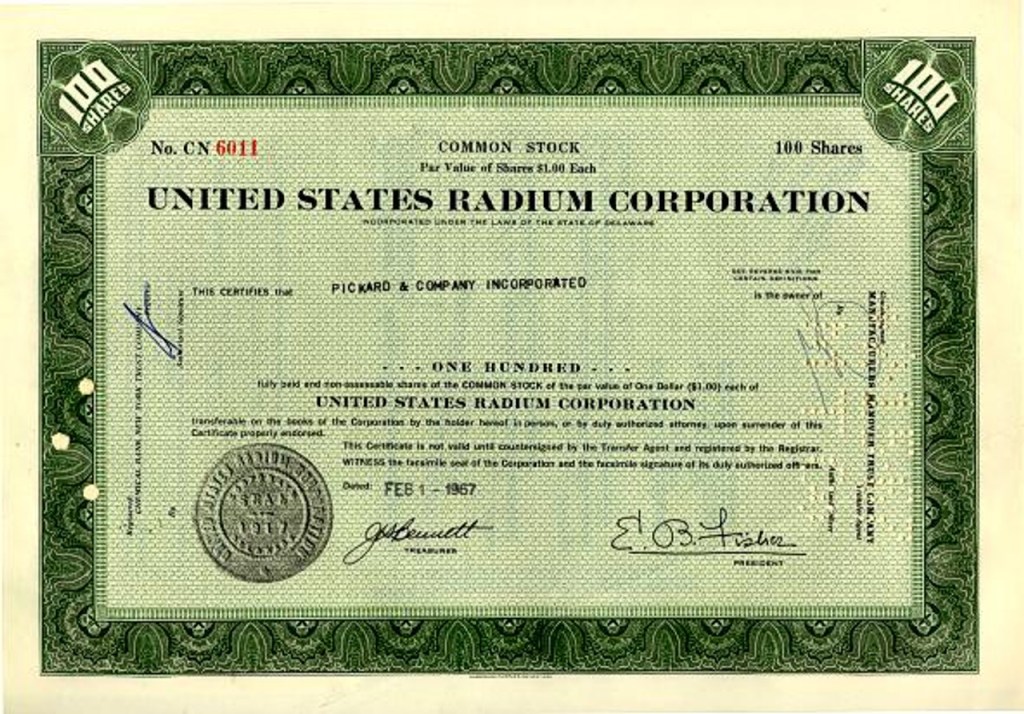
U.S. Radium Corp. Stock Certificate.

At every turn, U.S. Radium sought to delay the trial as much as possible with the hope that all the women in the case would die before an outcome could be reached (in fact all five of the original Radium girls were dead by the mid-1930s). With the company asking for delay after delay, the trial crawled along at a painful pace. Marie Curie herself chimed in on the issue, but had little comfort to give the radium girls by stating, “I would be only too happy to give any aid that I could, [but] there is absolutely no means of destroying the substance once it enters the human body.” Curie herself would die on July 4th, 1934 from leukemia; likely caused by her long-term exposure to Radium.

By the time the girls finally got a chance to testify in January of 1928, none of them were able to raise their arms to take the oath, and two were bedridden. After their testimonies, the case was once again postponed for a few months for no good reason. The case was settled in the fall of 1928 before it could be deliberated by the jury, and the settlement for each of the Radium girls was $10,000 ($135,000 in 2014 dollars) and a $600 per year annuity while they lived, and all medical and legal expenses would also be paid by the company. Many of the victims would ultimately end up using the money to pay for their own funerals. The lawsuit and resulting publicity were a factor in the establishment of occupational disease labor laws. Most importantly, the trial proved that the injuries suffered by the radium girls were completely preventable.

Abandoned U.S. Radium Corp. building at the southwest corner of High and Alden Streets in Orange, New Jersey.

As part of the settlement, the girls agreed not to hold U.S. Radium liable for their health problems. So what was U.S. Radium’s official position in the aftermath? They stated they didn’t settle because they were wrong, but rather because the public was biased against them and they couldn’t have received a fair trial. U.S. Radium’s president, Clarence Lee, stated: “We unfortunately gave work to a great many people who were physically unfit to procure employment in other lines of industry. Cripples and persons similarly incapacitated were engaged. What was then considered an act of kindness on our part has since been turned against us.”

But these Radium towns’ plight didn’t end when the case was settled in court. The chemical element found its way into the soil and groundwater, contaminating residential and commercial properties around the towns. The dangers of Radium no longer was isolated to those who worked in the Radium dial plant, it now threatened the populace. The factory sites became EPA Superfund cleanup sites in the 1980s. The plight of the Radium girls was now known to, and shared by, everyone.

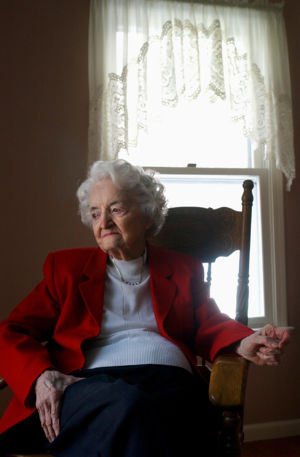
Mary “Mae” (O’Donnell) Keane (1906 – 2014)

But Mae Keane was a proud survivor. Over the years, she had some health problems: she developed numerous skin ailments and eye problems, suffered from migraines, and had two bouts with cancer. “The doctor wanted to give me chemotherapy,” Keane said. “I told him ‘no.’” Keane lost all of her teeth in her 30s and suffered pain in her gums until the day she died. “I was left with different things, but I lived through them. You just don’t know what to blame,” she said. The only prescription medication she ever took was to control her blood pressure. Despite her ailments, Mae admitted, “I was one of the fortunate ones.”

Keane, a Red Sox fan, was once asked about her secret to longevity. “I’m lazy,” Keane said, adding she never smoked, loved to walk and dance, and enjoyed caramel candy, chocolate, and an occasional apricot sour or Bailey’s Irish Cream. “I didn’t get old until I was 98,” she once said.” She was 107 when she died on March 1 in Middlebury, Connecticut; the last living participant in one of the darkest moments in American industrial history.

Health & Medicine, Hollywood, Indianapolis, Music, Pop Culture, Television

Warren Zevon — Accidentally Like a Martyr.

Publish Date September 12, 2024. This column first appeared in August 2013.

https://weeklyview.net/2024/09/12/warren-zevon-accidently-like-a-martyr-2/

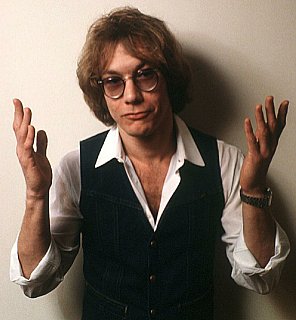
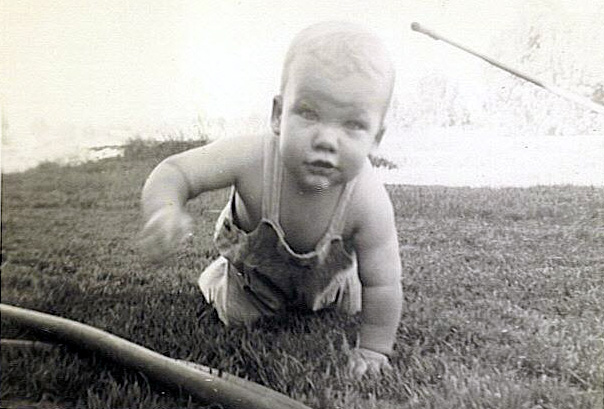
Warren Zevon 1992.

It’s hard to believe it’s been a decade since Warren Zevon died. If the name is not familiar to you, his songs might be: “Werewolves of London,” “Poor, Poor Pitiful Me,” or “Lawyers, Guns and Money” should ring a bell. Zevon was considered the rock star’s rock star, known for his songwriting talents in songs that showcased his quirky, sardonic wit in the dark humor of his ballads. Rock ‘n’ roll royalty like Jackson Browne, Bruce Springsteen, Bob Dylan, and Neil Young praised his talents and called him friend. Born in Chicago, Illinois, on January 24, 1947, he became the quintessential West Coast rocker, literally living the LA lifestyle right up until his death on September 7, 2003.

It’s easy to figure out why musicians thought Warren Zevon was so cool. From his earliest days, his personal pedigree made Warren unique and different. Zevon was the son of Beverly and William Zevon. His mother was from a Mormon family and his father was a Jewish immigrant from Russia whose original surname was “Zivotovsky.” William was a bookie who handled volume bets and dice games for notorious Los Angeles mobster Mickey Cohen. Known as Stumpy Zevon in Cohen’s employ, he was best man at Mickey’s first marriage and worked for him for years.

Warren William Zevon was born on January 24, 1947.

The family moved to Fresno, California when Warren was 13 years old. His British-born mother insisted that Warren take piano lessons. So Zevon started taking his lessons at the home of Igor Stravinsky, the  Russian-American composer, pianist and conductor widely considered to be one of the most important and influential composers of the 20th century. There, Warren briefly studied modern classical music, alongside future American conductor Robert Craft. Zevon’s parents divorced when he was 16 years old and he soon quit high school and moved from Los Angeles to New York to become a folk singer.

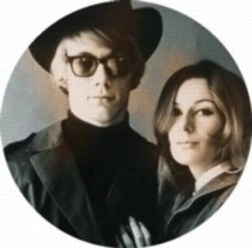
Lyme & cybelle

Zevon got his first taste of success with the song “Follow Me” as the male component of a musical coed duo called Lyme & Cybelle. He left the duo, citing artistic differences, and spent time as a session musician and jingle composer. He wrote several songs for the Turtles and another early composition (“She Quit Me”) was included in the soundtrack for the film Midnight Cowboy (1969). Zevon’s first attempt at a solo album, Wanted Dead or Alive (1969), was well-received but did not sell well. Zevon’s second effort, Leaf in the Wind, went unreleased.

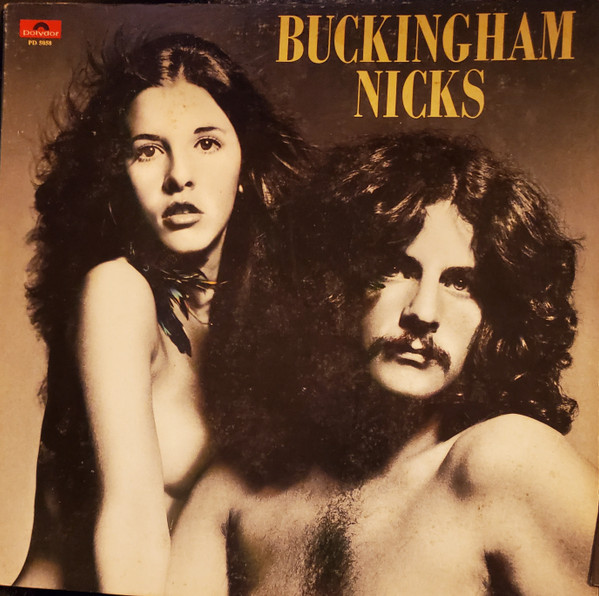
During the early 1970s, Zevon led the touring band for the Everly Brothers, serving as both keyboard player and band leader/musical coordinator. In the latter role Zevon became the first to recognize the talents of guitar player Lindsey Buckingham by hiring him for the band. It was during his time with the Everlys that Lindsey and girlfriend Stevie Nicks left to join Fleetwood Mac. Warren Zevon was a roommate of the famous duo in a Fairfax district apartment in Los Angeles at the time (September 1975). Zevon would remain friends with both for the rest of his life maintaining neutrality during the tumultuous breakups of both the Everly Brothers and Buckingham-Nicks.

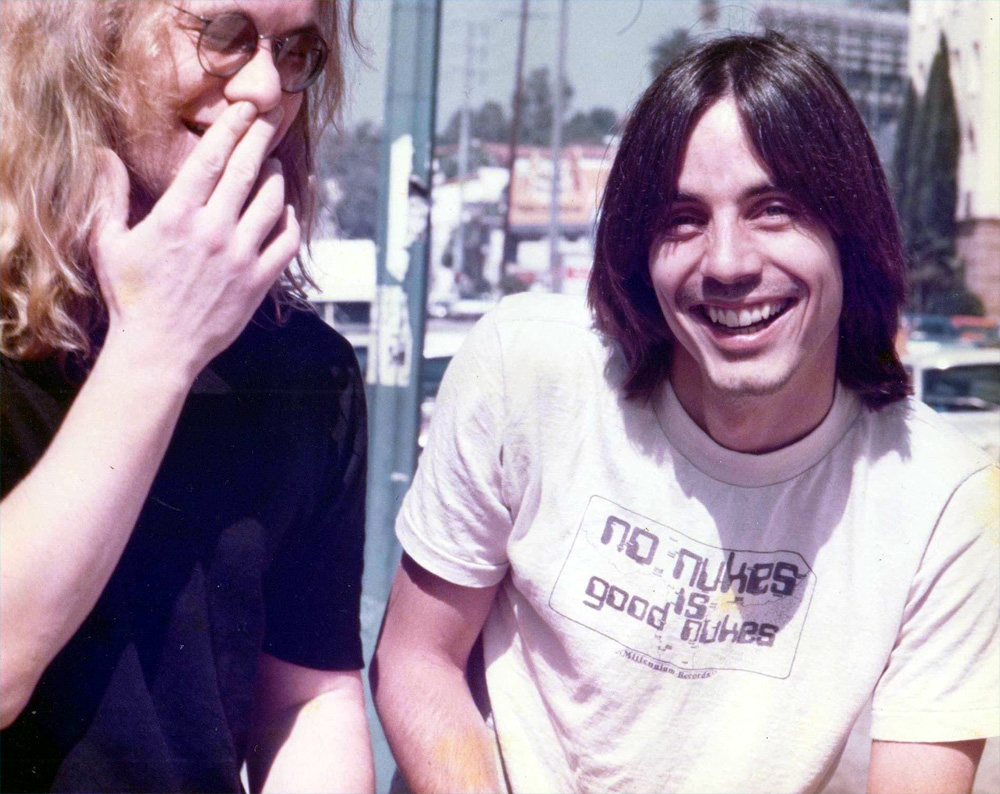
Warren Zevon & Jackson Browne.

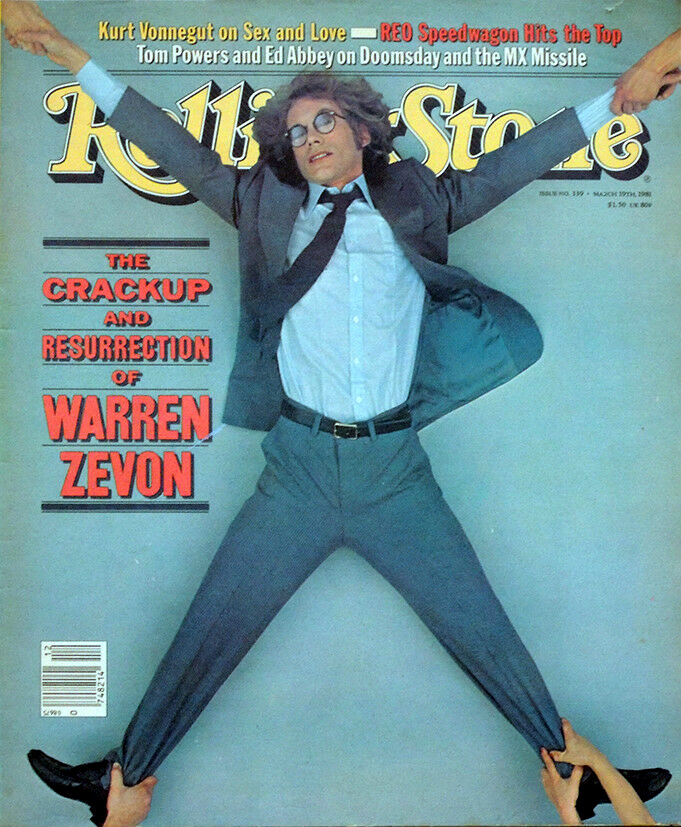
In late 1975, Zevon collaborated with Jackson Browne, who produced and promoted Zevon’s self-titled major-label debut in 1976. Contributors to this album included Nicks, Buckingham, Mick Fleetwood, John McVie, members of the Eagles, Carl Wilson, Linda Ronstadt, and Bonnie Raitt. This first album, although only a modest commercial success, was later recognized by Rolling Stone magazine as a masterpiece. Although  Zevon shared a grounding in earlier folk and country influences with his LA peers, this album brought Zevon to the forefront as a much darker and more ironic songwriter than other leading figures of the era’s L.A.-based singer-songwriter movement. Rolling Stone placed Zevon alongside Neil Young, Jackson Browne, and Bruce Springsteen as one of the four most important new artists to emerge in the decade of the 1970s.

In 1978, Zevon released Excitable Boy to critical acclaim and popular success. This album received heavy FM airplay mostly through the release of the single “Werewolves of London,” featuring Fleetwood Mac’s Mick Fleetwood on bass and John McVie on drums. The song is considered a classic and has been covered by artists ranging from the Grateful Dead to Bob Dylan to comedian Adam Sandler. The song has become a Halloween season staple. For all you trivia buffs out there, The Chinese restaurant mentioned in the song (Lee Ho Fook) is a real location situated on Gerrard Street in London’s Chinatown.

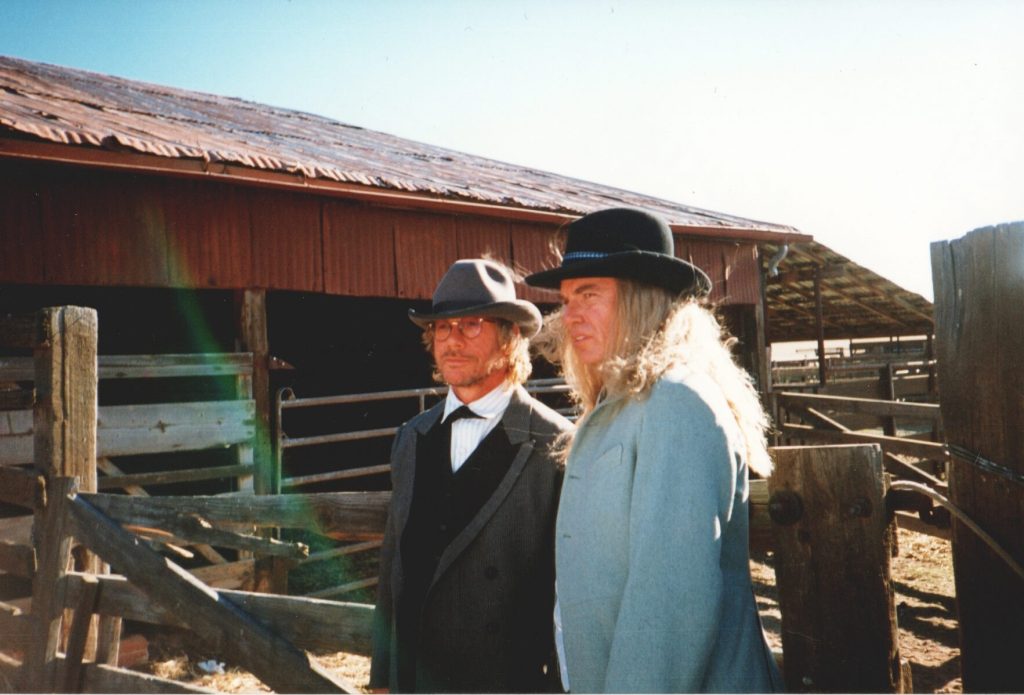
Zevon & Billy Bob Thornton on set of Dwight Yoakam’s 2000 western “South of Heaven, West of Hell”.

Although Zevon never again achieved popular acclaim, he continued to be recognized as an artist’s artist, releasing nine more albums over the next 25 years. It was during that quarter-century that Zevon lapsed in and out of the throes of excess, obsession, and addiction. To say that Warren Zevon suffered from excessive compulsion disorder would be a severe understatement. Warren had a continuing battle with drug addiction and alcoholism and was also a sex addict obsessed with the color gray and personal fame, or lack thereof. During this time, he and actor Billy Bob Thornton formed a close friendship galvanized by a shared obsessive-compulsive disorder and the fact they were neighbors living in the same apartment building.

Warren Zevon is his gray t-shirt.

One of Zevon’s compulsions was collecting identical Calvin Klein T-shirts. Like everything else in his life (his car, his couch, his carpeting and wall paint), the T-shirts were gray. One story relates how Warren insisted upon traveling to every department store carrying Calvin Klein T-shirts while touring on the road. If the store carried Warren’s prized Gray Calvin Klein t-shirt, Warren obsessively purchased every one of them and stowed them in the tour bus. When asked why, Warren replied that the new ones were being made in China and that those still on the shelf had been made in the USA and were “sure to become collector’s items and go up in value.” When he died at age 56, thousands of gray Calvin Klein t-shirts were found in his LA apartment; unopened in their original packaging.

From left to right: Roy Blount Jr., Stephen King, James McBride, Amy Tan, Kathy Kamin Goldmark , Dave Barry, Matt Groening

A voracious reader, Zevon was friendly with several well-known writers who also collaborated on his songwriting during this period, including gonzo author Hunter S. Thompson, Carl Hiaasen, Mitch Albom, Norman Mailer, and Maya Angelou. Zevon served as musical coordinator and occasional guitarist for an ad-hoc rock music group called the Rock Bottom Remainders, a collection of writers performing rock and roll standards at book fairs and other events. This group included Stephen King, Dave Barry, Matt Groening, and Amy Tan, among other popular writers.

Zevon cemented his superstar status by appearing in various TV shows and movies during his career, most often playing himself. Zevon played himself on two episodes of Suddenly Susan in 1999 along with singer/actor Rick Springfield. Warren also appeared as himself on the Larry Sanders Show on HBO, alongside actor John Ritter as talk show guests in the same episode. Ironically, Zevon and Ritter would die within four days of each other.

Although highly intelligent, well-read, and obsessive-compulsive in every way, Zevon had a lifelong phobia of doctors. Shortly before playing at the Edmonton Folk Music Festival in 2002, he started feeling dizzy and developed a chronic cough. After a period of suffering with pain and shortness of breath, while on a visit to his dentist, Zevon was ordered under threat of kidnapping to see a physician. A lifelong smoker, he was subsequently diagnosed with inoperable peritoneal mesothelioma (cancer of the abdominal lining commonly associated with asbestos exposure). Refusing treatments he believed might incapacitate him, Zevon instead began recording his final album, The Wind, which includes guest appearances by close friends Bruce Springsteen, Don Henley, Jackson Browne, Timothy B. Schmidt, Joe Walsh, David Lindley, Billy Bob Thornton, Emmylou Harris, Tom Petty, and Dwight Yoakam, among others.

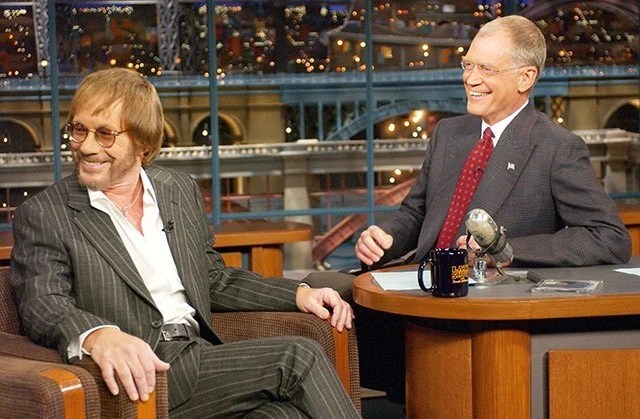
On October 30, 2002, Zevon was featured on the Late Show with David Letterman as the only guest for the entire hour. The band played “I’ll Sleep When I’m Dead” as his introduction. Zevon performed several songs and spoke at length about his illness. Zevon was a frequent guest and occasional substitute bandleader on Letterman’s television shows since Late Night was first broadcast in 1982. He noted, “I might have made a tactical error in not going to a physician for 20 years.” It was during this broadcast that, when asked by Letterman if he knew something more about life and death now, he first offered his oft-quoted insight on dying: “Enjoy every sandwich.” He  took time to thank Letterman for his years of support, calling him “the best friend my music’s ever had.” For his final song of the evening, and his final public performance, Zevon performed “Roland the Headless Thompson Gunner” at Letterman’s request. In the green room after the show, Zevon presented Letterman with the guitar that he always used on the show, with a single request: “Here, I want you to have this, take good care of it.”

Zevon was given only a few months to live after that fall of 2002 diagnosis; however, he lived to see the birth of twin grandsons in June 2003 and the release of The Wind on August 26, 2003. The album reached number 12 on the U.S. charts, Zevon’s highest placement since Excitable Boy. When his diagnosis became public, Zevon told the media that he just hoped to live long enough to see the next James Bond movie, a goal he accomplished. The Wind was certified gold in December 2003, just weeks after Zevon’s death, and Warren received five Grammy nominations, winning two posthumous Grammys, the first of his career.

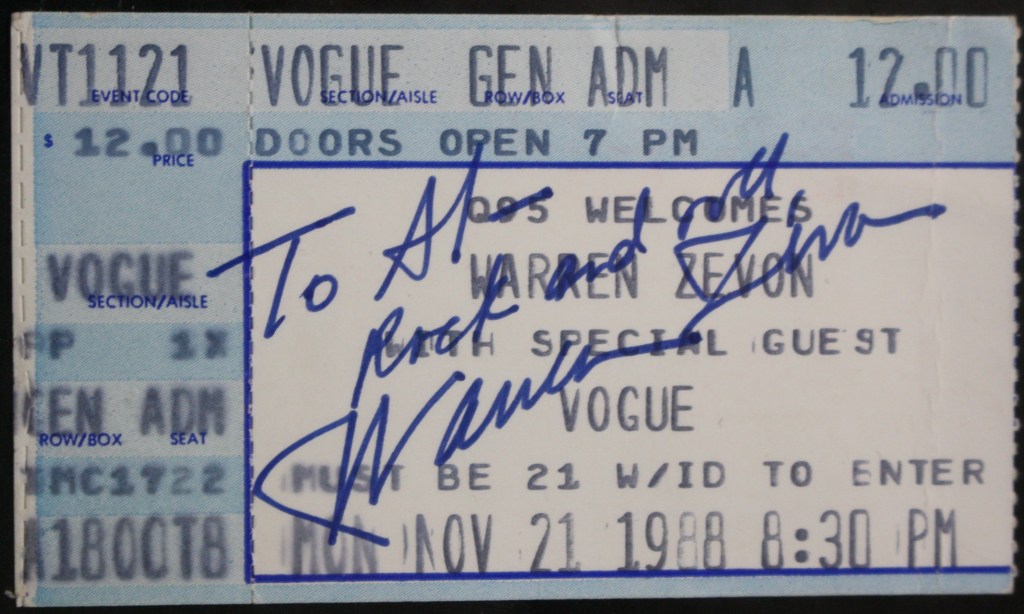
I have a brief personal connection to Warren Zevon. I interviewed him in the pre-holiday winter of 1988 after a concert at the Vogue in Broad Ripple. Zevon was touring with a patchwork band that included Timothy B. Schmidt of the Eagles. He performed all of his expected hits along with a couple covers. I specifically remember an unforgettable version of the Tom Jones standard “What’s New Pussycat?” as well as the Eagles former bass player Schmidt performing his signature song, “I Can’t Tell You Why.”

See if you can pick out Warren Zevon in this clip from the movie…Don’t blink!

After the show, I was led through the music hall to the back of the Vogue and told to wait. Meantime, out walked Schmidt and the rest of the band. Soon, Warren Zevon emerged. With his long blonde curls and John Lennon glasses, he looked more like a professor than a rock star. He maintained a constant smile throughout our session. Luckily, I struck a positive nerve by remarking that I had recognized him from his brief appearance during the closing credits of the 1988 Kevin Bacon film, She’s Having a Baby. Zevon leapt from his perch atop the bumper of his band’s equipment truck and began calling to his bandmates, “Hey guys, he saw me in the movie! I told you I was in it.” His band mates shrugged, but Warren thanked me for confirming what had until then, been just a rumor. As I recall, Zevon’s only word spoken in the film came in the naming the baby segment when he offered the name “Igor”.

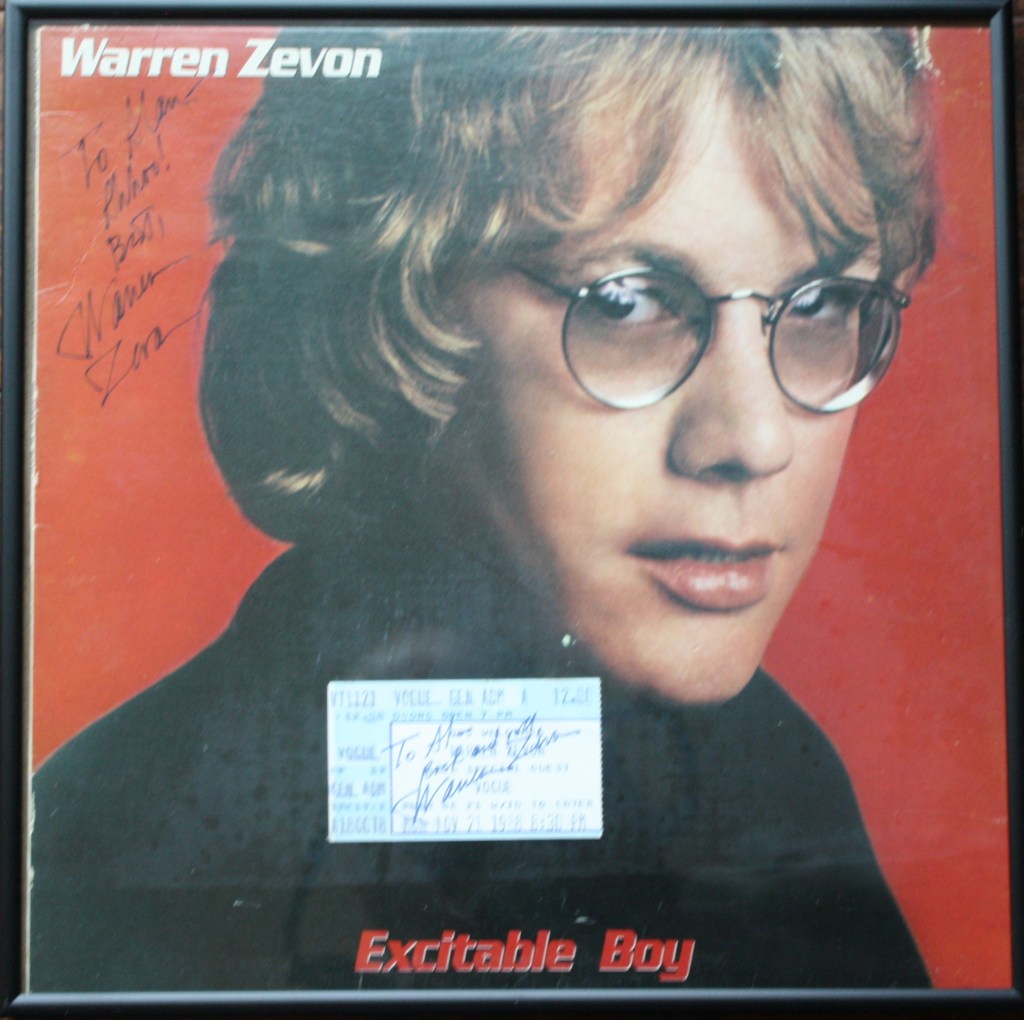
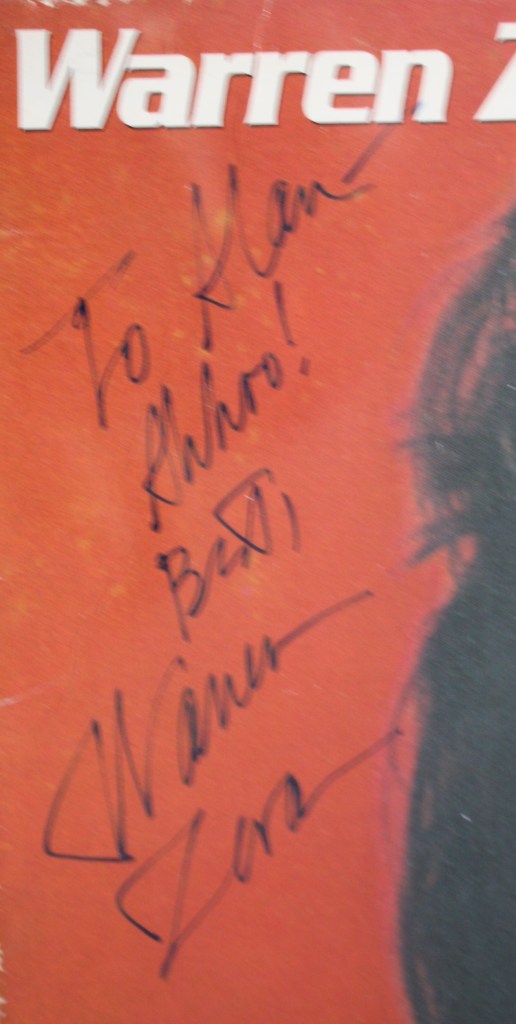
My autographed copy of Excitable Boy from that Vogue encounter.

I really can’t remember much of the encounter after that. I do remember Warren signed my copy of Excitable Boy and the interior paper cassette tape insert for A Quiet Normal Life, relics I still have. But the rest is a blur. There is a more important residual incident connected to that incident. That was the same night that my future wife Rhonda agreed to go out on our first date. Yep, I took her to a Sam Kinison comedy show at the old Indianapolis Tennis Center. Romantic huh?

Signature closeup.
My signed ticket stub from that night.

Two decades after that first date, Rhonda bought me the book, I’ll Sleep When I’m Dead: The Dirty Life and Times of Warren Zevon written and compiled by Zevon’s ex-wife Crystal Zevon (published in 2007 by Ecco Books). The book tore down every “nice guy” image I ever had of Warren Zevon, telling his life story through interviews with those who knew him. I walked away from it thinking “Wow, they had a real hard time finding anything nice to say about this guy.” The book has been described as being “notable for its unvarnished portrayal of Zevon.” Only later did I realize the book was written this way at Warren Zevon’s own request. As the words to Zevon’s song “It ain’t that pretty at all” bounce around in my head, I must say that I am not surprised or disappointed.

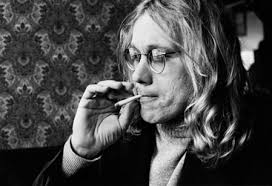
Warren Zevon still smokin’.

Criminals, Health & Medicine, Indianapolis, Medicine

THE BREATHALYZER

Original publish date February 22, 2024. https://weeklyview.net/2024/02/22/the-breathalyzer/

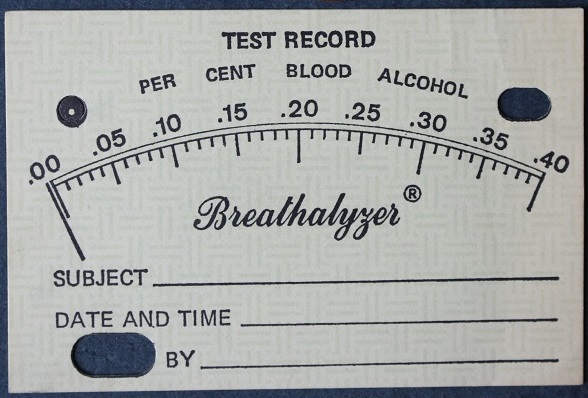
Recently, I found myself at an antique show rummaging through a small box of paper, not unfamiliar territory for me. The usual: postcards, coupons, ads, snapshot photos. Then my fingers danced past a small greenish-colored slip of paper with a frozen gauge chart numbered .00 to .40 and a pair of machine-cut holes in the corners. Titled “Breathalyzer” it was identified as a “Test Meter” to measure “Per Cent Blood Alcohol” with an unused 3-line identifier at the bottom for the “Subject” name, “Date and Time”, and name of the person administering the test. Okay, we all know what it means (some more than others) and if we are smart (or lucky) we have managed to avoid these at all costs in our lifetimes.

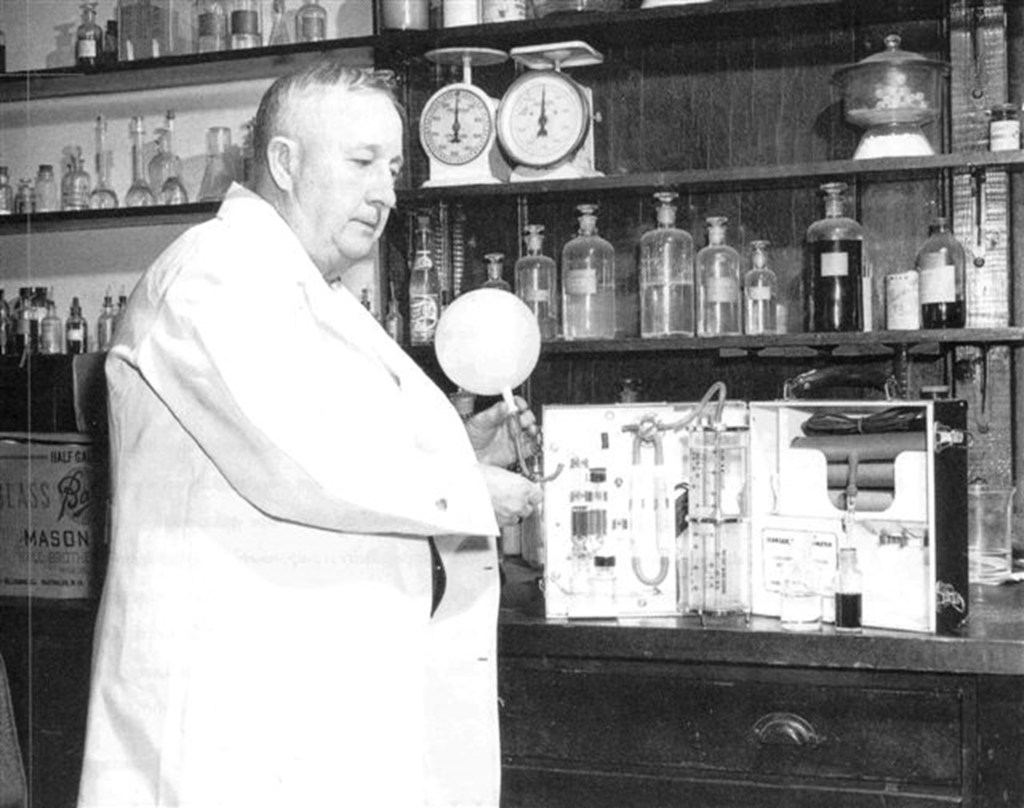
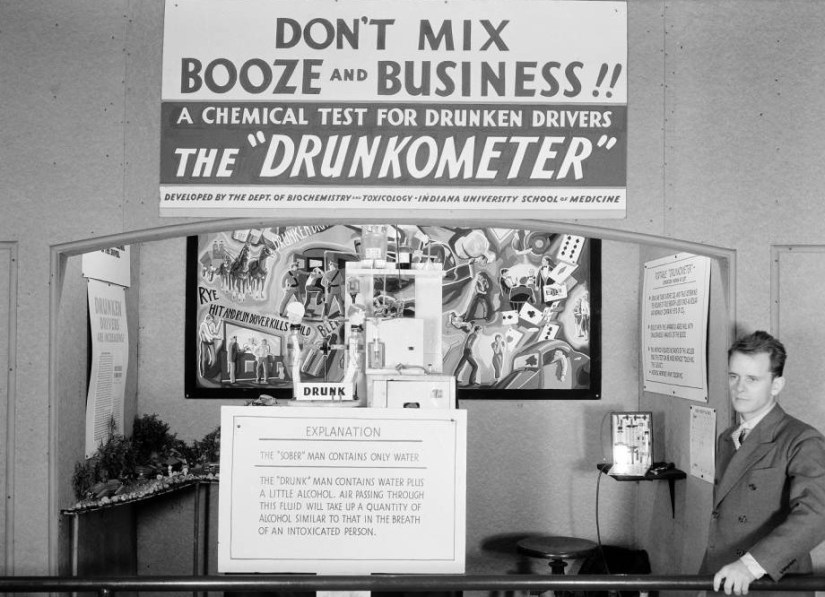
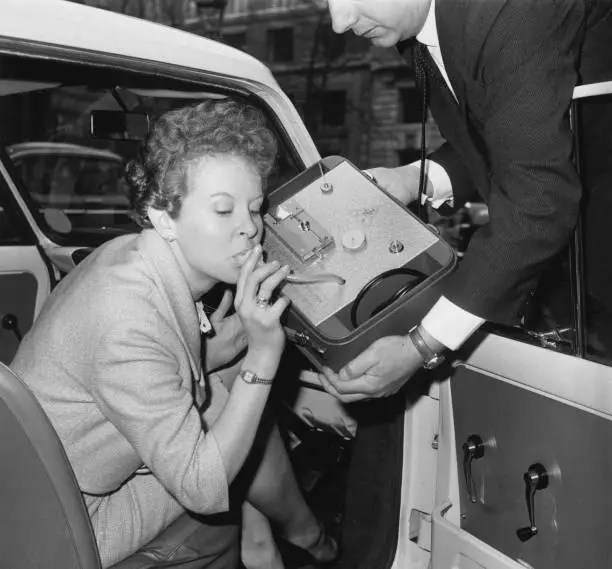
But did you know that the “Breathalyzer” instrument, known around the world as the “Breath of Death”, the “Intoxalock”, or the “Booze Kazoo”, was invented in Indiana? In 1931, a 41-year-old toxicology professor at Indiana University named Rolla Harger invented the first practical roadside breath-testing device called the Drunkometer. He was awarded a patent for it in 1936. The Drunkometer collected a sample of the motorist’s breath when the driver blew directly into a balloon attached to the machine. The breath sample was then pumped through an acidified potassium permanganate solution and if there was alcohol in the sample, the solution changed color. The greater the color change, the more alcohol there was present in the breath.

Rolla Neil Harger (January 14, 1890 – August 8, 1983).

In 1922, Harger became an assistant professor at Indiana University School of Medicine in the newly formed Department of Biochemistry and Pharmacology. He served as the department chairman from 1933 to 1956 and worked continuously in the department until 1960. However, the bulky Drunkometer proved impractical and unportable. The test required the suspected impaired driver to effectively inflate a balloon (a challenging task for some drunk or sober), which was then taken to the machine at police headquarters. This time-consuming, awkward process depended on the visual skills of the technician analyzing the sample-an Achilles heel that defense lawyers were often successful contesting. The Drunkometer eventually fell out of favor with police officers who saw it as complicated and unreliable. Police instead preferred to administer roadside dexterity tests to determine intoxication.

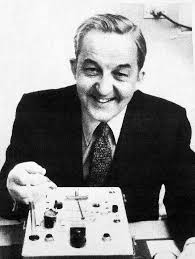
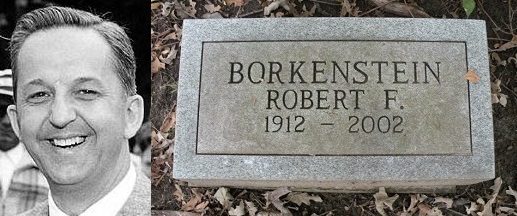
Frank Borkenstein (1912-2002)

Enter Robert Frank Borkenstein. Born August 31, 1912, in Fort Wayne, Borkenstein was a natural-born teacher, researcher, and inventor. Borkenstein was a product of the Great Depression, and like many young Hoosiers of that era, he was unable to attend college. His first job in Fort Wayne was as a photographic technician, where legend claims his expertise in color film led (at least in part) to the invention of the color camera. While that claim is hard to nail down, what we do know is that his skill and creativity were recognized by the Indiana State Police Criminology Laboratory which hired him in 1936. Borkenstein quickly rose through the ranks, he went from working as a clerk to Captain in charge of Laboratory Services to Director of the State Police Criminological Laboratory, one of the first state police laboratories in the US. During his time with the department, Borkenstein helped perfect the use of photography in law enforcement and worked extensively on developing the polygraph, or lie detector. He administered more than 15,000 tests before his retirement in the late 1980s.

Indiana University School of Medicine Dept. of Biochemistry-Toxicology display.

Also while with the department, Borkenstein developed a close professional relationship with IU Professor Rolla N. Harger who was still working to improve his Drunkometer. In the 1950s, Borkenstein attended Indiana University on a part-time basis, eventually earning his Bachelor of Arts in Forensic Science. In February of 1954, IPD Lieutenant Borkenstein, Director of the State police laboratory, developed his first working model of the Breathalyzer (an amalgam of “breath, alcohol and analyze”) in the partially dirt-floored basement of his small Indianapolis home at 6441 Broadway near Broad Ripple. His machine was more compact, easier to operate, and consistently produced reliable results when measuring blood alcohol content. The Breathalyzer substituted a rubber hose for the balloon and featured an automatic internal device to gauge the color changes previously determined by the naked eye. Borkenstein’s Breathalyzer was an inexpensive way to test intoxication and meant that BAC (blood alcohol content) could be quickly collected and analyzed for use as evidence. Upon graduation from IU, Borkenstein retired from the State Police and joined IU as Chairman of the newly-formed Department of Police Administration.

Borkenstein’s updated breathalyzer.

Robert Borkenstein, a convivial fellow known as “Bob” to friends, family, and colleagues, enjoyed listening to Gilbert and Sullivan, entertaining visitors, and serving drinks to his friends. According to one account, ironically Bob “exhibited a Catholic taste in wines and spirits”. But Bob insisted on one rule for himself and anyone consuming alcohol in his presence: No drinking and driving! This, even though he supervised a study, paid for by the liquor industry, that suggested that “the relaxing effect of having drunk less than two ounces of alcohol might produce a slightly better driver than one who had none”.

At I.U., Borkenstein was well-liked and known for his generosity to younger colleagues. He was also a Francophile who traveled extensively to Paris and other parts of France, incorporating the French language into much of his work. Another gadget Borkenstein invented was a coin-operated Breathalyser for use in bars. The idea is that when a customer drops a coin it causes a straw to pop up. When the straw is blown into, a reading of .04 or less would produce a message: “Be a safe driver.” Between .05 and .09, the machine blinked and advised: “Be a good walker.” At .10 or higher, it sounded a small alarm and warned: “You’re a passenger.”

He later became chairman of IU’s Forensic Studies Department and director of the university’s Centre for Studies of Law in Action. The class he established on alcohol and highway safety became a national standard in the United States for forensic science, law enforcement, and criminal justice professionals. Today, it is officially known as the “Robert F. Borkenstein Course on Alcohol and Highway Safety: Testing, Research, and Litigation”, more simply known as the “Borky”. In light of his achievements, Borkenstein was awarded an Honorary Doctor of Science by Wittenberg University in 1963 and an Honorary LL.D. from Indiana University in 1987. In March 1987 Borkenstein retired, though he continued to hold emeritus titles as both a professor and Director of the Center for Studies of Law in Action and was inducted into the Safety and Health Hall of Fame International in 1988. Borkenstein’s mentor Dr. Rolla Neil Harger died on August 8, 1983, in Indianapolis and is buried in Crown Hill Cemetery. Borkenstein’s papers are held at the Indiana University Archives in the Herman B Wells Library in Bloomington, IN.

Robert Borkenstein graveLindenwood Cemetery
Fort Wayne, Allen County, Indiana.

In 1938 Borkenstein married Marjorie K. Buchanan, a children’s book author who died in December 1998. The couple had no children. Robert Borkenstein died on August 10, 2002, at the age of 89. Borkenstein held the Breathalyzer patent for most of his life, finally selling it to the Colorado firm that markets it today. Although the Breathalyzer is no longer the dominant instrument used by police forces to determine alcohol intoxication, its name has entered the vernacular to the extent that it has become a generic name for any breath-testing instrument. Between 1955 and 1999, over 30,000 Breathalyzer units were sold. Without question, Bob Borkenstein’s invention has saved countless lives over the years and has become an irreplaceable tool of the police. And to think, it all started in Indiana.