Creepy history, Ghosts, Witches

Witch Marks.

w1Original publish date:  July 14, 2010

In the spirit of the approaching Halloween season, I’d like to share a story with you that combines many of the elements that peak my curiosity and fuel my passion for history and folklore. Recently, transplanted British antique dealer and collector Rick McMullen traveled back to his motherland in search of merchandise to sell in his shop or add to his home, which he describes as “virtually architecturally antique.”

Rick journeyed to an antique fair near Lincolnshire County in the Midlands of Great Britain where he found a curious large hand-carved oak panel. The 200 pound panel stood over 7 feet tall and was over 4 feet wide and was made in the “Carolean” style dating to sometime in the 1600’s. He had the panel shipped back to the states along with a Gothic-Victorian Era staircase and a 16th century oak timber frame with the intentions of incorporating all of them into his Virginia home.

However, it was that panel that made Rick’s mind race. What was it? What would he do with it? Where did it come from? When Rick’s wife saw the panel, she thought it might make a good headboard for a bed, but Rick quickly nixed that idea. Instead, the panel was set aside for future consideration while ongoing remodeling projects took precedence. There it would rest in peace until one fateful October evening when Rick was watching the history Channel and he saw something that seemed “hauntingly” familiar.

w2He was watching a documentary about witches and soon a segment flashed across the screen that told about the superstitious markings made by ancient people used to ward off witchcraft. The program talked about an English estate called “Kew Palace”, built in 1631. The owners were particularly superstitious, and believed that evil influences or witches could enter the house disguised as cats or frogs and cast spells on people while they slept. To ward this off, the original carpenters who made the roof carved special secret signs near windows, doors, fireplaces and other vulnerable places, to protect themselves from evil. ( Other ways of protecting a house included hiding old shoes, mummified cats and kittens under the floorboards, or ‘urine bottles’ filled with hair and nail-clippings in special, secret cavities.)

Rick immediately realized that he’d seen these very same markings before but couldn’t remember where. He searched his home and inventory looking for something that might jog his memory. He was about to give up when it came to him. It was the panel.

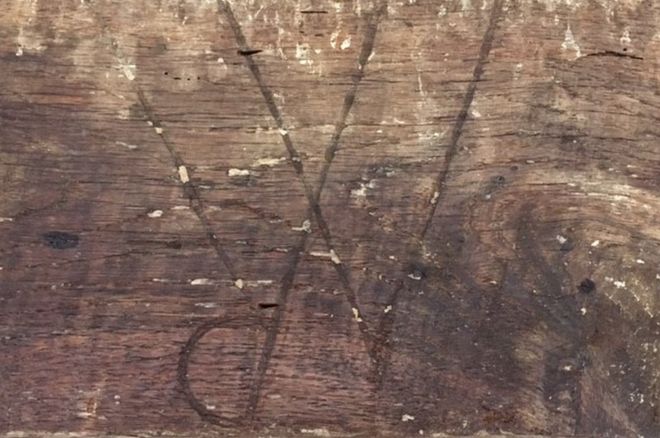
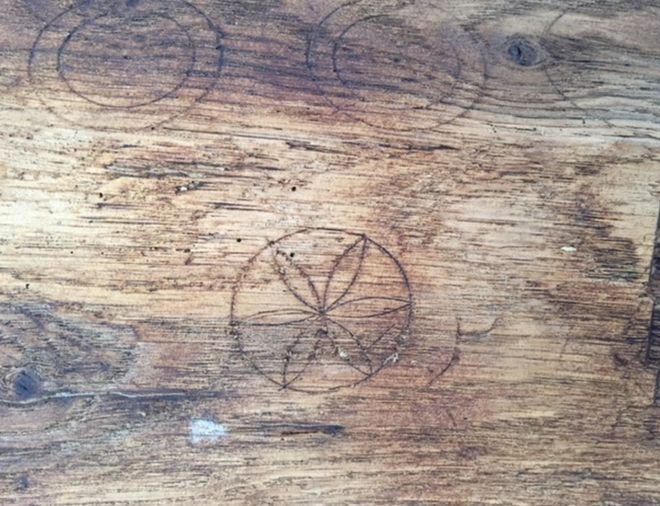
He turned the panel around and discovered about 40 hand carved figures and markings. These hand-cut marks varied in design and structure from interlaced V’s that more closely resemble fancy old English W’s to numerour carved daisy wheels. McMullen learned that these marks were called “ritual marks” or “apotropais”, a Greek word meaning “Intended to ward off evil” and were an important part of the folklore of Great Britain from the 15th to the 17th centuries. They were designed to keep witches, evil spirits and things that go bump in the night out of the home.

Among the Ancient Greeks the doorways and windows of buildings were felt to be particularly vulnerable to evil. On churches and castles, gargoyles or other grotesque faces and figures would be carved to frighten away witches and other malign influences. Those other openings, fireplaces or chimneys, may also have been carved. Rather than figural carvings, these seem to have been random simple geometric or letter carvings.

Contrary to what you may think, these ritual marks were not displayed prominently in the British Isles. It might make sense to put them over doors and above windows, but they were most often secreted away in hidden places to prevent a witch seeing and combating them. There is evidence of these “witches signs” appearing in churches, homes and other stone buildings all over the British Isles dating back to the late Medieval, Jacobean and Carolean Eras.
w3Rick has no idea where the panel originally came from but he suspects that the symbols were cut into the item by the resident family before being affixed as a softening decoration to an ancient stone wall. That way the marks would be unseen by the casual observer, presumed witch or evil spirit, but still provide protection for the family at the same time. Rick quickly discovered that there has been little formal study of these “witches signs” and historians have offered little support to his theories, choosing instead to dismiss them as silly superstitions.

Rick McMullen surmises that the two sets of deeply carved double V’s invoke the protection of holy Mary, “Virgin os Virgins” and mother of Jesus Christ. He believes that the carved daisy wheels, one of which is 18 inches in diameter, represent the “circle of life” with the petals overlapping each other to effectively become one.

McMullen admits that his theories are based on the scant available research and conjecture on the subject. “It’s quite bizarre,” he says. “But I believe it’s the only one in America…to my knowledge, these ritual marks predate Jamestown (1607, the first English settlement in the United States) and by the 17th century, it’s believed the marks were no longer used.”

However, the tradition can still be found in the often grotesque exaggerated faces carved into pumpkin jack-o-lanterns displayed each Halloween on porches and in windows of houses all over central Indiana. These cute childish symbols of Halloween were originally designed to avert evil and ward off the souls of the dead and other dangerous spirits walking the earth at that time.  Today, carved pumpkins are considered to be a wholesome part of the Halloween season shared by children and their parents in kitchens all over the state. A far cry from the origin of the mysterious ancient cravings known as “witch marks.”
Ghosts, Hollywood, Pop Culture

Clifton Webb’s Ghost-Forgotten Hoosier Hollywood Icon

webb1Original publish date:  November 9, 2008

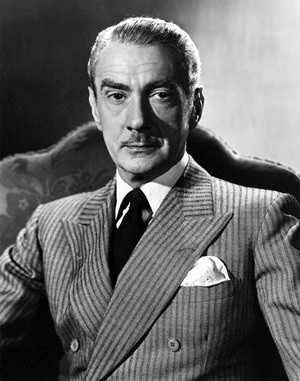
If you’re a fan of the Golden Age of Hollywood, then you should recognize the name Clifton Webb. If you’ve never heard of him, but consider yourself a fan of old Hollywood movies, don’t despair as you’ve probably seen Webb in one of his many old movies or television appearances made during his long career in Tinseltown. He’s one of those great character actors whose face is very familiar but whose name escapes us. So great in fact that he was nominated for 3 Academy Awards and 2 Golden Globe awards ( winning one in 1946) during his career. His story is sadly sweet.

If you’re a fan of the Golden Age of Hollywood, then you should recognize the name Clifton Webb. If you’ve never heard of him, but consider yourself a fan of old Hollywood movies, don’t despair as you’ve probably seen Webb in one of his many old movies or television appearances made during his long career in Tinseltown. He’s one of those great character actors whose face is very familiar but whose name escapes us. So great in fact that he was nominated for 3 Academy Awards and 2 Golden Globe awards ( winning one in 1946) during his career. His story is sadly sweet.  Clifton Webb was born Webb Parmelee Hollenbeck to a multi-generational Hoosier farming family in Marion County on November 19, 1889. If you find a biography on Mr. Webb, it will most likely claim that he was born in Beech Grove. However that information proves faulty when you realize that Beech Grove wasn’t formed as a community until after he was born. Beech Grove as we know it was not formed until 1906. Before that time it was known as a region known for the many Beech trees that populated the area. The town of Beech Grove was formed when the Big Four railroad began to use it as a hub during the early 1900s.

It’s much more accurate to say that Clifton Webb was born nearer to Brookville Road in the South eastern area of Marion County. So it’s accurate to say that Webb started life as an east-sider. However, he did not stay long. Webb’s father, Jacob Grant Hollenbeck (1867-1939) , was an Indiana farmer and sometime green grocer. His domineering mother, Maybelle A. Parmelee (1869-1960) was the daughter of a railroad conductor. Maybelle insisted that her “Little Webb” keep her family name along with that of Webb’s father. She moved with her “little Webb” to New York City after her husband’s job as a ticket taker did not suit her plans for her son’s career advancement in the theater.

Maybelle was known to tell anyone she came in contact with the “We never speak of him. He didn’t care for the theater.” Maybelle had “little Webb” enrolled in singing, dancing, & acting classes in New York City by the age of 5. Maybelle was an effective and aggressive stage mother who managed to get “little Webb” his stage debut at Carnegie Hall at the age of only 7 in a play called “The Brownies”. Webb was so effective in this first role that he was signed up to tour with a traveling vaudeville acting troupe. Shortly afterwards he was tapped for lead roles as Tom Sawyer and Oliver Twist. Maybelle kept “little Webb” busy between performances with painting and opera lessons. Webb quite school by the age of 13. He was performing opera solos on stage by the age of 17.

By the age of 19, Webb had dropped both the Parmelee and Hollenbeck names and adopted the stage name we know as “Clifton Webb”. He was performing regularly on Broadway and it was not unusual to find his mother Maybelle’s name listed in the playbill along with her “little Webb” as a minor scene player or extra. During this period, Webb co-starred with legends like Will Rogers and Al Jolson in plays and musicals written by luminaries like Cole Porter, Irving Berlin, Oscar Wilde, Noel Coward, the Gershwins and Jerome Kern. Webb received billing above Humphrey Bogart in Bogie’s first stage performance. Although he appeared in a few silent films in the 1920s, he stuck to Broadway until 1944.

webbclifton01Webb was tapped by director Otto Preminger to appear in the classic “Laura” alongside Gene Tierney. He would receive his first Oscar nomination for this appearance, even though he was relatively unknown to movie fans. 2 years later in 1946 he again starred with Tierney in the cult classic film “The Razor’s Edge”. He received his second Oscar nomination for this role. Webb’s created the lasting character “Mr. Belvedere” in 1949 for the film “Sitting Pretty” and would reprise the role 2 more times. This character would earn him his third and final Academy Award nomination. This same “Mr. Belvedere” character would be retooled as a TV show and played by 4 different actors from the 1950s thru the 1980s.
Some of Webb’s other films (He made 25 films in all) include: “The Dark Corner” in 1946, “Cheaper by the Dozen” with Myrna Loy in 1950, “For Heaven’s Sake” in 1950, “Dreamboat” in 1952, “Woman’s World” in 1954, “Titanic” in 1954 (He played Barbara Stanwyck’s doomed husband), “Three Coins in a Fountain” (1954), “The Man Who Never Was” in 1956, “Boy on a Dolphin” (1957), and “The Remarkable Mr. Pennypacker” in 1959. It’s been claimed that Webb’s real life persona was most like that of his “Mr. Belvedere” character, described as being somewhat of a “Sophisticated, stuffy, effete snob” by some who knew him. It was no secret that Clifton Webb was gay. This at a time in Hollywood when it was an unwritten rule in Tinseltown to “Don’t ask, don’t tell”.

Clifton Webb’s elegant style landed him on Hollywood’s best dressed list for decades. Webb was the subject of many great stories and quotes in Hollywood. One of comic Bob Newhart’s favorite stories is to relate how while he was a young & naive star in Hollywood at one of his first exclusive parties, Clifton Webb approached this wide eyed newcomer and startled Newhart by asking him if he wanted to dance. Despite this obvious frankness, Clifton Webb managed to keep his personal life out of the Hollywood tabloids. Although the rumor in late 1950’s Hollywood was that Webb was once romantically linked with fellow Hoosier icon James Dean. It was widely known that Webb openly flirted with young, good looking men at parties in Hollywood, taking satisfaction in garnering more attention from them than the women in the room.

However, this is all unsubstantiated Hollywood gossip. Webb was never seriously linked to anyone in Hollywood, male or female. He never married. This is at least due in part to his abnormally close relationship with his mother, who seemed to be the sole object of Webb’s tenderness and love. She lived with her son until her death at age 91 in 1960. Webb was distraught. So much so that his friend Noel Coward tried to get him to snap out of the deep depression months after her death by telling Webb, “It must be difficult to be orphaned at 70, Clifton.” As for trivia, cartoonist Jay Ward claimed that he modeled the “Peabody” character from the Rocky & Bullwinkle show on Clifton Webb.

Direct quotes attributed to Webb include, when speaking of his alternative lifestyle, he said “It’s never morals, it’s manners.” and “You can be rich and dull or poor and amusing–but you must always contribute something to the community.” On the subject of wearing a partially exposed handkerchief in a suit jacket pocket, Webb said “Never pointed, never square…it should always be, of course, pear shaped.”

Clifton Webb never really recovered from the loss of his mother and his health began to suffer for it. He reportedly locked her room and refused to remove her belongings, choosing instead to leave everything just as he left it. He spent the last 5 years of his life as a sad, lonely recluse in his Beverly Hills home. Sadly, upon her death he slipped into a prolonged period of denial and depression going so far as to contact dozens of clairvoyants and spirit mediums in an effort to contact the spirit of his dead mother. One of these mediums was the former Blonde Bombshell star Mae West, who was herself known for a powerful spiritually intuitive gift of communicating with the spirits of the dead.

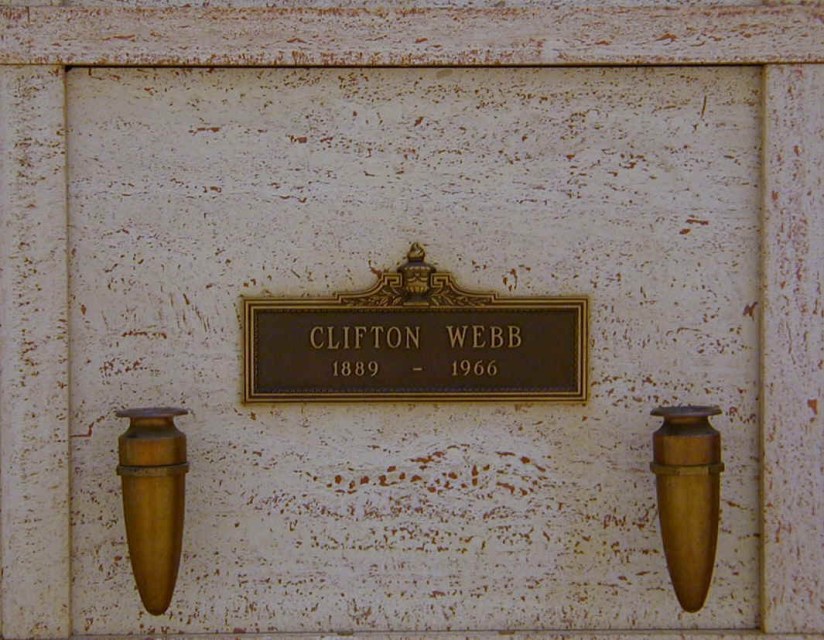
Clifton Webb died of a heart attack on October  13, 1966 at the age of 76. He was awarded his own star on the Hollywood walk of fame. It’s located at 6840 Hollywood Blvd. He was interred in a burial vault at Hollywood Forever Cemetery. His is crypt 2350, Corridor G-6 in the Abbey of Psalms. Why so much detail about Webb’s burial spot? Because it’s rumored to be haunted by Webb himself.

Rarely will you find accounts of ghosts “haunting” their gravesites, but Clifton Webb is the exception to this general rule. Clifton Webb’s restless spirit has been seen haunting the crypt in the section known as “The Sanctuary of Peace” where his mortal remains were laid to rest. Mr. Webb is always seen fastidiously dressed in his dapper suit and sometimes has been known to startle visitors by yelling at them in his distinctive voice. There are even a few accounts of Mr. Webb haunting his old house at 1005 Rexford Drive in Beverly Hills before it was torn down many years ago. It has been claimed that the reason for his haunting is his reluctance to relinquish his fame and the fear that his legacy might be forgotten. The precursor for these ghostly visits by Webb in his burial vaults is the unnerving sound of the marble slab that covers the opening shifting back and forth.

Clifton_Webb1I can tell you from first hand experience, this slab does indeed move to and fro within the slot that covers the burial cavity. I had heard these legends and visited the Hollywood Forever cemetery 9 years ago to test the theory. I will tell you that it’s an eerie feeling and an even stranger sound. If I were alone in that vault and heard that sound without explanation as to whom or what was causing it, I would not stick around to see if it was my famous fellow Hoosier, Clifton Webb!

Creepy history, Ghosts

The Spooky “Hidden Mother” Photo.

Hidden Mother photo side blanketOriginal publish date:  August 21, 2015

If you like haunting antique shops and shows like me, I’m about to give you a new hobby, or at the very least blow your mind a little. Next time you find yourself walking by a table with a shoebox full of old CDV’s, tintypes and cabinet photos (they seem to appear everywhere) pick them up and look carefully at the photos of small children and babies. You might just find a “Hidden Mother” in one them.
Back in the stone ages before the advancement of digital imaging, cameras required film which then required development at a photo lab. The lab would take the film, create a negative, print your image and Eureka, you had a photo you could actually hold in your hands, not just look at on a screen. The first practical digital cameras started popping up in the 1980s, but before that, there was no “photoshopping” people out of negatives. True, negatives from commercial cameras from the 1930s on could be manipulated by the skillful use of a razor blade and a re-shoot, but they were clunky and easy to spot. In the case of Civil War Era CDVs (Carte de Visites) and tintypes or Victorian Era Cabinet photos, editing was nearly impossible, so other methods were utilized. In early photographs, a subject had to sit still because of long camera exposure times, usually 10-15 seconds depending on the lighting.
The longer the exposure, the better the image. That is, of course, unless the subject was a squirming baby, distracted pet or active small child. In those instances, these subjects were sometimes held in a deftly disguised lap or reassured by a disembodied adult hand just out of range of the camera lens. In some cases , this was accomplished using a photographer’s assistant but in most cases it was a relative, a nanny, or father, but primarily it was the child’s mother. Collectors make no distinction and photos of this description are always known as “hidden mother photographs” of “hidden mama photos.”
Back in the horse-and-buggy days there were really only a few ways to have your picture made. You either visited a photography studio (every town had one), went to an event like a Carnival, Amusement Park, State or County Fair to visit the photographer’s tent, or took advantage of traveling photographers who routinely roamed the back roads (often with an adorable pony in tow) to make a picture of the family for a quarter. Since many parents wanted photographs showing only the children, photographers had to get creative to block out the person in charge of corralling the child.
This was accomplished a couple of ways: a mother would drape herself in fabric and hold the squirming child on her lap or she would attempt to hide herself out of the camera’s view. This resulted in photos that at best subtly hid the caretaker from view or, at worse, created an image that looked looked like there was a creepy old ghost in the room. In in the case of the undisguised “hidden mama”, the mother’s features were confined to a far edge or an upper corner, that way, after the photo was developed, it could be placed behind an oval mat or frame which would crop out the mother, thereby deceiving the viewer into thinking the child was posing alone.
There were many techniques used to disguise the mother and a good photographer could make her nearly invisible, but she was never quite completely gone. If you look closely, you’ll see a hand, a set of fingers or the outline of an arm (sometimes the silhouette of an entire body) hidden within the photo. Just as digital photography changed the camera industry forever, improvements in technology led to exposure time being drastically cut down from minutes to seconds by the close of 19th century. Those uncomfortably long exposure times gave us some unmistakable Victorian Era photography peculiarities that you’ll find in every photograph from that age, regardless if you’re lucky enough to find a “hidden mother” photo or not. These include the stiff postures and unsmiling faces of subjects trying to remain perfectly still during the excruciatingly long time it took for the photographer to remove the lens cap and expose the film. Having had several of these photos made of me and my family over the years, I can testify that you can remain itch free for hours until the moment that a box camera photographer tells you “Okay, stand still” and counts off the seconds. One unconscious twitch or involuntary movement would result in a ruined picture. You could blink your eyes and not have it appear in the finished photo, but that was about it.
Now that you know about these photos, I suspect you’ll start looking and finding them on your own. Obviously, you first need to find an old fashioned photo of a child, but failing that, you can also look at the photos of the adults, usually when they are posed standing alone in a studio. Sometimes, the cast iron photographer’s stand can be seen behind them. Look first at the floor behind the subject’s feet and then look at the neck. These bulky stands looked like an old floor lamp with tripod footing and a U-shaped topper that was placed behind the neck to hold the subject still. Most of these are subtle, but some are quite obvious when you know what to look for.
In the case of “hidden mother” photos, the mother is most often “seen” disguised as a chair or camouflaged under decorative throws behind or holding the child. The throws can be as simple as a black or white tablecloth (the white tablecloths REALLY making it look like a ghost) or bulky Persian rugs and drapes with heavy backings that surely made the “disguisee” herself wriggle uncomfortably during the process. Another interesting subset of the “ghost mother” phenomenon has developed more recently. That is the debate among fans of this type of photo asking, is the child dead or alive?
Post Mortem photos were very popular during the same era. While the practice of taking a photo of a dead person, particularly an infant, appears macabre, perhaps repulsive, to people today, it has a plausible explanation. The Post Mortem photo was often the only photo the family had of that person. Most of these photos are of the very old or the very young. The argument in the late 1800s to early 1900s was that elderly folks were born before the advent of commercial photography and usually lived their entire lives in rural settings with no opportunity, or need, for a photo to have ever been attempted of them. For babies and small children, the argument would be that parents believed there would be plenty of time to have photos made of the kids down the line. An unexpected, early death would hasten that schedule.
Quite obviously it would be highly unusual (and very creepy) to find a hidden mother in the photo of an adult. But not so unusual in the instance of a photo of a dead child. Grief and mourning for lost children was the same then as it is now. Depending on the timing of the sad event, the parent may have been reluctant to allow the child to be removed from their clutches while awaiting burial, particularly in the very early stages of infant death. The principal question is, if the child is dead and not moving, why is the mother hidden?
Well, just as photographers used cast iron braces, officially known as “posing stands”, to keep a wavering subject steady during the prolonged exposure process, perhaps the “hidden mother” was used for the dearly departed child because the parent refused to have their baby propped up by cold steel. After all, a concerned mother would want her precious child to appear as lifelike as possible and in fact many Post-Mortems have accomplished just that and are hard to distinguish by any but the most expert eye.
I’ve included a trio of photos of the “hidden mother” variety for you to see. But there is at least one obvious example of a Post Mortem hidden mama photo that you can easily view on the net by simply typing “hidden mother Post Mortem” into your browser bar. I decided to omit that photo from this article for the sake of propriety choosing instead to let you the reader make that choice for yourself. So if there is one obvious example of a Post Mortem “hidden mama”, there surely must be more. Regardless, the next time you pass one of those shoeboxes full of old photos invariably marked as “Instant Relatives”, pick up a stack and peruse them. Pay close attention, you might just find a “hidden mother” of your own.