

Original publish date: October 4, 2018
Relatively speaking, Paul Ruster Memorial Park is one of the newest additions to the Indianapolis Parks system. The park’s trail consists of a 1.2 mile moderately trafficked loop trail that features a river and is rated as moderate. The park is tucked away off of busy Washington Street and the trail is like stepping into a hidden forest. The trail features some steep inclines with several elevation changes and can be very tight in certain areas. It is more of a recreational facility than a park in the traditional sense of the word. Located near the bustling Washington Square Mall shopping complex, the 102-Acre park features a small fishing pond and playground.The Ruster park is bordered by walking trails, defined by Buck Creek that borders the area, that each offer eastsiders a rural setting for jogging, hiking and dog walking. During summer, locals take advantage of the park’s picnic facilities and shelter house. In 2007, the park added two fenced in “Bark Parks” (the third such facility in Indianapolis). During the winter, the park’s many hills are filled with sledders, skaters and tubers.
 Ask any of these visitors about the park’s namesake and you’re likely to catch them at a loss. What’s more, most visitors are unaware that Paul Ruster Park is haunted by a centuries-old ghost. The park, acquired by the Indy Parks system in 1970, is named after a 1964 Warren Central high school graduate, Paul M. Ruster. Paul, the oldest of three sons of Marvin and Marie Ruster, died December 10, 1978 of Hodgkin’s disease. Paul’s brother Bruce was a former Warren Central baseball star and much beloved Phys-Ed teacher at Warren Central for many years. Paul was born on the eastside, attending Eastridge elementary and Woodview Junior High. He graduated from Ball State University and returned to Indy’s eastside to teach Phys-Ed at Lowell in 1969.
During his ten years at Lowell, Mr. Ruster became admired, respected and loved by the people he worked with each day. People remember him for his winning smile and infectious laugh. He always seemed to be giving his time, talents, and energies to and for his pupils. He believed in kids, encouraged them, and was not disappointed in return. While at Lowell, he completed a master’s degree at Butler University. In addition to teaching and studying, he coached girls’ softball at Lowell little league. He later coached girls’ teams affiliated with the Amateur Softball Association.
His teams worked hard for recognition and were able to travel to several neighboring states to compete in various tournaments and playoff games. Paul was able to find time to start a “Dad’s Night” at school for the fathers who had a desire to take part. Mr. Ruster also found time to participate in several basketball leagues in the city. The Lowell PTA and the community honored Mr. Ruster by establishing a scholarship in his name and by starting a petition to have the city park at 11300 East Prospect Street in his honor. The approval for the park to be named after Paul Ruster came through on June 28, 1979.
 Although the park may have been new to the Indy Parks system, the haunted reputation was well established. Some of the first to report the strange happenings going on within the park were people who were themselves looked upon as strange by casual observers. These were the weekend warrior gatherings of young people dressed as medieval knights wearing full combat regalia while sword fighting and jousting around the green spaces of Ruster Park. These were the early days of the “Dungeons and Dragons” phenomenon in the 1980s involving fantasy role playing groups that met on a regular basis in the park. These groups began to report strange sights and sounds coming from the periphery of the park’s boundaries that would often stop participants in their tracks. Sometimes, these spooky sounds would drive the groups from the park in fear. Soon, the ghostly rumors made the rounds among Indianapolis paranormal groups that Paul Ruster Park was a hot spot for paranormal activity and an allegedly haunted area. Paranormal investigators declared that these unexplained occurrences were emanating from a nearby abandoned family cemetery a mere stone’s throw from the new park.

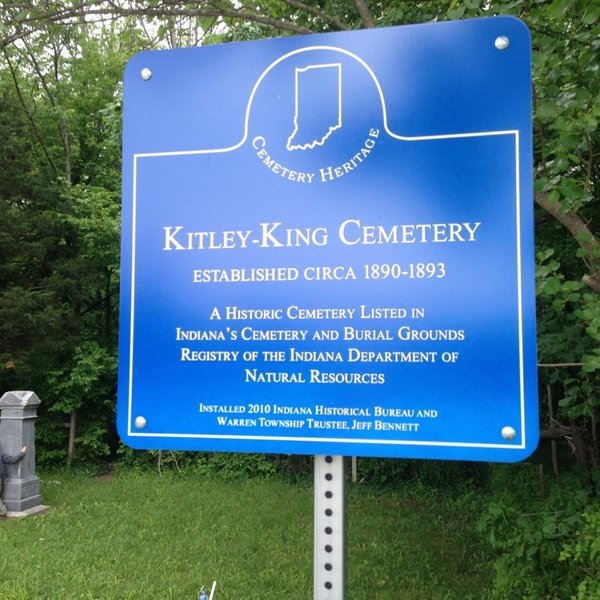
Kitley-King cemetery, located at 11000 East Prospect Road just east of German Church Road, is in an area of woods located on the southeastern edge of the soccer field complex located within Paul Ruster Park. Although located on busy Prospect road, the cemetery, located on the site of the old Kitley family farm, is over a century old and only visible when standing directly atop it. Resting across from the point where East Prospect Road is intersected by Touchstone Drive, a set of six broken and weathered steps ascending from the curb is the only clue to the graveyard’s existence. The steps lead up from the road into a stone walled square plot of ground within which rest a smattering of gravestones in varied states of disrepair nestled into what looks like the foundation of a long forgotten house.
Sadly, only two monuments remain intact. They are the John W. King (1806-1893) and Francis Kitley markers. The cemetery is not well maintained and the two remaining stones are severely cracked. The grass around the area is usually overgrown and uncut.
An 1889 Sanborn map of the area shows the presence of two farms at the intersection of German Church and Prospect Roads. The properties were registered to J. and J.N. Kitley and to Francis Kitley. Across the street on this 1889 map is a farm once owned by Andrew King. Francis’ home once rested on what today is the soccer field. Since the Kitleys and Kings were farmers, it was natural to bury their loved ones in the land beside the farms.
County records show that John Kitley recorded an eighty acre farm on this spot on December 16, 1825. Kitley was born in Hamilton County, Ohio on April 15, 1793 and died sometime around February 25, 1865 (based on his will’s probate date). His stone was once within the cemetery but is missing today, as is that of his wife, Anna Fox Kitley. However the couple’s mortal remains undoubtedly rest beneath the soil to this very day. John and Anna were organizers of the Cumberland Baptist Church on the National Road, or present day Washington Street, located a short distance to the north. The Scotch-Irish Kitleys, who were Methodists, intermarried with the neighboring King family, who were members of St. Johns Evangelical Church on German Church Road.
According to county records, also buried in the Kitley-King cemetery plot are John & Anna’s son, Francis Kitley (December 25, 1823-October 16, 1886) and Mary Jane Smithers Kitley, who is listed on the back of Francis’ stone with the dates: Feb. 6, 1841-Aug. 25, 1932. Other “lost” graves may include siblings Sarah King, Elizabeth King, Lillian Hart, Walter S Kitley, John Kitley, Hester Wiese and James Nelson. Still others may include James’ widow, Rose, and their children Floyd and Frank along with their wives, Alma and Anna, respectively. As with many Indiana pioneer cemeteries, records are sketchy and incomplete with graves remaining unmarked and unrecorded.
 Legend claims that many years ago a 12-year-old boy living on the farm was killed while walking along the nearby train tracks. No-one knows if he was struck by a train or whether some other harm befell him. Reportedly, he is now buried in an unmarked grave within the foundation of his old house. Witnesses claim that if you walk the long path leading from the soccer fields through the woods to his grave near Prospect you can hear the boy playing his harmonica. Still other witnesses have reported seeing the ghostly image of a young boy walking down the road and again, he is seen playing a harmonica.
The railroad tracks are long gone, but the wandering spirit of the musical boy remains. His spirit has been witnessed near the large fishing pond located just west of Muessing Road within the heavily wooded area of the park. Fishermen have often reported the plaintive sounds of a ghostly harmonica heard moving through the woods and around the perimeter of the old fishing hole, as if circling them. It is believed that this lonely wanderer is John Kitley, young namesake son of the farm’s owner, who died on April 12, 1864.
What is known is that Paul Ruster State Park, built for the enjoyment of the children of Indianapolis’ east side and named to honor a devoted kid-loving eastsider, is visited by hundreds of joyful children who run and play in its green spaces all year round. Most likely these visitors frolic and play unaware that a sad and lonely Civil War era lad may be watching from afar wishing he could join them, or perhaps just play them a tune.


 What better time to introduce two of the world’s most popular monsters? Frankenstein and Dracula were born on the same night in the same weekend in 1816. They were brought to life by Mary Shelley and Lord Byron during a contest to see who could create the scariest monster. The weekend was wet and stormy and Lord Byron suggested the reading of ghost stories to pass away the dreary weather. Sitting around a log fire at the Villa Diodati on the shores of Lake Geneva, the company of friends amused themselves by reading German ghost stories translated into French from the book Fantasmagoriana. The members of the party were Lord Byron and his mistress Claire Claremont, his doctor John Polidori, Percy Bysshe and Mary Shelley. Lord Byron is known for his poetry, mostly Don Juan. After reading a few stories, Byron suggested that each member of their party write their own story of horror.
 Unable to think of a story, young Mary became anxious, in the introduction to her book she recalled: “Have you thought of a story? I was asked each morning, and each morning I was forced to reply with a mortifying negative.” During one evening in the middle of summer, the discussions turned to the nature of the principle of life. “Perhaps a corpse would be re-animated”, Mary noted, “galvanism had given token of such things”. It was after midnight before they retired, and unable to sleep, she became possessed by her imagination as she beheld the grim terrors of her “waking dream.” In September 2011, astronomer Donald Olson, after visiting the Lake Geneva villa and inspecting data about the motion of the moon and stars, concluded that her “waking dream” took place “between 2 a.m. and 3 a.m.” on June 16, 1816, several days after the initial idea by Lord Byron that they each write a ghost story.
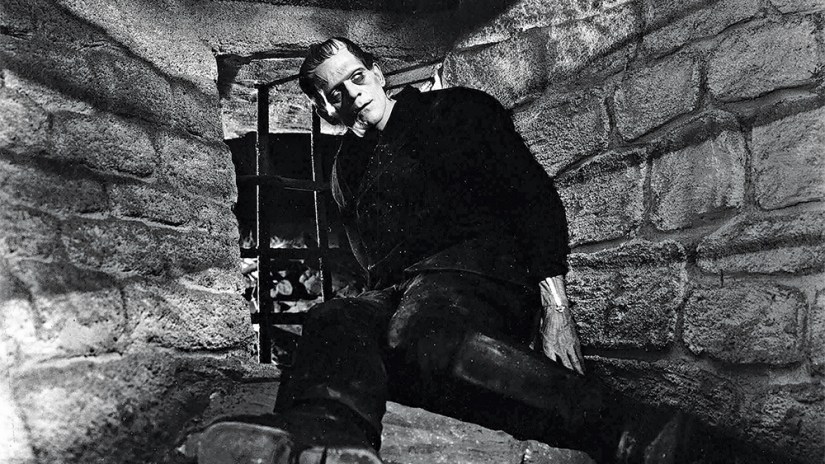 When “Frankenstein” was published it became an immediate sensation. Mary Shelley crafted her book so that readers’ sympathies would lie not only with Frankenstein, whose suffering is dreadful, but also with the creature, whose suffering is worse. Shelley skillfully directs her readers’ sympathy, page by page, paragraph by paragraph, sometimes even line by line, from Frankenstein to the creature. Shelley deftly navigates the creature’s vicious murders, first of Frankenstein’s little brother, then of his best friend, and, finally, of his bride. In 1824, one critic wrote, “The justice is indisputably on his side and his sufferings are, to me, touching to the last degree.”
 A century later, a lurching, grunting Boris Karloff defined the most widely accepted version of the creature in Universal Pictures’s 1931 production of “Frankenstein.” Karloff’s monster-portrayed as prodigiously eloquent, learned, and persuasive in the novel-was no longer merely nameless but all but speechless, too. “Frankenstein” has spawned many different depictions in the two centuries since its publication. For its bicentennial, the original, 1818 edition has been reissued in paperback form by Penguin Classics as “The New Annotated Frankenstein.”
 This coming Saturday, October 20th at 2 PM, several of those famous friends will be here in Irvington at the Irving theater to share their talent with our community in a program I have called, “Whispers from the Grave. Testimony of Irvington’s Most Famous Crimes.” Over the past decade and a half I have gathered testimony, witness accounts, personal statements and personality sketches of the characters, both good and bad, from the stories I share on the tours. This Saturday, local celebrities, journalists and members of the media will lend their talents to the voices of these characters. Much of this spoken word performance will offer accounts that have not been heard for over a century. This testimony, told in its entirety using the words of the subjects themselves, is always poignant, sometimes shocking and often scandalous.
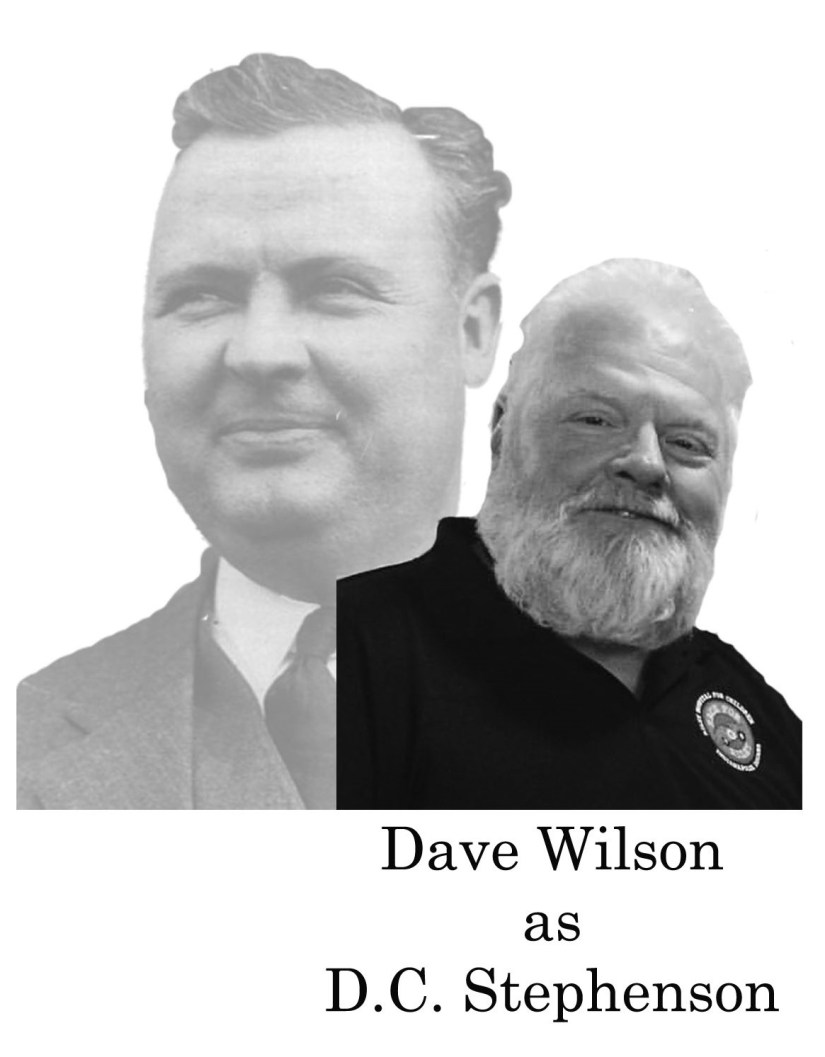 Joining us Saturday will be long time Q 95 star and stand up comic Dave “the King” Wilson reading the words of DC Stephenson. David Curtis Stephenson was the Grand Dragon of the Indiana Ku Klux Klan who reigned supreme here in central Indiana during The Roaring 20s. Stephenson controlled Indiana politics from the governor’s office to the mayor’s office with Klan money and influence from his University Avenue home here in Irvington. Gathering testimony and statements from Stephenson’s made all the more harder by the fact that after his 1925 trial for murder concluded, the official court papers mysteriously disappeared.
 2 – time Emmy award-winning former WTHR on air personality & meteorologist Nicole Misencik who will be voicing Madge Oberholtzer. Tragically, Madge was the undeserving victim of DC Stephenson’s crime in the spring of 1925. Madge was an Irvingtonian and former student at Butler College whose death at the hands of Stephenson brought down the Ku Klux Klan, which was the most powerful organization in the country at the time. Madge’s testimony was so graphically detailed that when it was read aloud in open court in Noblesville Indiana, women fainted and grown men got up and left the room. Nicole will recount Madge’s 9 – page deathbed declaration and its entirety for the first time in public and nearly a century.
 Former WTHR reporter Brandon Kline will be voicing Pinkerton detective Frank Geyer, the man who brought America’s first serial killer to justice. Brandon will wear the hero cape by voicing this legendary Pinkerton agent who is dogged determination alone solved Irvington’s first murder, that of 10-year-old Howard Pitezel. Brandon’s hero duty will be doubled when he also voices Irvingtonian lawyer Asa J Smith who recorded Madge’s deathbed declaration in what promises to be a most memorable exchange with his wife Nicole.
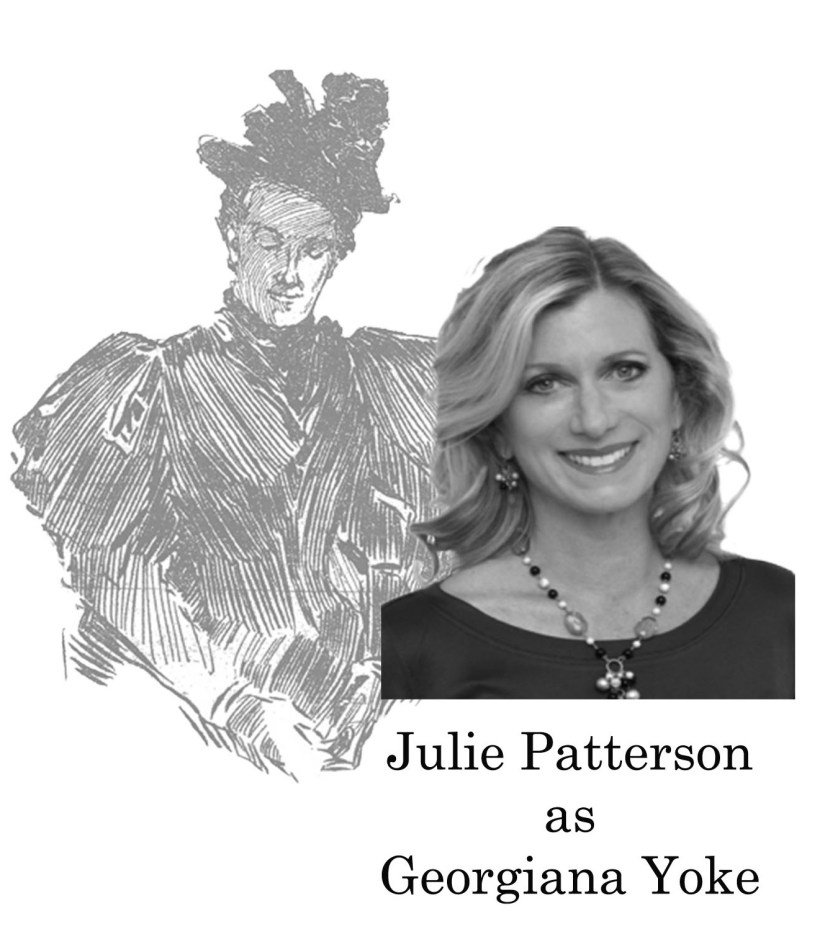 Boomer TV personality, longtime WZPL radio host and former WISH – TV alumni Julie Patterson will be voicing the last wife of HH Holmes, Georgiana Yoke. Ms. Yoke, a native of Franklin Indiana, is easily the most unknown character in the presentation. Georgiana’s family has deep connections to Indianapolis’east side at both Garfield Park and Holliday Park. Georgiana narrowly escaped death at the hands of her husband and, after his death by hanging, could not escape the cloud of suspicion that hung over her in Indianapolis after her husband’s crimes were revealed. Julie’s interpretation of Georgiana will also include her court testimony, some of which was delivered by her husband HH Holmes while acting as his own counsel.
 Ed Wenck, long time local radio host, journalist, author and on-air television personality, will be voicing America’s first serial killer HH Holmes. Allegedly responsible for over 200 murders, Holmes admitted to killing 27. The arch fiend came to Irvington in October 1894 on the heels of the 1893 Chicago world’s fair. His crimes are numerous, gruesome and unspeakable. Ed will voice America’s first serial killer using Holmes’ own words which are guaranteed to make your skin crawl.
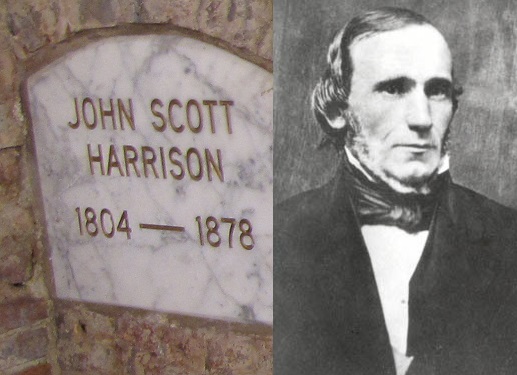
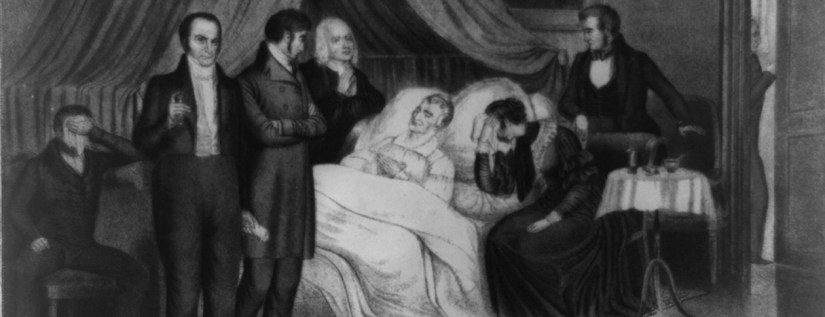
 The first order of business was to hide the fact from Devin’s widowed mother until the body could be recovered, and the second was to take precautions for safeguarding John Scott Harrison’s remains. Benjamin Harrison and his younger brother John carefully supervised the lowering of his father’s body into an eight-foot-long grave. At the bottom, they placed the state-of-the-art metallic casket into a secure brick vault with thick walls and a solid stone bottom. Three flat stones, eight or more inches thick were procured for a cover. With great difficulty the stones were lowered over the casket, the largest at the upper end and the two smaller slabs crosswise at the foot. All three of these slabs were carefully cemented together. The brothers waited patiently beside the open hole for several hours as the cement dried. Finally, with their father’s remains still under guard, a massive amount of dirt was shoveled into the hole and the brothers departed secure in the notion that their father would rest in peace for all eternity.
 John Harrison shrugged off the discovery knowing that his cousin Augustus Devin, the subject of their search, was a very young man. Still, the body was lain flat on the floor and the cloth was cast aside with the aid of a nearby stick. As the dead man’s face was revealed, John Harrison gasped in horror that the dead body was none other than that of his father, John Scott Harrison.


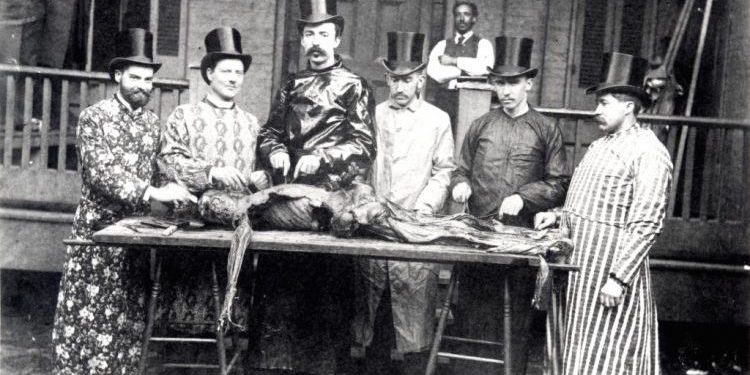
 is a rope with a hook at one end, a short crowbar, and a spade and a pick. He generally has a “pard,” as it is easier to hunt in couples. He is notified of the “plant” (body), and by personal inspection makes himself familiar with all the surroundings, before the attempt is made. The pick and spade remove the earth from the grave as far as the widest part of the coffin, and with the crowbar, the coffin is shattered, and the rope with the hook end fastened around the cadaver’s neck, when it is drawn out through the hole without disturbing the earth elsewhere. As soon as the cadaver is sacked, the earth replaced, and the grave made to look as near like it was as possible. There are some bunglers however, who have been guilty of leaving the grave open, with fragments of the cadaver’s clothing lying around. They are a disgrace to the profession, and have done much to foster an unfriendly public sentiment in this city.”
 THE MOST FRUITFUL FIELDS: “The most of the stiffs are raised at Greenlawn cemetery (in Franklin, south of the city), at the Mt. Jackson cemetery (on the grounds of Central State hospital), and at the Poor Farm cemetery (Northwest of the city). So far as I know Crown Hill has never been troubled. Many of the village cemeteries in the neighboring counties are also visited, however, and made to contribute their quota to the cause of science. Some of these village cadavers are those of people who moved in the best society, and besides their value in material for dissection, are rich in jewelry, laces, velvets, etc. The hair of a female subject is alone worth $25. Nothing is wasted, you may be sure. Even the ornaments on the coffin lids are used again..”
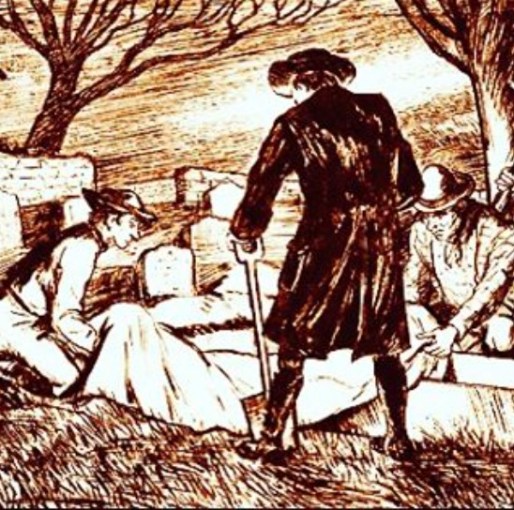 The night was a graverobber’s best friend. He lived in it, worked in it, played in it and hid in it. Late at night, these ghouls would steal into cemeteries where a burial had just taken place. In general, fresh graves were best, since the earth had not yet settled and digging was easy work. Laying a sheet or tarp beside the grave, the dirt was shoveled on top of it so the nearby grounds were undisturbed. Most body snatchers could remove the body in less time than it took most people to saddle a horse. They would carefully cover the telltale hole with dirt again, making sure the grave looked the same as it had before they came. Then hurriedly take the body away via the alleyways and sewers of the city, finally delivering the anonymous dearly departed to the back door of a medical school. In time, several of these ghouls began to furnish fresh corpses for sale by murdering the poor, homeless citizens of the city who once stood silent vigil in the alleys as the graverobbers crept past with their macabre cargo in tow.
 In the late 1800s in Indiana, it has been estimated that between 80 to 120 bodies each year were purchased from grave robbers to be used for medical instruction at medical schools and teaching facilities in Indianapolis. An end to the “big business” of grave robbing came as a result of twentieth-century legislation in Indiana which allowed individuals to donate their bodies for this purpose. In 1903, the Indiana General Assembly enacted legislation that created the state anatomical board that was empowered to receive unclaimed bodies from throughout the state and distribute them to medical schools. The act was “for the promotion of anatomical science and to prevent grave desecration.”
 Alan E. Hunter