It cannot be denied that Basketball is connected to our state like a child to its mother. Whether you played it, watched it, or avoided it, you cannot deny that basketball is what Indiana is known for. Go ahead and make your argument for the Indy 500, but you can’t play Indy 500 in your driveway in the pouring rain or by the light of the moon.
For most Hoosiers, basketball conjures up images of Bobby Plump sinking a last-second jumper, Reggie Miller raining 3-pointers from never-never land, or Neto, Roger, Mel, Freddie, Big Mac, Dr. Dunk, and Billy tearing through opponents toward another ABA title. Still, others believe that Indiana basketball is best defined by the greatest all-around pre-Michael Jordan player to ever lace up a pair of Chuck Taylors, Oscar “The Big O” Robertson.
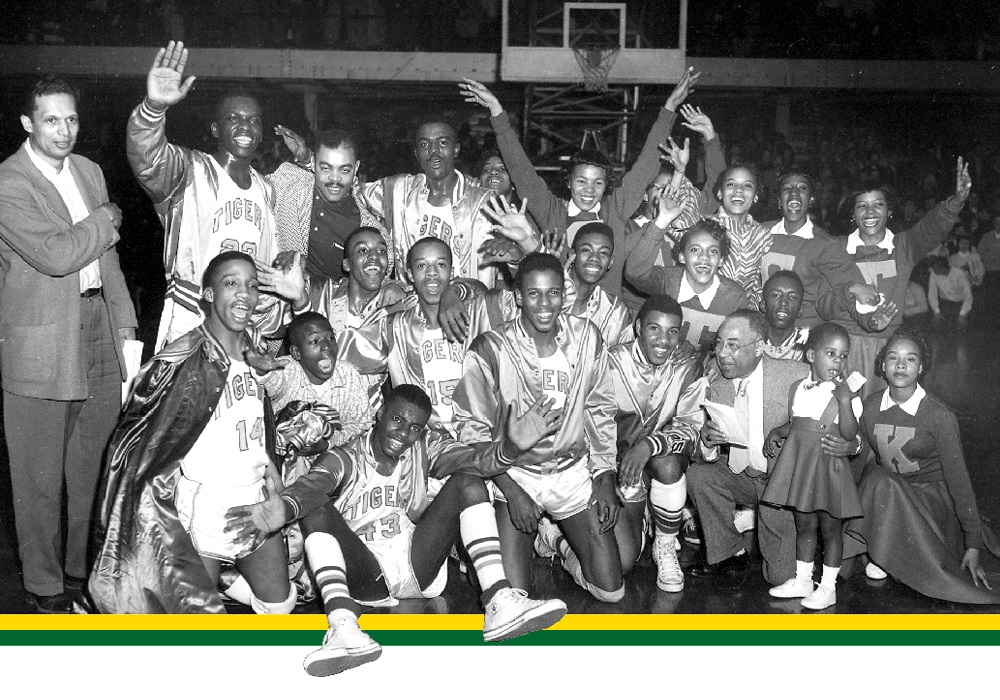
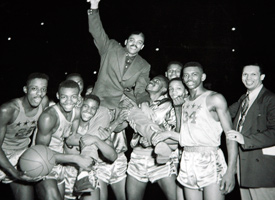
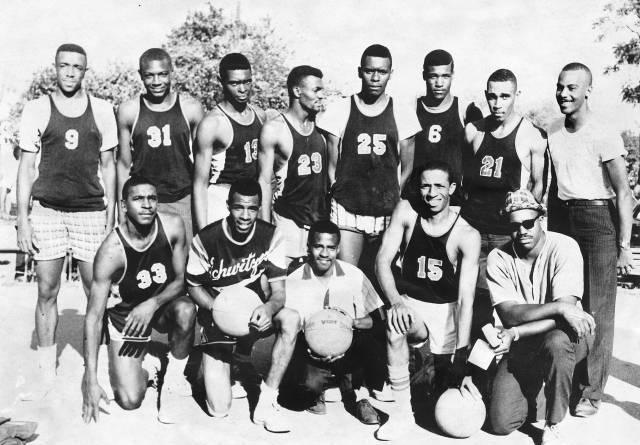
Crispus Attucks High School State Champion Basketball Team.
Any Hoosier basketball fan recalls those great Robertson-led Crispus Attucks high school teams that won back-to-back state championships in 1955 and 1956. For those readers unfamiliar with Crispus Attucks, it was the only all-black high school in Indianapolis. That 1955 team gained fame by becoming the first all-black school in the nation to win a state title as well as becoming the city of Indianapolis’ first state champion. Robertson led Crispus Attucks to another championship in 1956 and became the first Indiana high school team to complete an entire season undefeated. Okay, okay, you remember all that. But do you remember the Dust Bowl?
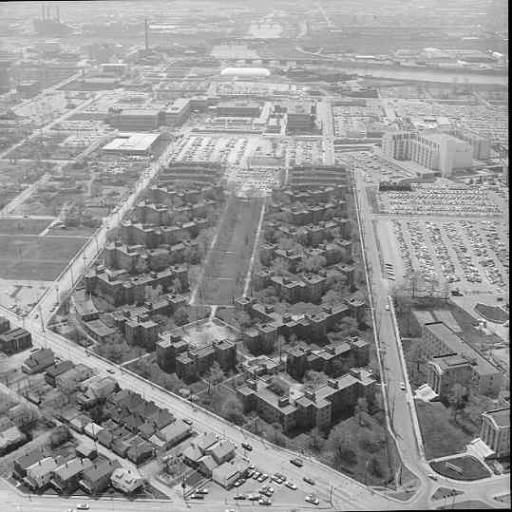
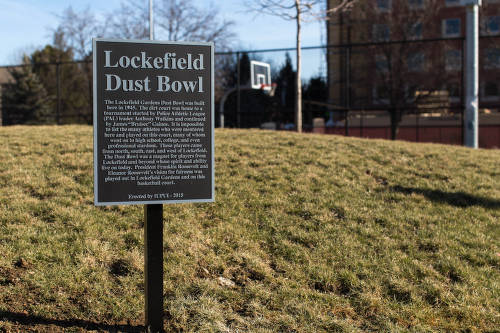
1980 image of Lockefield Gardens looking south. The Dust Bowl would have been near the top and center of this image at the south end of Lockefield Image Courtesy IUPUI University Archives.
In the 1950s, the city had THE toughest basketball proving ground in the country, known as “The Dust Bowl.” Located near Indiana Avenue in Lockefield Gardens (the first public housing project in the city built by the WPA in the 1930s), it was a makeshift basketball court carved out of a flat, grassless vacant lot. It earned it’s colorful nickname due to the huge dust clouds that would kick up every afternoon at 3 p.m. The brown cloud would envelop the area in a thick choking blanket of fine windswept dirt. The failed social experiment known as Lockefield Gardens consisted of a 748-unit housing project bounded on the north by Indiana Avenue, on the south by North Street, on the east by Blake Street, and on the west by Locke Street. During the dark days of segregation, it was home to many poor black and minority families. Today, much of the area is part of the IUPUI campus.
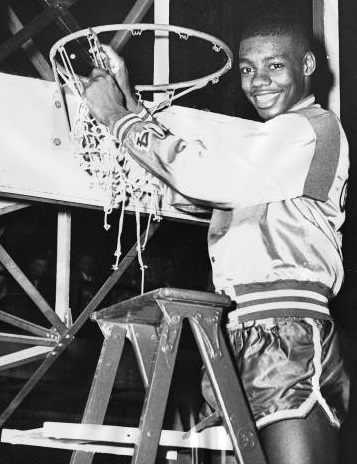
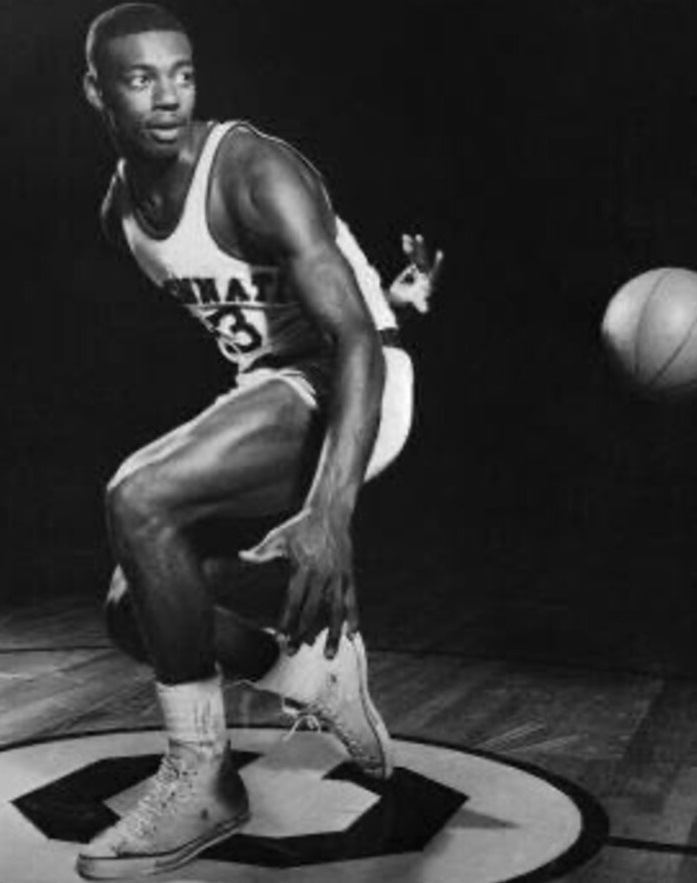
The Big O.
When no regulation basketball could be had, kids flocked to the court with tightly wound socks in place of a real basketball. Because Robertson’s family could not afford a basketball, he developed his shot by tossing tennis balls and rubber band bound rags into a peach basket behind his family’s home. This temporarily packed earth court would spawn the prototype player for a new breed of urban hoopsters. Until this era, basketball in Indiana was mostly the domain of rural, white farm boys shooting from grass surfaced courts at metal hoops nailed to the sides of barns. The Dust Bowl changed all that and a more innovative, fast paced aggressive game was born. It was here that future high school all-star, College All-American and NBA MVP Oscar Robertson learned to play the game. The Big O would change the sport, and race relations in his home city, forever.
Atucks Champs.
Although undoubtedly a painful memory for Hoosiers of that era, Robertson and his Crispus Attucks teammates broke down the “air of superiority” that most white hoops fans felt towards their all-black school opposition. There was a feeling that Attucks could never compete with traditional white dominated powerhouse teams from Muncie, Evansville and Ft. Wayne. Keep in mind, the tiny Milan team led by Bobby Plump had won the state championship the year before in 1954, ending the small schools versus big schools argument. (Robertson played on the Attucks team that Milan beat in the state semi-finals that year.) Now Attucks came along to break the color barrier.
But it all started at the Dust Bowl. The rules were simple; winners stayed, losers walked. Robertson’s relationship with the Dust Bowl started early. Born on November 24, 1938, in Charlotte, Tennessee, he moved with his family to Indianapolis when he was four and took up basketball at the age of 6. He was too young and too small to do anything but watch the older, bigger kids take to the court to battle each other from the late afternoon into darkness of night. So he played during the only time allowed him, every day after school from 3 to 5:30 p.m. when the big kids started to make their way over. The court was vacant because of the dust clouds and the heat of the late afternoon sun. If he was lucky, he could retake the court in the darkness hours after most of the players had gone home. The Big O’s routine continued for several summers, watching, working and waiting for his chance to play.
The older players that dominated the Lockefield Gardens courts were well known by area residents. They developed natural cliques and often teamed up together. These cliques were very hard to penetrate. It was considered a high honor to be asked to substitute into these scrimmages, if only for a few plays. While still in junior high, Robertson learned to make the most of these rare opportunities and by the summer before his freshman year, he was fast becoming a Dust Bowl fixture during the evening’s main games.
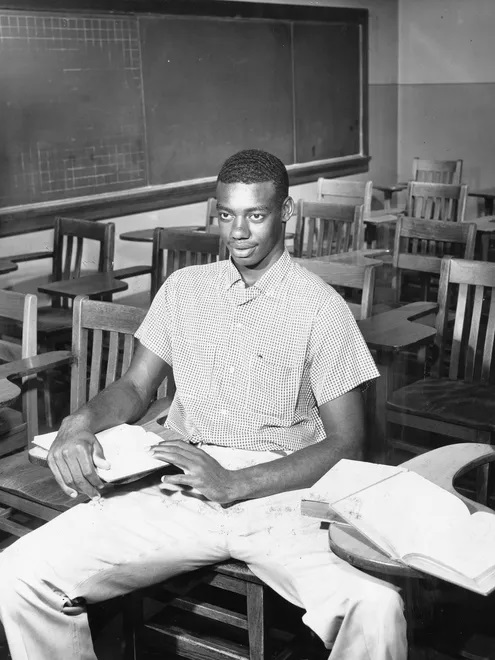
Robertson at Crispus Attucks High School, Aug. 13, 1958. George Tilford/IndyStar File Photo.
The 6-foot-5, 220-pound Robertson led his teams to two high school state championships, two final fours at the University of Cincinnati, a Gold Medal at the 1960 Olympics, and one NBA Championship in the 1970-71 season. His pro career included a league MVP award, 12 All-Star appearances, and 11 appearances on the elite All-NBA Team in just 14 professional seasons. He remains the only player in NBA history to average a triple-double for an entire season. But in our city, he is remembered most for the feats he accomplished at the Dust Bowl.
Winners of the Douglass Park Dustbowl Tourney, 1966. Credit: Indianapolis Recorder Collection, Indiana Historical Society
For the quarter century following the Big O’s departure from Indianapolis, although the Lockefield Gardens complex was demolished in 1976, the Dust Bowl remained a Hoosier city hoops hotspot until IUPUI took over the property in 1983. The legend of Oscar Robertson grew and his shadow cast influence over every game played thereafter. Robertson’s time spent at the Dust Bowl was the most productive of his accomplished life. It was there that he learned to play the game that would change the Hoosier landscape forever.
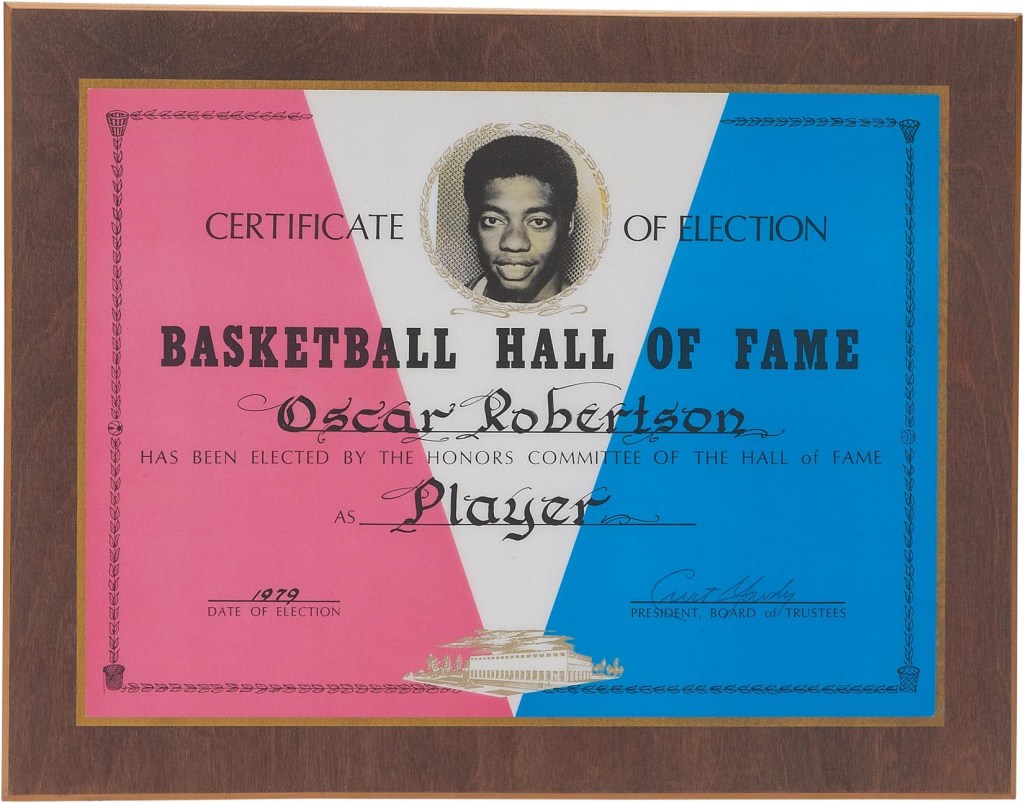
For his outstanding achievements, Robertson was inducted into the Naismith Memorial Basketball Hall of Fame in 1980 and was voted one of the 50 Greatest Players in NBA History in 1996. The United States Basketball Writers Association renamed their college Player of the Year Award the Oscar Robertson Trophy in his honor in 1998, and he was one of five people chosen to represent the inaugural National Collegiate Basketball Hall of Fame class in 2006. After the 1983 demolitions, only the units along Blake Street and Locke Street (now University Boulevard), remained. The remaining structures were placed on the National Register of Historic Places. Today, there are Dust Bowl residents who can recall how Oscar’s mom used to yank him off the darkened court near midnight. Neighbors remember the echoes of the solitary bounce of a basketball like a clock in the nighttime, keeping them from sleeping. Invariably, upon investigation, young Oscar would be found out on the court alone, practicing; always practicing. A rumor persists to this day that if it got too late, residents of the Dust Bowl would shoot BB guns at the backboard; a signal that it was time for Oscar to go home.
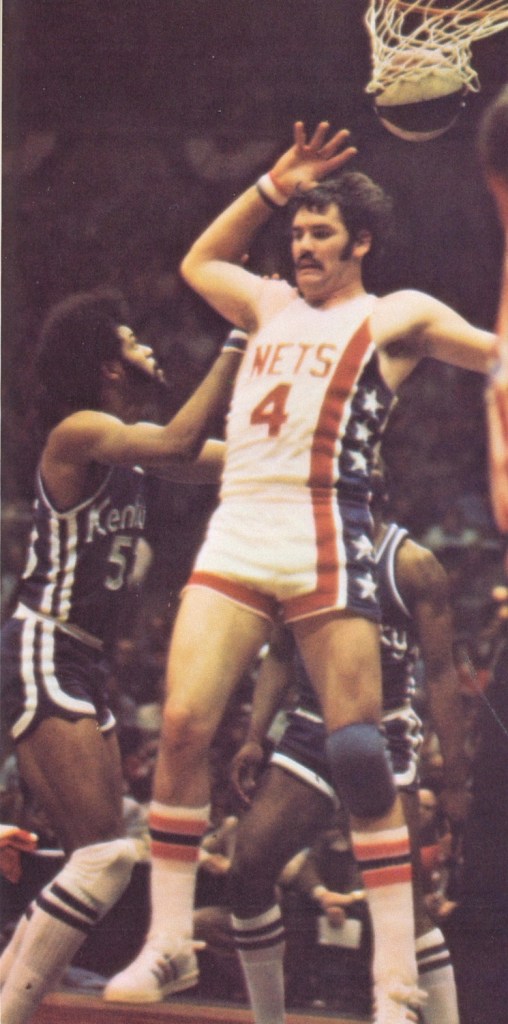
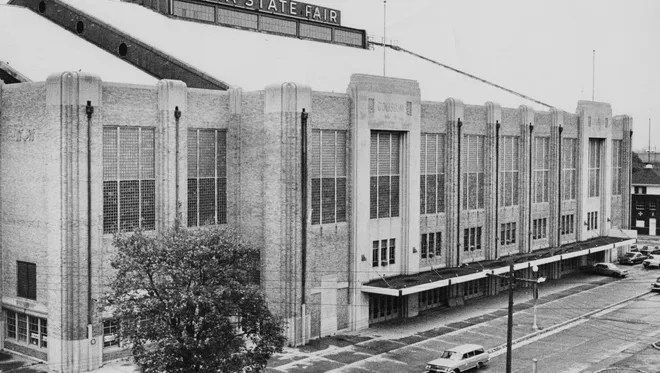
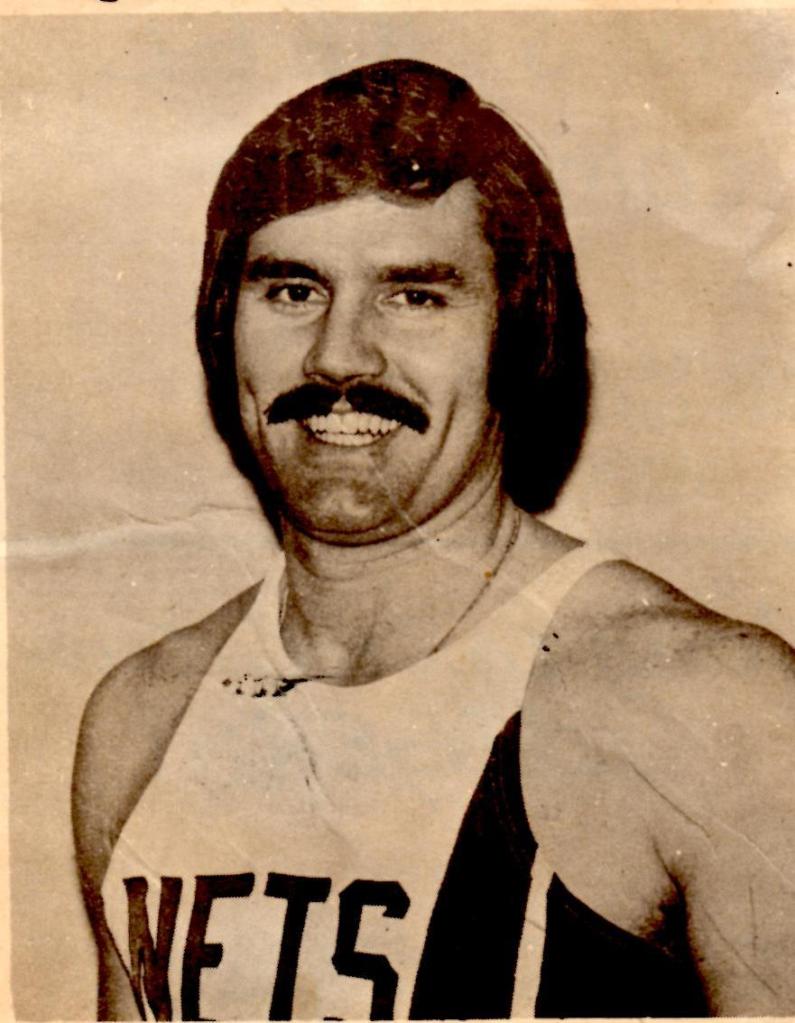
I grew up a gym rat. I’ve mentioned before how my parents used to take me down to the Fairgrounds, drop me off at the player entrance at the State Fairgrounds Coliseum, and leave me there for an hour or so while they traveled over to the TeePee Restaurant for pie and coffee. That’s when this reporter, then a 10-year-old with a Hollywood burr, first encountered a muscular, burly 6-foot-5, 220-pound guy who was a dead ringer for Burt Reynolds. His name was Wendell Ladner, and even though for much of his career he wasn’t even a starter, he always hustled, threw himself after any loose ball, and elbowed his way to every rebound. He was an important cog for a New York Nets team that won an ABA championship and a Kentucky Colonels team that thumped up on my beloved Indiana Pacers often enough that I held a grudge. But he was always nice enough to stop, smile, and talk for a minute to a shy buck-toothed kid when I asked him for an autograph.
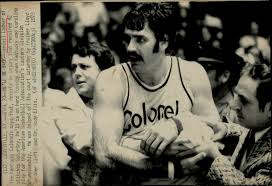
Wendell Ladner.
Things changed for Wendell Ladner midway between the 1972-73 season when he joined Southport High School’s “Little” Louie Dampier, “The Horse” Dan Issel, and the “A-Train” Artis Gilmore as a member of Pacer’s arch-rival Kentucky Colonels. His numbers weren’t his best with the Colonels, falling to 7.3 ppg and 4.9 rpg the first season and 9.9 ppg and 7.9 rpg that second season. Despite those numbers, he quickly became one of the most popular players on the Colonels roster — “expecially” with the ladies. However, if you were ever privileged enough to see a Pacers vs. Colonels game in person back then, you know that Colonels fans are tough. So Wendell had to win the male fans over first.
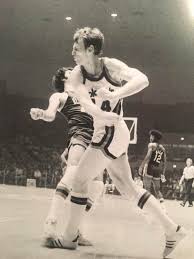
Today, they would call Wendell Ladner a “defensive specialist” for the Colonels. But what that really meant was Ladner was an enforcer whose job it was to hack the hell out of anyone who dared foul Dan Issel or Artis Gilmore. He was involved in more than one Pacers fistfight during his tenure with the Colonels. While fight stats in the ABA were never kept, I would be willing to bet that Ladner got in a “spirited scuffle” with players on every team in the league. Rumor has it that the Dallas Cowboys once invited Ladner to try out for the team. Colonels minority owner Bill Boone called him “the toughest SOB I’ve ever seen . . . a rebounding fool and hatchet man.”
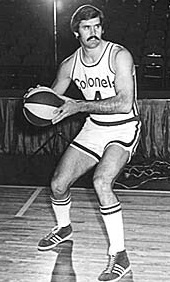
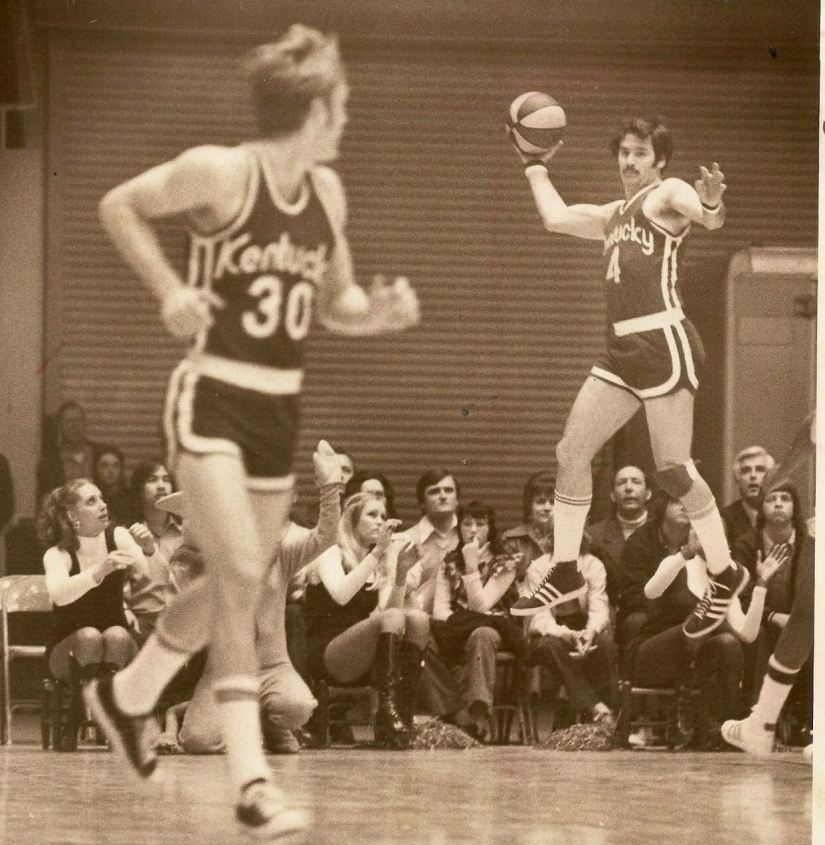
Wendell Ladner Kentucky Colonels.
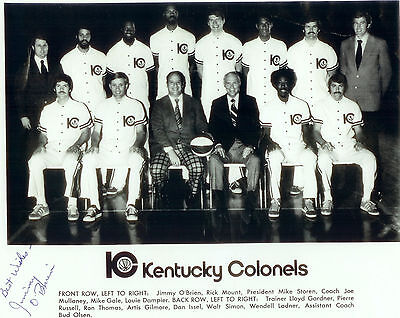
During the 30th ABA reunion in 1997, Bob Netolicky and I traveled down to do a radio show in Louisville with longtime Colonels trainer Lloyd “Pink” Gardner. After the show, we retreated to the radio station breakroom for some after-hour storytelling. Pink was the team trainer for all nine seasons of the ABA (1967-1975) so he knew everyone. He remembered Wendell’s habit of fussing over his hair constantly. Pinky said, “Wendell had a habit of never adding the ‘ed’ suffix to his words when he talked. He’d say things like ‘I don’t want to get my hair all mess up.’ or ‘I’m going out tonight so I gotta get all dress up.’ One night Ladner had a terrible game, lost us the game actually. Dan Issel came into the locker room and saw Wendell primping in the mirror with his hairbrush getting ready to scoot out for a hot date. Dan yelled, ‘Watch out everybody, Wendell’s game was all foul up so don’t say nothin’ to him or you’ll get him all peeve off.’ (Only Issel didn’t say foul or peeve if you know what I mean.) Next thing you know Issel and Ladner were throwing punches while the whole locker room was rolling on the floor laughing.”
1972-73 Kentucky Colonels. Lloyd Gardner back row far left. Wendell Ladner back row 2nd from right.
In his book Kentucky Colonels: Shots from the Sidelines, Pink explained: “Wendell always played with reckless abandon, always diving after loose balls, jumping over press tables, always hoping that he would come down in the lap of some beautiful lady.” Pink recalled one game “with 3:09 left in the game and the Colonels with a sizable lead, Wendell went airborne over the Cougars bench, crashing into a five-gallon glass water cooler.” The bottle smashed to the floor and Wendell landed on the shards of broken glass. He jumped up quickly and tried to get back to the floor, but the trainer stopped him because he was bleeding profusely from gashes in his arm. Pink continued, “He wanted to go back out and play. Dr. Rudy Ellis said no. We took him to the hospital and stitched him up, 37 stitches in all.
It was April 21st, 1973, game 6 of the ABA Eastern Division finals against the Carolina Cougars at Freedom Hall and the Cougars were up in the series 3 games to 2. Play was stopped while Wendell was led to the locker room dripping in blood while the crowd watched in stunned silence. Thirty minutes later, here comes Ladner sprinting back to the bench, a bandage encasing his left forearm. The Colonels were losing and Ladner begged to re-enter the game, but sanity prevailed and Mr. Excitement was placed at the end of the bench for his own protection.” Pink noted, “but Wendell never missed a practice or game.” Kentucky would win that game and then another to take the series. But they lost the ABA Championship to the Indiana Pacers 4 games to 3. The Pacers became the first team to win a third ABA championship while the Colonels became the first team to lose two separate ABA championship series. Complete disclosure: The Pacers would eventually lose two, too.
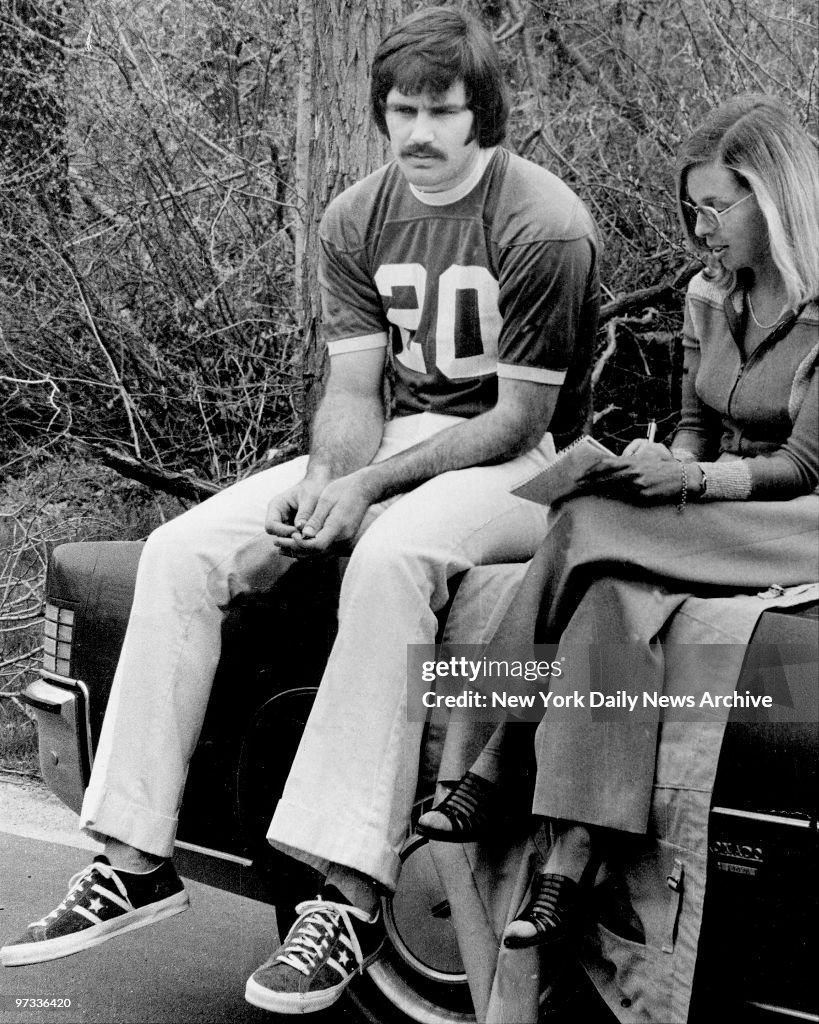
Wendell Ladner talks to reporter Kay Gilman. Getty images.
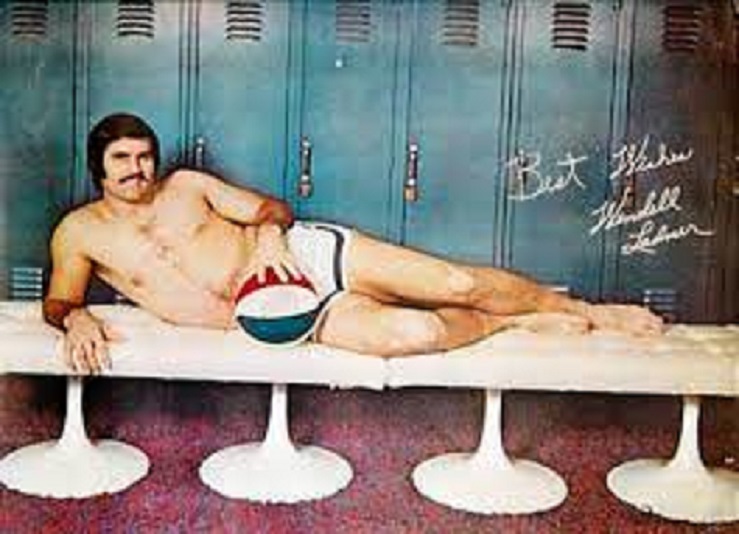
Also in 1973, Wendell pulled off the stunt he is most remembered for to this day. Ladner did his best imitation of Burt Reynolds infamous Cosmopolitan magazine nude pose in a shirtless beefcake poster that sold out in hours. Wendell is posed stretched out on the Colonels’ locker room bench at Freedom Hall in Louisville wearing only his “tighty-whitey” home uniform trunks (players didn’t wear the baggy trunks they wear today) with a Red, White, & Blue ABA basketball strategically positioned to hide his naughty bits. Ladner flashed a million-dollar smile for the female Colonel faithful. Oh, and the poster has a “Best Wishes” facsimile autograph in the upper right corner. After that poster came out, Ladner really played up to that image. During timeouts, women jockeyed for position behind the Colonels bench to giggle and shout sweet nothings to their favorite as he brushed the hair away from his eyes and smiled back at them.
Dan Issel and Ladner go at it.
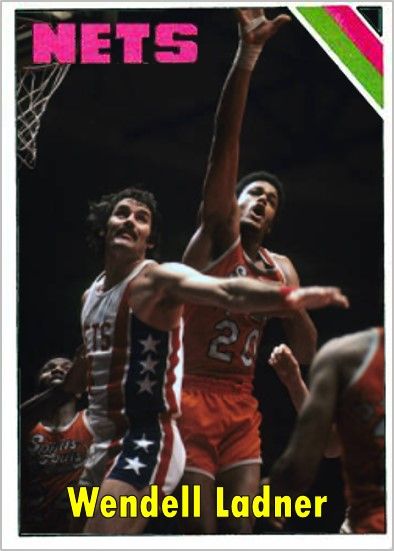
The next season (January of 1974), Ladner was traded to the New York Nets, a trade KFC magnate and Colonels owner John Y. Brown, Jr. later said he regretted. The Colonels traded Ladner and Mike Gale to the Nets for John Roche, pronounced “Ouch” by Colonels fans. At the time of the trade New York trailed Kentucky in the Eastern Division standings, but after adding Ladner, the Nets surged past the Colonels to win the Eastern Division championship and the 1974 ABA championship beating his old team. During that series, Ladner and his old teammate Dan Issel exchanged punches in one game: Issel wound up with three stitches under one eye.
Former ABA Virginia Squires and Cincinnati Reds broadcaster Marty Brennaman called it “the worst trade ever in professional basketball.” Maybe not the worst pro basketball trade ever, but it sure was a bad one. The next year, Little Louie Dampier busted his hand wide open during a game and asked Colonels team doctor Rudy Ellis to stitch up his hand “in a hurry so I can get back into the game” to which the Doctor replied, “I thought Wendell Ladner was the only person that crazy.” In New York, Ladner’s job with the Nets was to protect Julius Erving. Dr. J called Wendell his wackiest teammate ever because “he wanted to be Burt Reynolds with a basketball”.
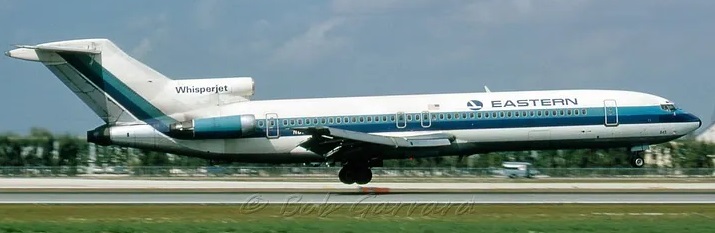
Eastern Air Lines Flight 66.
After winning his one and only ABA Championship, on June 24, 1975, Ladner boarded Eastern Air Lines Flight 66 from New Orleans to New York City. The plane, a Boeing 727 trijet tail number N8845E, departed from Moisant Field (Louis Armstrong International Airport today) without any reported difficulty at 1:19 PM EDT with 124 people on board, including 116 passengers and a crew of 8. A severe thunderstorm hit JFK airport just as Flight 66 was approaching the New York City area. At 3:52, the approach controller warned all incoming aircraft that the airport was experiencing “very light rain showers and haze” with zero visibility and that all approaching aircraft would need to perform instrumental landings. At 3:53, Flight 66 was approaching Runway 22L. 6 minutes later, the controller warned all aircraft of “a severe wind shift” on the final approach, the aircraft encountered a microburst or wind shear environment caused by the severe storms.
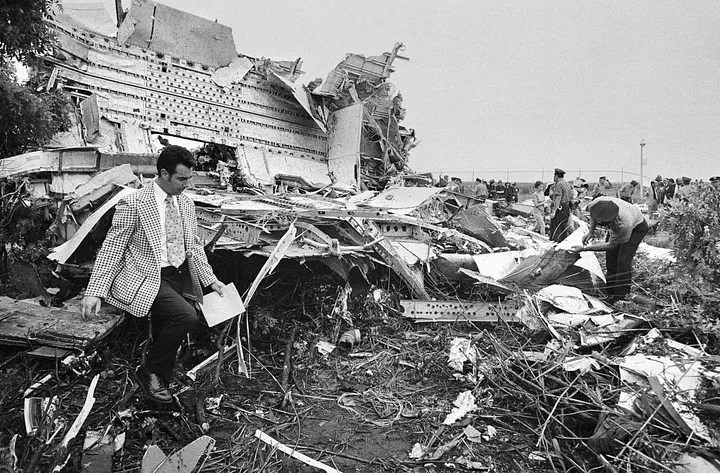
The wreckage of Eastern Airlines flight 66 after it crashed on approach to JFK Airport. (AP)
The plane continued its descent until it began striking the approach lights approximately 2,400 feet from the start of the runway. Upon the first impact, the plane banked to the left. It continued striking the approach lights until it burst into flames and scattered the wreckage along Rockaway Boulevard, which runs along the northeast perimeter of JFK airport. Of the 124 people on board, 107 passengers and six crew members (including all four flight crew members) were killed. The other 11 people on board, including nine passengers and two flight attendants, were injured but survived. Wendell Ladner was not among them.
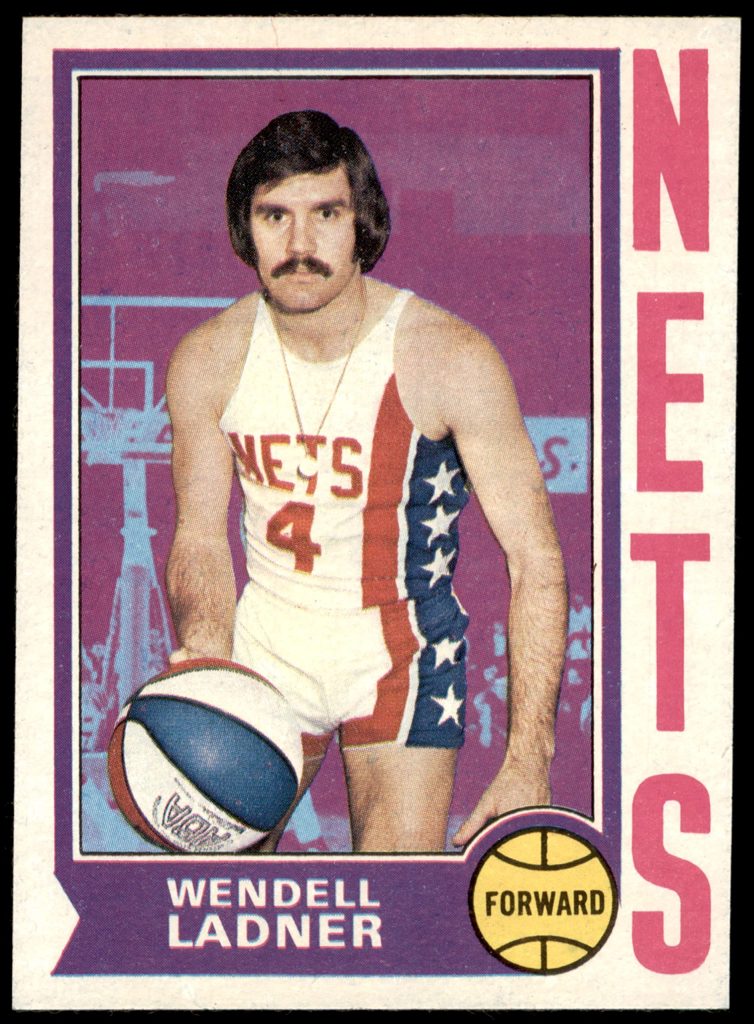
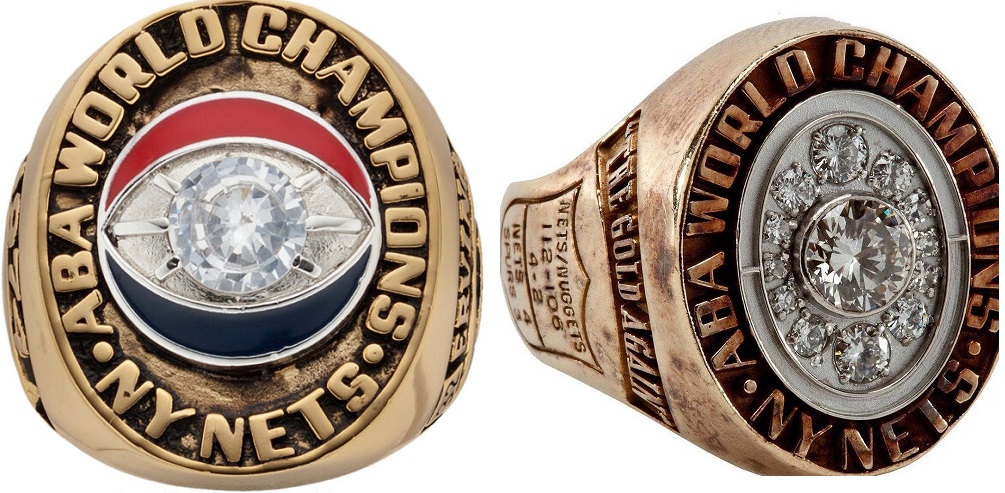
Ladner died at the age of 26. His body was identified by medical examiners only because he was wearing his charred Nets ABA championship ring. At the time, the crash was the deadliest in United States history. For many years, the Nets included his name and uniform number in their list of retired numbers, though Ladner’s No. 4 did not hang in the rafters with the other retired numbers. Out of respect to Ladner, Fritz Massmann, Nets trainer from 1970 to 1992, never issued No. 4 to any other player for 17 years after Ladner’s death. When Fritz retired, the New Jersey Nets issued Wendell’s number 4 to Rick Mahorn which he wore for the next 4 years.
Wendell Ladner finished his 300-game ABA career with 3,474 points and 2,481 rebounds. He also played in 40 ABA playoff games and a pair of ABA all-star games. Ladner also has a road in Perkinston, Mississippi, named after him in his honor. The crash of Flight 66 led to the development of the first low-level wind shear alert system by the U.S. Federal Aviation Administration in 1976. The accident also led to the discovery of downbursts, a weather phenomenon that creates vertical wind shear and poses dangers to landing aircraft, which ultimately sparked decades of research into downburst and microburst phenomena and their effects on aircraft. ABA fans might find it ironic that the term for the natural phenomenon that took Wendell Ladner’s life became known as a microburst. If Mother Nature had nicknamed this masculine mauler from the Magnolia State herself, she quite likely would have reserved the name microburst for him. Because, make no mistake about it, Wendell Ladner was a true force of nature.
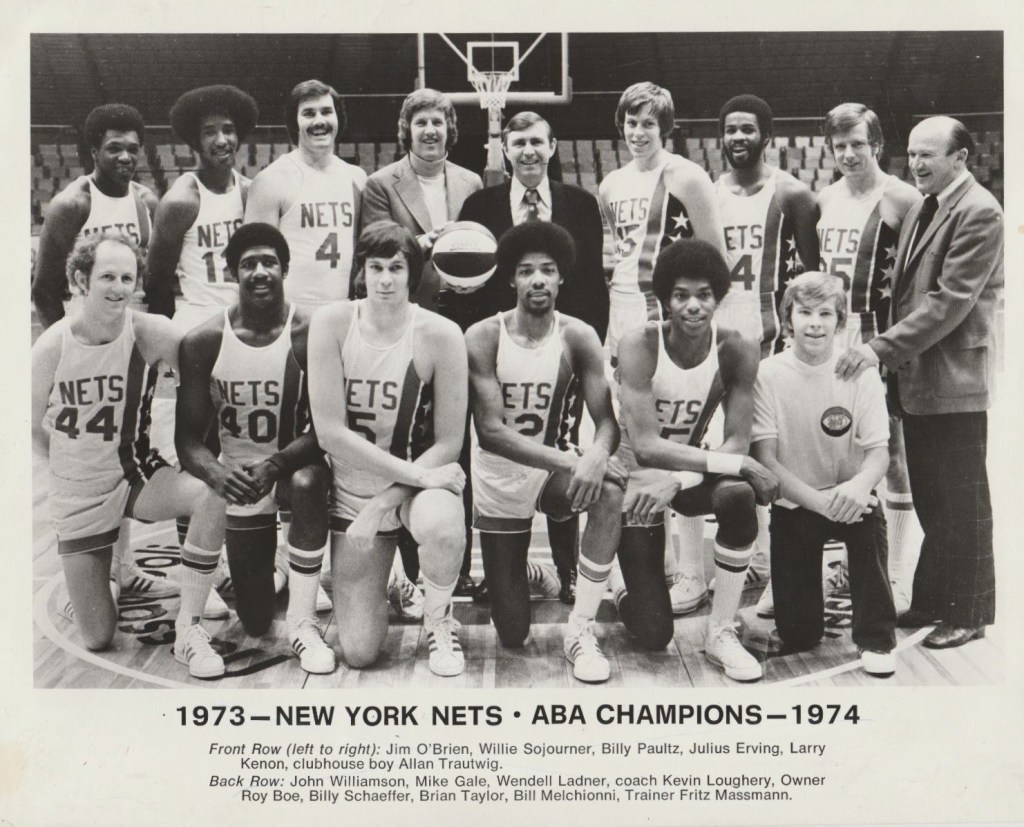
1973-74 ABA Champion New York Nets. Wendell Ladner # 4 standing baw row 3rd from left.
Rhonda and I headed down to the Indiana State Fairgrounds for the Greater Indianapolis Garage Sale this weekend. We hadn’t been to that show in a couple of years, mostly due to Covid-19 concerns. We enjoy that show simply because it is one of the true flea market-style gatherings left in the Circle City. We always find something. It might be a tchotchke for the kids or a treasure for the wife, you never can tell. Me, I like diving into boxes of old paper. You never know what you’re going to find.
This time, as I thumbed through a box of old paper goods and tickled my way past maps, old greeting cards, receipts, family photos, and travel brochures, I found a hidden treasure. A treasure to my eyes anyway. Folded up into quarters wedged between a couple of totally dissimilar items was a photo of the 1973-74 ABA New York Nets. I was (and always will be) an Indiana Pacers kid. But I always had a healthy respect for three rival teams: The Kentucky Colonels, Utah Stars, and the New York Nets. It always seemed that when the Pacers weren’t winning championships, it was because of one of those damned teams stole one from us. It was a thrill to find the photo just a few hundred yards away from the building where they actually played.
State Fairgrounds Coliseum. Home of the ABA Pacers.
So here they were, dressed in those classic home white uniforms with the stars and stripes ribbon bursting out of their heart and flowing down the side. Julius “Dr. J” Erving was front and center (right where he should be) flanked by Billy “Whopper” Paultz, “Super John” Williamson (who spent some time as a Pacer), Mike “Sugar” Gale, Willie “Rainbow” Sojourner (who gave his teammate the nickname “Dr. J”), Larry “Mr. K” Kenon, Bill “Cyclops” Melchioni, Brian Taylor (who didn’t have a nickname but was so good he deserved one) and a teenaged clubhouse boy named Allan Trautwig. Yes — the same Al Trautwig from MSG Network, ABC, NBC, NBC Sports Network, and USA Network and the pre-game/post-game shows/sometime play-by-play man for the New York Knicks and Rangers during his Emmy Award-winning career.
Wendell Ladner.
But the man in that photo that drew my interest was standing in the back row, third from the left. It was “Mr. Excitement” Wendell Ladner. If you are a fan of the ABA, you remember Wendell Ladner. Ladner was born on October 6, 1948, in Necaise Crossing, a tiny, unincorporated town in Hancock County, Mississippi, the far southwest corner of the state. Ladner’s birth seems to be the only noteworthy thing that ever happened there. Ladner played prep ball for the Hancock North Central High School Hawks in Kiln, Mississippi. The school opened in 1959 and for a quarter century, Wendell was the school’s star athlete until Green Bay Packers quarterback Brett Favre came along in 1985.
Jim O’Brien.
Legendary ABA beat writer (and friend) Jim O’Brien was one of the first to recognize Ladner’s talent. Writing about him in 1972 in the book ABA All-Stars, O’Brien said, “Ladner likes to talk about his town, which he says had about 600 people living in it. The nearest big town was Gulfport, about 32 miles away. ‘None of my friends had driver’s licenses, so without transportation, we couldn’t go to town very often. I’d never been around a town a lot. Necaise Crossing, to me, was a lot of fun. I grew up there and might’ve played basketball from the time I was 9 ‘til I was 17 and went away to college. We’d shoot basketball all day and into the night. We didn’t have any lights, so we’d go out into the woods with axes and cut us some logs. It was no big thing. We’d cut up oak trees that had fallen. We’d chop them up good, and use the splinters to start the fire. We’d have one big fire and it’d light the area so we could play. The only other thing you did was milk cows and ride horses. We raised hogs, too. My family had a dairy barn. We had no heat in the house, except for the big fireplace, and no bathroom. We’d get a wagonload of wood and pile it by our house. We were over at our grandmother’s house killing hogs one day when our house burned down. Some ashes hadn’t gone out, my sister said, and they started a fire again and it caught on some drapes and the whole place went up in smoke.’”
A young Wendell Ladner.
Of his college years, Ladner told the sportswriter, “‘I never watched my weight in college. I just ate all the time. I never trained like I should have. This is a lot different from college. It’s a lot rougher. In college, I had to go against guys my size, but now most of the people I play against are a lot bigger.’ O’Brien added, “That’s how he got started. Now Ladner would like to improve his play and help the Pros to build a winner in Memphis. ‘I think I’ll be a lot better,’ he said at the start of his second season in the ABA. ‘I’m still making too many fouls and lots of mistakes, but I know when to take a shot now. You know, I really was surprised I had a rookie season like I did. I just wanted to make the team. I didn’t think I’d make it. But in the first exhibition game, I scored 17 points and grabbed 15 rebounds, and it surprised me that I could do something like that. The biggest surprise, of course,’ he continued, ‘was making the All-Star team. It was an honor to make it…the only rookie on the West team. That was a big thrill.’ Brute strength and a desire to excel are among his most recognizable traits. He has good basketball instincts and is unusually quick for a man his size. ‘I like the way he rebounds and gets the ball out in a hurry,’ said (coach) Babe McCarthy. ‘He could be a big asset in a fast-break attack.’ ‘I’m not going to live on my first-year reputation,’ Ladner told us. ‘I have to prove it this year again and get back into that All-Star game.’”
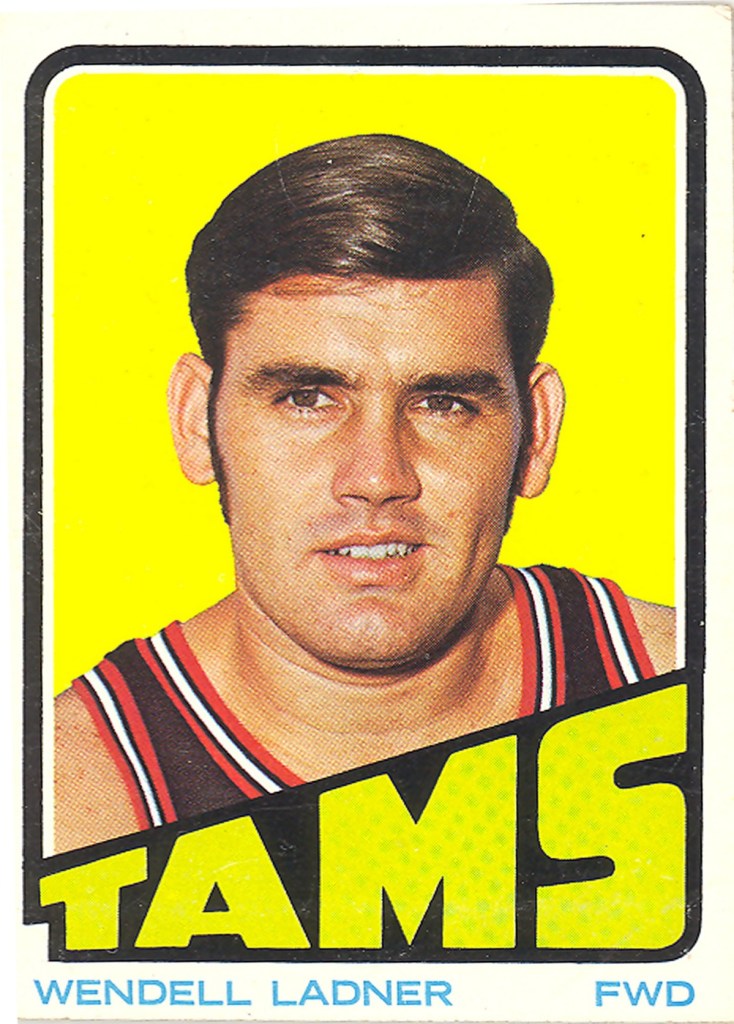
Ladner was a star at the University of Southern Mississippi from 1966 to 1970 averaging 20.5 ppg and 16.5 rpg for his career. His 1,256 career rebound mark is still the second-highest in USM history and the highest among 3-season players. His SMU career stats: 650 out of 1,410 Field Goals, and 261 out of 390 Free Throws for a total of 1,561 points place him 11th all-time in scoring at Southern Miss and his career scoring average of 20.5 is still the best in school history. He owns 14 of the top 16 rebounding performances in Southern Miss history including a school record 32 rebounds against Texas-Pan American, 31 against Old Dominion, and 30 against Louisville during the 1969-70 season. Ladner was drafted in the second round of the American Basketball Association draft by the Memphis Tams and was signed prior to the NBA draft, where he was projected to be one of the top 20 prospects.
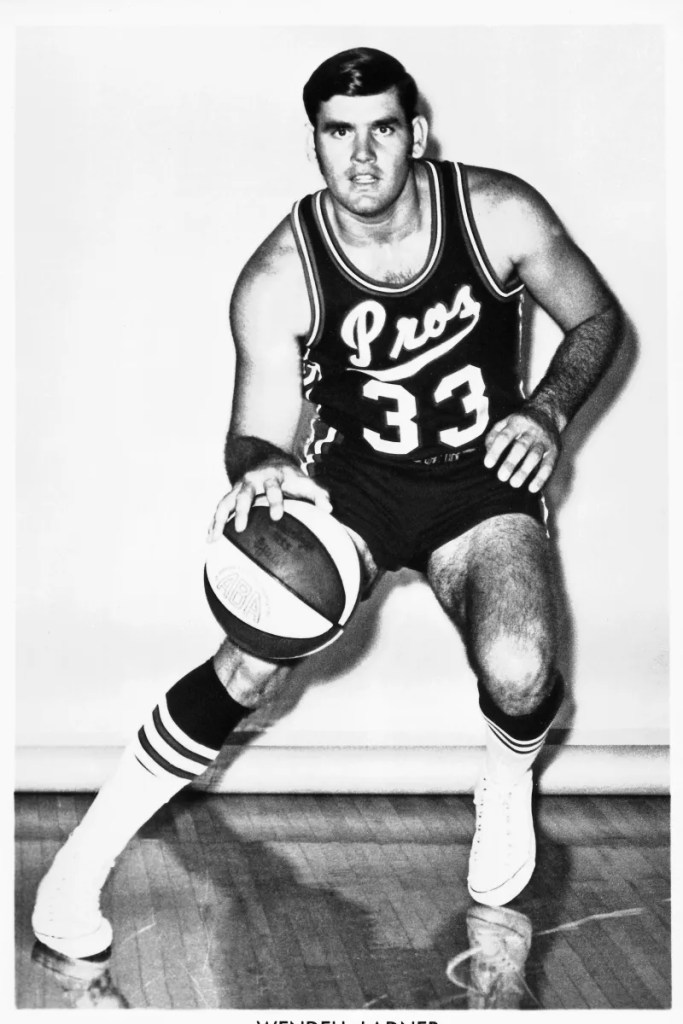
Wendell Ladner Memphis Pros.
From 1970 to 1973, Wendell played for the Memphis Pros, Carolina Cougars, and Memphis Tams, all utterly forgettable teams. Ladner was named to the 1971 ABA All-Rookie team, and selected to the ABA all-star game his rookie season alongside Dan Issel and Charlie Scott, the ABA’s Co-Rookies of the Year. That year, on January 24, he set his career-high points total of 34 in a Memphis win over The Floridians. During those years, the 6 ft. 5 inch, 220-pound power forward developed into one of the league’s toughest enforcers while averaging 16 points and 10 rebounds per game. Unsurprisingly, he also averaged over 4 fouls per game during that time, leading the league in 2 out of his first 3 seasons, in both of those foul-leading seasons, he made the all-star team. He was the enforcer for five ABA teams during his career, which lasted from 1970 to 1975. His job was to protect his star teammates like Dr. J and Dan Issel by roughing up anyone he viewed as playing too rough.
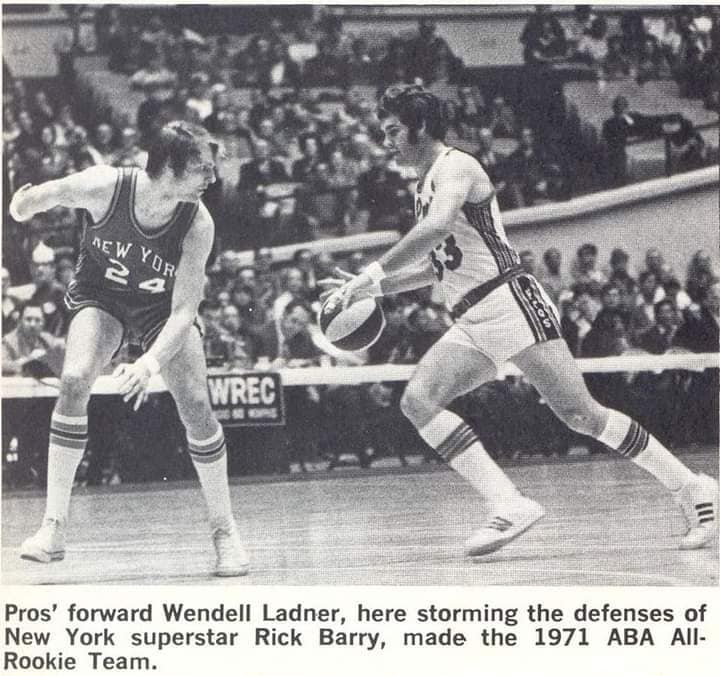
Early in the 1971-72 season, playing against the Nets in New York, Ladner was ejected from the game during an overtime period for what an official termed “a malicious foul” on superstar Rick Barry. Ladner said it was necessary for him to play Barry aggressively, but insisted he didn’t mean to hurt him. “I sure wouldn’t want to break his leg and put him up in bed with his family,” said the good old boy from Mississippi. He said it wasn’t a dirty play, and even stopped by the Nets dressing room to explain it to Barry. “I know one thing,” said Barry. “If you were trying to hurt me, you would have done a better job of it.”
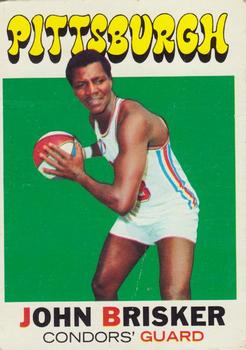
One of the great stories about Ladner involves a former ABA player named John Brisker whom I profiled years ago in a Weekly View story that actually led to my appearance in a Beyond the Paint documentary on ESPN (I appeared sandwiched in between Rick Barry and Julius Erving no less!). Ladner regularly squared off against Brisker, widely considered to be the meanest, roughest, toughest player in the history of the ABA. Legend claims that Ladner once marched into the Pittsburgh Condors’ locker room before the game started yelling, “Hey, John, you wanna fight right now or wait for the game?” Brisker and Ladner often beat each other bloody on the court, only to hang out together at a local bar afterward. Those were the kind of stories that made Wendell Ladner a legend and Wendell Ladner was the kind of player that made the ABA legendary.
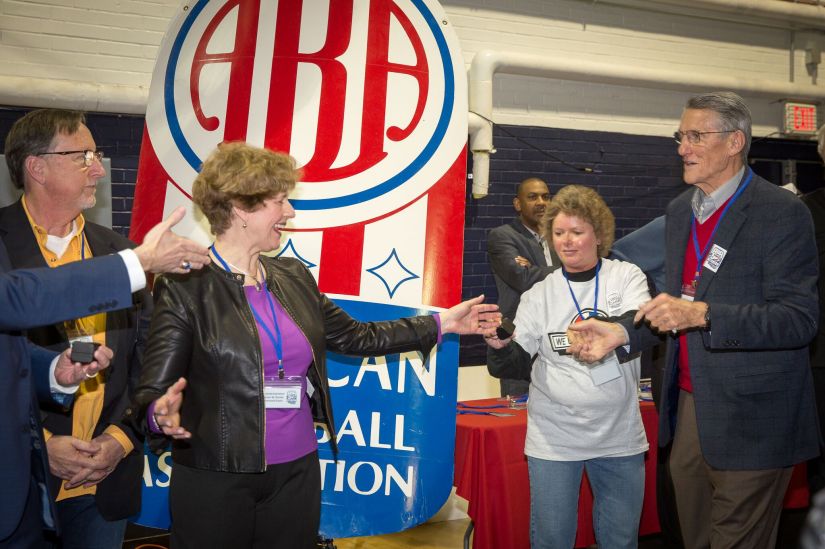
Mayor Joe Hogsett, Dick Wolfsie, City Councilman Michael McQuillen, Senator Joe Donnelly, City Councilman Vop Osili, Dr. John Abrams, Scott Tarter, Rupert Boneham, Ted Green and Congresswoman Susan Brooks. Photo by Ron Sanders.
Original publish date: May 17, 2018
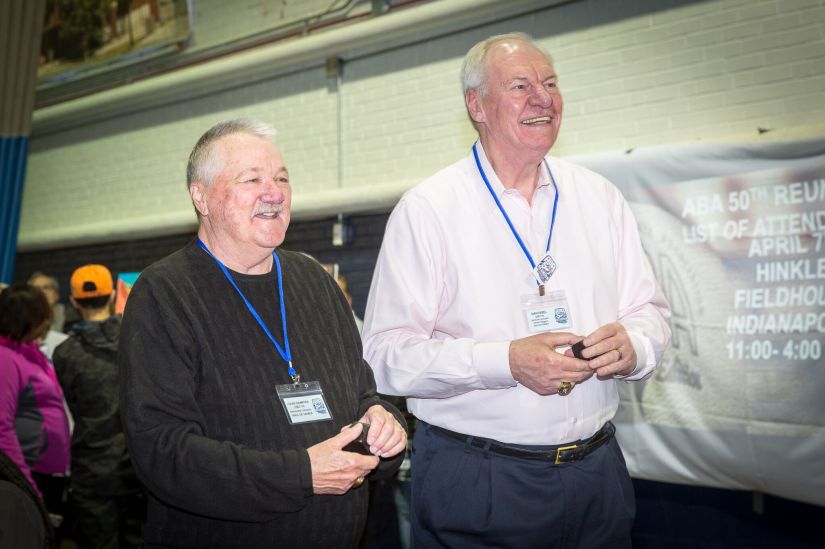
On Saturday April 7, 2018, Indianapolis was the setting for the 50th anniversary reunion of the American Basketball Association hosted by the Dropping Dimes Foundation. A special Saturday event was held at historic Hinkle Fieldhouse on the campus of Butler University. The choice of venue was not by accident. Hinkle had hosted the first ABA All-Star game on January 9, 1968. The East team, led by Pacers stars Roger Brown, Mel Daniels, Bob Netolicky and Freddie Lewis, defeated the West team by a score of 126 to 120. Despite being on the losing side, somehow Larry Brown was named MVP of the game, even though he wasn’t even the leading scorer on the west squad and was outscored by 3 members of the winning east squad. I should also mention that Brown didn’t show up for the reunion either but somehow got a ring.
Hinkle Fieldhouse. Photo by Lauri Mohr of Imagine Mohr Photography
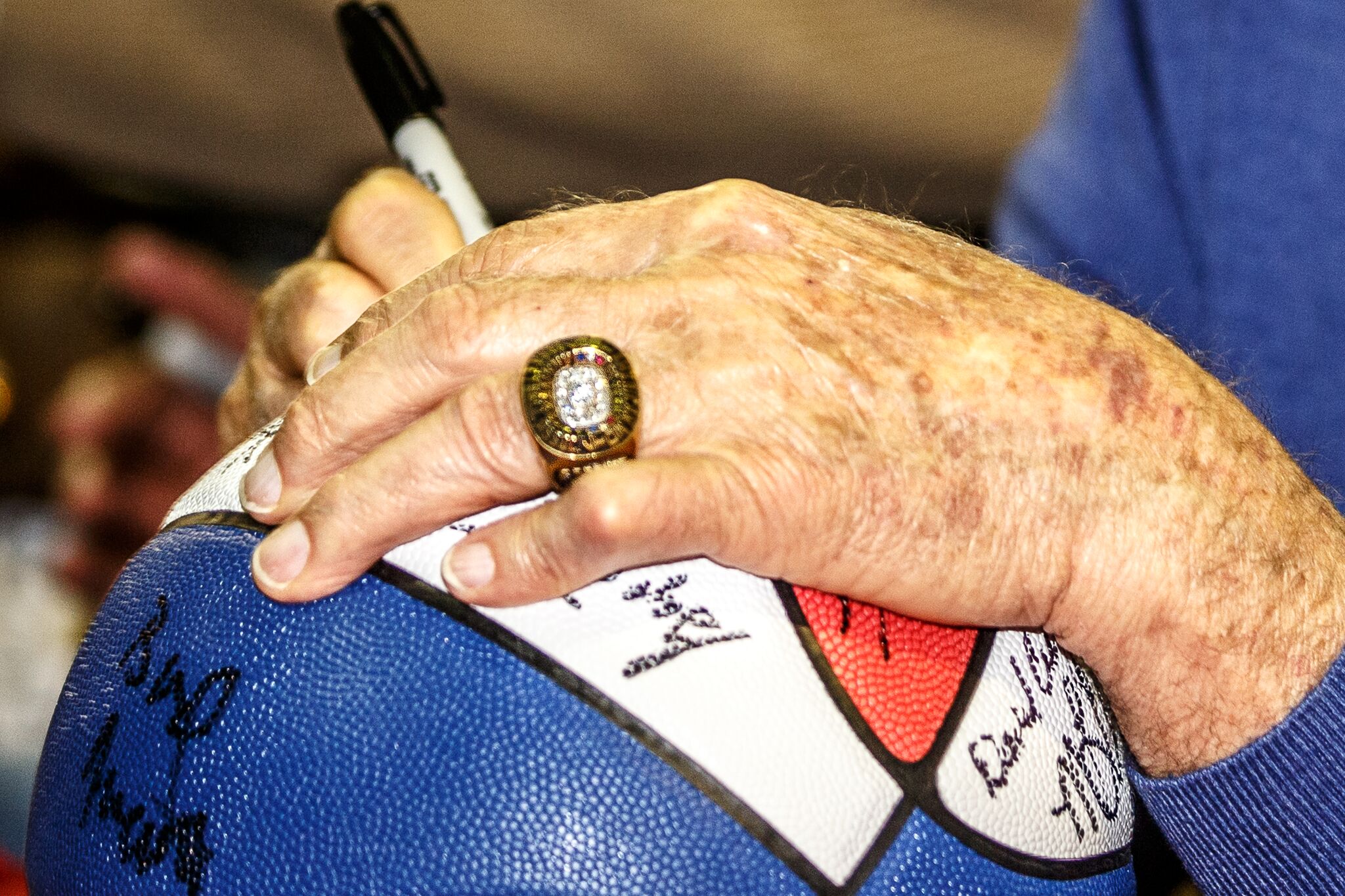
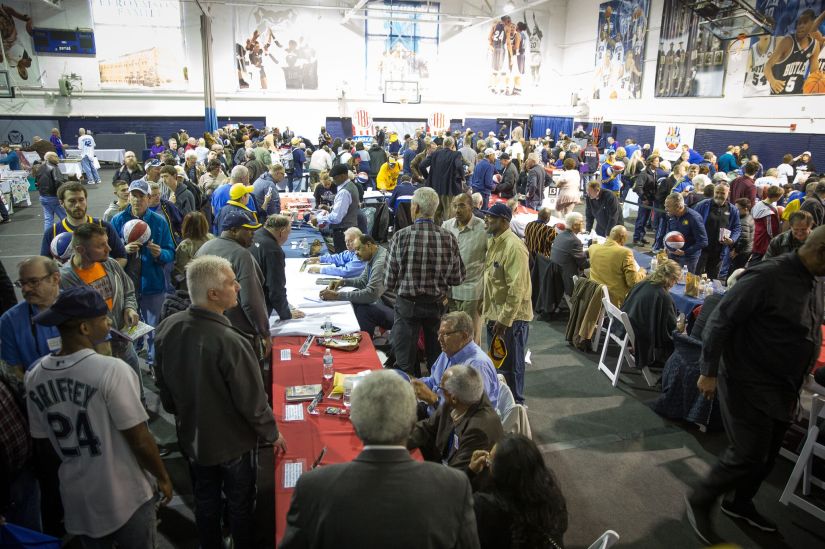
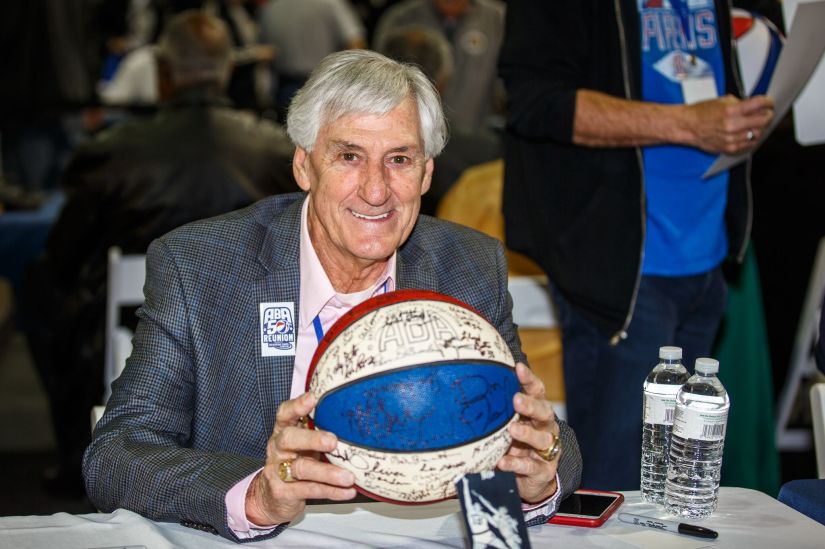
The Hinkle event included a card & memorabilia show hosted by J & J All-Star Sports cards and an autograph signing featuring over 90 former players and alumni of the ABA league. But the highlight of the day’s events was the ring presentation ceremony. As detailed in part I of this story, Bob Netolicky, Slick Leonard and I designed and created a special 50th anniversary ABA ring to be presented to league alumni in attendance that day. The road to the ceremony was not an easy one.
Original artwork for the ABA 50th Anniversary ring.
When Neto & I, who, along with ABA Pacers co-founder Richard P. Tinkham Jr., planned, created and hosted the 30 year ABA reunion two decades before, agreed to help out with the 50th reunion we were roughly six weeks out. The desire was still there, the ABA flame still burned and the passion of 20 years before was unwaning. But was there enough time to pull it off?
The ring design was finalized and approved during a late February Board meeting of the Dropping Dimes foundation. The meeting took place in the top floor conference room of the Bose, McKinney & Evans law firm in the Sales Force Tower on Monument Circle. The sample ring was passed around the room hand-to-hand by those assembled. For those few moments, we band of dreamers watched in awe as the ring floated above the clouds of the city that created the dynasty franchise of the ABA. It would be hard to imagine a more fitting setting for the big reveal.
One detail remained: we still needed a ring sponsor. Neto and Dr. Abrams did their level best to seek out a willing benefactor, including two noteworthy Circle-City car dealers who consistently run ads with local sports stars touting their community support. They both declined. But the rings were in production, players were sending in ring sizes and, sponsor or not, we were going ahead with the rings. As you might expect, the ring sizes varied and were all over the board. Bob Costas, who started his career in broadcasting with the Spirits of St. Louis, wore the smallest at 6 7/8 while Carolina Cougars / Miami Floridians / Dallas Chaparrals 7-footer Rich Niemann wore the largest ring at 18.
Kentucky Colonels legend Artis Gilmore, who at 7′ 2″ tall is the biggest man I’ve ever met, wore a size 15. Believe me, shaking the A-train’s hand is like putting your hand in a vice. It will bring you to your knees. Fellow Colonels Hall of famers Dan Issel wore a 13 1/2 and Louie Dampier a 10 1/2. The remaining ABA Hall of famers checked in at: George Gervin & Ricky Barry-13, Spencer Haywood-12 1/2, George McGinnis-12 and Bobby “Slick” Leonard a size 9 1/2. These Hall of Famer’s ring size information has no real historical value, but it sure makes for fun trivia. When all was said and done, nearly 100 player rings were ordered. But still, no sponsor.
The week before the reunion, event emcee Bob Costas called dropping Dimes co-founder Scott Tarter to confirm the final details and to ask if there was anything else he could do to help make the reunion a success. Scott asked if Costas could put him in touch with Bob’s old boss, Spirits owner Dan Silna. Tarter explained the need for a ring sponsor and within a few hours, Dan Silna agreed to sponsor the rings. Mr. Silna has been the subject of a past column, google him to learn his amazing story.
Meantime, Bob Netolicky was working on finding a ring sponsor on his own. Neto contacted his old San Antonio Spurs boss, Red McCombs. The 90-year-old McCombs, who attended the 30 year reunion but could not attend the 50th, not only owned the ABA Spurs, but also the NBA Denver Nuggets and NFL Minnesota Vikings. Neto secured a ring co-sponsorship from Red as well. So, after weeks with no sponsor, we now found ourselves with two. The rings were completed and delivered on Friday April 6th, mere hours before the players arrival.
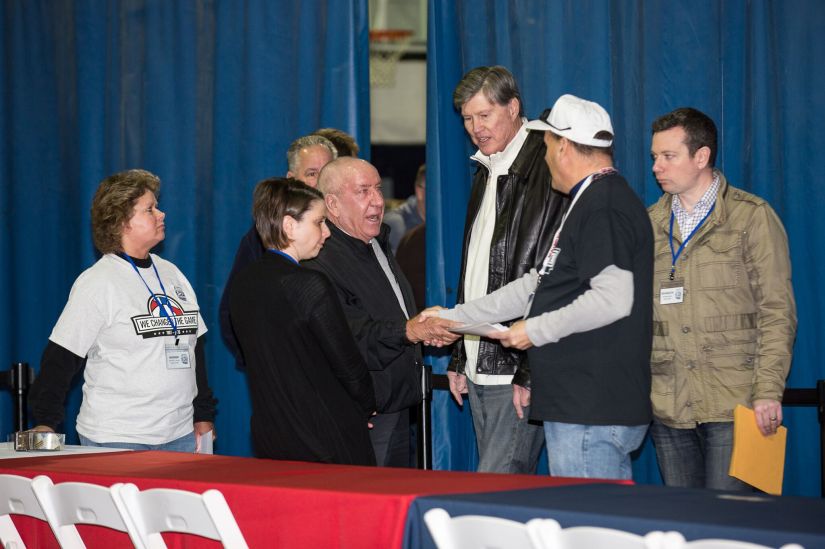
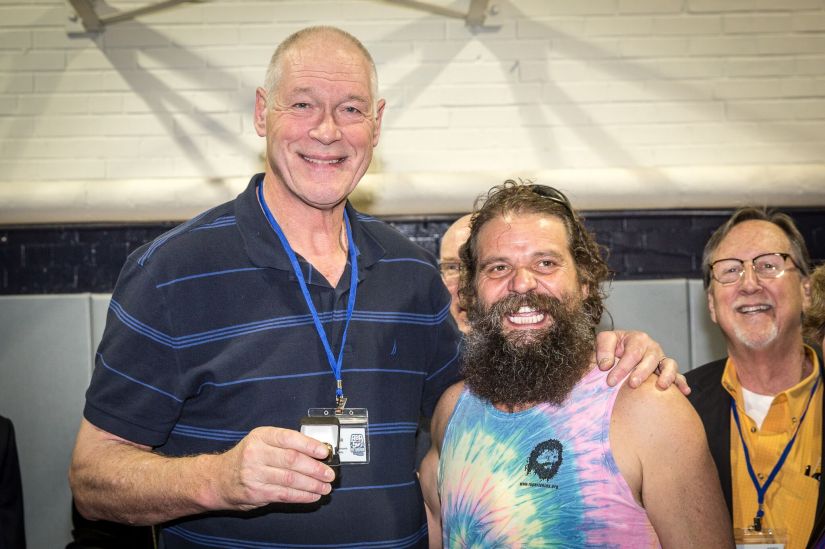
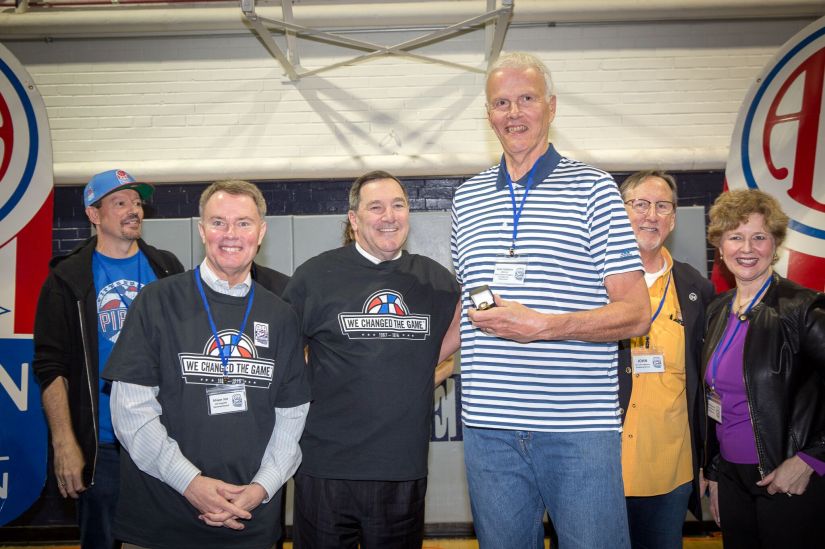
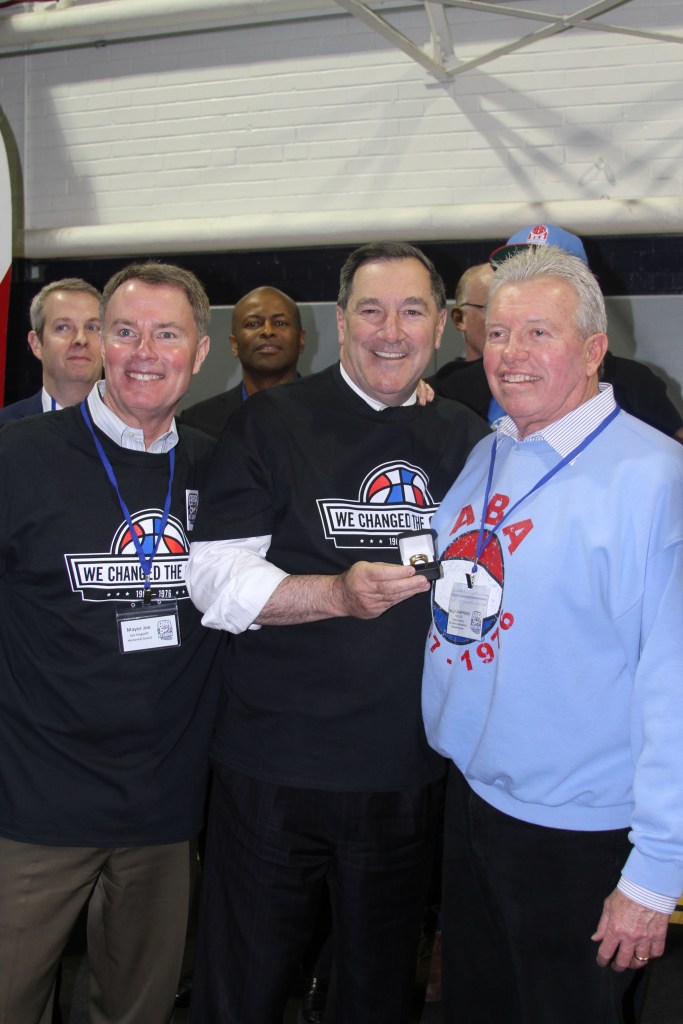
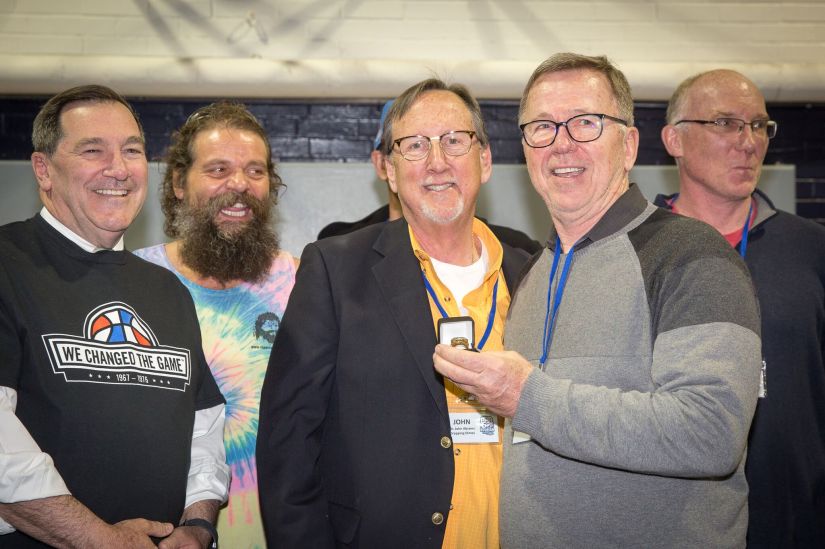
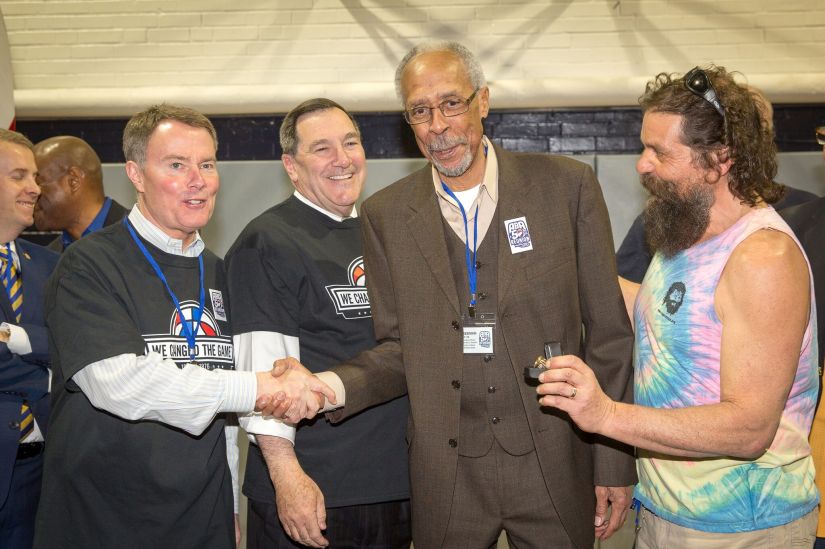
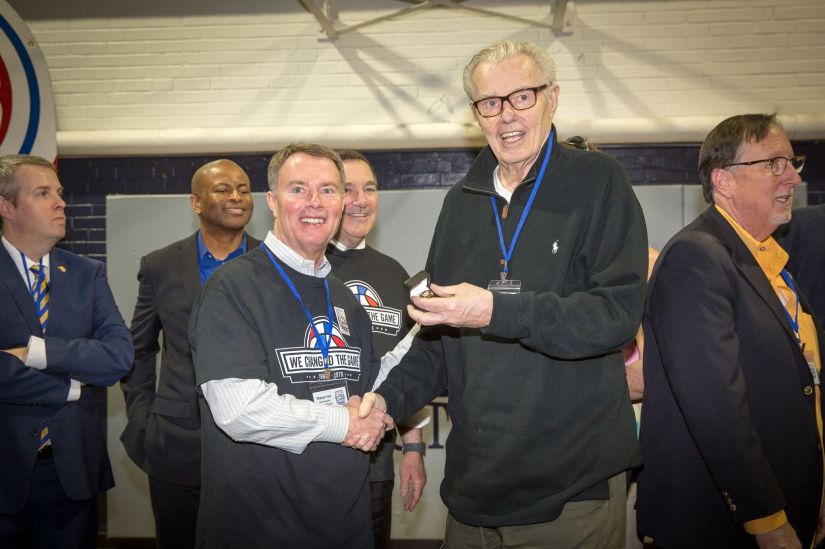
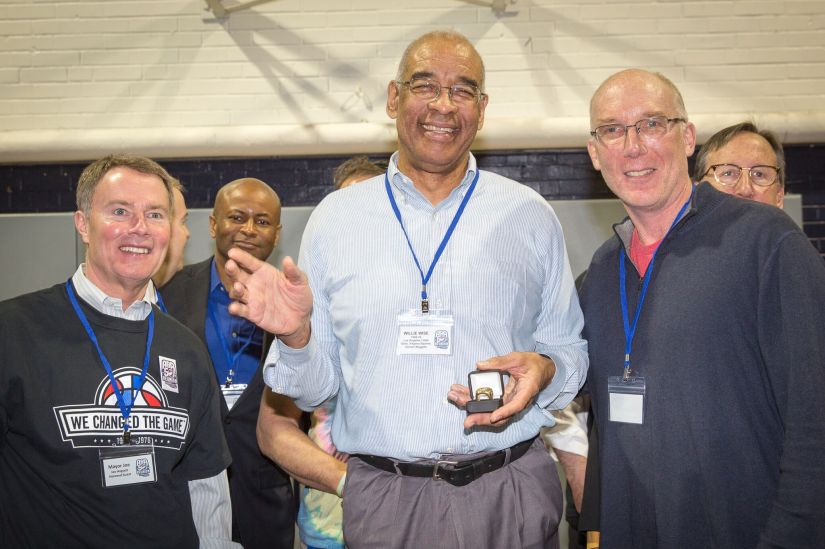
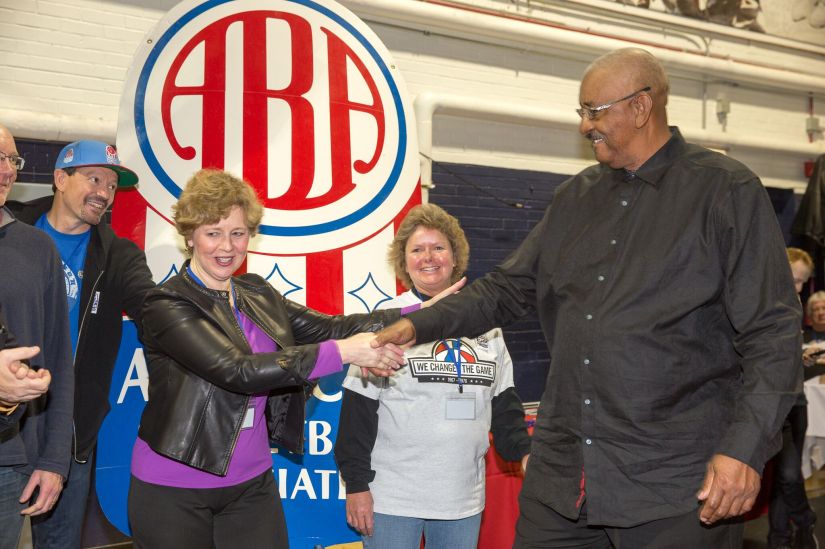
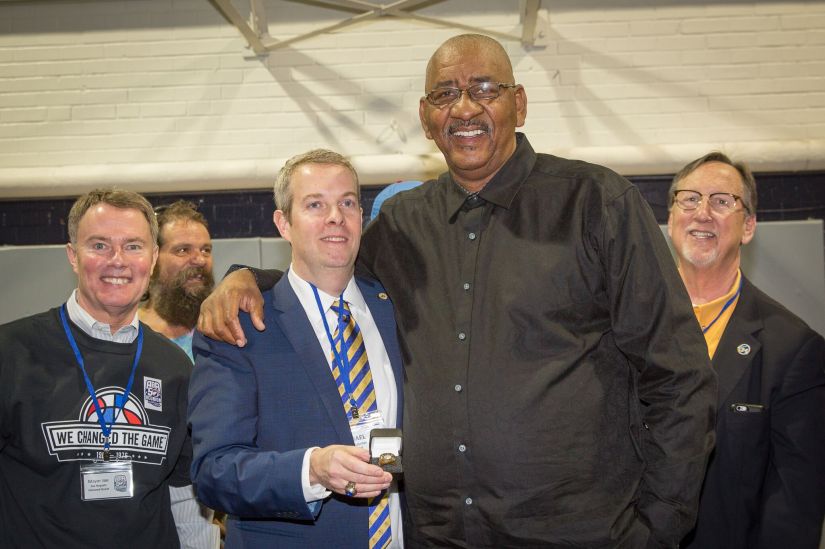
To make the event even more meaningful for the players and fans in attendance, several local dignitaries volunteered as honorary guest ring presenters. Senator Joe Donnelly, Congresswoman Susan Brooks, Mayor Joe Hogsett, City Councillors Vop Osili and Michael McQuillen, newscaster Dick Wolfsie, Trip III (the Butler “Blue” Bulldog) and even Rupert Boneham from Survivor showed up to pass out the iron. Former Q-95 regular Dave “The King” Wilson announced each player individually to the delight of the estimated 1,000 friends, fans and family of the ABA honorees.
Dr. John Abrams, Congresswoman Susan Brooks, Rhonda Hunter & Kentucky Colonels Bobby Rascoe getting his ring. Photo by Lauri Mohr of Imagine Mohr Photography
Rhonda Hunter and Kris Branch secured, double-checked and delivered the rings to the dignitaries. “It was fun to watch the dignitaries jockey for position and compete to present a ring to their favorite player.” said Rhonda. “The Pacer players were in high demand but it was great to see how much all of the players enjoyed themselves.” Kris added, “I’ll always remember the expressions of pure joy on the faces of those legends as they received their rings and I will always remember that I had the once-in-a-lifetime honor of handling every ring.”
Nicole Misencik, Kris Branch, Brandon Kline, Trudy Rowe & Rhonda Hunter. Photo by Lauri Mohr of Imagine Mohr Photography.
Roger Branch, Steve Hunt and Keith Hudson served as security for the rings. Tim and Cecelia Poynter, Christy McAbee, Cindy Adkins, Trudy Rowe and Kerry Hooker pitched in wherever needed. Brandon Kline and Nicole Misencik were invaluable to the day’s proceedings making sure gaps were filled wherever needed. My lovely mother-in-law Kathy Hudson and everybody’s favorite Irvingtonion Dawn Briggs served as hostesses for the event. Several troops of Indianapolis Girl Scouts were on hand to aid the alumni players throughout the day. It was hectic but fun for everyone involved. Since all of these folks were volunteering their time and services to help out in this once-in-a-lifetime event, I cannot thank them enough.
Mayor Joe Hogsett, Louie Dampier & Scott Tarter. Photo by Ron Sanders.
The Dropping Dimes trio of Scott Tarter, Dr. John Abrams and Ted Green served their worthy foundation majestically during the ring presentation ceremony by greeting every player as they received their rings. Tarter later remarked that he believed the ring ceremony made the day unforgettable. After the reunion weekend hoopla subsided, Tarter told me, “You know, when you originally brought up the ring idea, at first I wasn’t sure about it. But now I realize that the ring was the thing. You knocked it out of the park with that one Al.”
Dr. John Abrams, a former ABA Pacers ball-boy who is now one of the most successful eye doctors in the Circle City, remarked, “I still can’t believe how many of the former players came up and hugged me with tears in their eyes telling me how much that ring meant to them. That is the memory I will take away from the event.” For many of the players, those rings were the only official recognition they ever got for their service in a league left forgotten and unacknowledged by the NBA for three decades after the merger. The Saturday ring presentation at Hinkle Fieldhouse went off without a hitch but the saga of the rings was not over yet.
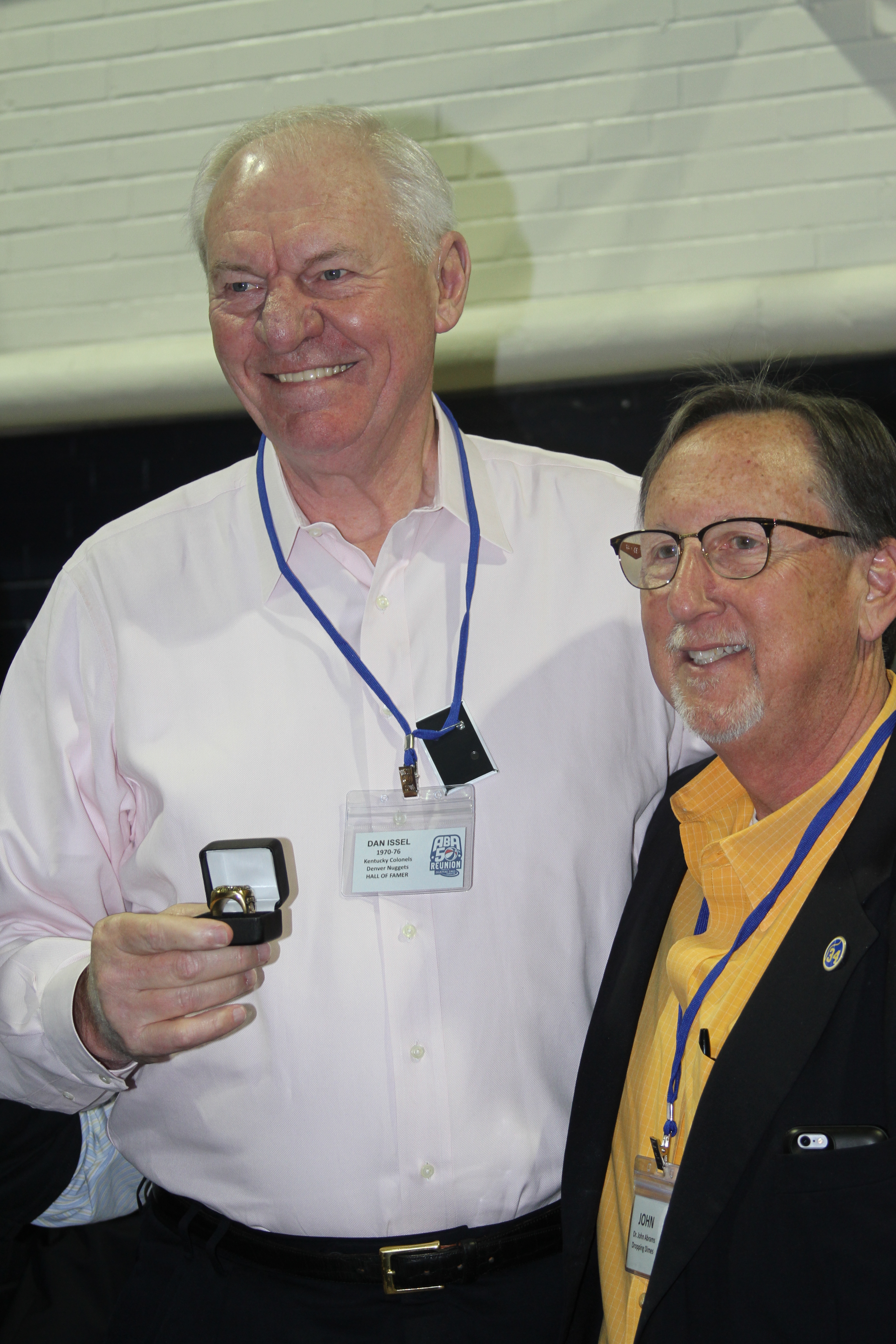
Dan Issel and Dr. John Abrams. Photo by Ron Sanders.
The Hinkle event concluded at 3:00 pm as the players boarded the bus transports back to the hotel. There were some twenty rings left over, made for players who were scheduled to attend but, for whatever reason, were not present to receive them. The rings were secured in the back of the Hunter van as Rhonda & I headed back home to prepare for that night’s gala at Banker’s Life Fieldhouse. We were to pick up Bob and Elaine Netolicky and drive down together to the event and deliver the rest of the rings. At least, that was the plan.
Problem was, when we arrived home, the rings were gone. It is hard to describe the level of panic that set in, but it was bad. Keep in mind, among the missing rings were those belonging to Julius “Dr. J” Erving, George McGinnis, Bobby “Slick” Leonard and Bob Costas. I called Neto and informed him the rings were gone. For once Neto was speechless.
Photo by Lauri Mohr of Imagine Mohr Photography.
The idea that the rings were gone left us thunderstruck. Needless to say, it was a long ride down to the Fieldhouse that night. The one bright spot of the mostly silent car ride was a phone call from Bob & Elaine’s daughter Nicole. When she learned about the missing rings, Nicole said, “Don’t worry, they’ll turn up somewhere daddy.” At that moment, I appreciated the sentiment but doubted the prediction. An hour long cocktail party preceded the banquet. Word had gotten out about the missing rings and during that happy hour I was approached time and time again by players expressing their heartfelt concern and support about the situation. Indiana basketball Hall of Famer Monte Towe chief among them.
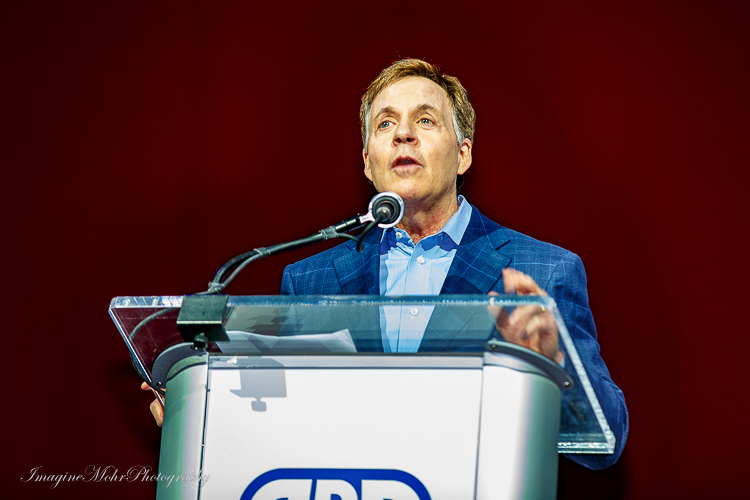
Bob Costas. Photo by Lauri Mohr of Imagine Mohr Photography.
The banquet concluded, complete with the presentation of a “dummy” ring on stage to emcee Bob Costas. Fueled by the excitement of the evening, the ride home was more jovial. The ring situation was on the back burner until Neto began to rub his chin and stare off in space before remarking, “How could someone have gotten in your locked car? You’re gonna find those rings. You know what happened, you hit a chuckhole and they fell out of the box. They’re under the seat in the back floorboard of your car.” I mumbled something in polite incredulity and dropped our guests off for the night.
During the final leg of our journey home I tried to think positive and buy in to Neto’s theory. We pulled in the driveway and I dashed into the house to retrieve the keys to the van, which had remained parked and loaded with supplies from the Hinkle Fieldhouse event. I was careful not to tell Rhonda simply because I didn’t want her to get her hopes up. I looked behind the driver’s seat where the empty boxes were found, but found nothing. I searched the back of the van, nothing. As a last ditch effort, I removed some empty plastic bags behind the passenger’s seat, certain the rings could never have ended up there. Faith and Begorrah, there they were. The missing rings had been found, just as Neto theorized.
I called Bob even before I told Rhonda. I have never heard Neto laugh so long and so loud. Neto called Rhonda as I gathered the rings and before I had the chance to go in and tell her. The next morning, Rhonda & I headed down to the J.W.Marriott to get the rings safely into the hands of the Dropping Dimes guys and also to get the rings to a few of the players before they left town. Nets great and Dropping Dimes Board member Brian Taylor met Tarter, Abrams and I in the lobby and took Julius his ring while Dr. J was eating breakfast in the restaurant. Tarter got McGinnis his ring and the rest were mailed. Finally, all rings were delivered.
I managed to drop Bob Costas off his ring just minutes before he left town. He was staying at the Conrad. I left the ring with the front desk and made my way back home, secure that all but one of the rings were safely out of my hands once and for all. Neto and I went to Slick Leonard’s house that Sunday morning and Neto gave me the honor of presenting Slick his ring. All’s well that ends well.
Later that day, I discovered that Pacers media guy Mark Montieth wrote an article about the event mentioning me (by name) and the missing ring situation. Not exactly how you want to see your name in print. Luckily, Montieth’s story was not the final note on the ABA ring affair. Later that afternoon, I received a voicemail from Bob Costas. The message said, “Hi Al, this is Bob Costas. I just wanted to call and thank you for delivering my ring and let you know how much I appreciate your bringing it down here for me. Take care and thanks again.”
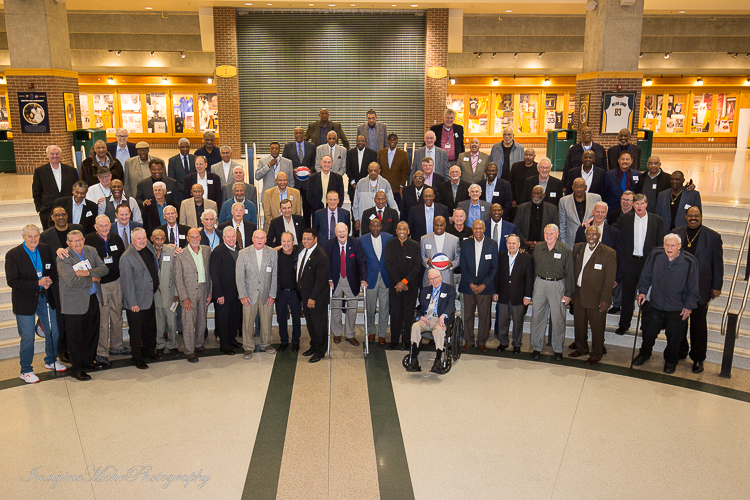
The ABA Alumni. Photo by Lauri Mohr of Imagine Mohr Photography.
Now you know the true and accurate story of the ABA 50th anniversary rings. I wanted to set the record straight for posterity once and for all. The rings started out as an idea, developed into reality and came together only through the efforts of many people sharing the same vision. The rings will outlive us all. Someday they may be the only reminder of that one special weekend in April of 21018 when the Golden anniversary of the American Basketball Association was celebrated here in Indianapolis. Proof positive that dreams really can come true.
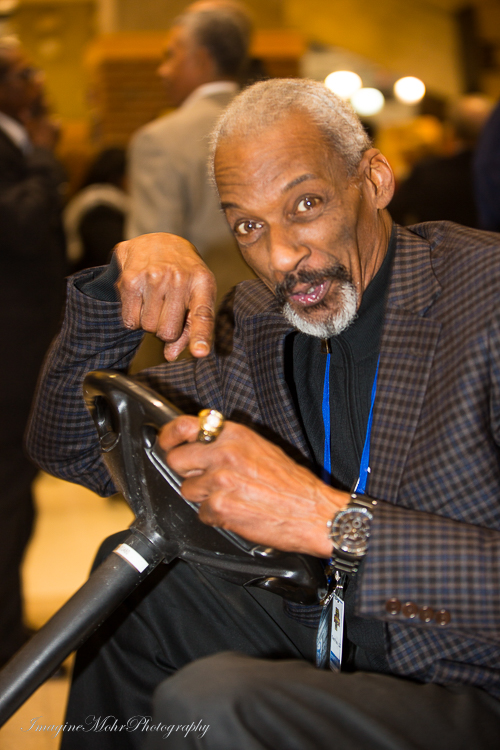
Now Dr. Dunk, you know the rest of the story. Photo by Lauri Mohr of Imagine Mohr Photography.
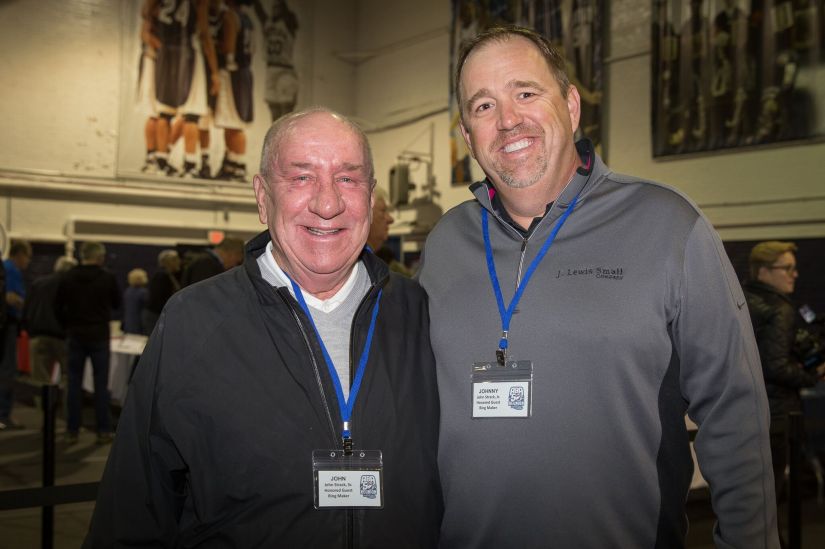
Johnny Strack Sr. and Johnny Strack Jr.- The ring makers. Photo by Lauri Mohr of Imagine Mohr Photography.
The card show crowd. Photo by Lauri Mohr of Imagine Mohr Photography.
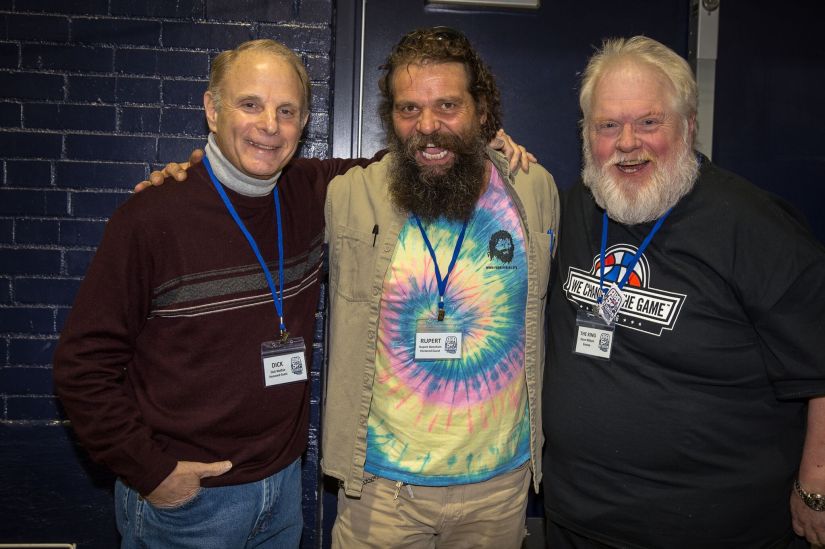
Dick Wolfsie, Rupert & Dave Wilson. Photo by Lauri Mohr of Imagine Mohr Photography.
The Butler Girl Scouts on site to lend a hand. Photo by Lauri Mohr of Imagine Mohr Photography.
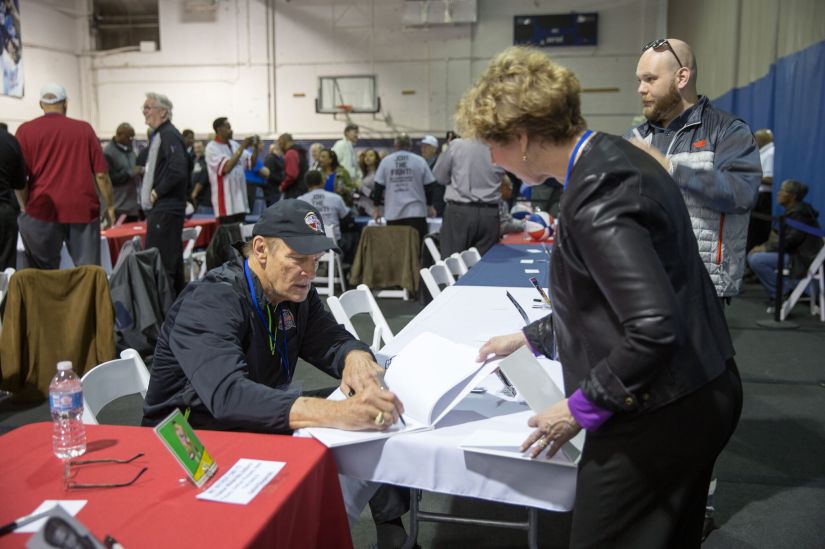
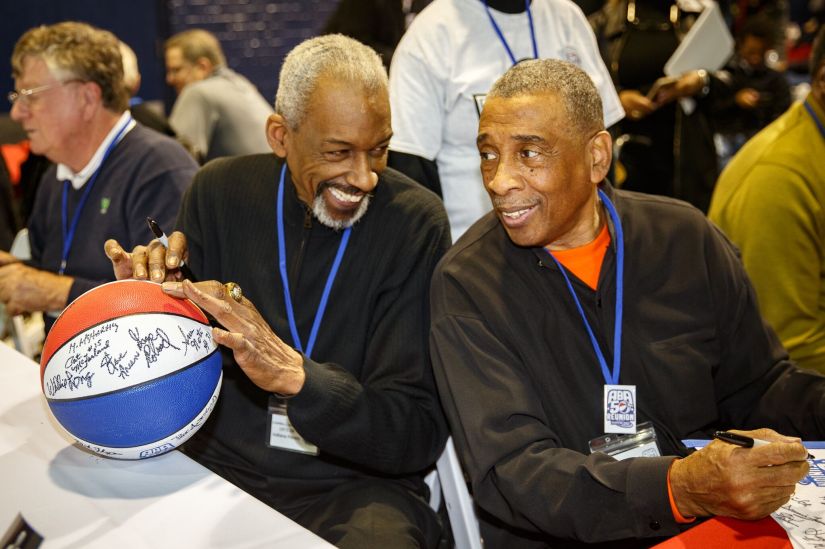
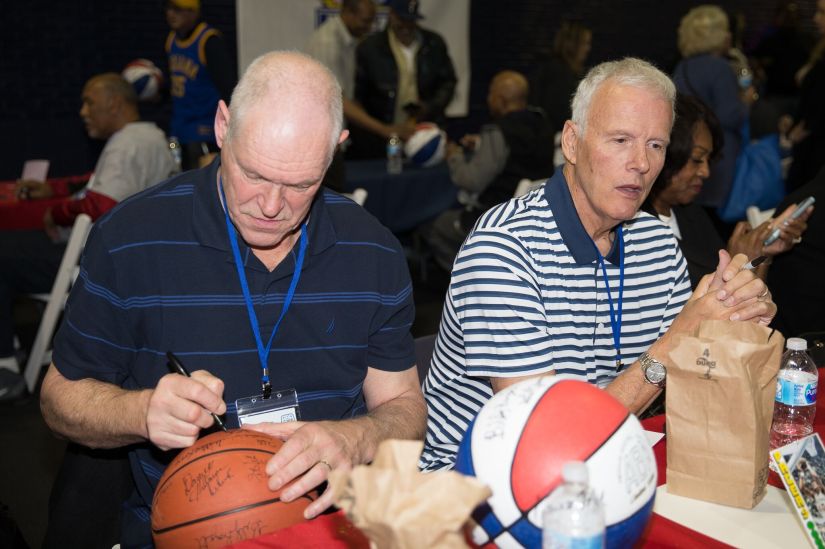
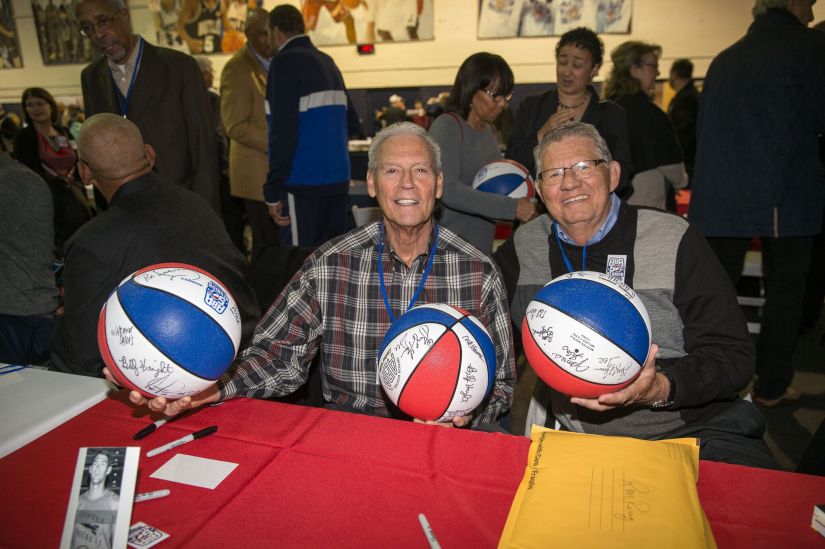
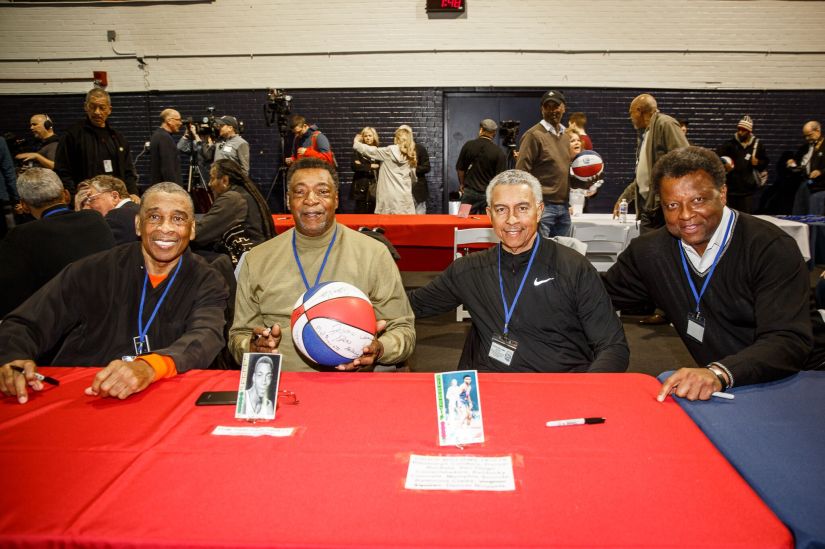
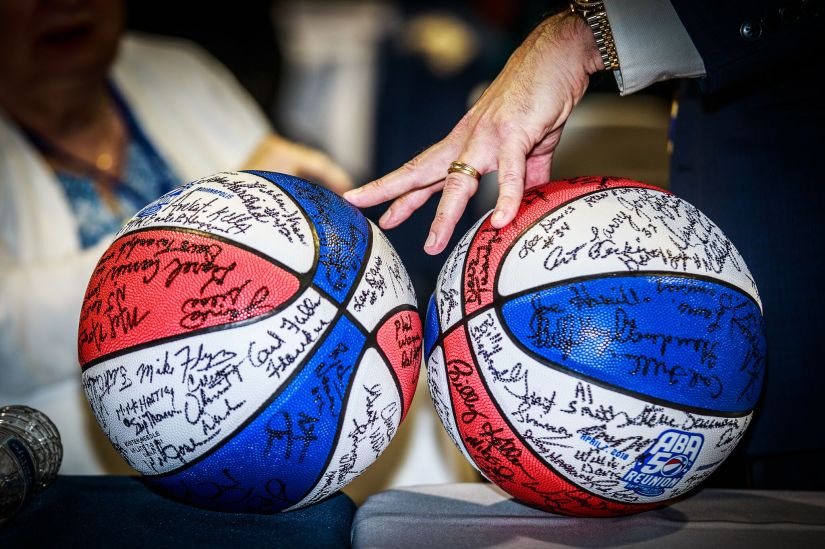
Over 90 former ABA players were on hand to sign autographs for the public. Photo by Lauri Mohr of Imagine Mohr Photography.
Rhonda Hunter, Nicole Micensik, Johnny Strack, Sr., Bob Netolicky, Alan E. Hunter & Brandon Kline getting ready for the festivities to begin, The calm before the storm. Photo by Lauri Mohr of Imagine Mohr Photography.
Rick Barry signing an autograph for Congresswoman Susan Brooks. Photo by Lauri Mohr of Imagine Mohr Photography.
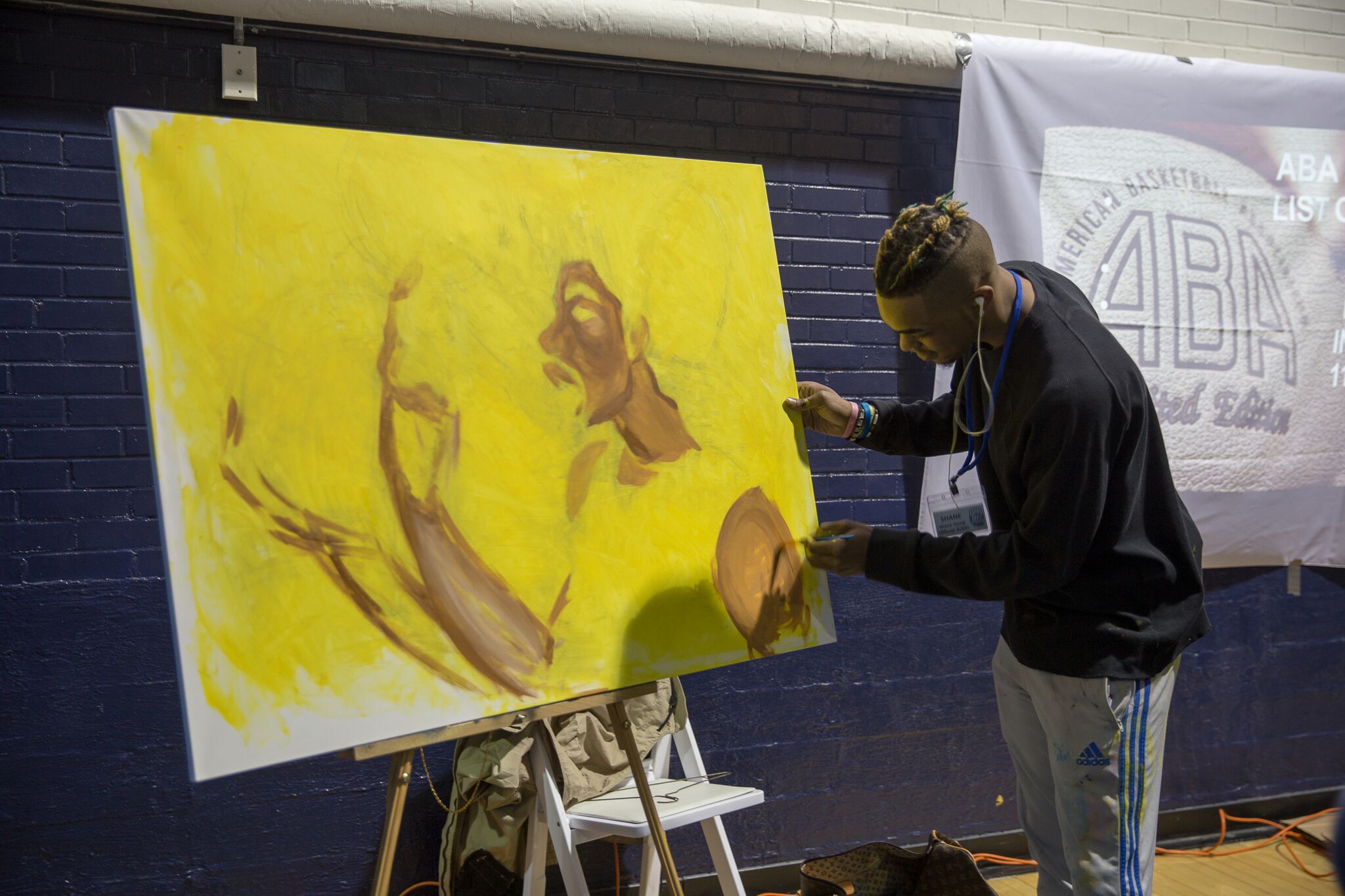
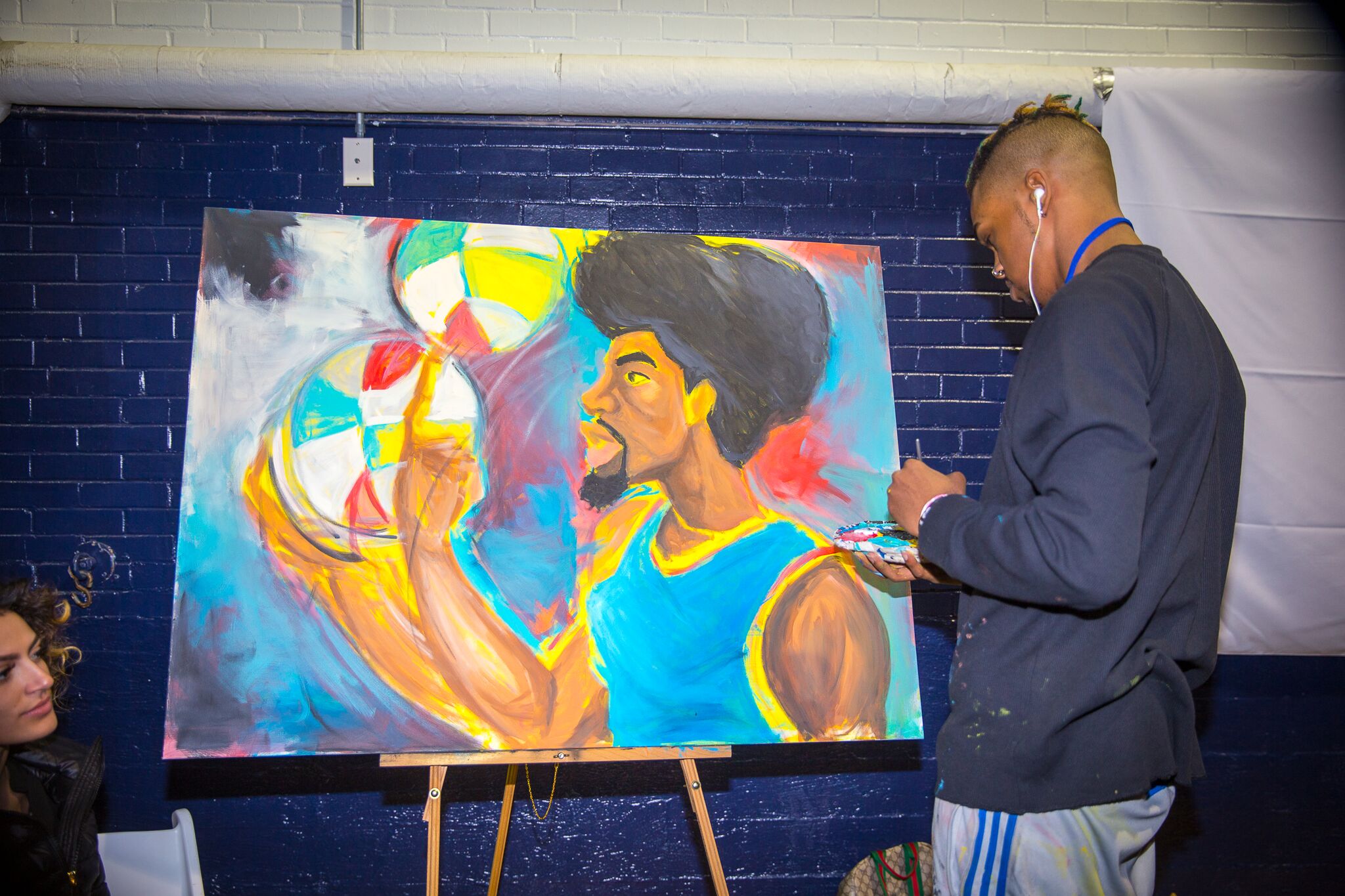
Artist Shane James Harden Young at work on Julius “Dr. J” painting. Skills! Photo by Lauri Mohr of Imagine Mohr Photography.
Scott Tarter shows off a couple of Shane’s portraits from his own collection to ABA Denver Rockets player Grant Simmons. Photo by Michael B. Delaney.
IU / ABA standout Steve Green & Bob Netolicky “discussing” the ABA Pension cause. Photo by Ron Sanders.
Rupert and Senator Joe Donnelly. Photo by Ron Sanders.
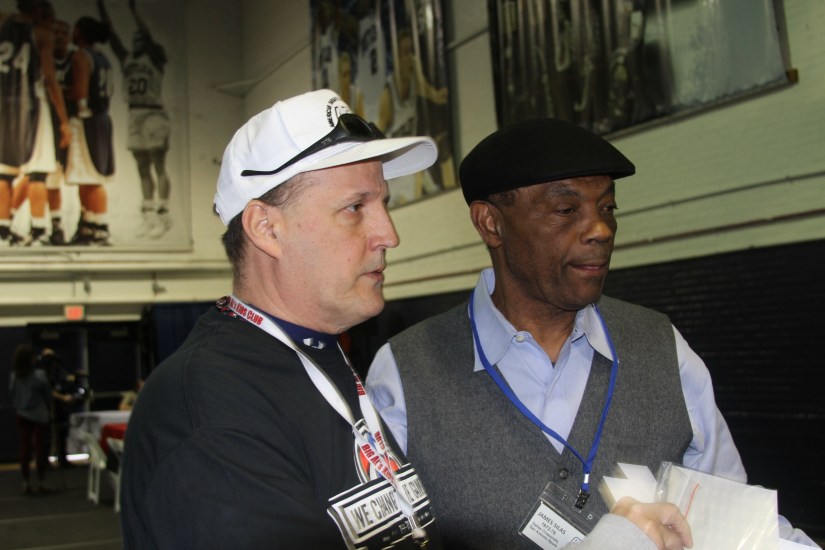
Alan E. Hunter & San Antonio Spurs Legend James Silas. The Snake! Photo by Ron Sanders.
Senator Joe Donnelly and Alan E. Hunter. Photo by Ron Sanders.
Rupert and Dave Wilson. Photo by Ron Sanders.
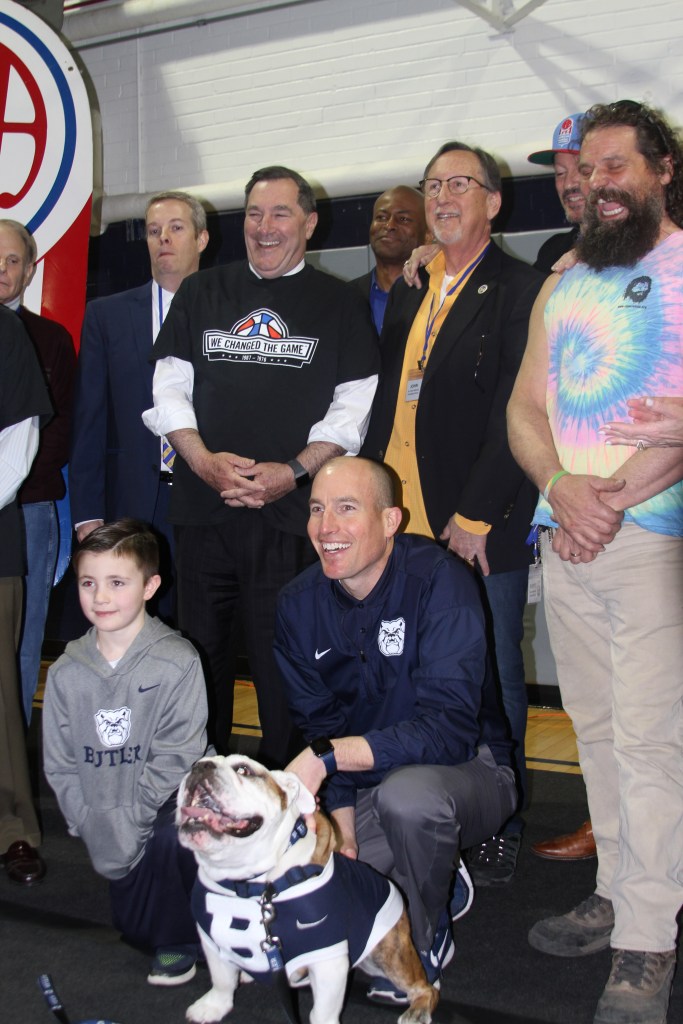
Dick Wolfsie, Mike McQuillen, Senator Joe Donnelly, Vop Osili, Dr. John Abrams, Scott Tarter, Rupert and Butler Blue III (Trip). Photo by Ron Sanders.
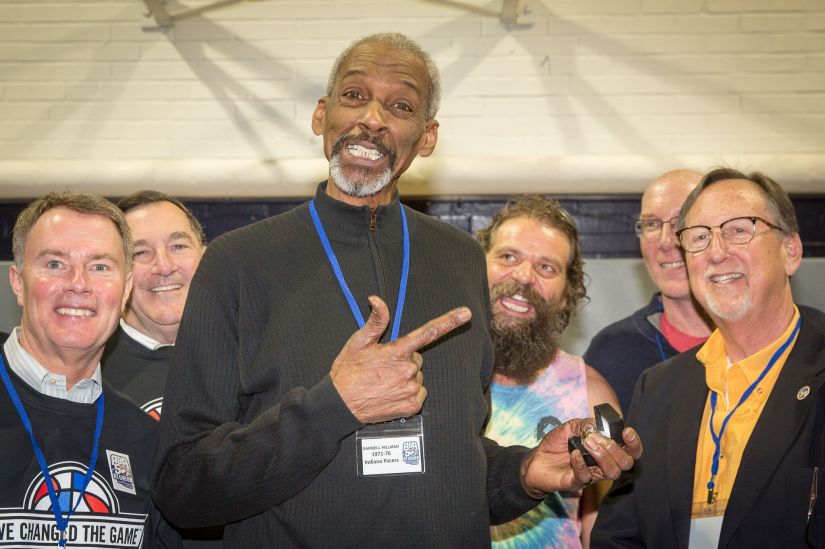
Pacers Darnell “Dr. Dunk” Hillman & Captain Freddie Lewis. Photo by Lauri Mohr of Imagine Mohr Photography.
Swen Nater & Dave Robisch. Photo by Lauri Mohr of Imagine Mohr Photography.
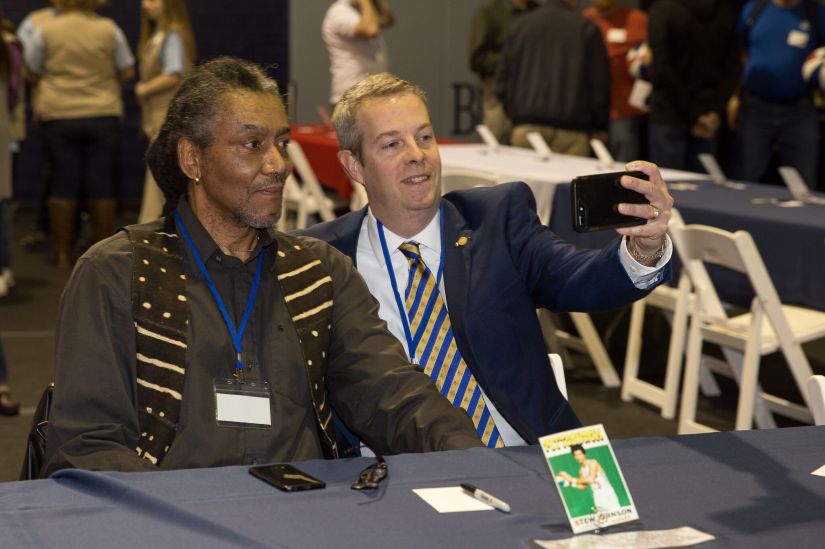
Stew Johnson (all the way from Sweden) and Councilman Mike McQuillen. Photo by Lauri Mohr of Imagine Mohr Photography.
ABA Pacers John Fairchild and Ron Perry. Photo by Lauri Mohr of Imagine Mohr Photography.
First Season ABA Pittsburgh Pipers Champs team player Steve Vacendak & Alan E. Hunter. Photo by Lauri Mohr of Imagine Mohr Photography.
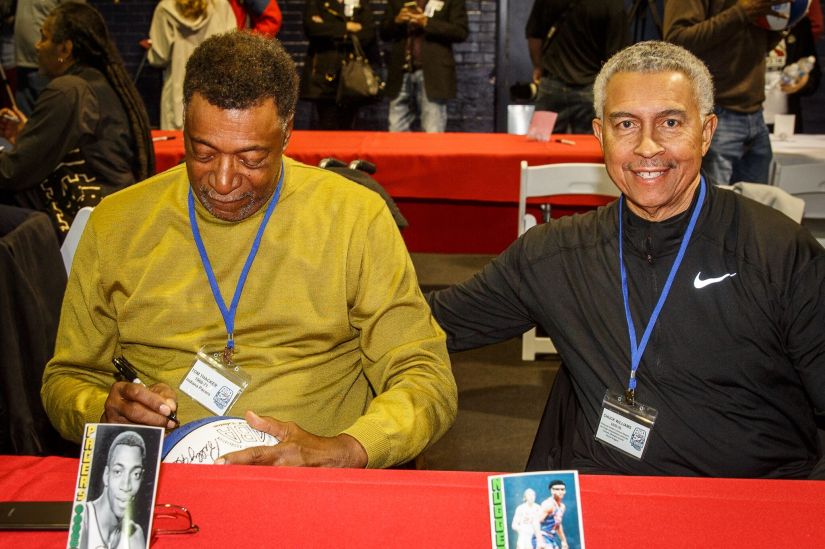
ABA Pacer Tom Thacker and All-Star Chuck Williams. Photo by Lauri Mohr of Imagine Mohr Photography.
ABA Pacers Freddie Lewis, Tom Thacker, Chuck Williams & Pacer Billy Knight. Photo by Lauri Mohr of Imagine Mohr Photography.
Mayor Joe Hogsett with ABA Pacers John Fairchild and Ron Perry. Photo by Lauri Mohr of Imagine Mohr Photography.
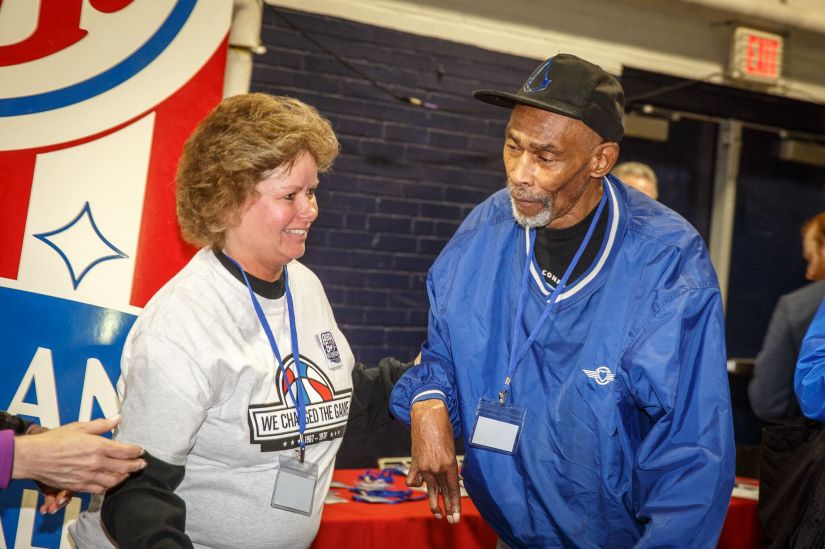
Rhonda Hunter with Kentucky Colonels Bird Averitt. Photo by Lauri Mohr of Imagine Mohr Photography.
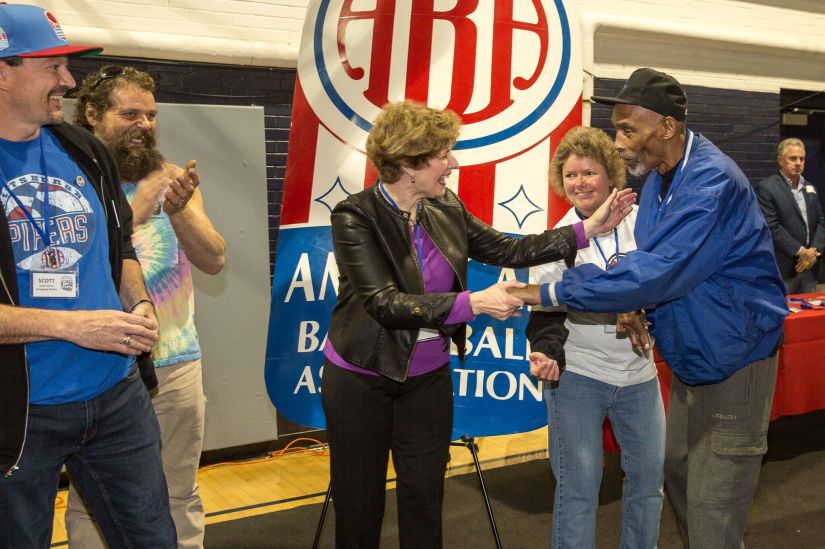
Scott Tarter, Rupert, Congresswoman Susan Brooks, Rhonda Hunter & Kentucky Colonels Bird Averitt. Photo by Lauri Mohr of Imagine Mohr Photography.
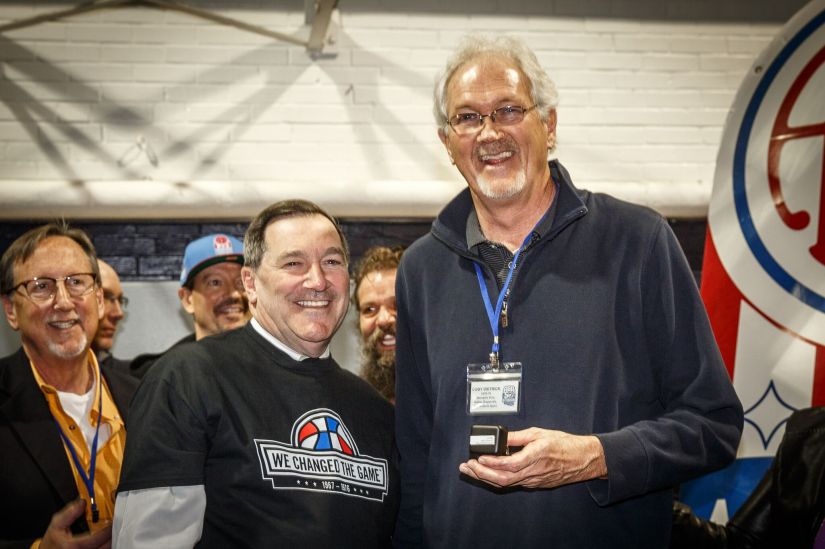
Dr. John Abrams, Scott Tarter, Senator Joe Donnelly & ABA Spurs star Coby Dietrick. Photo by Lauri Mohr of Imagine Mohr Photography.
Congresswoman Susan Brooks & ABA Spurs / Nets / Colonels star Mike Gale. Photo by Lauri Mohr of Imagine Mohr Photography.
Mayor Joe Hogsett, Councilman Vop Osili & ABA Pacers Jerry Harkness. Photo by Lauri Mohr of Imagine Mohr Photography.
Swen Nater, Rupert & Dr. John Abrams. Photo by Lauri Mohr of Imagine Mohr Photography.
Mayor Joe Hogsett, ABA Great Bill Melchioni & Senator Joe Donnelly. Photo by Lauri Mohr of Imagine Mohr Photography.
Scott Tarter, Senator Joe Donnelly, Peter Vecsey, Ted Green & Dr. John Abrams. Photo by Lauri Mohr of Imagine Mohr Photography.
ABA Pacer Wayne Pack, Dr. John Abrams & Congresswoman Susan Brooks. Photo by Lauri Mohr of Imagine Mohr Photography.
Scott Tarter, Mayor Joe Hogsett, Senator Joe Donnelly, Dr. John Abrams, Indiana Pacers Dave Robisch and Congresswoman Susan Brooks. Photo by Lauri Mohr of Imagine Mohr Photography.
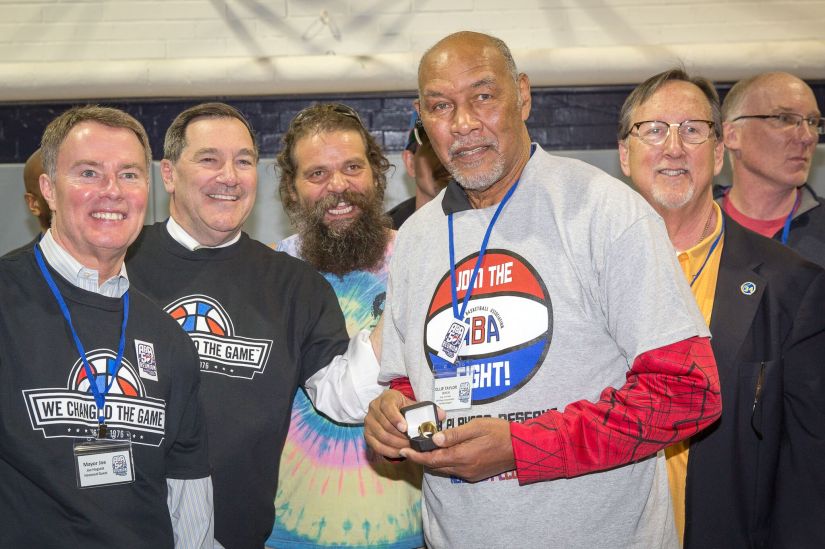
Mayor Joe Hogsett, Senator Joe Donnelly, Rupert, ABA Great Ollie Taylor, Dr. John Abrams and Ted Green. Photo by Lauri Mohr of Imagine Mohr Photography.
Senator Joe Donnelly, Vop Osili, Rupert, ABA Great Claude Terry, Dr. John Abrams and Ted Green and Congresswoman Susan Brooks. Photo by Lauri Mohr of Imagine Mohr Photography.
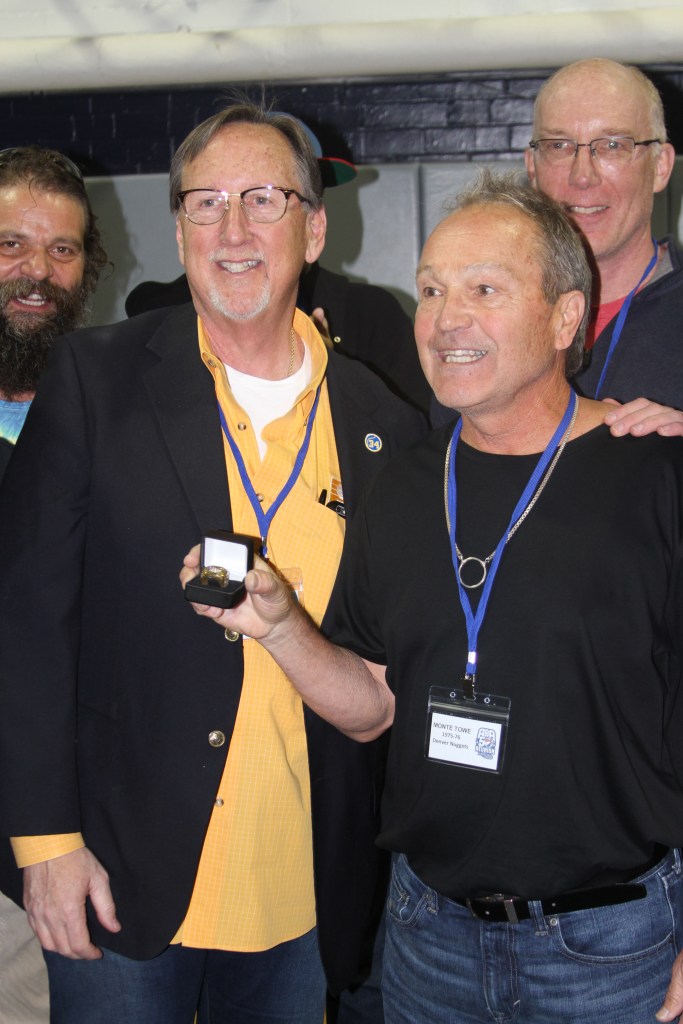
Dr. John Abrams and ABA Star Monte Towe. Photo by Ron Sanders.
Michael McQuillen, Mayor Joe Hogsett, Vop Osili, Senator Joe Donnelly and ABA & Butler Great Billy Shepherd. Photo by Ron Sanders.
Senator Joe Donnelly, Rupert, Dr. John Abrams, ABA Great Dave Twardzik and Ted Green. Photo by Lauri Mohr of Imagine Mohr Photography.
Senator Joe Donnelly, ABA Great Jim Eakins & Dr. John Abrams. Photo by Lauri Mohr of Imagine Mohr Photography.
Congresswoman Susan Brooks, Rhonda Hunter & Kentucky Colonels Darel Carrier. Photo by Lauri Mohr of Imagine Mohr Photography.
Congresswoman Susan Brooks & Indiana Pacers Great Billy Knight. Photo by Lauri Mohr of Imagine Mohr Photography.
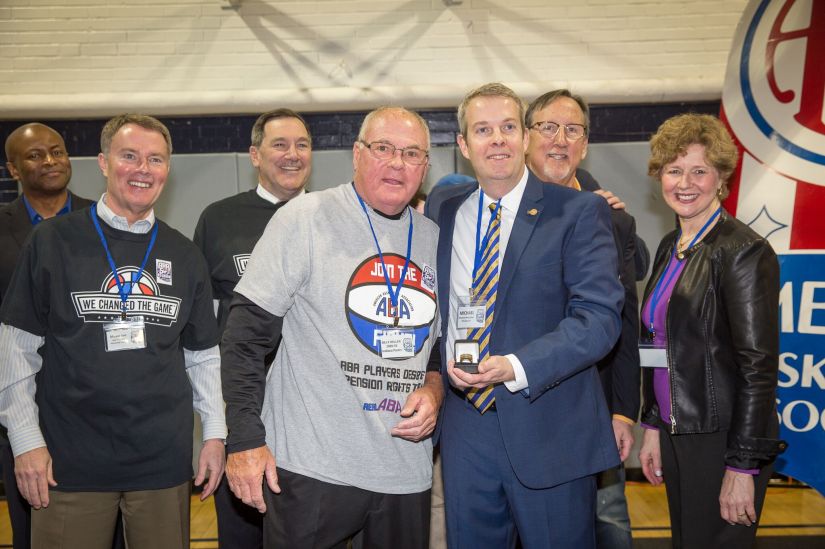
Vop Osili, Mayor Joe Hogsett, Senator Joe Donnelly, ABA Pacers Great Billy Keller, Mike McQuillen, Dr. John Abrams and Congresswoman Susan Brooks. Photo by Lauri Mohr of Imagine Mohr Photography.
Senator Joe Donnelly, Rupert, ABA Great Larry Jones & Dr. John Abrams. Photo by Lauri Mohr of Imagine Mohr Photography.
Senator Joe Donnelly, ABA Great Mack Calvin, Dr. John Abrams & Congresswoman Susan Brooks. Photo by Lauri Mohr of Imagine Mohr Photography.
Mayor Joe Hogsett, Senator Joe Donnelly, ABA Pacers Darnell Hillman, Rupert, Ted Green & Dr. John Abrams. Photo by Lauri Mohr of Imagine Mohr Photography.
Mayor Joe Hogsett, Senator Joe Donnelly, ABA Pacers Donnie Freeman, & Rupert. Photo by Lauri Mohr of Imagine Mohr Photography.
Councilman Vop Osili and ABA Pacers Great Bob Netolicky. Photo by Ron Sanders.
Mike McQuillen, Vop Osili, Mayor Joe Hogsett, Senator Joe Donnelly, ABA Great Doug Moe, & Dr. John Abrams. Photo by Lauri Mohr of Imagine Mohr Photography.
Mayor Joe Hogsett, Vop Osili ABA Great Willie Wise, & Ted Green. Photo by Lauri Mohr of Imagine Mohr Photography.
ABA Kentucky Colonels Hall of Famers Louie Dampier & Dan Issel. Photo by Lauri Mohr of Imagine Mohr Photography.
Scott Tarter, Congresswoman Susan Brooks, Rhonda Hunter and ABA San Antonio Spurs Hall of Famer George Gervin aka “The Iceman”. Photo by Lauri Mohr of Imagine Mohr Photography.
Mayor Joe Hogsett, Rupert, Mike McQuillen, ABA San Antonio Spurs Hall of Famer George Gervin and Dr. John Abrams. Photo by Lauri Mohr of Imagine Mohr Photography.
Congresswoman Susan Brooks & ABA Kentucky Colonels Hall of Famer Artis Gilmore aka “The A-Train”. Photo by Lauri Mohr of Imagine Mohr Photography.
Hall of Famer Rick Barry & Councilman Michael McQuillen. Photo by Ron Sanders.
Mayor Joe Hogset, Councilman Vop Osili, Hall of Famer Spencer Haywood, Scott Tarter & Ted Green. Photo by Ron Sanders.
The Ring. Photo by Lauri Mohr of Imagine Mohr Photography.
ABA vet Grant Simmons brought his own ABA Dave DeBusschere ball to have signed. How cool is that? Photo by Lauri Mohr of Imagine Mohr Photography.
Photo by Lauri Mohr of Imagine Mohr Photography.
The Coach. Hall of Famer Bobby “Slick” Leonard, Photo by Lauri Mohr of Imagine Mohr Photography.
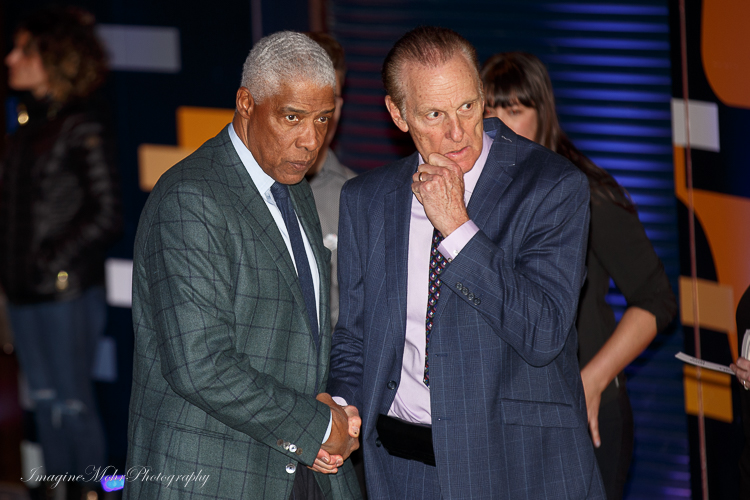
Julius Erving and Rick Barry. Photo by Lauri Mohr of Imagine Mohr Photography.
Indiana Pacers Hall of Famer George McGinnis. Photo by Lauri Mohr of Imagine Mohr Photography.
Brian Taylor & George McGinnis. Photo by Lauri Mohr of Imagine Mohr Photography.
Rick Barry and Bobby “Slick” Leonard signing Barry’s basketball panels. Photo by Lauri Mohr of Imagine Mohr Photography.
Julius Erving and Elaine Netolicky. Photo by Lauri Mohr of Imagine Mohr Photography.
ABA Kentucky Colonels star Joe Hamilton signing for fans. Photo by Michael B. Delaney.
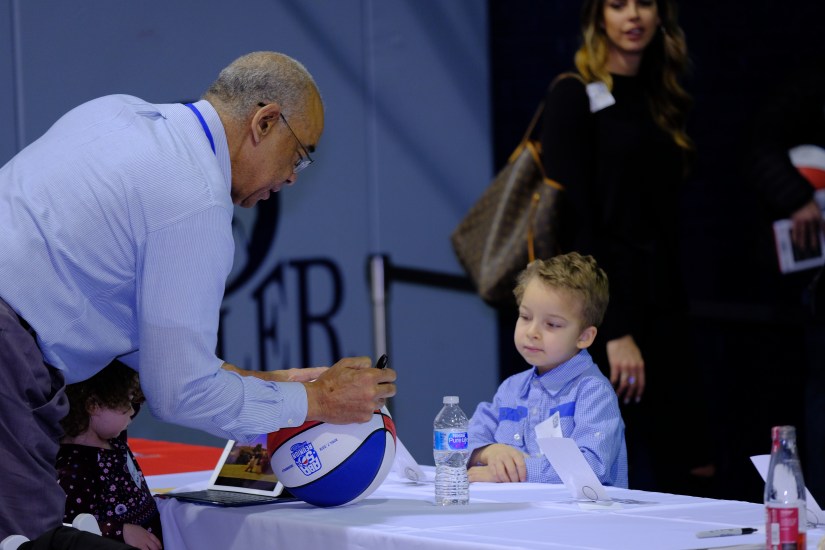
ABA Utah Stars Legend Willie Wise signing for a young fan. Photo by Michael B. Delaney.
ABA Indiana Pacers Star Bob Netolicky says “That’s all folks!”. Photo by Lauri Mohr of Imagine Mohr Photography.
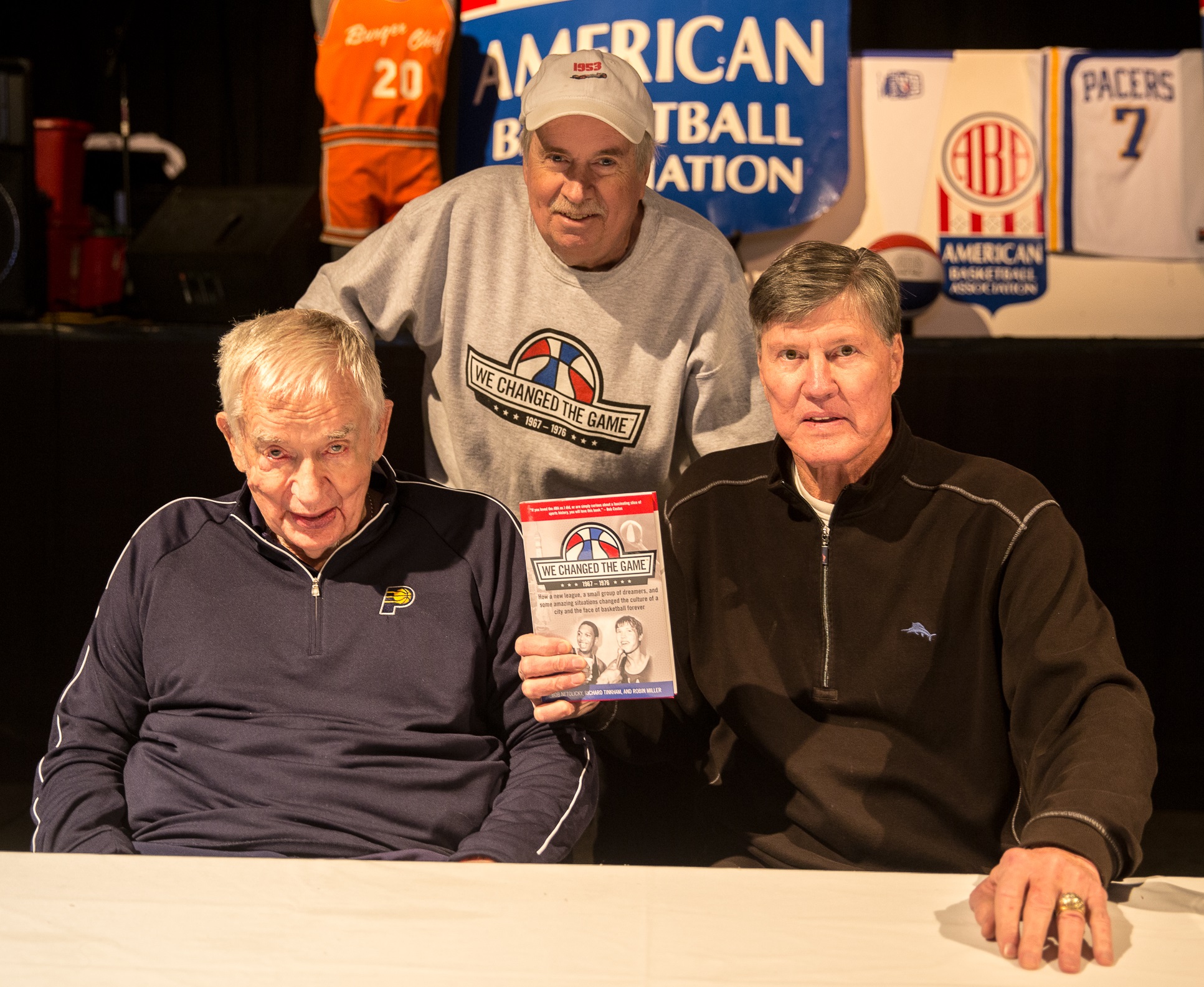
Richard P. Tinkham Jr., who visited the Irving Theatre in Irvington last Sunday, is one of the true pioneers of the American Basketball Association, which celebrates its 50th anniversary this year. Mr. Tinkham was in the Irv, along with co-authors Bob Netolicky & Robin Miller, to sign copies of their new book, “We changed the game.” Mr. Tinkham, co-founder of the ABA and the Indiana Pacers franchise, knows all of the league’s secrets. He was instrumental in the creation of Market Square Arena and co-chaired the ABA merger committee that sent four ABA teams into the NBA and helped lead the ABA/NBA consolidation. As detailed in part one of this series, that road to merger was a long journey. Dick Tinkham was there for every step.
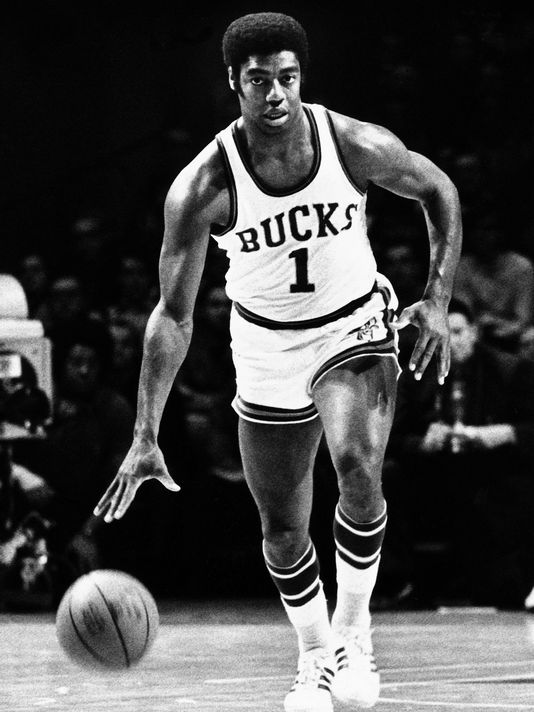
Oscar Robertson- The Big O.
Indianapolis native Oscar Robertson delayed the first merger attempt in 1971 with a court case and subsequent injunction that ultimately doomed the league. Before the 1975–76 season, the Denver Nuggets and New York Nets tried to defect from the ABA to join the NBA. The owners of the Nets and Nuggets had approached John Y. Brown, Jr. (Kentucky Fried Chicken magnate and future Governor of the Blue Grass State) in an attempt to get his Kentucky Colonels to join their attempted defection. Brown refused, saying he would remain loyal to the ABA.
Instead, the two teams were forced by judicial order to play a lame-duck season in the ABA. Ironically, the two would be defector teams had the last laugh as they would end up playing for the championship that final season (The Nets beat the Nuggets 4 games to 2).
This attempted defection exposed the emerging financial weakness of the league’s lesser teams. Soon, the ABA began it’s death throe. Perhaps the best illustration of league instability can be found in the New Orleans / Memphis franchise. The New Orleans Buccaneers were among the original 11 teams. In 1972 the Bucs moved to Memphis and began a 5 year identity crisis. The team left New Orleans and became the Pros, then the Tams and finally the Sounds. That last Memphis team looked an awful lot like the Indiana Pacers.
Mike Storen’s team with former Indiana Pacers Rick Mount, Freddie Lewis, Mel Daniels & Roger Brown.
The team was led by Mike Storen, former vice president and general manager of the Indiana Pacers. Storen stacked the Sounds with former Indiana players Mel Daniels, Freddie Lewis, Roger Brown and Rick Mount along with Hoosier hot shot Billy Shepherd. Prior to the start of the 1975-76 season, the Sounds moved to Baltimore, Maryland. The team was initially named the Baltimore Hustlers, but public pressure forced them to rename it the Claws. The Claws folded in October of 1975 during the preseason after playing just three exhibition games. Mel Daniels, disappointed at the Claws’ demise, retired rather than play for another team. Later Daniels recalled that the Claws’ players were encouraged to take equipment and furniture from the team office in lieu of payment.
Not long after the Claws folded, the San Diego Sails followed suit. The Sails (formerly the Conquistadors) were the ABA’s first and only expansion team. While the departure of those two teams may not have been a surprise, when the Utah Stars, one of the ABA’s most successful teams, folded, the league dropped from 10 teams to 7. The Virginia Squires folded in May following the end of the season.
That left six teams standing: the Kentucky Colonels, Denver Nuggets, Indiana Pacers, New York Nets, Spirits of St. Louis and San Antonio Spurs. With settlement of the Oscar Robertson suit on February 3, 1976, the final merger negotiations began. Dick Tinkham says “Calling it a merger is a misnomer, the NBA said it was an expansion draft, but in truth, it was a massacre.” During the June 1976 negotiations, the NBA made it clear that it would accept only four ABA teams, not five. In addition “The NBA required that the remaining four ABA teams pay a $ 3.2 million expansion fee by September 15, 1976,” states Tinkham.
ABA Kentucky Colonels owner (& future Governor) John Y. Brown,
On June 17, 1976, Kentucky owner John Y. Brown folded the Colonels for a $3 million payment from the remaining teams. In addition to the $3 million he received for agreeing to stay out of the merger, Brown also sold Gilmore’s rights to the Bulls for $1.1 million. Additionally, the Portland Trail Blazers took Maurice Lucas for $300,000, the Buffalo Braves took Bird Averitt for $125,000, the Pacers took Wil Jones for $50,000, the Nets took Jan van Breda Kolff for $60,000, and the Spurs took Louie Dampier for $20,000. Ironically, with all of those funds, Brown bought the NBA’s Buffalo Braves for $1.5 million, and later parlayed the Braves into ownership of the Boston Celtics.
Lawyer Tinkham points out that although Brown came out smelling like a rose when the ABA folded, it was the owners of the Spirits of St. Louis who struck the best deal with the use of one obscure Latin term inserted at the tail end of their “merger” deal. “As part of the deal, none of the four teams would receive any television money during the first three seasons, on top of having to pay one -seventh of their annual television revenues of the defunct Spirits team in perpetuity.” That term, “In Perpetuity”, would prove most advantageous in the years to come.
The 1976 ABA-NBA “merger” saw the Denver Nuggets, Indiana Pacers, New York Nets, and San Antonio Spurs join the NBA. The deal was finally consummated on June 17, 1976, at the NBA league meetings in the Cape Cod Room at Dunfey’s Hyannis Resort in Hyannis, Massachusetts.
Perhaps fittingly, brothers Ozzie and Daniel Silna made their fortune as pioneers in the manufacture of polyester, the fabric that defined the 1970s. After failing to buy the Detroit Pistons, an NBA franchise that began life in Ft. Wayne, the Silnas’ purchased the ABA’s Carolina Cougars. The Cougars began life as the Houston Mavericks in 1967. Just as future North Carolina Lieutenant Governor Jim Gardner had bought the Mavericks and moved them to North Carolina in 1969, the Silna brothers bought the Cougars with the expectation of moving it to St. Louis. In 1974, St. Louis, Missouri was the largest city in the United States without a professional basketball team.
The 1975–76 Spirits season had not gone well in either attendance or wins. In May 1976, due to attendance problems, the Spirits announced that they were going to merge with the Utah Stars. But the Stars folded before the merger could occur and instead, the Spirits wound up with some of Utah’s best players. Then in an effort to be included in the ABA–NBA merger, the Silna brothers proposed selling the Spirits to a Utah group, buying the Kentucky Colonels franchise, and moving them to Buffalo to replace the Buffalo Braves. Seems that the Silna brothers were always looking towards a future in the NBA. That deal didn’t happen either.
The merger included the Spirits of St. Louis players being put into a special dispersal draft. Marvin Barnes went to the Detroit Pistons for $500,000, Moses Malone went to the Portland Trail Blazers for $300,000, Ron Boone went to the Kansas City Kings for $250,000, Randy Denton went to the New York Knicks for $50,000 and Mike Barr went to the Kansas City Kings for $15,000. It must be noted that, in all, twelve players from the final two Spirits of St. Louis rosters (1974–76) played in the NBA during the 1976–77 season and beyond: Maurice Lucas, Ron Boone, Marvin Barnes, Caldwell Jones, Lonnie Shelton, Steve Green, Gus Gerard, Moses Malone, Don Adams, Don Chaney, M. L. Carr and Freddie Lewis.
But that wasn’t the end of the line for the Silna boys. Together, they managed to turn the ABA-NBA merger into one of the greatest deals in the history of professional sports. First, the remaining ABA owners agreed, in return for the Spirits folding, to pay the Silnas’ $2.2 million in cash and that 1/7 share of television revenues in perpetuity. As the NBA’s popularity exploded in the 1980s and 1990s, the league’s television rights were sold to CBS and then NBC, and additional deals were struck with the TNT and TBS cable networks; league television revenue soared into the hundreds of millions of dollars. The Silnas’ continue to receive checks from the NBA on a yearly basis, representing a 4/7 share of the television money that would normally go to any NBA franchise, or about two percent of the entire league’s TV deal.
That deal turned into at least $4.4 million per year through the 1990s. From 1999 through 2002 the deal netted the Silnas’ another $12.50 million per year; from 2003 to 2006 their take was at least $15.6 million per year.The two Silna brothers each get 45% of that television revenue per year and their merger, Donald Schupak, receives the orher 10%. As of 2013, the Silna brothers have received over $300 million in NBA revenue, despite the fact that the Spirits never played a single NBA game.
In 2012, the Silna brothers sued the NBA for “hundreds of millions of dollars more” they felt were owed them for NBA League Pass subscriptions and streaming video revenues that claimed was an extension of television revenues. In January 2014, a conditional settlement agreement between the NBA, the four active former-ABA clubs and the Silnas was announced and the Silnas’ received an estimated $500 million more from the former ABA teams. Ozzie Silna passed in 2014 at the age of 83. Daniel Silva is a successful philanthropist living in New Jersey.
In the first NBA All Star Game after the merger, 10 of the 24 NBA All Stars were former ABA players, five (Julius Erving, Caldwell Jones, George McGinnis, Dave Twardzik and Maurice Lucas) were starters. Of the 84 players in the ABA at the time of the merger, 63 played in the NBA during the 1976–77 season. Additionally, four of the NBA’s top ten scorers were former ABA players (Billy Knight, David Thompson, Dan Issel and George Gervin). The Pacers’ Don Buse led the NBA in both steals and assists during that first post-merger season. The Spirits of St. Louis’ Moses Malone finished third in rebounding, Kentucky Colonels’ Artis Gilmore was fourth. Gilmore and his former Colonels teammate Caldwell Jones were both among the top five in the NBA in blocked shots. Tom Nissalke left the ABA to coach the NBA’s Houston Rockets in the first post-merger season and was named NBA Coach of the Year. Yes, the ABA left its mark on the NBA instantly.
And where was Richard P. Tinkham, the man right in the middle of all of those previous league negotiations when the merger news was announced? “I was driving home from the airport when I heard the news on the radio,” he says, “It was great news, but people have no idea what it took to pull it off.” On Saturday, April 7th, Indianapolis will host the 50th reunion celebration of the ABA with an evening banquet at Banker’s Life Fieldhouse and a special daytime public event at Hinkle Fieldhouse from 11:00 to 3:00. The public is invited to attend this once in a lifetime event that will include a special ABA 50th anniversary ring presentation for all the players followed by a Guinness World Book of Records attempt to set the mark for most pro athletes signing autographs in a single session.
Special guest ring presenters for this charity event include Mayor Joe Hogsett, Senator Joe Donnelly, Congresswoman Susan Brooks, City Councillors Mike McQuillen and Vop Osili, WISH-TV personality Dick Wolfsie and Rupert from Survivor. It promises to be a very special event. Dick Tinkham will be there too, watching over his players as they gather for one last collective hurah. Oh, and the man paying for those player rings? None other than Spirits of St.Louis owner Dan Silva. Paying it forward, “In Perpetuity”.
Mayor Joe Hogsett, Dick Wolfsie, City Councilman Michael McQuillen, Senator Joe Donnelly, City Councilman Vop Osili, Dr. John Abrams, Scott Tarter, Rupert Boneham, Ted Green & Congresswoman Susan Brooks. Photo by Ron Sanders.






























![ABA 50th_BLF[2]](https://alanehunter.com/wp-content/uploads/2018/05/aba-50th_blf2.png) On Saturday, April 7th, Indianapolis will host the 50th reunion celebration of the ABA with an evening banquet at Banker’s Life Fieldhouse and a special daytime public event at Hinkle Fieldhouse from 11:00 to 3:00. The public is invited to attend this once in a lifetime event that will include a special ABA 50th anniversary ring presentation for all the players followed by a Guinness World Book of Records attempt to set the mark for most pro athletes signing autographs in a single session.
On Saturday, April 7th, Indianapolis will host the 50th reunion celebration of the ABA with an evening banquet at Banker’s Life Fieldhouse and a special daytime public event at Hinkle Fieldhouse from 11:00 to 3:00. The public is invited to attend this once in a lifetime event that will include a special ABA 50th anniversary ring presentation for all the players followed by a Guinness World Book of Records attempt to set the mark for most pro athletes signing autographs in a single session.
 Alan E. Hunter