Abe Lincoln, Presidents

In Search of Ann Rutledge: Lincoln’s lost love.

Original publish date March 23, 2023. https://weeklyview.net/2023/03/23/in-search-of-ann-rutledge-lincolns-lost-love/
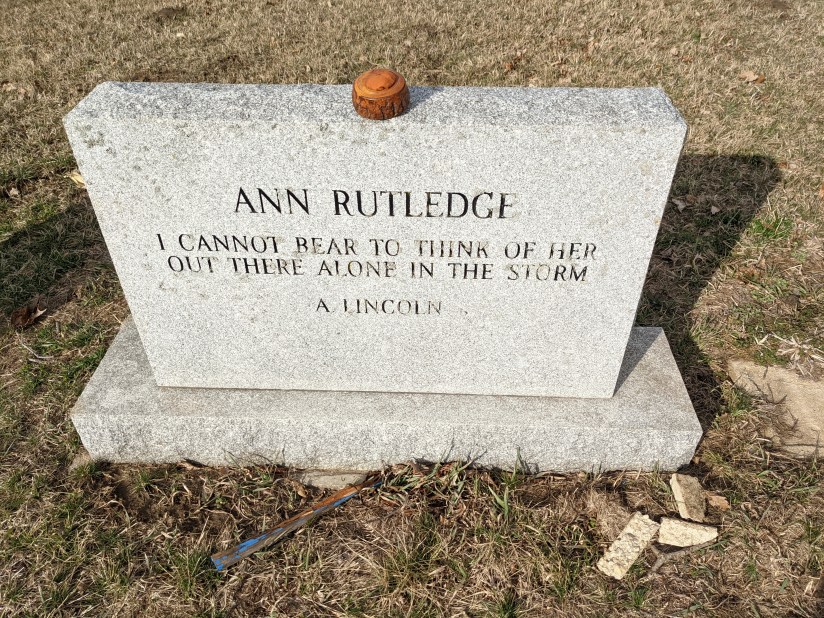
Ann Rutledge Grave Old Concord graveyard near New Salem, Illinois.
(Author’s trinket explained below)

On March 1 I visited Springfield Illinois while working on an ongoing book project. My wife Rhonda wanted me out of the house for a couple of days for heavy spring cleaning. So I took advantage of an opportunity to visit some of the places I had long wished to visit but never seemed to get to. I visited a few of the markers on Lincoln’s 400-mile 8th judicial court circuit that he regularly traveled as a young lawyer during the 1840s and 1850s. I visited the courthouse in Taylorsville, where Lincoln’s court proceedings were often interrupted by the sounds of squealing pigs rooting under the courthouse floor — once so loudly that Lincoln asked the judge for a “writ of quietus” to calm the commotion. As you might imagine, Illinois is full of interesting Lincoln sites off the beaten path.
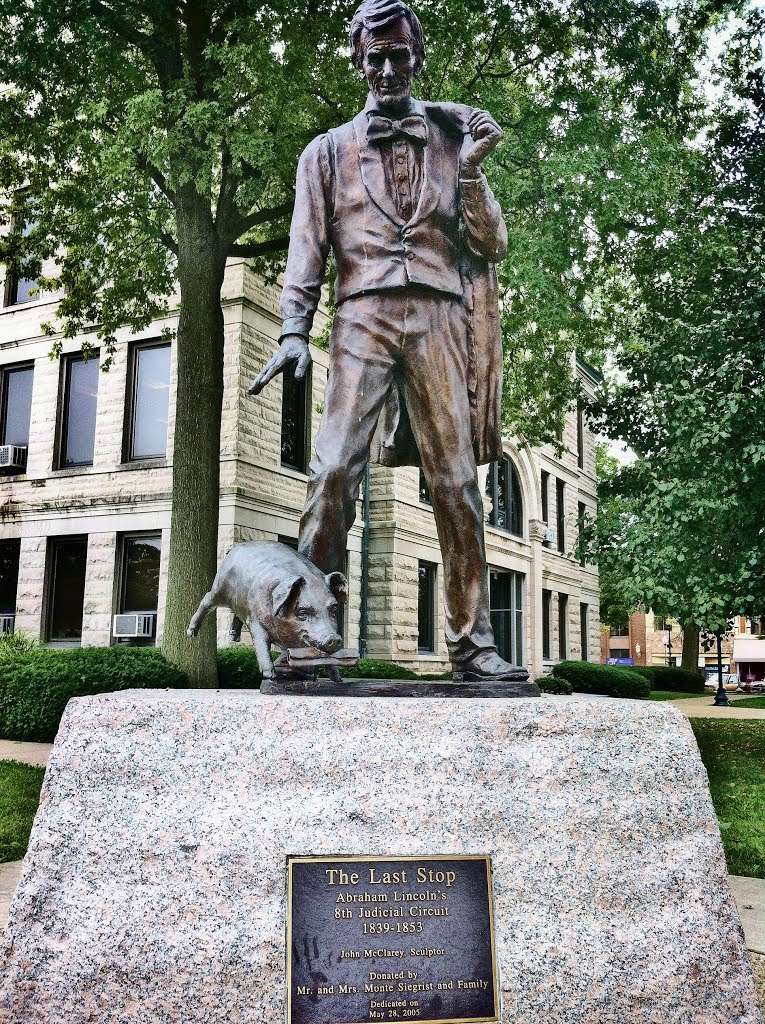
Lincoln piggy statue at Taylorsville, Illinois.

The place that I longed to see most was the final resting place of Abraham Lincoln’s first love, Ann Mayes Rutledge. She was born on January 7, 1813, near Henderson, Kentucky, the third of ten children born to Mary Ann Miller Rutledge and James Rutledge. In 1829, her father moved to Illinois and became one of the founders of New Salem, a community located 21 miles northwest of Springfield.

James Rutledge built a dam, sawmill, and gristmill in New Salem and is credited with laying out the town and selling the first lots of land there. In time, he converted his home into a tavern and inn where Ann worked — eventually, she took over the family business. Allegedly, Ann was the first (some say the only) girl to attend New Salem School. She was described as physically beautiful, 5 feet, 3 inches tall, 120 pounds with auburn hair, blue eyes, and a fair complexion. Her attitude was always positive, described as sweet and angelic, beloved by all who knew her. Her schoolteacher, Mentor Graham, described her as beautiful, amiable, kind, and an exceptionally good scholar. In 1832, young Abraham Lincoln boarded at the Rutledge Inn, where he got to know her.
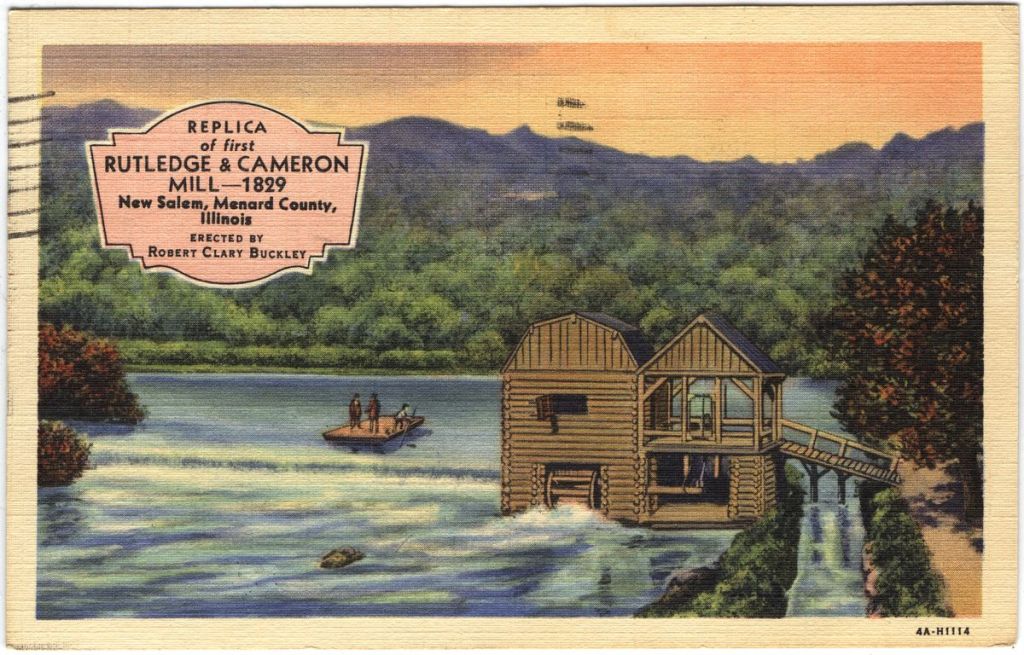
Postcard depicting the Rutledge Mill in New Salem, Illinois.

While historians may disagree on the depth of her relationship with the rail splitter, there is no doubt that Ann Rutledge knew Abraham Lincoln. Ann died before the invention of photography, so no photos of her exist and no contemporary drawings of her have ever been found. Little in the way of verifiable data survives about Ann. Most of the details of her life were collected by Lincoln’s law partner of 17 years, former Springfield Mayor William Herndon. Billy was among the first to research those early years of Lincoln. While researching his book on Lincoln, Herndon retraced Lincoln’s tracks through central Illinois and southern Indiana. Billy Herndon did not care for Mary Lincoln and the feeling was mutual. So it comes as no surprise that Herndon was the first to push the relationship between Abraham and Ann.
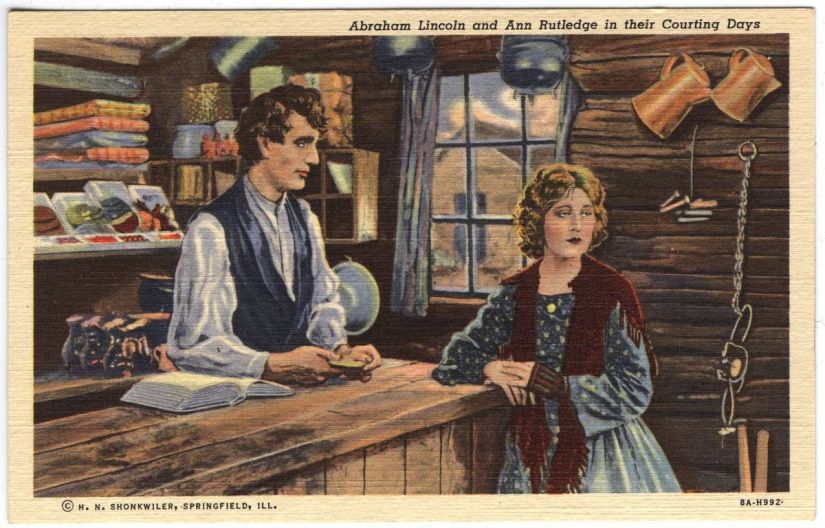
Herndon’s details about Ann’s life came from people that knew Ann in New Salem, witnesses that historians have called “Herndon’s informants.” Rutledge neighbor James Short described Ann as “a good-looking, smart, lively girl, a good housekeeper, with a moderate education.” Likewise, Harvey Lee Ross, a boarder at the Rutledge family tavern in New Salem described Ann as “very handsome and attractive, as well as industrious and sweet-spirited. I seldom saw her when she was not engaged in some occupation – knitting, sewing, waiting on tables, etc…I think she did the sewing for the entire family. Lincoln was boarding at the tavern and fell deeply in love with Ann, and she was no less in love with him. They were engaged to be married, but they had been putting off the wedding for a while, as he wanted to accumulate a little more property and she wanted to go longer to school.” When interviewed by Herndon, Ann’s family testified that Lincoln was certainly smitten with Ann.
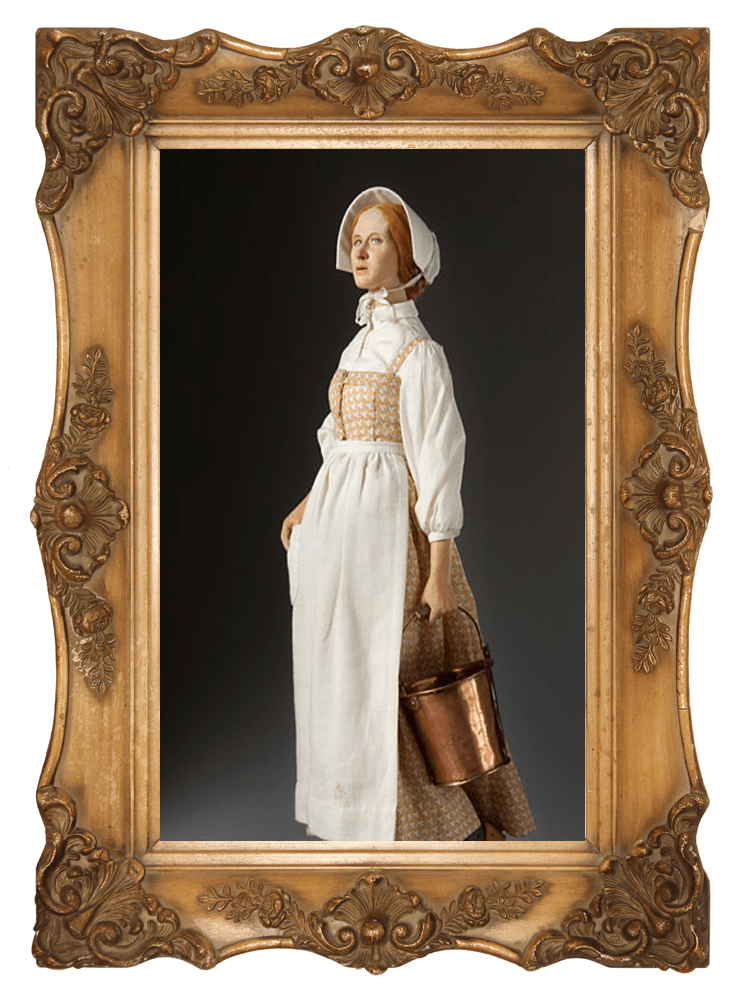
Artist and historian George S. Stuart created a likeness of Ann Rutledge based on her physical description mentioned in historical records. No known painting of Ann Rutledge exists from life.

Not only was Lincoln attracted to Ann’s good looks, but he was also intrigued by her intelligence, a rare quality on the frontier. Herndon once said “I believe his very soul was wrapped up in that lovely girl. It was his first love – the holiest thing in life – the love that cannot die.” That all changed on August 25, 1835, when typhoid fever swept through New Salem and 22-year-old Ann Rutledge died. Legend states that Ann called Lincoln to her deathbed for a final goodbye before passing. Ann’s death unhinged Lincoln, leaving him severely depressed, a condition he would battle for the rest of his life. Upon her death, Lincoln confided to Mentor Graham that he felt like committing suicide, but Graham reassured him that “God has another purpose for you.” New Salem resident John Hill later said “Lincoln bore up under it very well until some days afterward when a heavy rain fell, which unnerved him.” Lincoln’s friend, Henry McHenry, testified that after Ann’s passing Lincoln “seemed quite changed, he seemed retired, & loved solitude, he seemed wrapped in profound thought, indifferent, to transpiring events.”
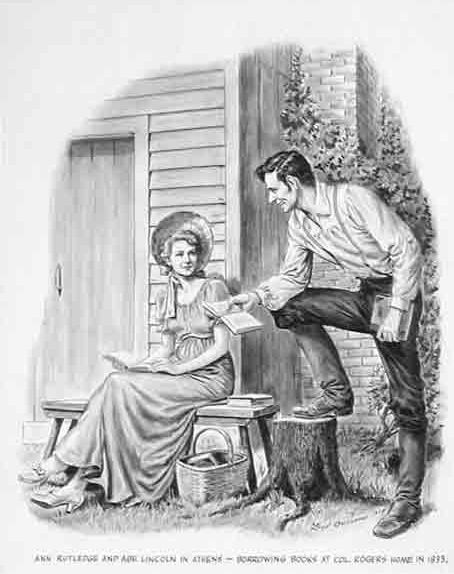
Anne Rutledge & Abraham Lincoln by artist Lloyd Ostendorf.

According to author Harvey Lee Ross in his book The Early Pioneers and Pioneer Events of the State of Illinois, Lincoln told friends: ‘My heart is buried in the grave with that dear girl. He would often go and sit by her grave and read a little pocket Testament he carried with him.” Another New Salem neighbor, Isaac Cogdal told Herndon that President-elect Lincoln confessed his love of Ann to him before leaving Springfield for Washington. “I did really – I ran off the track: it was my first. I loved the woman dearly & sacredly: she was a handsome girl – would have made a good loving wife – was natural and quite intellectual, though not highly educated…I did honestly – & truly love the girl & think often – often of her now.”
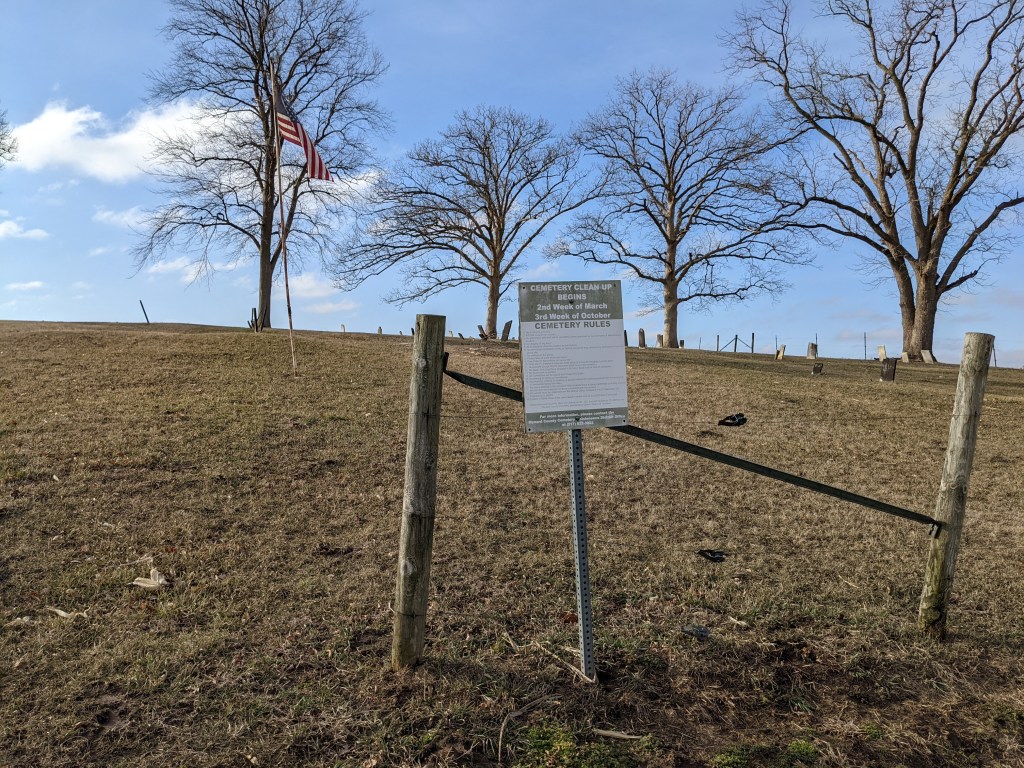
Old Concord graveyard near New Salem, Illinois.

Ann was originally buried at the Old Concord graveyard (sometimes called Goodpasture graveyard) a pioneer cemetery located about seven miles northwest of New Salem. Some 200 people were buried there, many of whom knew Abraham and Ann personally. Today they stand as silent sentinels to the truthfulness of their courtship. Lincoln visited her gravesite frequently. According to Herndon, after Ann’s death, Lincoln “sorrowed and grieved, rambled over the hills and through the forests, day and night. He suffered and bore it for a while like a great man — a philosopher. He slept not, he ate not, joyed not. This he did until his body became emaciated and weak, and gave way. In his imagination he muttered words to her he loved … Love, future happiness, death, sorrow, grief, and pure and perfect despair, the want of sleep, the want of food, a cracked and aching heart, and intense thought, soon worked a partial wreck of body and of mind.”
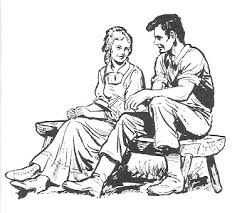
Rutledge and Lincoln.

To friends, Lincoln claimed that the thought of “the snows and rains fall(ing) upon her grave filled him with indescribable grief.” For days following her death, damp, stormy days, and gloomy weather triggered a deep depression that sent Lincoln to her gravesite where he lay prostrate over Ann’s grave. Lincoln’s behavior became so alarming that his friends sent him to the house of another kind friend, Bowlin Greene, who lived in a secluded spot hidden by the hills, a mile south of town. According to Herndon, “Here Lincoln remained for weeks under the care and ever-watchful eye of this noble friend, who gradually brought him back to reason or at least a realization of his true condition.” Yes, Abraham Lincoln knew Old Concord Graveyard well.
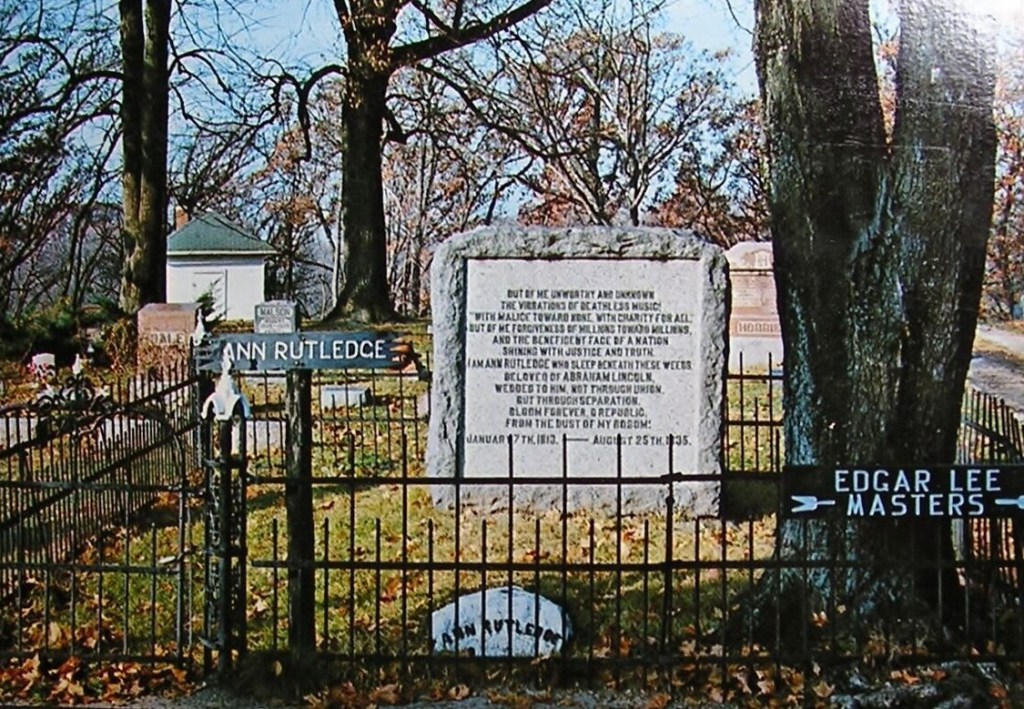
Postcard image of Ann Rutledge’s relocated grave in Oakland Cemetery in Petersburg, Illinois.
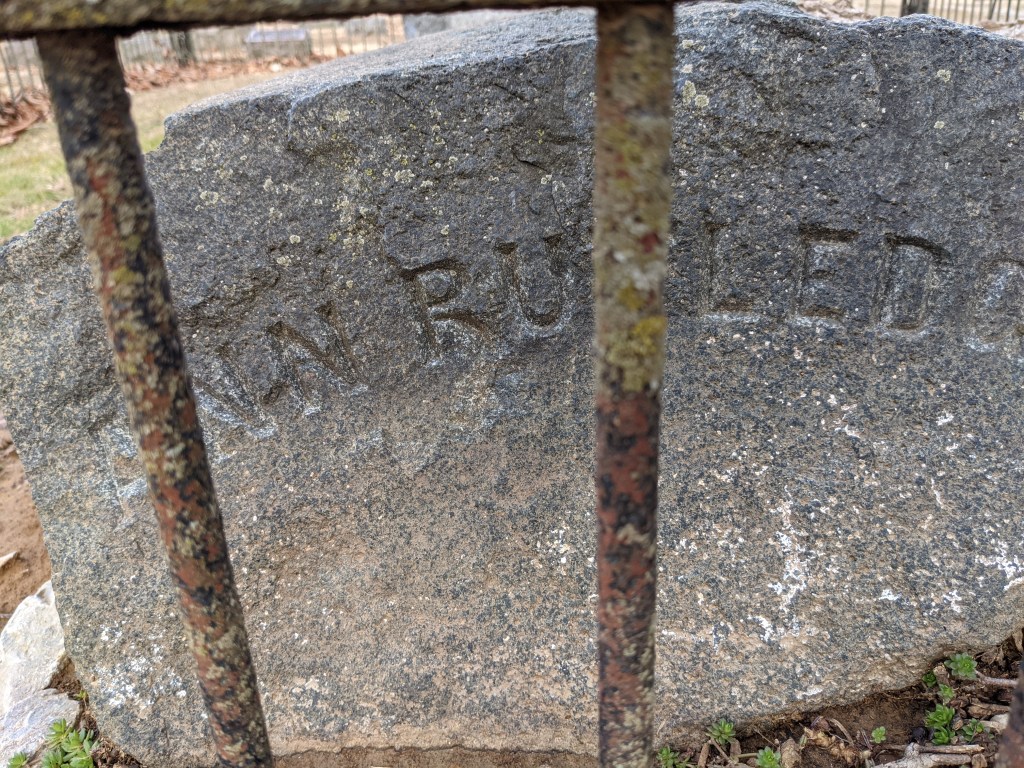
PImage of Ann Rutledge’s smaller grave marker n Oakland Cemetery in Petersburg, Illinois today.
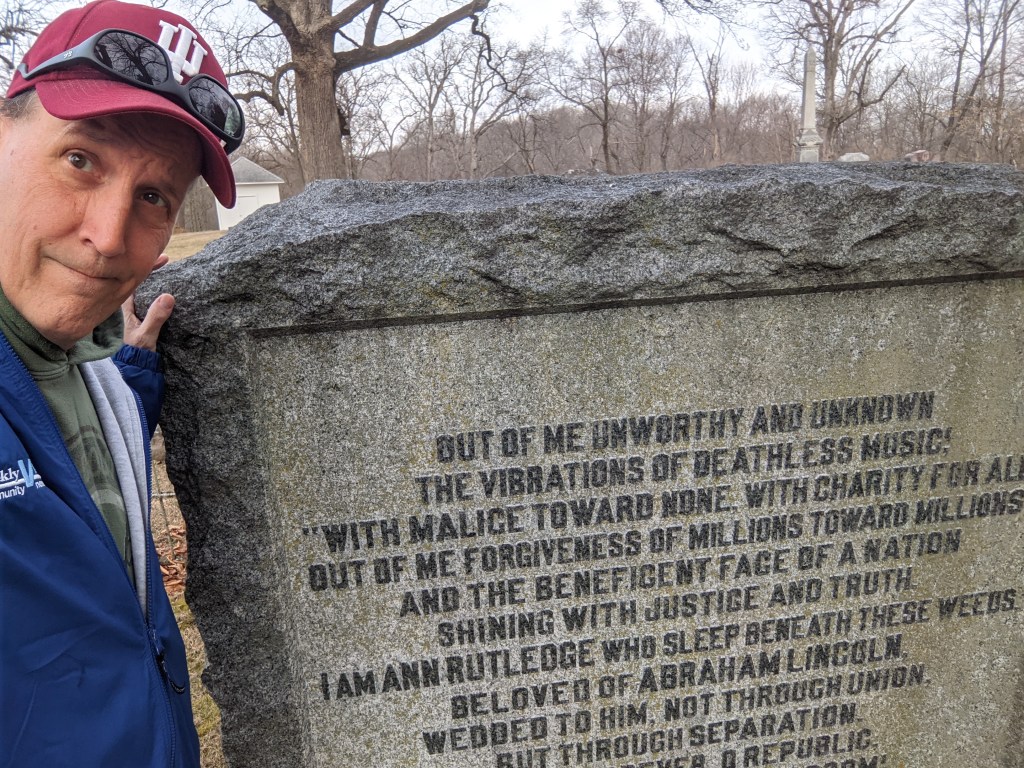
The author at Rutledge’s grave marker with the Edgar Lee Masters quote on back.

Here’s where the story takes a strange turn. Many years later, some enterprising citizens of nearby Petersburg, a town located four miles to the north, decided that Ann’s grave could help put their town on the map. Chief among them was Petersburg undertaker Samual Montgomery, ironically an elderly relative of Ann’s, and a cemetery promoter with the improbable name of D.M. Bone. These ad-hoc graverobbers decided it would be financially advantageous to move Rutledge’s remains for fear that their cemetery needed the draw of a famous name to compete with crosstown rival Rose Cemetery.
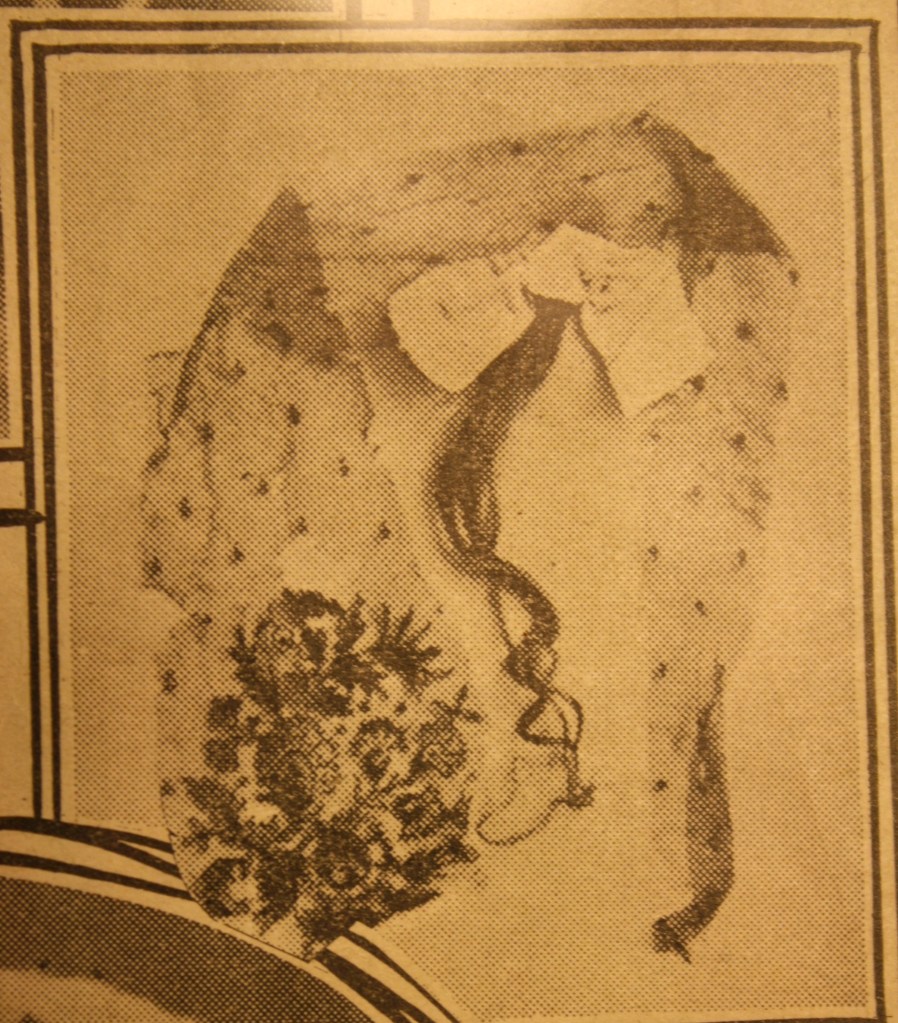
Intriguing object from Osborn H. Oldroyd’s Lincoln Museum collection in the Lincoln Home in Springfield and the House Where Lincoln Died in Washington DC. Oldroyd published a photo of a large swatch of cloth from a dress once worn by Ann Rutledge along with a long curly lock of her hair in a photo he captioned “Relics of Ann Rutledge”. Where these items are today remains unknown.

For three decades, all that marked Ann’s grave at the new cemetery was a rough stone with her name emblazoned in white letters on the front. In January 1921, Rutledge’s grave was fitted out with a magnificent granite monument inscribed with the text of the poem “Anne Rutledge,” from Edgar Lee Masters’s Spoon River Anthology. His words, engraved on her cenotaph at Oakland Cemetery are haunting: “I am Ann Rutledge who sleeps beneath these weeds, Beloved in life of Abraham Lincoln, Wedded to him, not through union, But through separation. Bloom forever, O Republic, From the dust of my bosom!” Regardless of the attempts by Lincoln biographers like Herndon, Ward Hill Lamon (Lincoln’s bodyguard), Carl Sandburg, and Indiana Senator Albert Beveridge to legitimize the Lincoln/Rutledge romance as fact, by the 1930-40s, Lincoln scholars expressed increased skepticism of the story. Most biographers agree that Lincoln and Rutledge were close, but several historians point to a lack of evidence of a love affair between them.
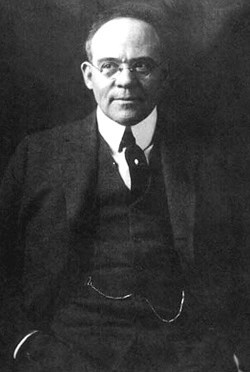
Poet Edgar Lee Masters.

For my part, as a lifelong student of Lincoln, I choose it to be true. It is for that reason that I traveled to Petersburg, Illinois in search of Ann Rutledge’s grave. Finding Oakland Cemetery is an easy task and worth the visit. The massive granite marker is the most impressive memorial in the graveyard. Surrounded by an equally impressive wrought iron fence, the rough stone marker that originally graced her final resting place remains tucked away at the front of the plot although her name is slowly eroding away. Edgar Lee Masters’ epitaph is clear, legible, and easy to read. Master’s grave is only yards away. As impressive as the site may be, if you know the backstory, an overpowering soullessness pervades the spot simply because she is not there.
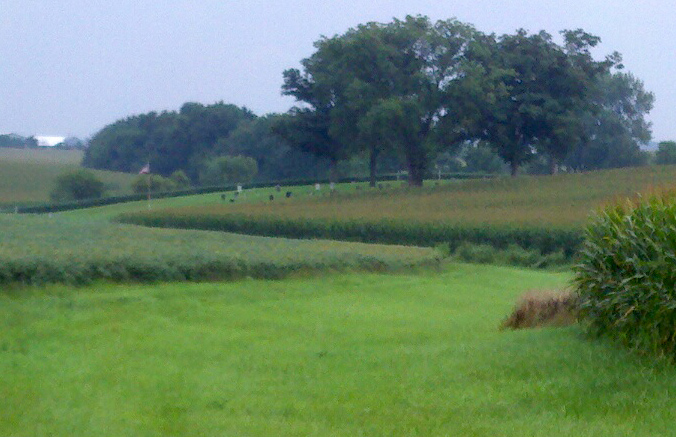
Old Concord graveyard near New Salem, Illinois showing the waterway road between cornfields.
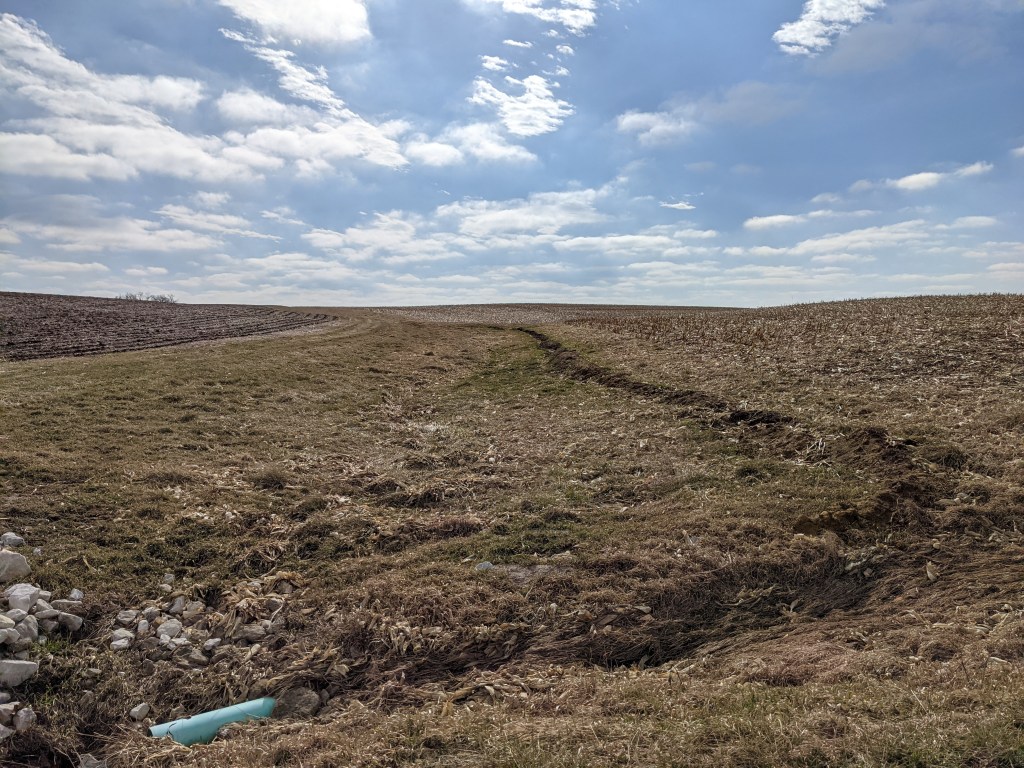
Looking back towards the road from the dried-up waterway route from the graveyard.

The place I really wanted to find was the Old Concord Graveyard. So I did what every stranger in a strange place does: I consulted Google maps. Oh, the navigator took me there, but just barely. The map directions led me to Route 97 North and the Lincoln Trail Road through the farm fields of Menard County, off the paved highway, and onto a gravel road. Like most midwestern roads, the winding serpentine roadways mimic the buffalo traces of centuries past. They wind through hills cut not by machinery, but by carts pulled by oxen and horses generations ago. Blind hills make the driver wonder if the road continues past each rise and dangerous curves make you tighten your grip on the steering wheel. Along the way, pheasants and quail stroll leisurely along the roadside. This is their domain and they fear no man out here.
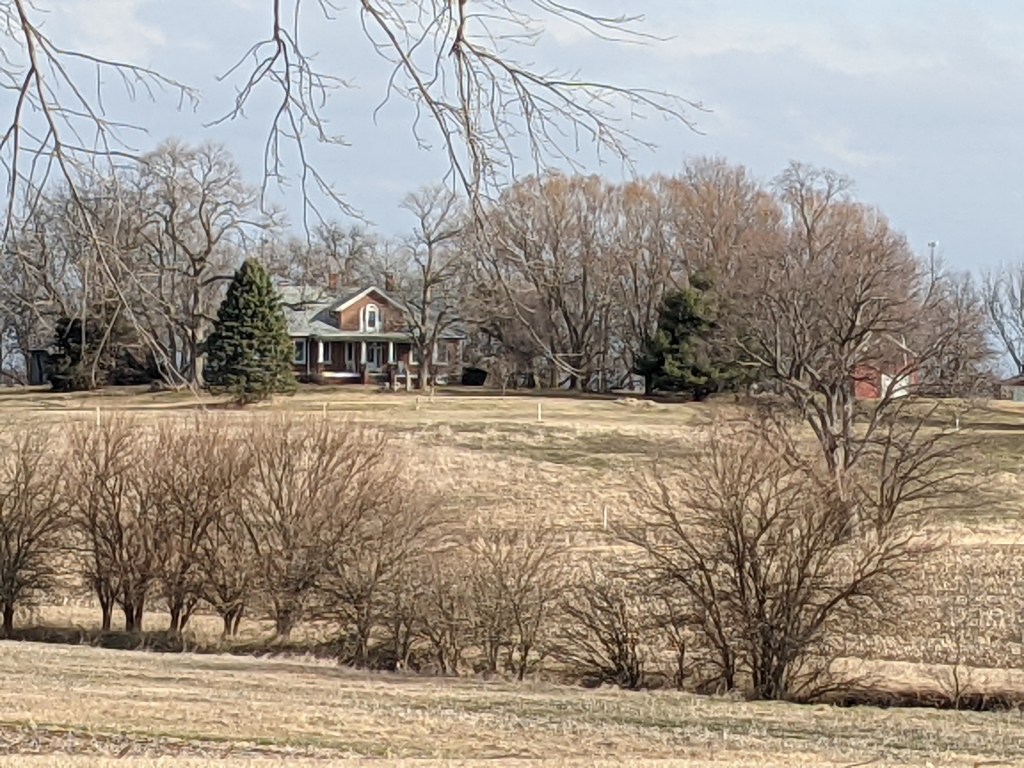
The brick farmhouse where the original path to the Concord Graveyard once began.

Time and time again, my GPS ended in front of a brick farmhouse proclaiming “You have reached your destination.” This was not a cemetery, so I retraced my route, and five miles later, I found myself in the same spot. Finally, I pulled into the driveway and knocked on the door. My summons was answered by a friendly dog followed by a lovely mature woman. I threw myself upon the mercy of a stranger, apologized for the intrusion, and asked if this was the place. She smiled and said, “Well, you’re close” and led me to the side of the house where she pointed to the cemetery about a half mile in the distance.

She told me to head back out on the county road and keep turning left until I found an abandoned, dried-up waterway through a pair of cornfields. She said, “It is not really a road but the county crews still drive their equipment back there to keep the grass cut, so you should be able to find it,” The cemetery can not be seen from the gravel road, so it took me two passes to find it. When I did, I nervously went offroading about a quarter mile back upon a grassy lane between two cornfields. It had been raining before my arrival and rain was predicted for later that day, so I was less than confident that I could make it without getting stuck. Luckily, I arrived there safely.

Jack Armstrong of the Clary Grove Boys Gang Grave Marker.

The ancient graveyard is filled with veterans of the Revolutionary War like Robert Armstrong from North Carolina who died September 9th, 1834. Next to Robert is the marker of his son, Jack Armstrong of the Clary Grove gang, who famously fought Abe Lincoln to a draw in a wrestling match in New Salem. The battle became the stuff of legend and ultimately got Lincoln inducted into the Wrestling Hall of Fame. It did nothing for Jack Armstrong though. He died in 1854 although his stone incorrectly lists the death date as 1857. Most of the stones have been laid down face up so that they may still be read. Many are broken and rest in pieces strewn about in this ancient burying ground. A flagpole stands guard with a tattered American flag that shows the scars of a constant battle with the rough winds of the Illinois plains.
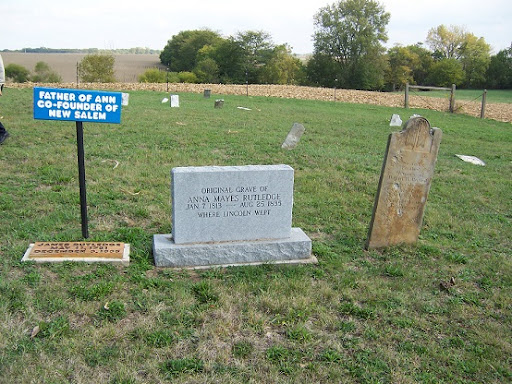
The Rutledge family plot.

Ann’s grave rests on top of the hill next to that of her father, whose body was not removed to the new cemetery. Also near Ann is the grave of her brother David who died in 1842, a decade after serving with Abraham Lincoln in the Black Hawk War. There are many Rutledges still resting here. It is likely that most, if not all of them, were known by Ann or she by them. From Ann’s grave, I could look over my shoulder and see the farmhouse where I started. I wonder to myself what it would be like to live so close to such a magical place. Talking with the lady she told me they had been living there for 30 years. They had directed a few travelers like me to the spot, but not many. She informed me that her home was built by the Grosbaugh family and that it would have been there in 1835 when Ann drew Lincoln there. She pointed to an ancient natural stone step in the sideyard between her house and the graveyard and stated, “This was the watering trough and buggy turnaround, the start of a path that used to lead directly to the cemetery. It hasn’t been used in over a century.”
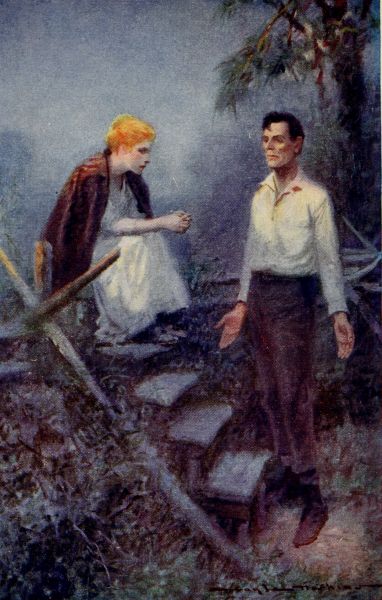
“ABRAHAM, THIS PLACE SEEMS HOLY AND YOU ARE ITS PROPHET” from the book “The Soul of Ann Rutledge”.

I’ve chased Lincoln all over this country. I’m sure I have stepped in his footprints many times. This spot, the Old Concord Cemetery, is the toughest Lincoln site I have ever found. It is impossible to find on your own and no map will lead you here. Here young Abraham Lincoln came day after day to mourn over his lost love. Here he lay upon her grave from autumn to winter, protecting her because he could not bear the thought of it raining or snowing upon her mortal remains. Today, a modern stone rests in Old Concord Graveyard on the spot that reads: “Original Grave of Ann Mayes Rutledge Jan. 7, 1813-August 25, 1835. Where Lincoln Wept.” Lincoln was here and here Ann remains. Her body literally melted into the soil of the central Illinois prairie. Here is the lone individual spot where anyone may visit to experience the raw emotion that was Abraham Lincoln.
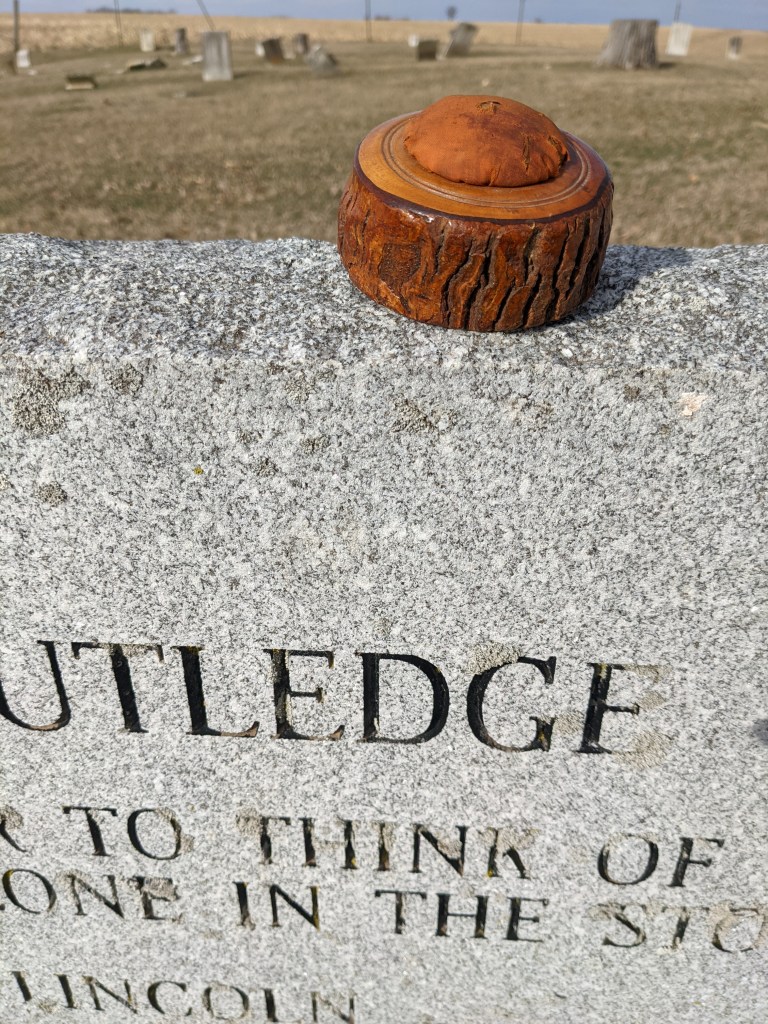
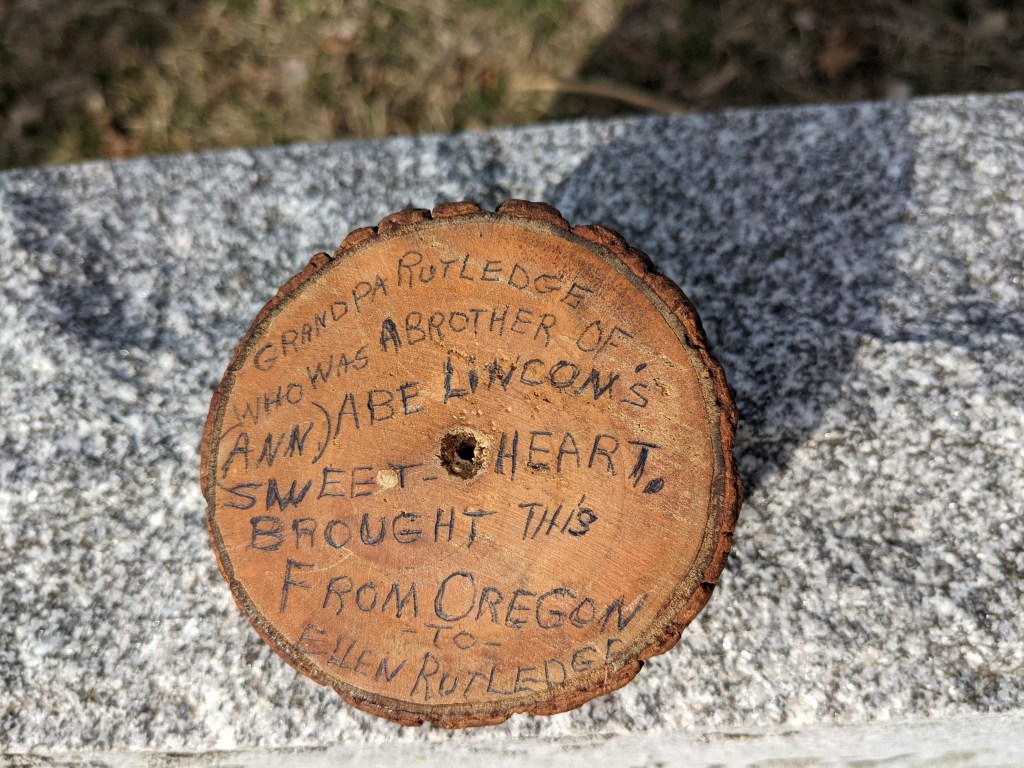
For my trip, I brought along this little item from my personal collection. A pin cushion made from an Oregon tree. Once the property of Ann Rutledge’s brother. It is pictured resting upon the marker above.
Music, Pop Culture, Television

Parky’s Place.

Original publish date August 31, 2023. https://weeklyview.net/2023/08/31/parkys-place/

Parky’s Place Harry Einstein (1904-1958)

Recently I wrote an article about a couple of photos of Dick the Bruiser I found along the route of the World’s Longest Yardsale that stretches from Alabama to Michigan. I have an affinity for old photos (and old paper in general) and always linger a little bit longer when I see them for sale on a dealer’s table. This particular spot was inside a tent near the Alvin C. York General Store and Visitor’s Center in Pall Mall, Tennessee. I bought several old promo photos of Country Music Stars (termed “Hillbilly Music” back in the day) from the 1940-50s Era. Hank Williams, Sr., Roy Acuff, Red Foley, and a few more. Also among them was an old promo still dated 1947 from the Mutual Broadcasting System for a radio show called “Meet Me At Parky’s” that aired on Sunday nights from 9:00 to 9:30. Since I can remember trivial minutia better than I can family birthdays, I knew the backstory and bought the photo.

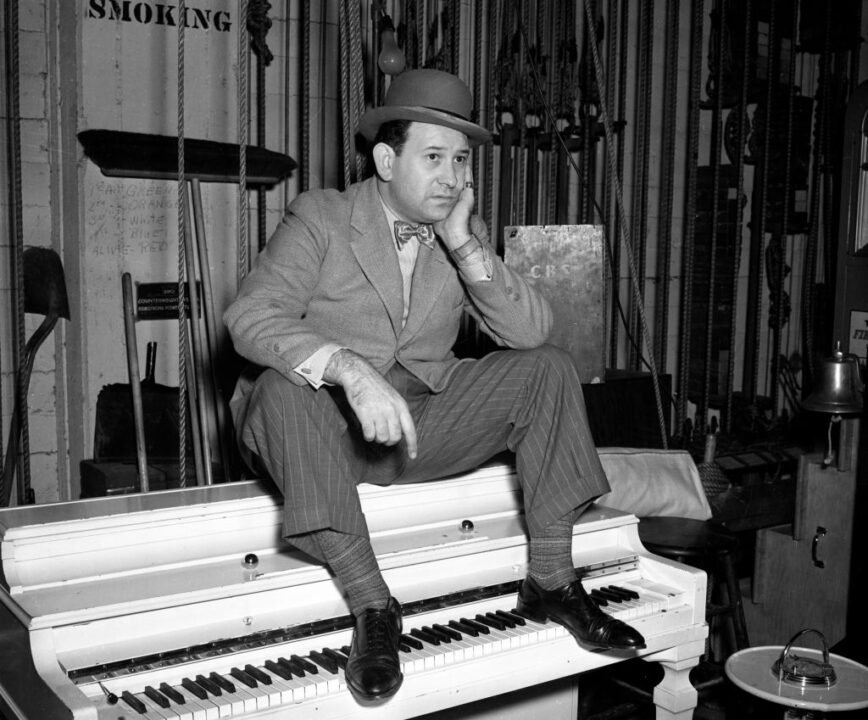
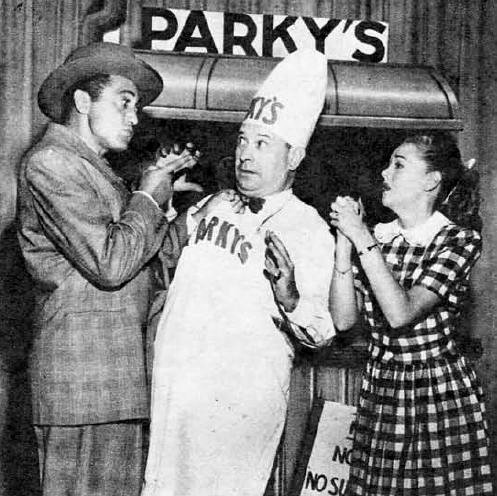
CBS Radio comic personality Harry Einstein portrays his character Parkyakarkus on The Al Jolson Show. Image dated February 1, 1938. Hollywood, CA. (Photo by CBS via Getty Images)

I seriously doubt anyone reading this column was around in 1947 to listen to this radio show, so, I’ll share what I know about it. The photo pictures comedian Harry Einstein posed leaning atop a kitchen counter with a cigar in his hand, a wink in his eye, and a chef’s hat with the name “Parky’s” on the front. Einstein, better known by the stage names Nick Parkyakarkus or Harry Parke, was an American comedian, writer, and character actor whose specialty was Greek dialect comedy. A natural humorist, Einstein came to comedy quite by accident. Born on May 6, 1904, in Boston, Mass., to a Jewish mother from Russia and a Jewish pawnbroker father from Austria, Einstein first worked as a newspaper reporter but eventually moved into advertising for Boston’s Hearst Newspapers.

On nights and weekends, Harry enjoyed performing comedy routines for friends at parties, in nightclubs, taverns, and Bar / Bat Mitzvahs. In 1924, he became a fan favorite on radio as “The Bad Boy from a Good Home”, doing comedy skits on Boston station WEEI (AM). He also worked in advertising for the Taylor Furniture Company, where he managed their radio department. He branched out in the advertising business and was soon doing the same for another larger Boston furniture store named Summerfield’s. Boston bandleader Joe Rines, a close friend at the station, tried to convince Harry to become a full-time comedian, but Harry was making a good living as advertising manager for three Boston Furniture stores. Einstein relented and began appearing on Rines’ radio program in his spare time. It was here that Harry created the Pigeon-English-speaking pseudo-Greek character of Nick Parkyakarkus for a skit on Rines’ radio show. At the time, no one blinked an eye at the “political correctness” of ethnic humor, and Harry always brought down the house.

Listeners loved the Parkyakarkus character and it didn’t take long for the national networks to take notice. Einstein got his big break nationally when he was hired as a performer on Eddie Cantor’s radio show in 1934. That led to a part-time gig on the Al Jolson show. Cantor and Jolson were big Hollywood names and soon Tinseltown came calling. In 1936 he appeared alongside Cantor in Strike Me Pink (co-starring Ethel Merman and William Frawley aka Fred Mertz from “I Love Lucy”), the next year he appeared in The Life of the Party and New Faces of 1937 (alongside Milton Berle). While filming the latter, he met his second wife, actress Thelma Leeds. From 1936 to 1945, Harry appeared as his Parkyakarkas character in eleven films. Einstein’s character name became so inextricably linked to him that, in the 1930s, Harry attempted to change his name legally to Parkyakarkus; the judge denied the request (although his star at 1708 Vine Street on the Hollywood Walk of Fame bears his character’s name instead of his own.)

Einstein as Parky between Sheldon Leonard and Betty Rhodes in 1948.

In June of 1945, Einstein began a radio show of his own called Meet Me at Parky’s, The show featured Einstein as Greek restaurant owner Nick Parkyakarkus. A typical show opened with a couple of short sketches, a short comic monologue by Parkyakarkus (sure to have the live audience rolling in the aisles), followed by the show’s singer (Betty Jane Rhodes) showing up to help Parkyakarkus with that week’s problem. Einstein wrote the scripts himself and the show co-starred Sheldon Leonard, fresh off his role as Nick the Bartender in It’s a Wonderful Life the year before. In the 1960s, Leonard would trade his actor’s chair for a producer’s megaphone creating shows like The Andy Griffith Show, Gomer Pyle U.S.M.C., The Dick Van Dyke Show, and I Spy. Parky’s Place ran for two seasons on NBC before moving to the Mutual Broadcasting System in 1947 for its third and final season, ending in November of 1948. After the show ended, Einstein became a highly sought-after guest and emcee on the Borscht Belt (or Yiddish Alps as some comics called it) in New York’s Catskill Mountains and the Friars’ Club of New York City.

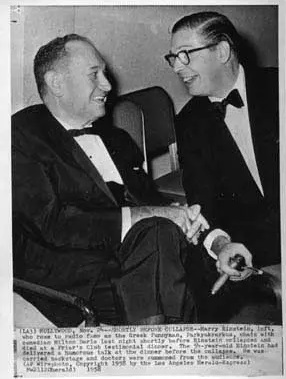
Harry Einstein and Milton Berle.

On Sunday, November 23, 1958, almost exactly a decade after his radio show ended, Einstein was a featured performer on the dais as the Friars Club inducted two new members: Lucille Ball and Desi Arnaz, the ultra-famous wife-and-husband team that created I Love Lucy. These events were traditional “Roasts” where comics, performers, friends, and fellow club members would tease and cajole the honorees, sometimes mercilessly. 1200 people packed the International Ballroom at the Beverly Hilton Hotel for the $200-a-plate testimonial dinner to Television’s original power couple. Art Linkletter was the emcee and alongside Einstein on the dais were Dean Martin, Sammy Davis, Jr., George Burns, Danny Thomas, George Murphy, and Milton Berle. Harry was the second to last speaker, and everyone agreed that his toast was the funniest of the night. Harry butchered the couple’s names, calling them Danny Arnaz and Lucille Bowles, while poking fun at Desi’s immigration status and the Friars’ Club’s “strict” rules of eligibility which included “many prominent businessmen, several fine judges, and quite a few defendants.” His routine lasted 10 minutes and, according to Milton Berle, “closed with a standing ovation.”

Harry Einstein.

Einstein took his seat next to Milton Berle as Emcee Linkletter wiped tears of laughter from his eyes and exclaimed, “Every time he finishes, I ask myself, why isn’t he on the air in a prime time?” To which, Harry turned to Berle and said, “Yeah, how come?” According to Linkletter, those were Harry’s last words before he slumped over, put his head on Milton Berle’s lap, and shut his eyes. Everyone thought it was part of the routine. Berle shouted “Is there a doctor in the house?” but the crowd thought it was a humorous ad-lib; part of the show. Harry’s wife, Thelma, who was seated to the left of comic Ed Wynn, knew immediately what was wrong and rushed to the stage. She fumbled in her husband’s pocket for a bottle of nitroglycerin pills, designed to increase the blood flow through his coronary arteries. But Harry’s teeth were clenched tight and she could not get the pill into his mouth. Ed Wynn, whose distinctive high-pitched giggly voice created Walt Disney’s mad-hatter, created an unintentionally humorous aside by repeatedly calling out, “Is there a doctor in the house?” as Einstein lay helpless on the floor of the platform. Luckily, the event had been a charity benefit for local hospitals and several physicians were in attendance.

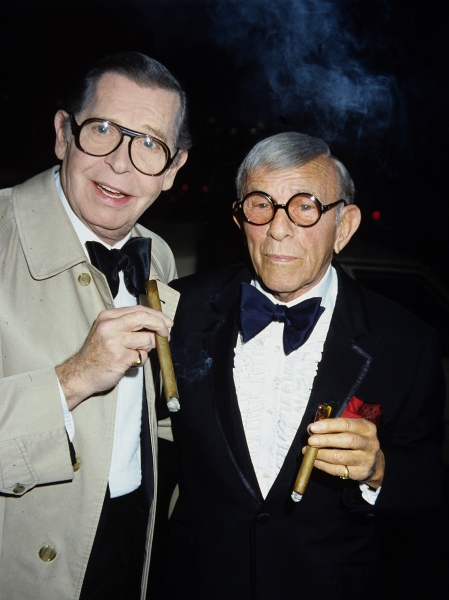
Milton Berle & George Burns.

Berle and George Burns assisted others by carrying Einstein backstage, where five physicians worked to revive him. Amazingly, one of the physicians pulled a pocketknife out of his pocket, sterilized it quickly, then sliced open Einstein’s chest and within seconds was holding Harry’s heart in his hands, massaging it in an attempt to get it beating again. One report states that another doctor yanked an electrical cord from a nearby lamp and placed the live ends against the exposed heart as an improvised defibrillator. The combined effort of five doctors working tirelessly, literally taking turns massaging the heart, brought Einstein back to life, but only temporarily. It was later determined that Harry Einstein had literally died on stage. EMTs arrived and worked backstage to save Einstein’s life.

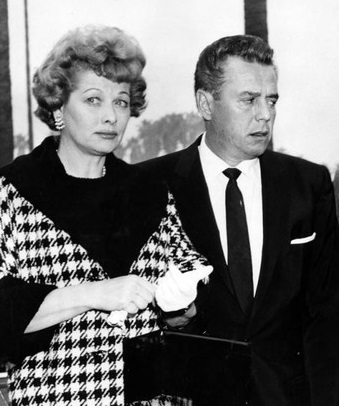
Lucille Ball & Desi Arnaz at Einstein’s Funeral.

On the other side of the curtain, the show was going on. Well, sort of anyway. George Burns sang a song from his Vaudeville days and assured the guests that “Parky will be alright.” But somehow, everyone on the dais knew better. Berle called to crooner Tony Martin, imploring him to sing a song. Martin began to sing the song There’s No Tomorrow. Obviously, that didn’t help. Desi and Lucy were to be the evening’s closing speakers. When Desi took the podium, his face was ashen and his countenance grim. Lucille Ball then came to the microphone and managed only, “I can say nothing,” through tears. Desi spoke into the microphone in almost a whisper, “This is one of the moments that Lucy and I have waited a lifetime for, but it’s meaningless. They say the show must go on. But why must it? Let’s close the show now by praying for this wonderful man backstage who made the world laugh.” Arnaz took the award from Linkletter and shoved it into his pocket. Sammy Davis, Jr. was supposed to sing a closing song, but he was so emotional that he could not do it.

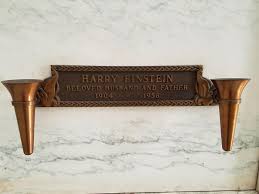
Harry Einstein’s Grave Home of Peace mausoleum L.A.

Despite two hours of continuous resuscitation attempts, Harry Einstein was pronounced dead at 1:20 a.m. on November 24. He was 54 years old. Einstein’s funeral service was attended by 300 mourners. George Jessel delivered the eulogy. Einstein is buried not far from the Three Stooges Moe & Curly Howard, Louis B. Mayer, & the Warner Brothers in the Home of Peace mausoleum, the first and oldest Jewish cemetery in Los Angeles.

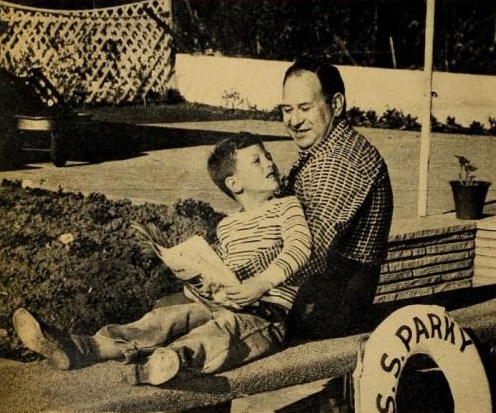
Harry Einstein and son.

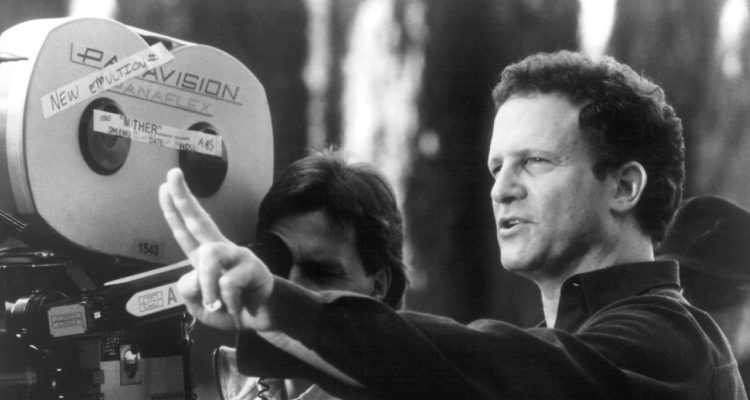
Harry Einstein was the father of four sons: Albert, Bob, Charles, and Clifford Einstein. That’s comedians Albert Brooks and Bob Einstein. Albert is best known as an Academy Award-nominated actor (Broadcast News-1987) but also for Taxi Driver (1976), Private Benjamin (1980), and Unfaithfully Yours (1984). He has written and directed several comedy films; Modern Romance (1981), Lost in America (1985), and Defending Your Life (1991). His voice acting credits include Marlin in Finding Nemo (2003) and Finding Dory (2016), Tiberius in The Secret Life of Pets (2016), and several one-time characters in The Simpsons.

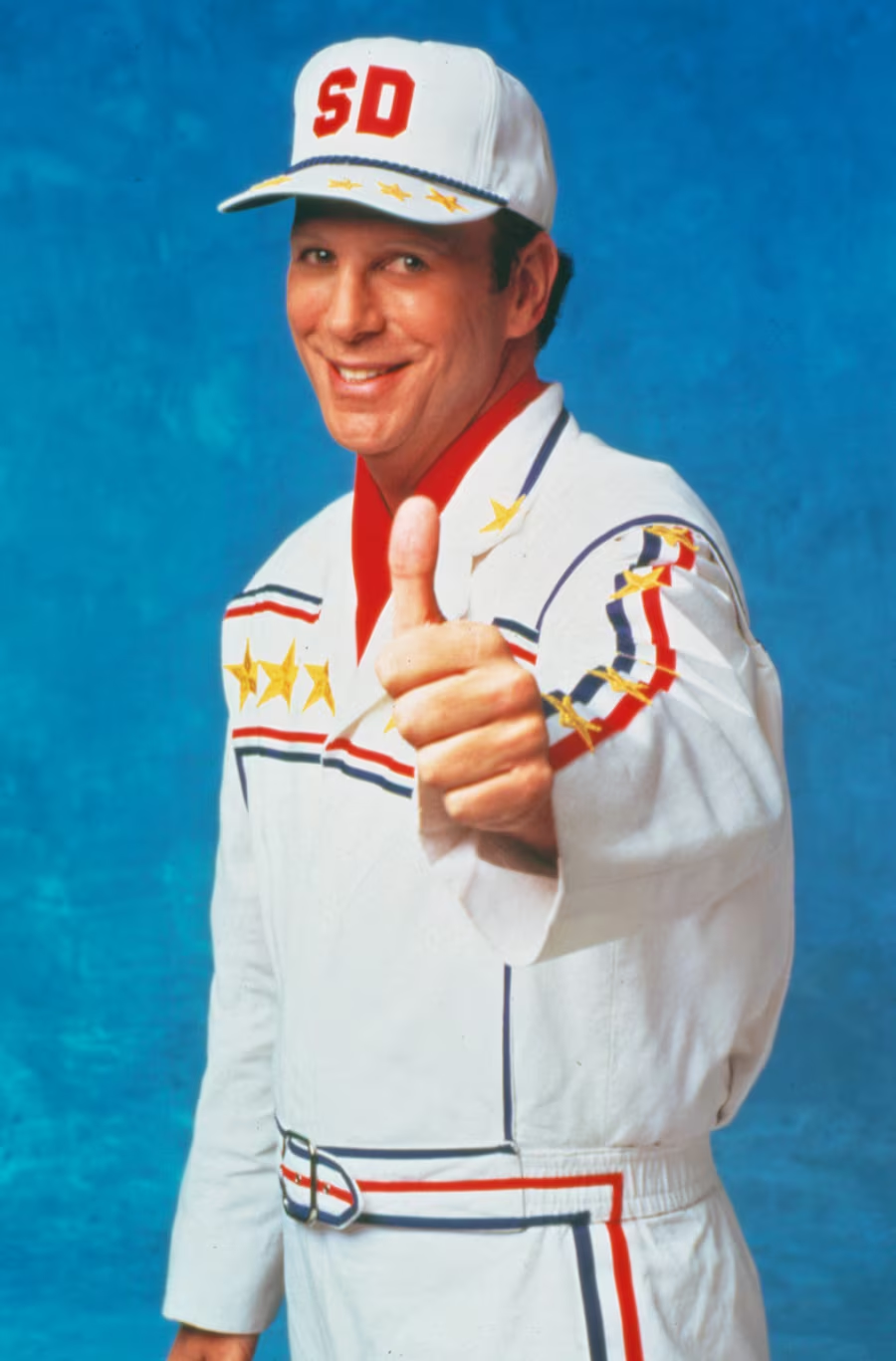
Bob Einstein as Super Dave Osborne.

Bob Einstein is best remembered for the character he created known as Super Dave Osborne, a satirical stuntman character who repeatedly survived deadly stunts. But he was also known for his roles as Marty Funkhouser in Curb Your Enthusiasm, and Larry Middleman on Arrested Development. Einstein got his start as a writer for several television variety shows, including The Smothers Brothers Comedy Hour and The Sonny & Cher Comedy Hour for which he won two Emmy Awards (he was nominated four other times). He also won a CableACE Award for acting as Super Dave, along with five other nominations.

Actor / Director Albert Brooks.

Albert Brooks, who was 11 years old when Einstein died, has addressed his father’s death briefly in his movie, Defending Your Life. In the film, Brooks’s recently deceased character, Daniel Miller, finds himself in an afterlife nightclub, watching a terrible comedian. “How’d you die?” the comic asks him; Albert replies, “Onstage, like you.” When Meryl Streep’s character invites Albert to leave with her. “I can’t,” he says, gesturing toward the stage. “That’s my father.” Bob (Super Dave) Osborne, really never got over his dad’s death. In an episode of Comedians in Cars Getting Coffee, Einstein, who was 16 years old when his father died, tells host Jerry Seinfeld that his father’s death turned him off from performing for many years. Specifically, he was highly offended by the fact that both Milton Berle and George Jessel performed their comedy routines as eulogies at Harry Einstein’s funeral, feeling it was insensitive, and this made him uncomfortable with comedy. Now you know the story behind that Highway 127 photograph. It just goes to show you, sometimes, a picture really is worth a thousand words.

Criminals, Health & Medicine, Indianapolis, Medicine

THE BREATHALYZER

Original publish date February 22, 2024. https://weeklyview.net/2024/02/22/the-breathalyzer/

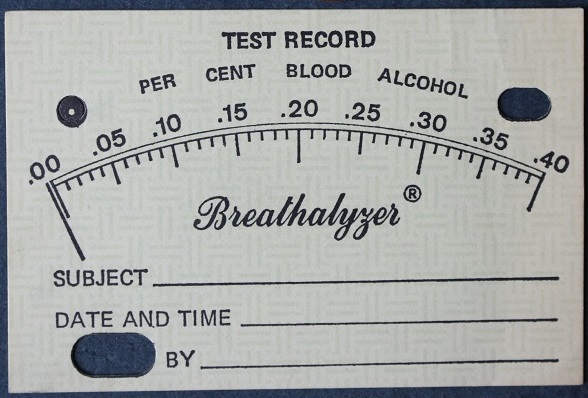
Recently, I found myself at an antique show rummaging through a small box of paper, not unfamiliar territory for me. The usual: postcards, coupons, ads, snapshot photos. Then my fingers danced past a small greenish-colored slip of paper with a frozen gauge chart numbered .00 to .40 and a pair of machine-cut holes in the corners. Titled “Breathalyzer” it was identified as a “Test Meter” to measure “Per Cent Blood Alcohol” with an unused 3-line identifier at the bottom for the “Subject” name, “Date and Time”, and name of the person administering the test. Okay, we all know what it means (some more than others) and if we are smart (or lucky) we have managed to avoid these at all costs in our lifetimes.

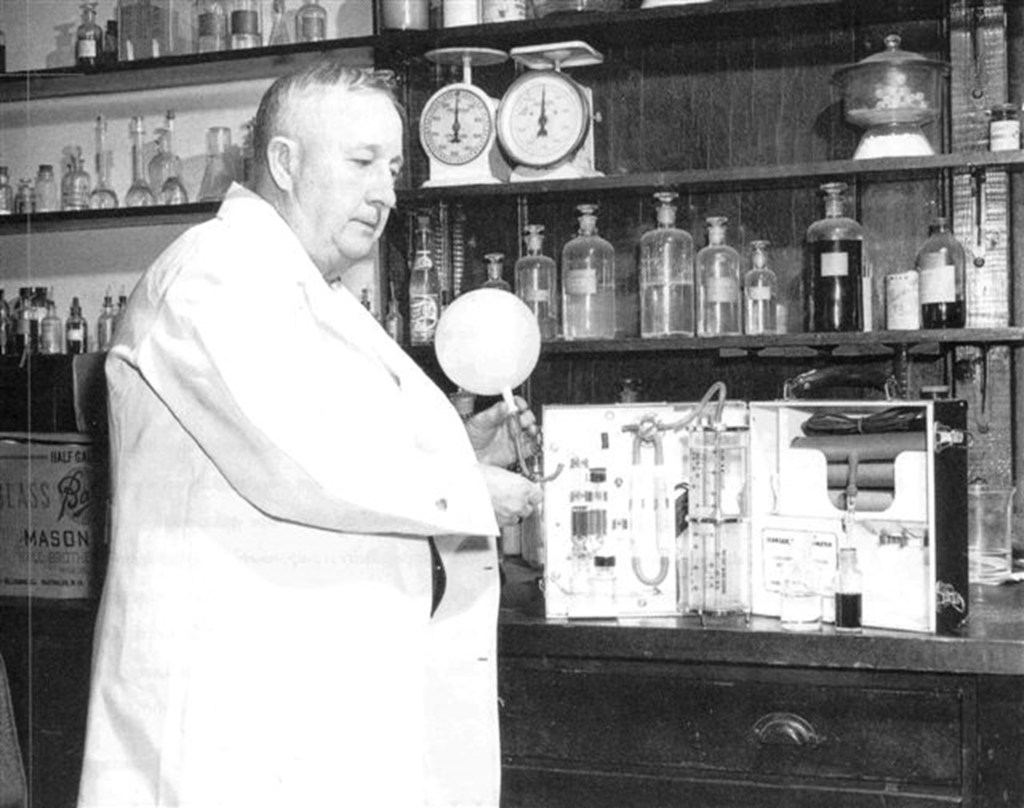
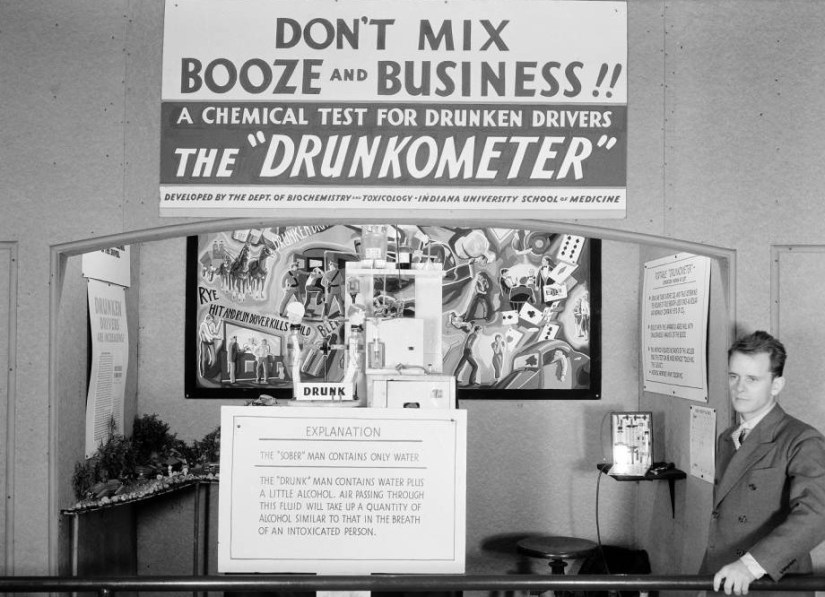
But did you know that the “Breathalyzer” instrument, known around the world as the “Breath of Death”, the “Intoxalock”, or the “Booze Kazoo”, was invented in Indiana? In 1931, a 41-year-old toxicology professor at Indiana University named Rolla Harger invented the first practical roadside breath-testing device called the Drunkometer. He was awarded a patent for it in 1936. The Drunkometer collected a sample of the motorist’s breath when the driver blew directly into a balloon attached to the machine. The breath sample was then pumped through an acidified potassium permanganate solution and if there was alcohol in the sample, the solution changed color. The greater the color change, the more alcohol there was present in the breath.

Rolla Neil Harger (January 14, 1890 – August 8, 1983).

In 1922, Harger became an assistant professor at Indiana University School of Medicine in the newly formed Department of Biochemistry and Pharmacology. He served as the department chairman from 1933 to 1956 and worked continuously in the department until 1960. However, the bulky Drunkometer proved impractical and unportable. The test required the suspected impaired driver to effectively inflate a balloon (a challenging task for some drunk or sober), which was then taken to the machine at police headquarters. This time-consuming, awkward process depended on the visual skills of the technician analyzing the sample-an Achilles heel that defense lawyers were often successful contesting. The Drunkometer eventually fell out of favor with police officers who saw it as complicated and unreliable. Police instead preferred to administer roadside dexterity tests to determine intoxication.

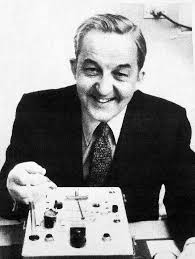
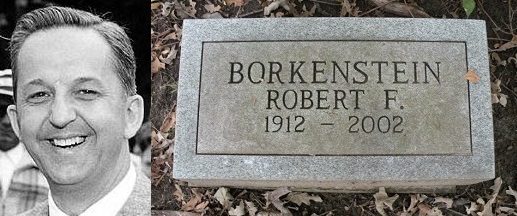
Frank Borkenstein (1912-2002)

Enter Robert Frank Borkenstein. Born August 31, 1912, in Fort Wayne, Borkenstein was a natural-born teacher, researcher, and inventor. Borkenstein was a product of the Great Depression, and like many young Hoosiers of that era, he was unable to attend college. His first job in Fort Wayne was as a photographic technician, where legend claims his expertise in color film led (at least in part) to the invention of the color camera. While that claim is hard to nail down, what we do know is that his skill and creativity were recognized by the Indiana State Police Criminology Laboratory which hired him in 1936. Borkenstein quickly rose through the ranks, he went from working as a clerk to Captain in charge of Laboratory Services to Director of the State Police Criminological Laboratory, one of the first state police laboratories in the US. During his time with the department, Borkenstein helped perfect the use of photography in law enforcement and worked extensively on developing the polygraph, or lie detector. He administered more than 15,000 tests before his retirement in the late 1980s.

Indiana University School of Medicine Dept. of Biochemistry-Toxicology display.

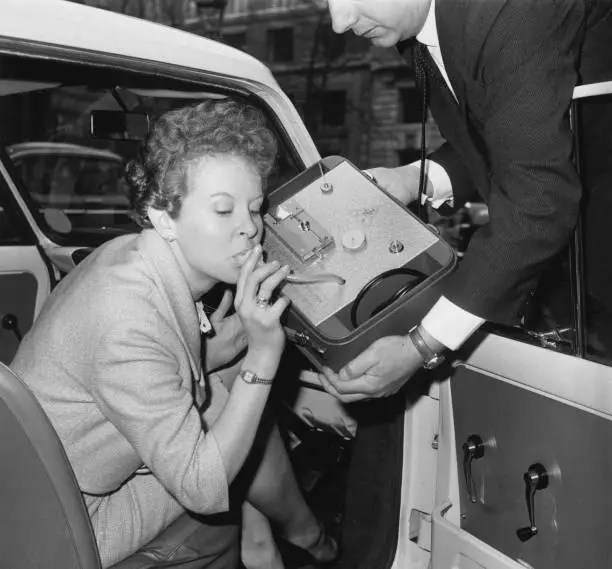
Also while with the department, Borkenstein developed a close professional relationship with IU Professor Rolla N. Harger who was still working to improve his Drunkometer. In the 1950s, Borkenstein attended Indiana University on a part-time basis, eventually earning his Bachelor of Arts in Forensic Science. In February of 1954, IPD Lieutenant Borkenstein, Director of the State police laboratory, developed his first working model of the Breathalyzer (an amalgam of “breath, alcohol and analyze”) in the partially dirt-floored basement of his small Indianapolis home at 6441 Broadway near Broad Ripple. His machine was more compact, easier to operate, and consistently produced reliable results when measuring blood alcohol content. The Breathalyzer substituted a rubber hose for the balloon and featured an automatic internal device to gauge the color changes previously determined by the naked eye. Borkenstein’s Breathalyzer was an inexpensive way to test intoxication and meant that BAC (blood alcohol content) could be quickly collected and analyzed for use as evidence. Upon graduation from IU, Borkenstein retired from the State Police and joined IU as Chairman of the newly-formed Department of Police Administration.

Borkenstein’s updated breathalyzer.

Robert Borkenstein, a convivial fellow known as “Bob” to friends, family, and colleagues, enjoyed listening to Gilbert and Sullivan, entertaining visitors, and serving drinks to his friends. According to one account, ironically Bob “exhibited a Catholic taste in wines and spirits”. But Bob insisted on one rule for himself and anyone consuming alcohol in his presence: No drinking and driving! This, even though he supervised a study, paid for by the liquor industry, that suggested that “the relaxing effect of having drunk less than two ounces of alcohol might produce a slightly better driver than one who had none”.

At I.U., Borkenstein was well-liked and known for his generosity to younger colleagues. He was also a Francophile who traveled extensively to Paris and other parts of France, incorporating the French language into much of his work. Another gadget Borkenstein invented was a coin-operated Breathalyser for use in bars. The idea is that when a customer drops a coin it causes a straw to pop up. When the straw is blown into, a reading of .04 or less would produce a message: “Be a safe driver.” Between .05 and .09, the machine blinked and advised: “Be a good walker.” At .10 or higher, it sounded a small alarm and warned: “You’re a passenger.”

He later became chairman of IU’s Forensic Studies Department and director of the university’s Centre for Studies of Law in Action. The class he established on alcohol and highway safety became a national standard in the United States for forensic science, law enforcement, and criminal justice professionals. Today, it is officially known as the “Robert F. Borkenstein Course on Alcohol and Highway Safety: Testing, Research, and Litigation”, more simply known as the “Borky”. In light of his achievements, Borkenstein was awarded an Honorary Doctor of Science by Wittenberg University in 1963 and an Honorary LL.D. from Indiana University in 1987. In March 1987 Borkenstein retired, though he continued to hold emeritus titles as both a professor and Director of the Center for Studies of Law in Action and was inducted into the Safety and Health Hall of Fame International in 1988. Borkenstein’s mentor Dr. Rolla Neil Harger died on August 8, 1983, in Indianapolis and is buried in Crown Hill Cemetery. Borkenstein’s papers are held at the Indiana University Archives in the Herman B Wells Library in Bloomington, IN.

Robert Borkenstein graveLindenwood Cemetery
Fort Wayne, Allen County, Indiana.

In 1938 Borkenstein married Marjorie K. Buchanan, a children’s book author who died in December 1998. The couple had no children. Robert Borkenstein died on August 10, 2002, at the age of 89. Borkenstein held the Breathalyzer patent for most of his life, finally selling it to the Colorado firm that markets it today. Although the Breathalyzer is no longer the dominant instrument used by police forces to determine alcohol intoxication, its name has entered the vernacular to the extent that it has become a generic name for any breath-testing instrument. Between 1955 and 1999, over 30,000 Breathalyzer units were sold. Without question, Bob Borkenstein’s invention has saved countless lives over the years and has become an irreplaceable tool of the police. And to think, it all started in Indiana.

Abe Lincoln, Art, Museums, Presidents

Abraham Lincoln’s Favorite Poem.

Original publish date October 19, 2023. https://weeklyview.net/2023/10/19/abraham-lincolns-favorite-poem/

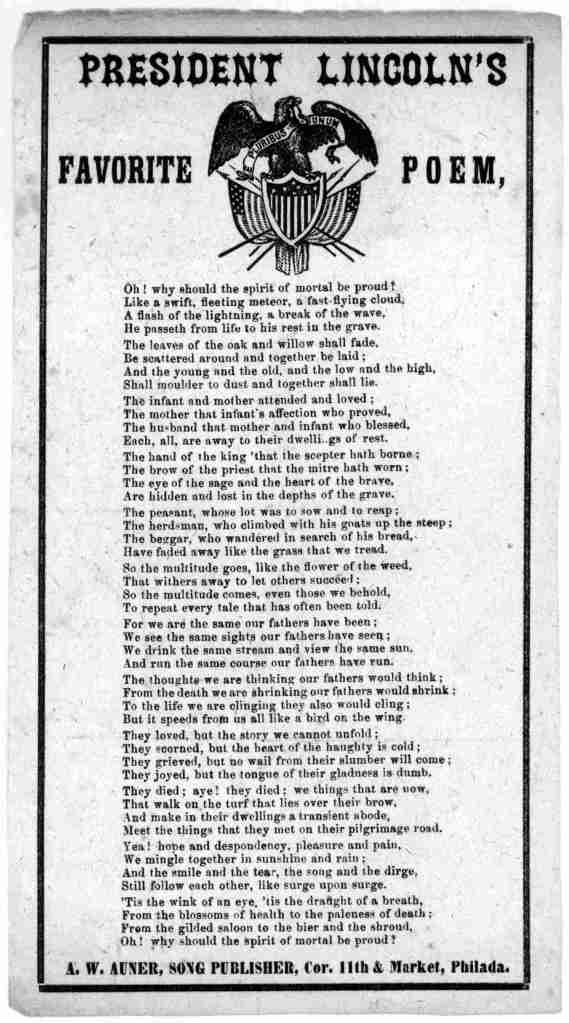
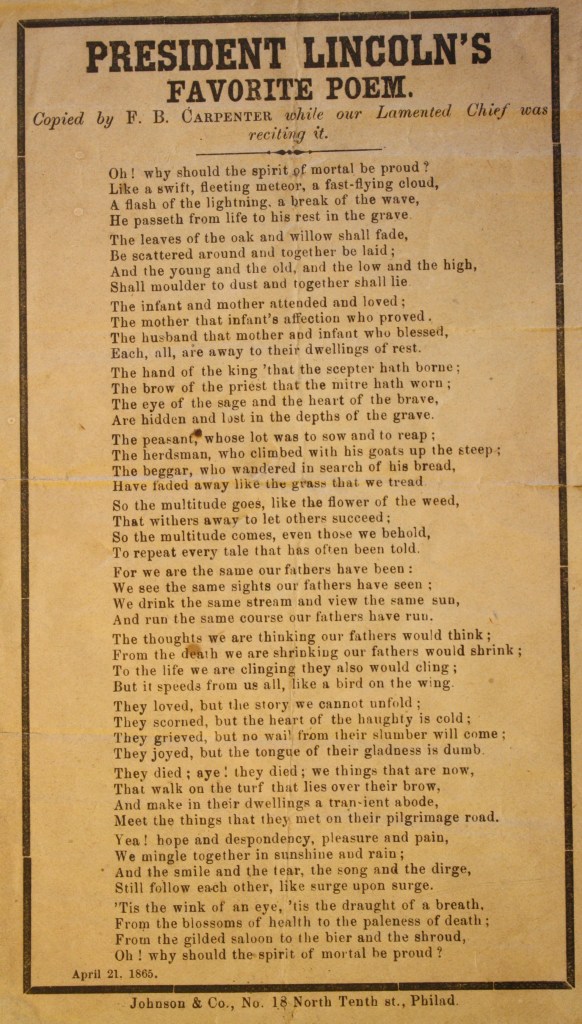
This was once displayed in Osborn H. Oldroyd’s museum inside the Lincoln Home in Springfield, Illinois. The poem was read aloud on the 15th anniversary of the President’s death, April 15, 1880, at the first memorial service at Lincoln’s Tomb ceremony by Mrs. Edward S. Johnson (wife of Lincoln Guard of Honor member and second Lincoln Tomb custodian Major Edward S. Johnson). Undoubtedly this leaflet was handed out at that ceremony on that day as a souvenir. It is titled “President Lincoln’s Favorite Poem. Copied by F.B. Carpenter while our Lamented Chief was reciting it.”

During the month of October in Irvington, I am near-constantly surrounded by reminders of the dead. While Irvington celebrates Halloween with little door-knocking ghosties and goblins gliding from door to door in search of treats, it does nothing to dispel the fact that Halloween revolves around the spirits of the dearly departed. I write often about Abraham Lincoln, but seldom about Lincoln and Halloween. I thought it might be a good time to examine a mysterious poem that fits the season and has often been referred to as Lincoln’s favorite.

Lincoln developed his lifelong love of poetry while a boy in Southern Indiana. Although by his own admission, Lincoln got his education “by littles” and the total time spent in a classroom by the young rail-splitter amounted to less than a year, he devoured the poetry found in the four school readers historians attribute to his early years in the Hoosier state. Many of those poems were about death. John Goldsmith’s 1766 poem, An Elegy On The Death Of A Mad Dog, Edgar Allan Poe’s 1845 poem The Raven, Oliver Wendell Holmes’ 1831 poem The Last Leaf, and Thomas Gray’s 1751 poem Elegy Written in a Country Churchyard. And of course, Lincoln’s love of William Shakespeare is widely known.

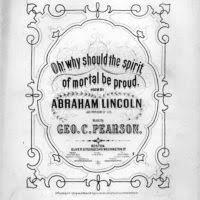
These poets in particular capture the gloomy, melancholic poetry of which Lincoln was so fond of as a young man. Lincoln, a capable amateur poet himself, memorized the poems he cherished, reciting them to friends and inserting them in conversations and speeches throughout his life. His favorite poem, which he recited so often that people suspected he was its author, was William Knox’s “Mortality,” alternately known as “O, Why should the Spirit of Mortal be Proud!” Lincoln often opined to friends (and at least once in a letter) that he, “would give all I am worth, and go in debt, to be able to write so fine a piece as I think that is.”

The poem was cut from a newspaper and given to Lincoln by Dr. Jason Duncan in New Salem, Illinois. At the time, its author was anonymous, and attribution was unknown. On at least a few occasions, having committed it to memory, Lincoln wrote the Mortality poem out longhand and sent it to friends, always noting that “I am not the author.” He would spend twenty years searching for the poet. Aptly for the season, one stormy night in the White House, Lincoln recited the poem for a small group of friends including a congressman, an army chaplain, and an actor, noting that the “poem was his constant companion” and that it crossed his mind whenever he sought “relief from his almost constant anxiety.”

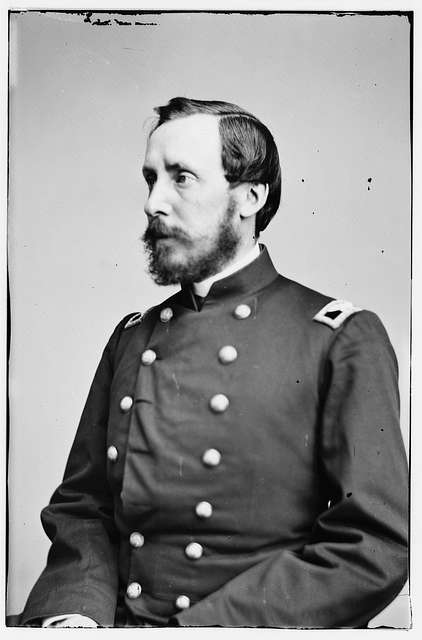
General James Grant Wilson (1832-1914)

When the group departed, Lincoln requested that his guests help to discover who had written it. “Its author has been greatly my benefactor, and I would be glad to name him when I speak of the poem…that I may treasure it as a memorial of a dear friend.” Union General James Grant Wilson (1832-1914) would ultimately inform the President that the poem was written by an obscure Scottish poet named William Knox (1789-1825). The poem was first published in his 1824 book Songs of Israel. After Lincoln’s death, the poem experienced a resurgence in popularity.

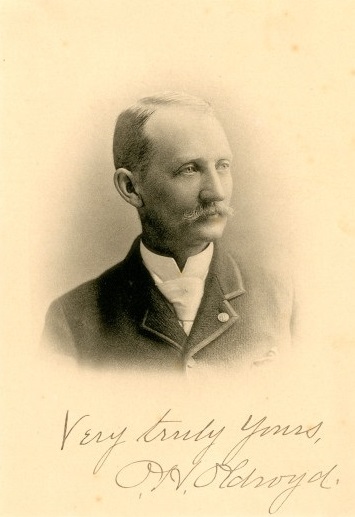
Osborn H. Oldroyd.

On April 15, 1880, on the 15th anniversary of the President’s death, the poem was read aloud by Mrs. Edward S. Johnson (wife of Lincoln Guard of Honor member and second Lincoln tomb custodian Major Edward S. Johnson) during a ceremony at the tomb in Springfield. A leaflet, handed out at that ceremony and found in my collection, was saved by Lincoln collector and personal muse Osborn H. Oldroyd and displayed in his collection in the Lincoln home for years. It remains important to the Oldroyd story as the impetus for his personal resolve to build a Lincoln Museum of his own.

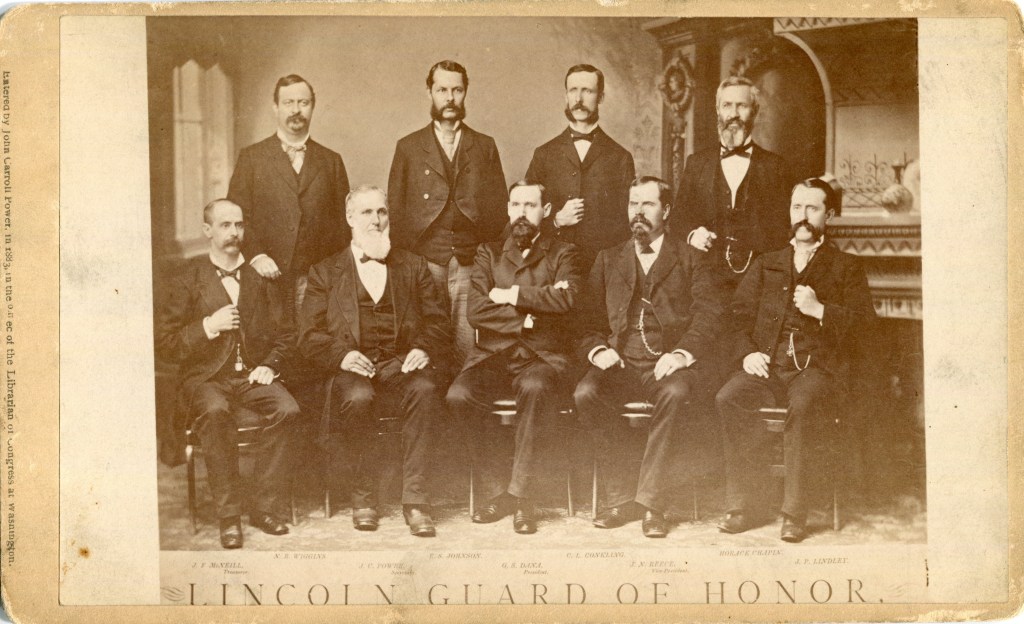
Lincoln Tomb Guard of Honor. John Carroll Power seated front row second from left.

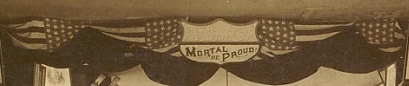
At that time the tomb’s Memorial Hall housed a small exhibit of Lincoln artifacts gathered by custodian John Carroll Power (a subject of my past columns). At that event, Oldroyd decided that his collection might be a bigger deal than he thought it was. “As I gazed on the…resting place of him whom I had learned to love in my boyhood years, I fell to wondering whether it might not be possible for me to contribute my might toward adding luster to the fame of this great product of American institutions,” wrote Oldroyd. It was after gazing upon those priceless Lincoln relics at the tomb that Oldroyd resolved to build a Memorial Hall in Springfield to display his own collection of Lincoln memorabilia. For a decade (1883 to 1893) that museum occupied the front parlors of the only home Abraham Lincoln ever owned at 8th and Jackson. The divider between those two rooms was adorned by a shield-shaped, flag-draped wooden motif adorned with the title “O, Why should the Spirit of Mortal be Proud!” Oldroyd made sure that every visitor to his museum was aware of the poem’s significance in the Lincoln chronology while surreptitiously causing each visitor to cast their eyes towards the heavens to receive the message.

Oldroyd’s Springfield Museum.
A stanza from the poem fashioned into a plaque hangs above the door in the above photo.

The poem is written in Quatrain form with an A-A-B-B rhyme scheme, or clerihew, with all of the dominant words highlighted by the rhyme. The poem resounded in Lincoln’s mind like an echo, its pauses, and connotations framing the beat of the poem. The poem causes its reader to reflect on the inevitable continuity of life; Life is short so why sweat the small stuff? We are but insignificant players in a much grander scheme, so do all you can while you’re here. Here, submitted for your approval in the spirit of Halloween, is Abraham Lincoln’s favorite poem in its entirety.

“O why should the spirit of mortal be proud! Like a fast-flitting meteor, a fast-flying cloud, A flash of the lightning, a break of the wave-He passes from life to his rest in the grave. The leaves of the oak and the willow shall fade, Be scattered around and together be laid; As the young and the old, and the low and the high, Shall moulder to dust, and together shall lie. The child that a mother attended and loved, The mother that infant’s affection that proved, The husband that mother and infant that blest, Each-all are away to their dwelling of rest. The maid on whose cheek, on whose brow, in whose eye, Shone beauty and pleasure-her triumphs are by: And the memory of those that beloved her and praised, And alike from the minds of the living erased. The hand of the king that the sceptre hath borne, The brow of the priest that the mitre hath worn, The eye of the sage, and the heart of the brave, Are hidden and lost in the depths of the grave.”

“The peasant whose lot was to sow and to reap, The herdsman who climbed with his goats to the steep, The beggar that wandered in search of his bread, Have faded away like the grass that we tread. The saint that enjoyed the communion of Heaven, The sinner that dared to remain unforgiven, The wise and the foolish, the guilty and just, Have quietly mingled their bones in the dust. So the multitude goes-like the flower and the weed, That wither away to let others succeed; So the multitude comes-even those we behold, To repeat every tale that hath often been told. For we are the same things that our fathers have been, We see the same sights that our fathers have seen, We drink the same stream, and we feel the same sun, And we run the same course that our fathers have run.”

“The thoughts we are thinking our fathers would think, From the death we are shrinking from they too would shrink, To the life we are clinging to, they too would cling-But it speeds from the earth like a bird on the wing. They loved-but their story we cannot unfold; They scorned-but the heart of the haughty is cold; They grieved-but no wail from their slumbers may come; They joyed-but the voice of their gladness is dumb. They died-ay, they died! and we, things that are now, Who walk on the turf that lies over their brow, Who make in their dwellings a transient abode, Meet the changes they met on their pilgrimage road. Yea, hope and despondence, and pleasure and pain, Are mingled together like sunshine and rain: And the smile and the tear, and the song and the dirge, Still follow each other like surge upon surge. ‘Tis the twink of an eye, ’tis the draught of a breath, From the blossom of health to the paleness of death, From the gilded saloon to the bier and the shroud-O why should the spirit of mortal be proud!”

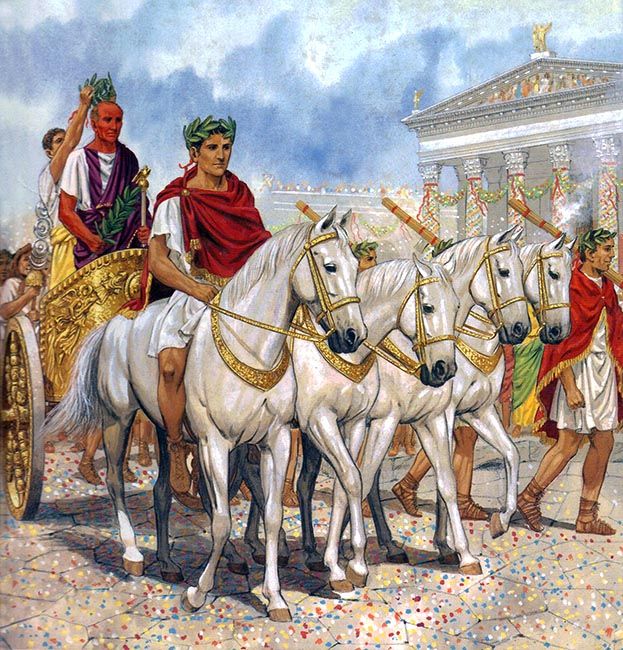
Memento homo (remember you are only a man).

So what is the takeaway? Why should you be so proud of what you have, when all you have is so little in the bigger picture? The theme is one of life and death. A bleak and somber contrast reminds us that life is short, and in Lincoln’s case, fame is fleeting. Auriga, the slave charged with accompanying Roman Generals and Emperors through the streets of Rome after triumph in battle, often whispered the phrase Memento homo (remember you are only a man) while holding the golden crown inches above their heads. From a young age, Lincoln was well acquainted with the idea of mortality. So it comes as no surprise that he adored that poem. But it isn’t all gloom and doom. Within its stanzas are found muted messages of hope and the promise that it is not too late for society to change its ways by following in the footsteps of our ancestors. Reading this poem, one experiences the same feeling of reflection as Lincoln did. It explains how, during his entire lifetime, The Great Emancipator remained penitent and humble by simply following the lessons of this poem.