National Park Service, Presidents, Travel

The Devils Tower.

Original publish date: September 23, 2021. https://weeklyview.net/2021/09/23/the-devils-tower/

https://www.digitalindy.org/digital/collection/twv/id/4308/rec/153
Over the last couple of weeks, I detailed a long-lost Indiana landmark known as the Hoosier Slide in Michigan City. This giant mound of sand became a tourist attraction when visitors discovered that they could slide down its slopes on slices of cardboard or fragments of cloth like a sled on a snow mound. The Hoosier Slide disappeared from the northern Indiana landscape around World War I after it was purchased by the Ball Brothers Corporation in Muncie to furnish the distinctive blue tint for their popular Ball Brand fruit jars.
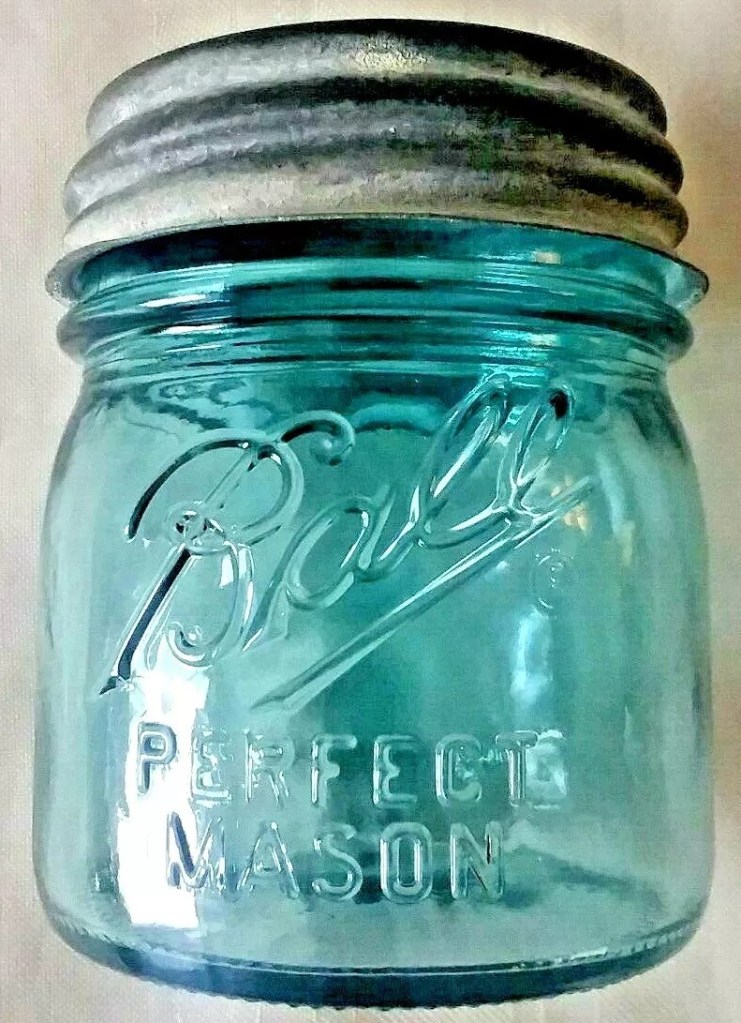
Blue Ball Jar.

Continuing that theme, it was 115 years ago this week (Sept. 24, 1906) that President Theodore Roosevelt proclaimed Devils Tower in Wyoming as the nation’s first National Monument, under new authority granted to him by Congress in the Antiquities Act. The Antiquities Act resulted from concerns about protecting mostly prehistoric Native American ruins and artifacts (aka “antiquities”) located on federal lands. The United States Congress designated the area a U.S. forest reserve in 1892. However, in the ensuing years, the threat of commercial development and the removal of artifacts from these unprotected lands by private collectors, whom Teddy famously referred to as “pot hunters,” had become a serious problem. Making this a high-priority goal for Teddy’s second term.
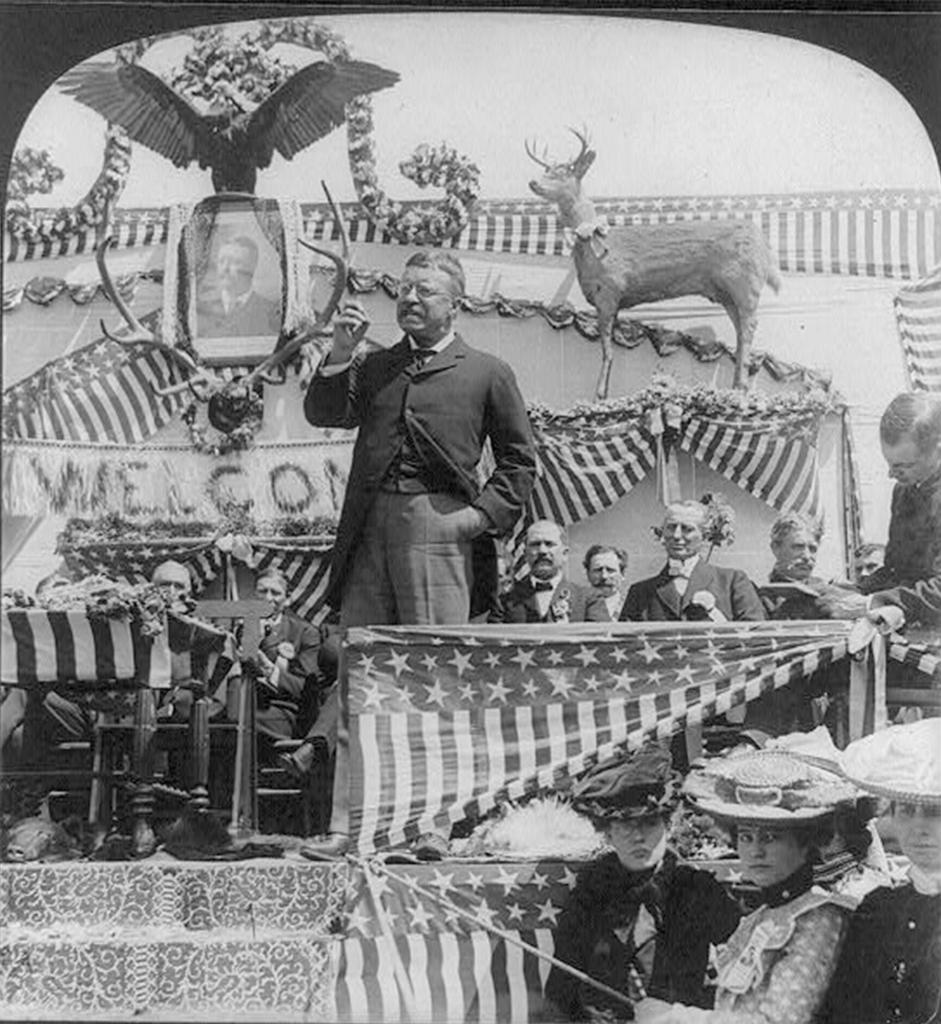
President Theodore Roosevelt giving a speech in Wyoming.

Although Devils Tower (apostrophe purposely omitted) might not ring any bells in your house, it was so important to Roosevelt that he designated it for protection before he established the Grand Canyon Game Preserve by proclamation on November 28, 1906, and the Grand Canyon National Monument on January 11, 1908. Devils Tower, also called Bear Lodge Butte, is part of the Black Hills mountain range located above the Belle Fourche River near Hulett and Sundance in Crook County, northeastern Wyoming. The tower, technically called a “monolith”, was formed from cooled magma exposed through erosion. It stands 1,267 feet tall; 867 feet from summit to base (5,112 feet above sea level) and encloses an area of 1,347 acres.
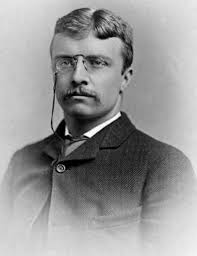
Teddy Roosevelt.

The oldest rocks visible in Devils Tower National Monument were once part of a shallow sea during the Triassic period 250 million years ago, which saw the rise of reptiles and the first dinosaurs. Devils Tower hails from the Jurassic period, about 200 million years ago, which ushered in birds and mammals. The Tower was here 150 million years before the Rocky Mountains and the Black Hills were formed. It is easy to imagine that the thought of dinosaurs roaming around Devils Tower may well have sparked Teddy Roosevelt’s vivid imagination, thus leading him to designate it as the country’s first National Landmark.
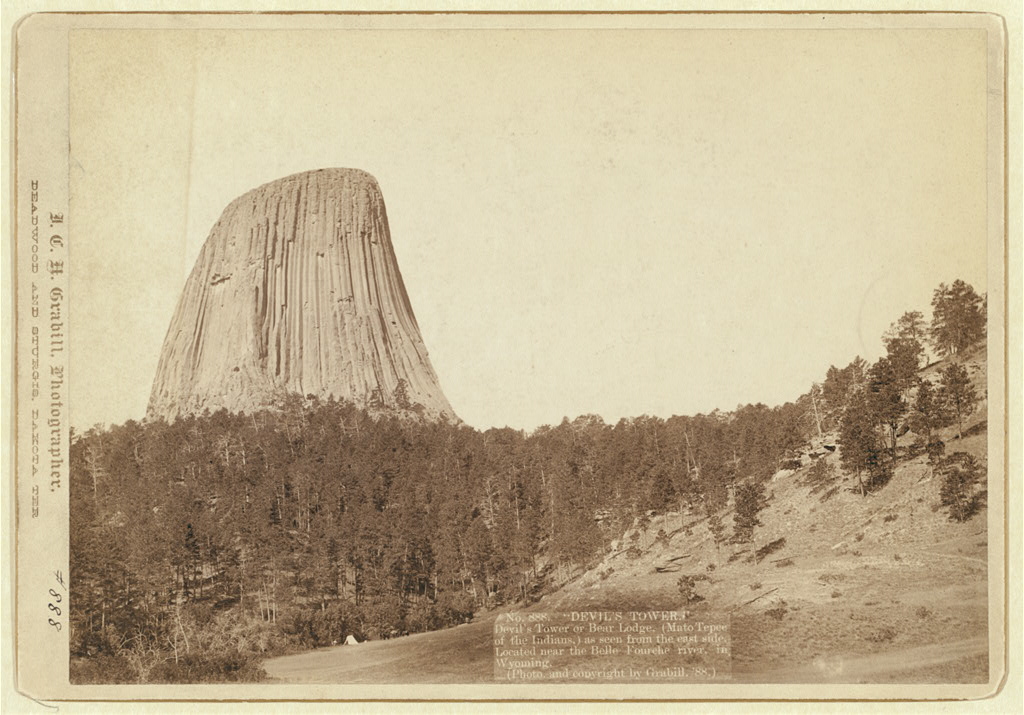
1888 Cabinet Photos of Devils Tower or Bear Lodge as seen from the east side.

Fur trappers may have visited Devils Tower, but they left no written evidence of having done so. The first documented Caucasian visitors were members of Captain William F. Raynolds’s 1859 expedition to Yellowstone. Sixteen years later, Colonel Richard I. Dodge escorted a US Government Office of Indian Affairs scientific survey party to the massive rock formation and coined the name Devils Tower. The misnomer was created when his interpreter reportedly misinterpreted a native name to mean “Bad God’s Tower”. The Indigenous Native American people had many names for the outcropping including Bear’s House, Grizzly Bear Lodge, Bear’s Tipi, Home of the Bear, Bear’s Lair, Tree Rock, Great Gray Horn, and Brown Buffalo Horn.
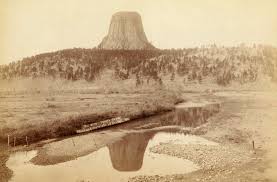
Devils Tower in 1890, 16 years before President Theodore Roosevelt declared it a national monument. The photo is by Black Hills area photographer John Grabill. 

According to the lore of the Lakota tribe, the traditional name for the tower came after a group of girls went out to play and were spotted by several giant bears, who began to chase them. In an effort to escape the bears, the girls climbed atop a rock, fell to their knees, and prayed to the Great Spirit to save them. Hearing their prayers, the Great Spirit made the rock rise from the ground towards the heavens so that the bears could not reach the girls. The bears, in an effort to climb the rock, left deep claw marks in the sides, which had become too steep to climb. Those are the marks that appear today on the sides of Devils Tower. When the girls reached the sky, they were turned into the star formation known as the “Seven Sisters.”

Another version tells that two Kiowa Sioux boys wandered far from their village when Mato the bear, a huge creature that had claws the size of teepee poles, spotted them and wanted to eat them for breakfast. He was almost upon them when the boys prayed to Wakan Tanka the Creator to help them. They rose up on a huge rock, while Mato tried to get up from every side, leaving huge scratch marks as he did. Finally, he sauntered off, disappointed, discouraged, and hungry. The bear came to rest east of the Black Hills at what is now Bear Butte. Wanblee, the eagle, helped the boys off the rock and back to their village. A painting depicting this legend by artist Herbert A. Collins hangs over the fireplace in the visitor’s center at Devils Tower.
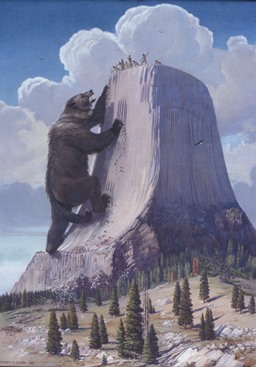
In a Cheyenne version of the story, the giant bear pursues the girls and kills most of them. Two sisters escape back to their home with the bear still tracking them. They tell two boys that the bear can only be killed with an arrow shot through the underside of its foot. The boys have the sisters lead the bear to Devils Tower and trick it into thinking they have climbed the rock. The boys attempt to shoot the bear through the foot while it repeatedly attempts to climb up and slides back down leaving more claw marks each time. The bear was finally scared off when an arrow came very close to its left foot. This last arrow continued to go up and never came down.

Wooden Leg warrior of the Northern Cheyenne who fought in the Battle of Little Bighorn in 1876.

Wooden Leg, a Northern Cheyenne, related still another legend told to him by an old man as they were traveling together past the Devils Tower around 1866. A Native American man decided to sleep at the base of Bear Lodge. In the morning he found that he had been transported to the top of the rock by the Great Medicine with no way down. He spent another day and night on the rock with no food or water. After he had prayed all day and then gone to sleep, he awoke to find that the Great Medicine had brought him back down to the ground. Devils Tower is still considered to be sacred ground which has caused distress among the Native American tribes who described the Devils Tower designation as offensive. However, the name was never changed.
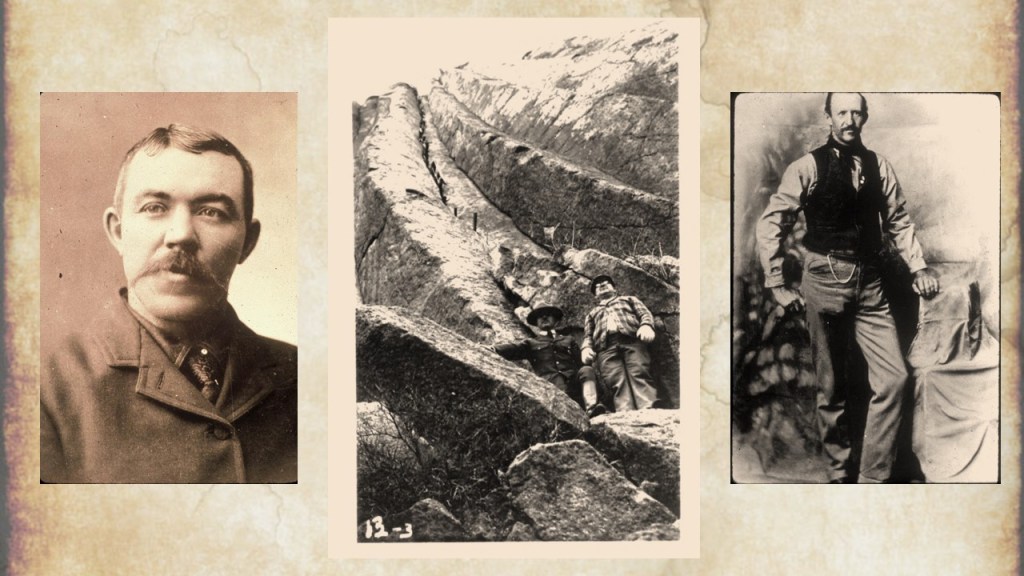
1893 Devils Tower Stake Ladder Expedition-Left: Willard Ripley, Right: William Rogers, area rancher. The base of the 1893 Stake Ladder in center. Photo Courtesy Rockpile Museum.

In recent years, climbing Devils Tower is on many a bucket list. The first known ascent of Devils Tower occurred on July 4, 1893. It is credited to a pair of local ranchers, William Rogers and Willard Ripley. They completed this first ascent after constructing a ladder of wooden pegs driven into cracks in the rock face. About 1,000 people came from up to 12 miles away to witness this first formal ascent of the tower. Rogers’ wife Linnie ascended the ladder two years later, becoming the first woman to reach the summit of the tower. An estimated 215 people later ascended the tower using Rogers’ ladder. It was last used in 1927 by stunt climber Babe (”the Human Fly”) White, a roaring twenties daredevil who climbed skyscrapers all over the country for publicity.

Rogers and Ripley’s climb jump-started a sport climbing industry at the tower that continues to the present day. Over thirty years, the ladder, located on the southeast side of Devils Tower, fell into disrepair. Today, what remains of the ladder begins about 100 feet above the ground and ascends from there to the summit. Sources vary on the original length of the ladder, some accounts say it was 350 feet while others say 270 feet. In the 1930s, the decision was made to remove the lower 100 feet of the ladder for safety reasons. The ladder can still be seen from the trails around the monument.
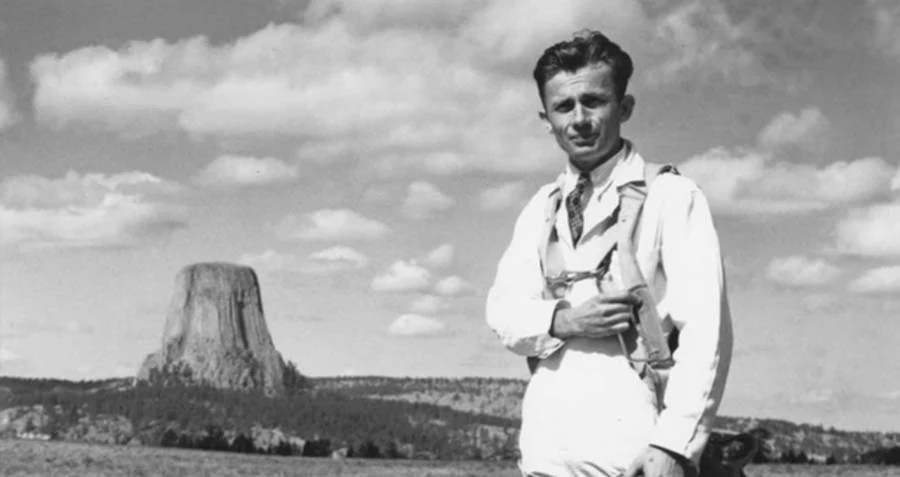
Daredevil George Hopkins parachuted onto Devils Tower in 1941.

In 1941, Devils Tower became front-page news. Daredevil George Hopkins parachuted onto Devils Tower to settle a bet. His intention was to repel down the slope via a 1,000-foot rope dropped to him after a successful landing on the butte. To Hopkins’ horror, the package containing the rope, a sledgehammer, and a car axle to be driven into the rock as an anchor piton for the rope. As the weather deteriorated, a second attempt was made to drop equipment, but the rope froze in the rain and wind and could not be used. Hopkins was stranded for six days, exposed to frigid temperatures, freezing rain, and 50 mph winds before a mountain rescue team reached him and brought him down.
Climbers on Devils Tower.

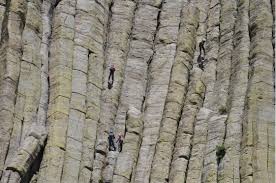
Today, hundreds of climbers scale the sheer rock walls of Devils Tower via climbing routes covering every side of the prehistoric landmark. All of them must check in with a park ranger before and after attempting a climb. No overnight camping at the summit is allowed; climbers return to base on the same day they ascend. Because the Tower is sacred to several Plains tribes, including the Lakota, Cheyenne, and Kiowa, many Native American leaders objected to climbers ascending the monument, considering this to be a desecration. Because of this, a compromise was reached with a voluntary climbing ban during the month of June when the tribes are conducting ceremonies around the monument.
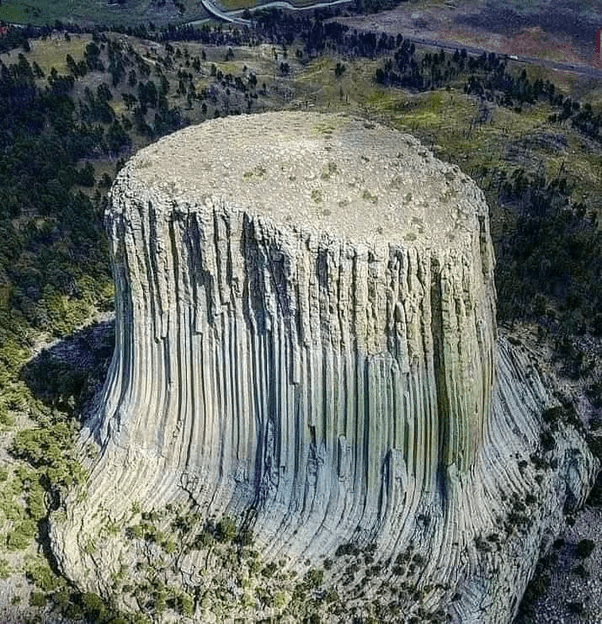
Top of Devils Tower.

The tower has a flat top covering 1.5 acres and its fluted sides give it an otherworldly appearance. Its color is mainly light gray and buff. Lichens cover parts of the tower, and sage, moss, and grass grow on its top. Chipmunks and birds live on the summit, and a pine forest covers the surrounding countrysides below. Additionally, Devils Tower National Monument protects many species of wildlife, such as white-tailed deer, bald eagles, and prairie dogs, the latter of which maintain a sizeable population at the base of the monument.
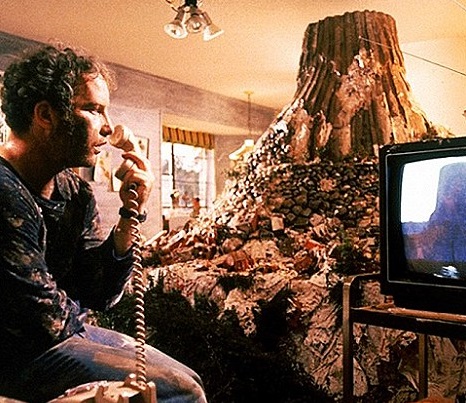
Richard Dreyfuss re-creating Devils Tower in his living room.

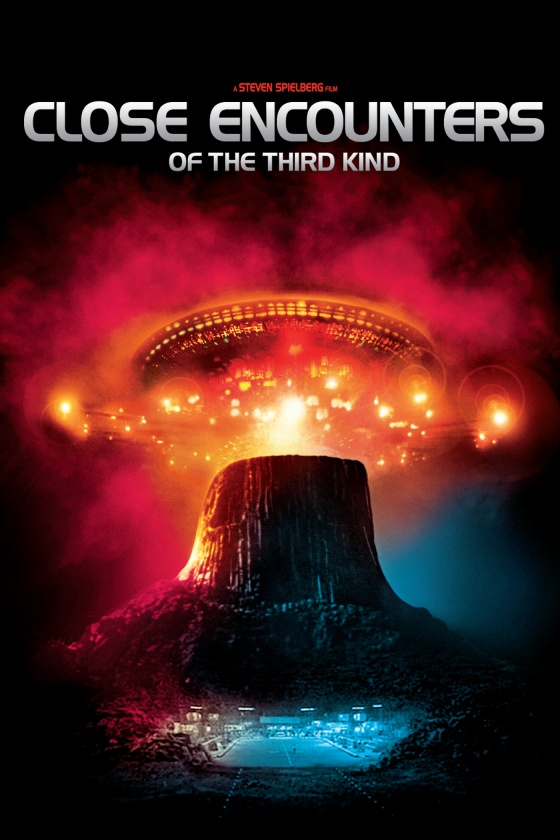
All of this is well and good and obviously, had the Hoosier slide been likewise protected, we may still be sliding down the massive sand dune in northern Indiana today. But movie buffs everywhere recognize Devils Tower for another reason. The 1977 movie Close Encounters of the Third Kind used the formation as the bellwether of its climactic scene. It soon became the film’s trademark logo. Its release caused a large increase in visitors and climbers to the monument. Today, the otherworldly pull and Hollywood fame of Devils Tower has made it a cultural waymark.
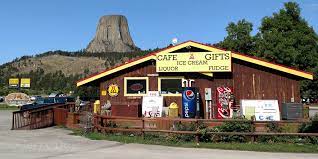
Devils Tower Campground Cafe & Gift Store.

With the funds from the film’s creation, the owners of the surrounding land were able to open a campground and restaurant to host climbers, sightseeing fans of the landscape, and movie buffs. Campers are welcome to hike and climb the tower twenty-four hours a day, and at night they’re treated to a showing of Close Encounters on a screen at the base of the landmark. According to the brochure, “Visitors leave with a new appreciation for the unique rock formation and a deepened curiosity about our place in space.”
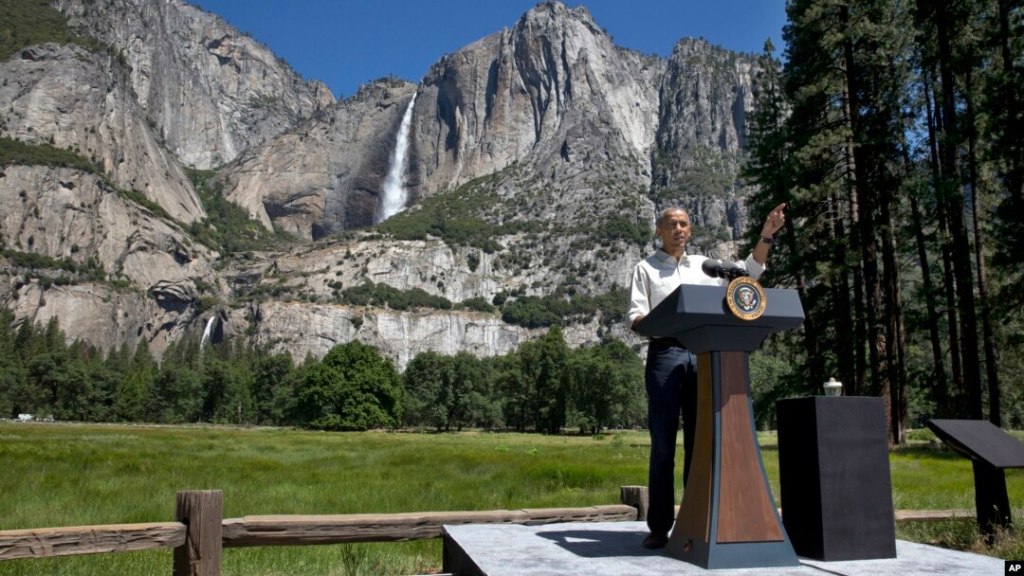
President Barack Obamas at Yosemite.

And, for an added “new appreciation”, although Teddy Roosevelt is considered to be the “father” of the National Park System, you might be interested to learn that during his two terms, President Obama established more monuments than any President before him with 26, breaking the previous record held by President Theodore Roosevelt who had 18. In short, on both accounts, it was a bi-partisan land grab for the good.
food, Politics

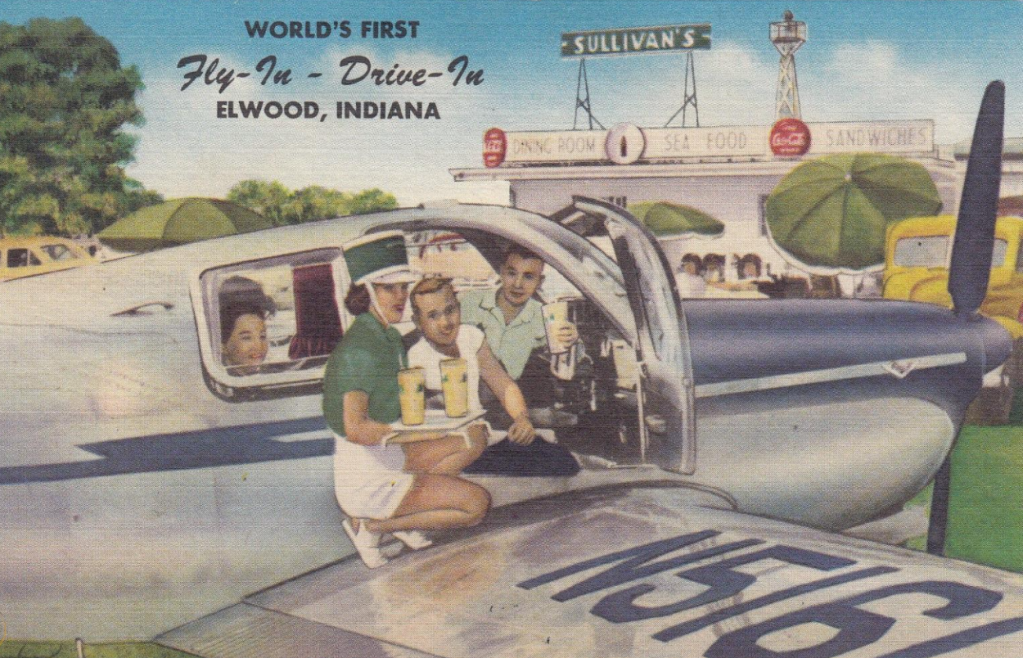
Elwood’s Airport Restaurant. The world’s only fly-in / drive-in.

Original publish date March 24, 2022. https://weeklyview.net/2022/03/24/elwoods-airport-restaurant-the-worlds-only-fly-in-drive-in/

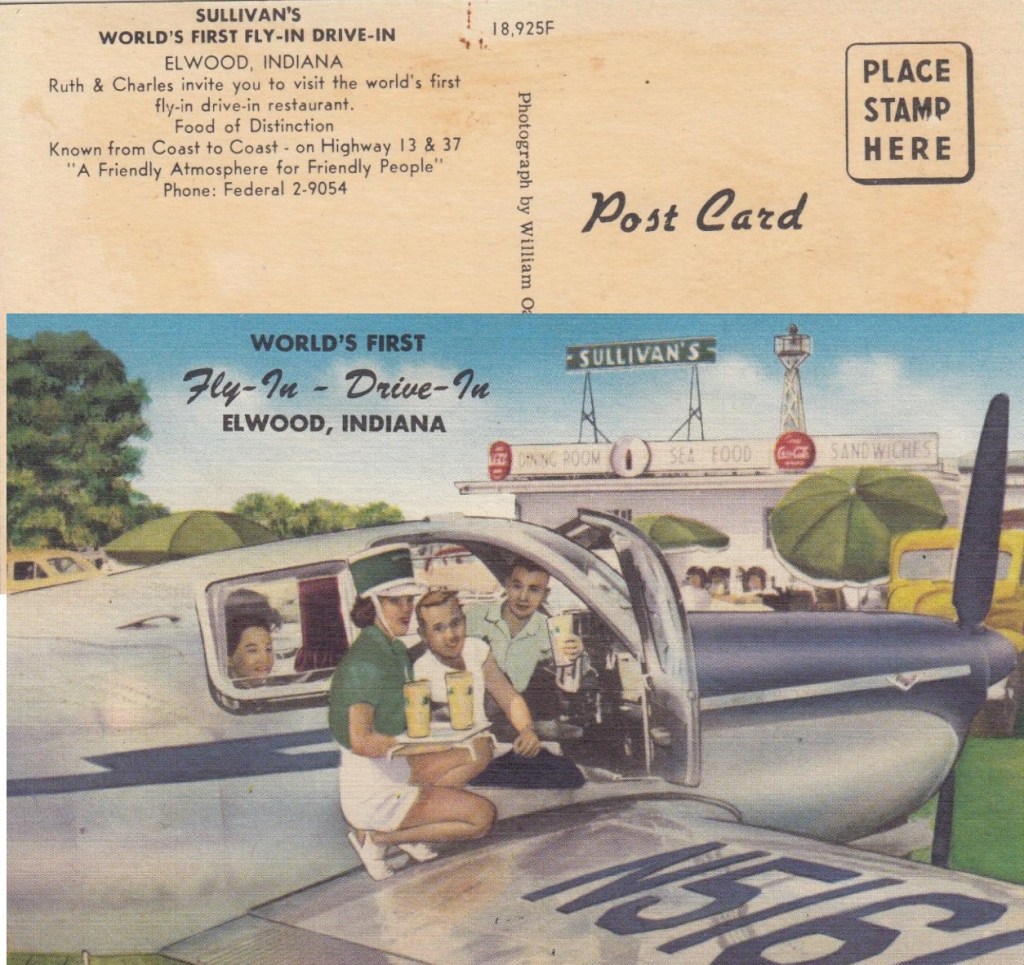
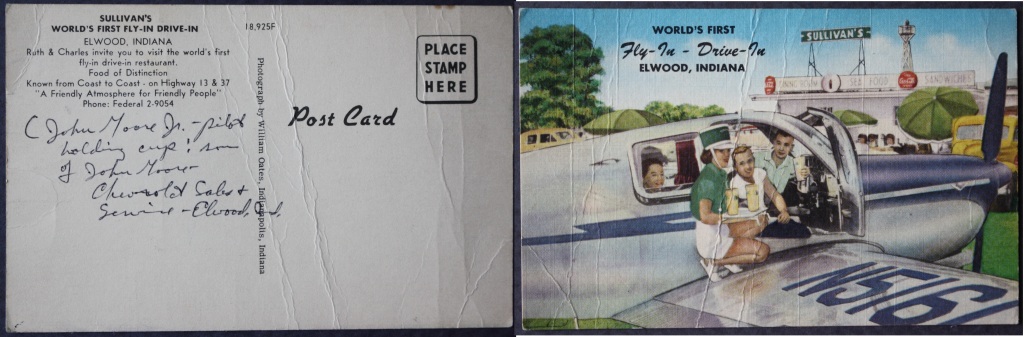
The author’s recent antique show find produced this postcard with the caption: “John Moore, Jr.-pilot holding cup, son of John Moore Chevrolet Sales + Service, Elwood, Ind.” written in vintage ink.

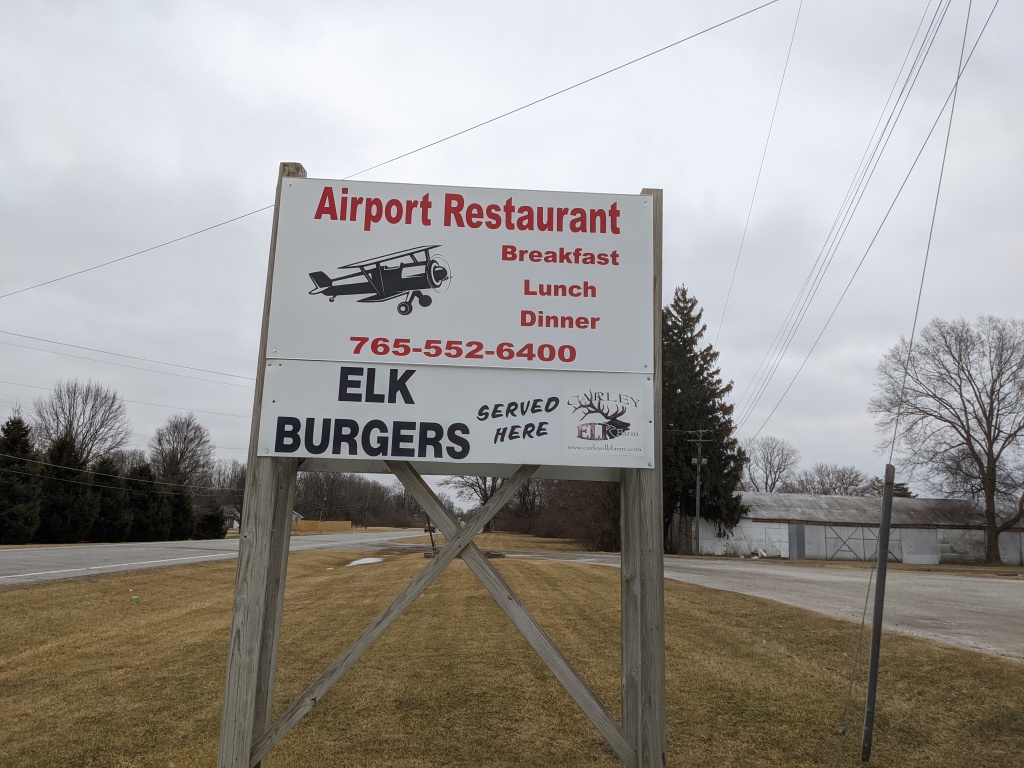
A couple of weeks ago, my wife Rhonda and I drove about 40 miles north of Irvington to Elwood to visit the world’s first (and only) fly-in drive-in restaurant. Resting just northeast of the intersection of Indiana 37 and 13, the Airport Restaurant is located at 10130 State Road 37 on what was once the Elwood Airport. The planes are long gone, and diners no longer rub elbows with pilots, but the Airport Restaurant is still the place where all the locals eat.

The airport was founded just after World War II by Elwood residents Don and Georgia Orbaugh. It featured two grass runways, measuring 2,243 feet and 2,076 feet. The sod landing strips accommodated single-engine planes and their specialty was known as the $100 hamburger. The restaurant did not charge $100 for burgers, but for pilots, that’s what they became. “By the time you get in your airplane, fill it up with gas, and fly a 100 miles, it’s a $100 hamburger,” the old pilot’s joke went. Don and Georgia Orbaugh owned and operated the airport for 56 years before it passed to daughters Ann Brewer and Donna Ewing.

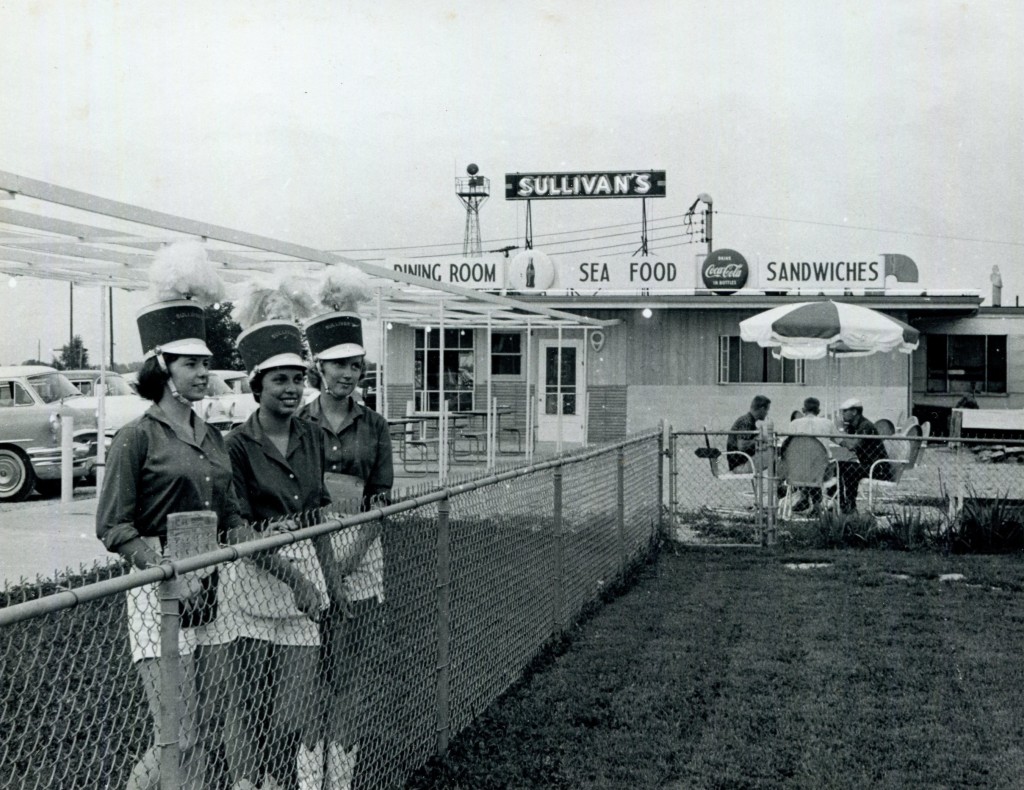
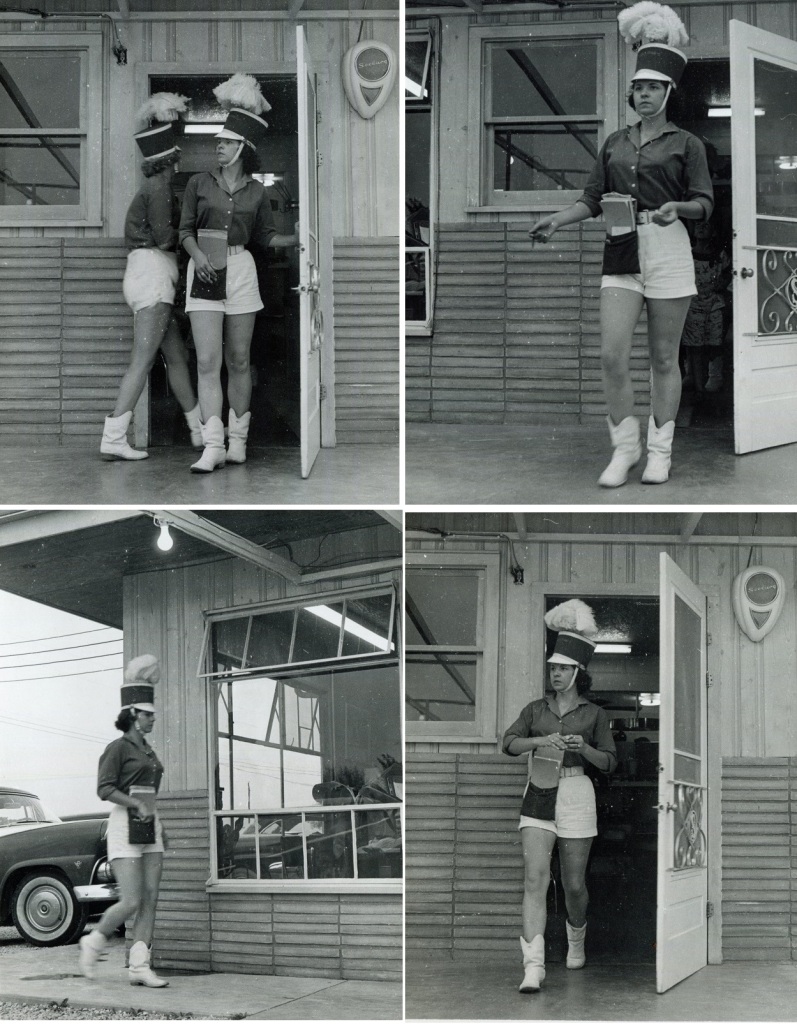
The uniformed carhops at Sullivans Airport Restaurant in Elwood, Indiana.

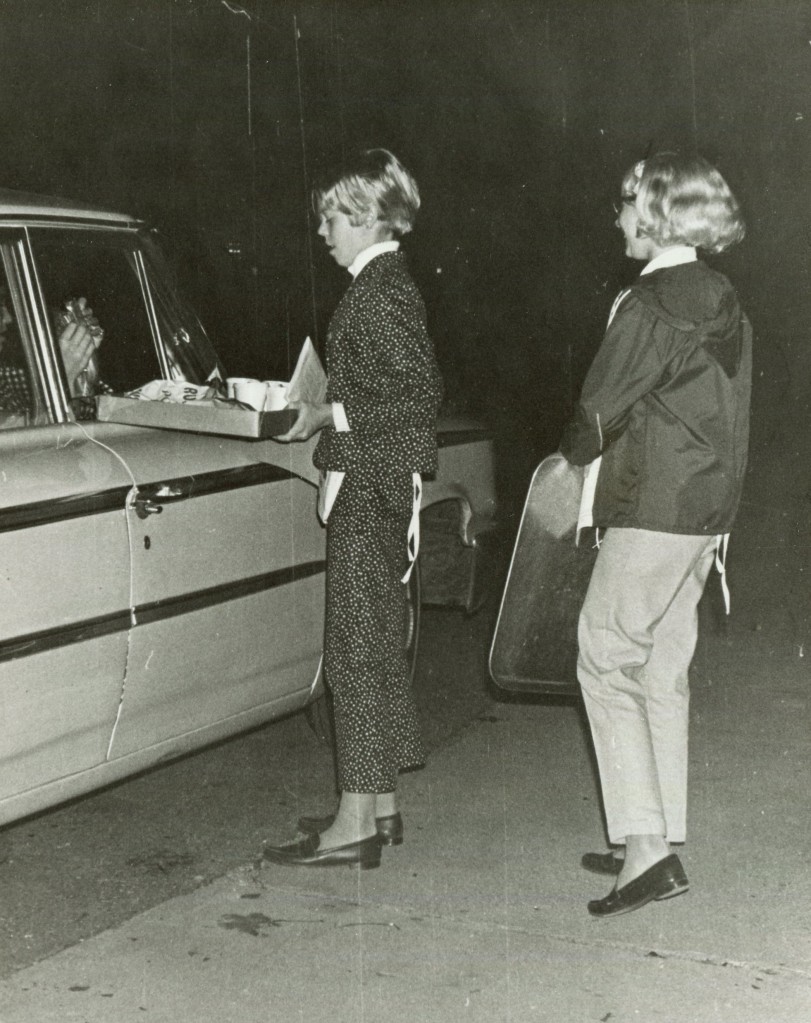
In 1952, “Sullivan’s Airport Restaurant” gained statewide attention when it opened an ice cream shack staffed by pretty young carhops. By 1953, a dining room was added to the shack, and young girls wearing tiny green uniforms with boxy marching band hats served curbside customers in their cars and pilots in their planes. Truth be told, the airport was really a “touch-and-go” facility where pilots practiced their landings and takeoffs. Most pilots only flew into the airport to visit the restaurant and ogle the carhops. By the end of the 50s, the novelty was over. There are a few photos (and at least one postcard) surviving of the Airport Restaurant during its heyday. The photos show the young waitresses in their carhop uniforms and the postcard pictures one of them standing on the wing of an airplane serving food to the pilots inside the cockpit.

Civilian employees serving customers in cars at Sullivan’s Airport Restaurant in Elwood, Indiana.
The carhops at Sullivan’s Airport Restaurant in Elwood, Indiana.

Al Swineforth, the current owner of the Airport Restaurant, has a long history in the restaurant business. “I moved to Elwood in 1970. I was a General Manager for Darden Foods in Anderson for 22 years when I retired,” he stated. For those who don’t know, Darden’s family of restaurants features some of the most recognizable and successful brands in full-service dining — Olive Garden, LongHorn Steakhouse, and Cheddar’s to name a few — serving more than 320 million guests annually in over 1,800 restaurants located across North America. Al smiled wryly, then said, “The day I retired, I was driving north on 13 when I stopped at 37 and saw the old Wheeler’s truck stop. I stayed retired for a total of four hours.”

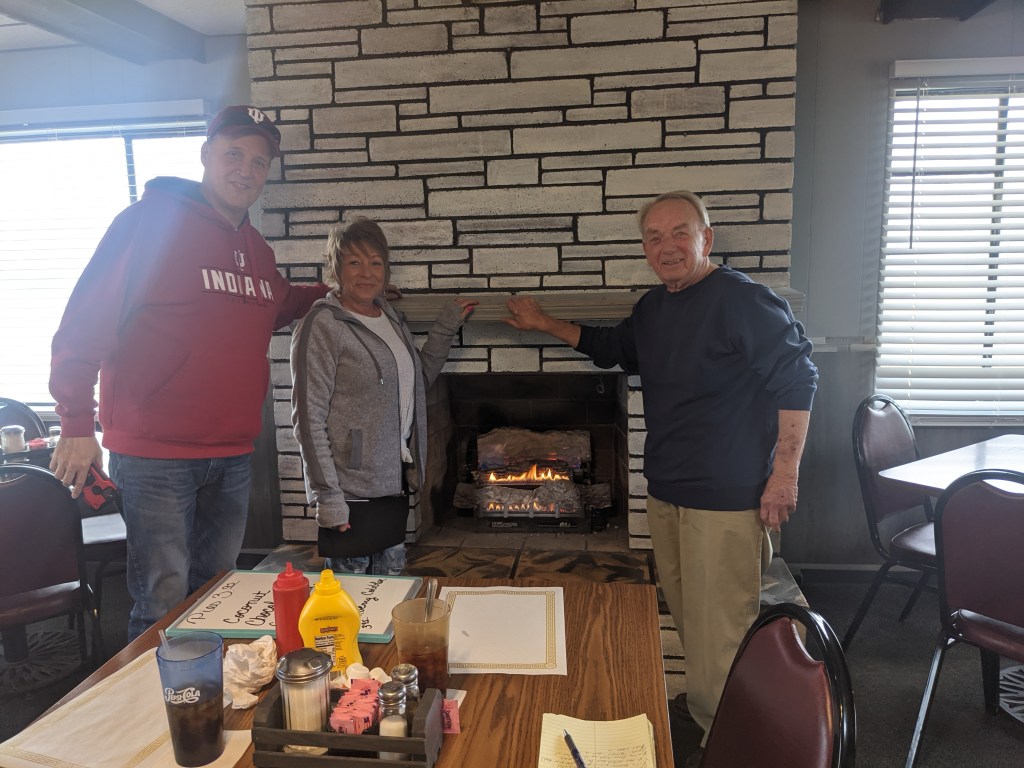
The author with Holly Fettig and Al Swineforth.

Anyone who has ever driven through northern Hamilton County on State Road 37 knows the old “Wheelers” building. The truck stop opened in 1940 as  “Scotty’s Inn.” This was back when SR 37 was the main route between Fort Wayne and Indy, so Scotty’s became a well-known stop for truckers, local farmers, and travelers alike. It featured gas pumps, a restaurant on the main floor, and “tourist rooms” upstairs. Swineforth reopened the restaurant after it sat derelict for many years following a devastating kitchen fire in the 1970s.

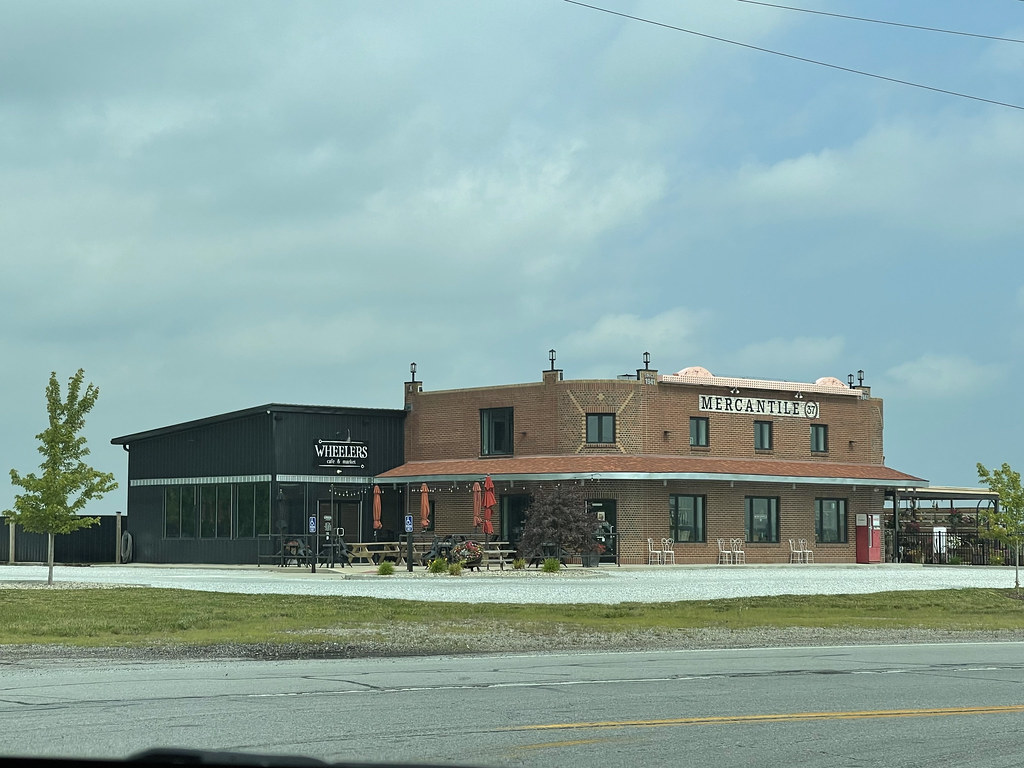
Wheeler’s Restaurant & Mercantile on State Road 37 today.

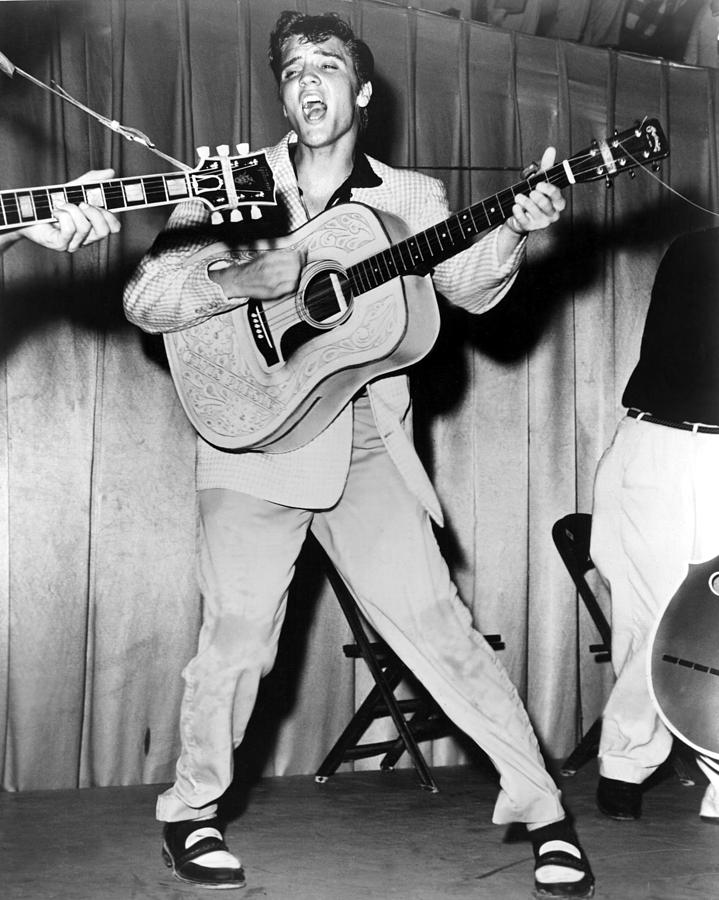
Swineforth recalled that the place was a mess when he took it over. “Oh the stories that building could tell,” he said. “Those rooms upstairs were rented to truckers by the hour,” he whispered with a wink. “You know, Elvis Presley came through there once back in the 1950s.” Swineforth ran his restaurant from 1993 to 1999 before the ancient infrastructure finally forced him to shut it down. The building remained vacant for nearly two decades before it reopened in 2018 as Mercantile 37.

Indiana Governor Frank O’Bannon.

After Swineforth closed his restaurant at the old Wheelers, he landed in Elwood. “I rent the building from the Orbaugh daughters. I own the name and everything within these walls, but the 74-acre airport property remains in the Orbaugh family,” Al noted. “Every Governor since Otis Bowen has stopped in here. Well, except Evan Bayh, he was never here. Mike Pence came in here all the time before he became Vice-President.” Al said, “He used to hold meetings right over there at that corner table.” Swineforth recalls one Governor’s visit in particular. “Frank O’Bannon came in here once for a meet-and-greet. We were running planes then and there were a couple of pilots in here. The Governor’s bodyguards went out and pulled the car up to leave and while they were gone the Governor said that he’d really like to take a plane ride. Pilot John Ward told him his plane was right outside and the Governor took off out the back door and was circling the runways within minutes.” Al closed by saying, “When those bodyguards came back in to get him, you should have seen the looks on their faces when I pointed to the sky and told them ‘there he goes.’ You couldn’t get away with that nowadays.”
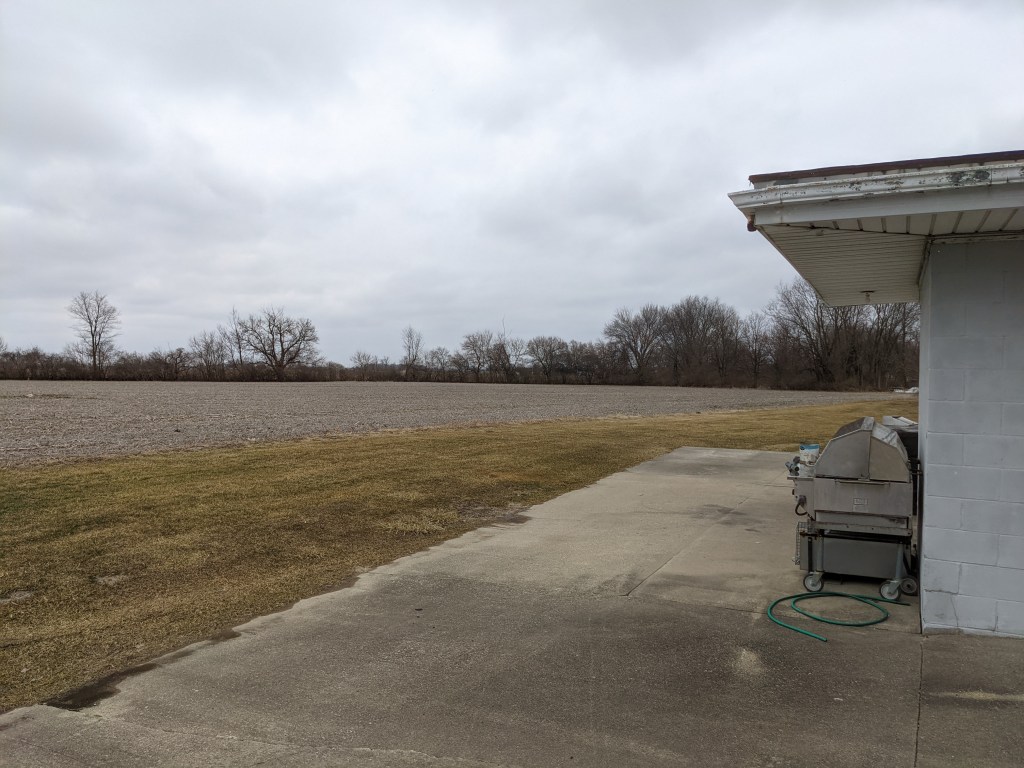
The old runways are a farm field behind the restaurant today.
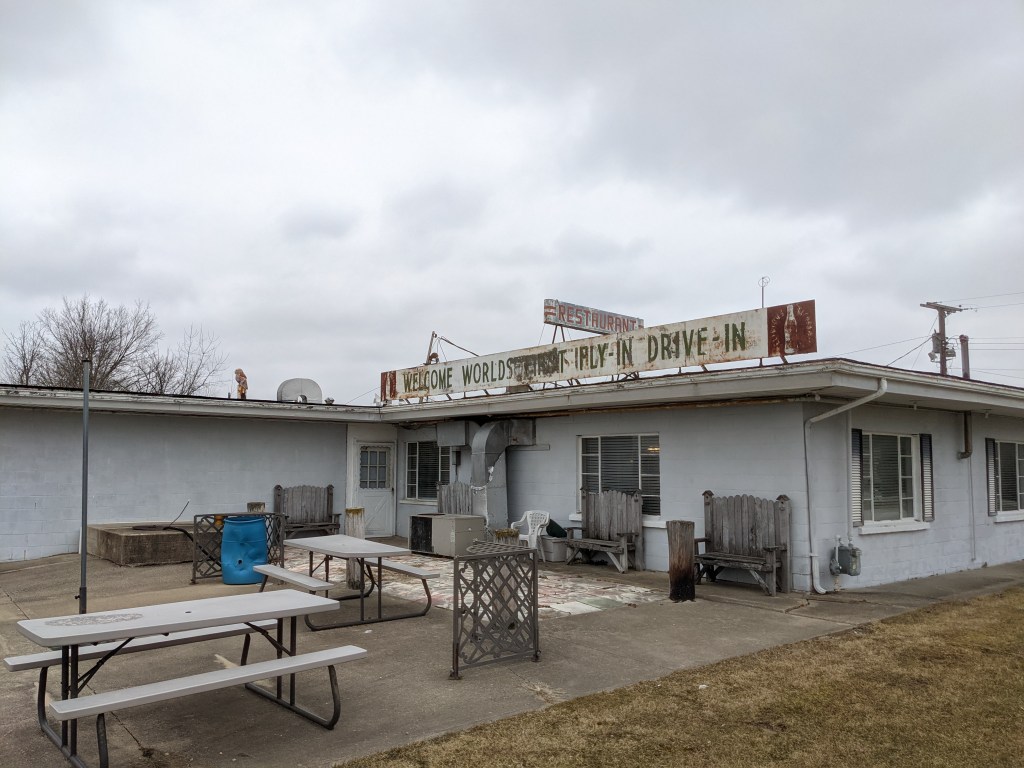
Back of the restaurant today.
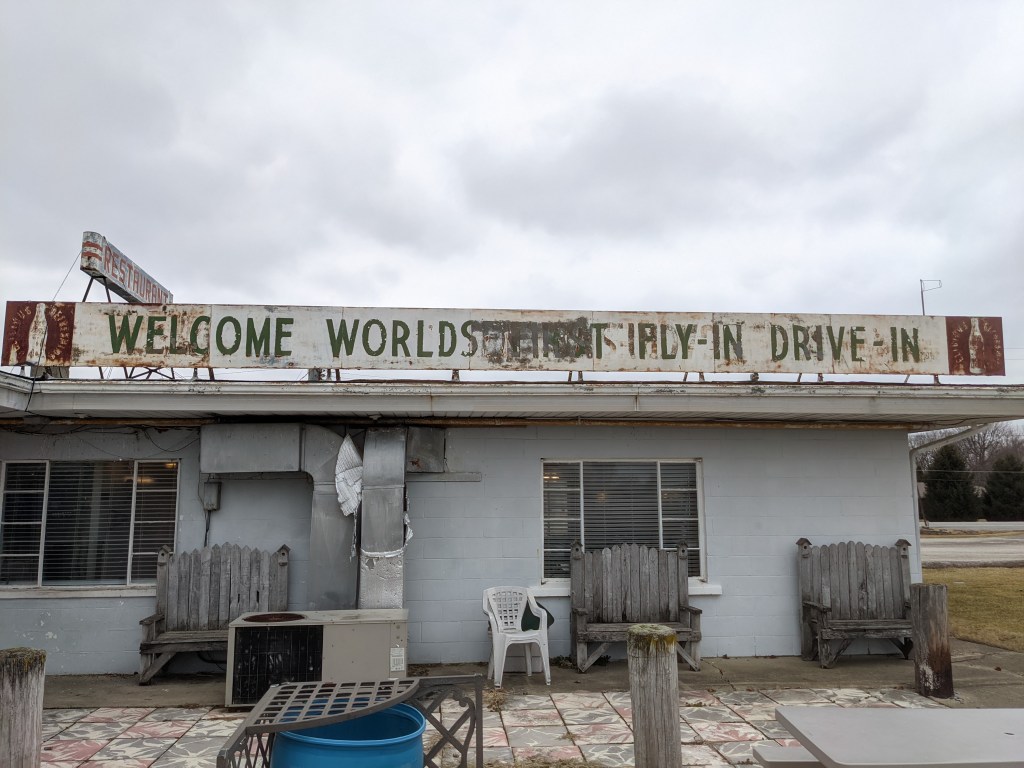
The original welcome sign for the restaurant as seen from the back patio.

The airport closed for good on September 1, 2008. The former runways were leased to a local farmer, who has since planted them in crops. Statistics from the previous year showed that the airport had 2,604 general aviation aircraft operations, an average of 217 per month. When I asked him how it affected his business, Al replied, “I lost $100,000 overnight.” That wasn’t the only calamity Swineforth had to weather. Like most restaurants, the COVID-19 pandemic nearly devastated the Airport Restaurant. “We never closed during COVID,” he stated. “Oh we shuttered the dining room but we were open for curbside and delivery.” It might surprise some to learn that Swineforth thinks the pandemic actually helped his business. “The community really came through for us. I think they appreciated that we never closed. Our business picked up after we reopened.”

I visited the Airport Restaurant on a weekday and was immediately greeted by owner Al Swineforth. Al insisted that we have lunch before we sat down to chat, his treat. We were seated in the dining room right next to the fireplace. Our waitress Holly Fettig greeted us warmly and informed us that she had worked there since she was 18 years old. “My mom worked here for a few years before I started,” Holly said. “I’ve been here for over 25 years now.” I question that statement because she looks like she would still get carded in any bar she found herself in today.

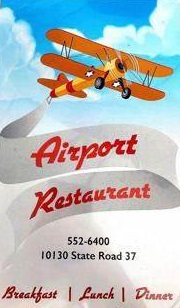
Elwood’s Airport Inn Menu.

The menu is full of so many different dishes that it is hard to zero in on any one particular selection. The restaurant fare runs the gamut from Hoosier staples like grilled tenderloins, onion rings, fried green tomatoes, and double-decker hamburgers to steak, chicken and noodles, or fish dinners. Holly informed us that they are “famous for our elk burgers.” Rhonda had broccoli cheddar soup and a grilled ham & cheese sandwich and I opted for a giant hamburger, fries, and chili. Next time, I’m trying that elk burger. We were not disappointed. The restaurant serves breakfast, lunch, and dinner with homemade pies also available.

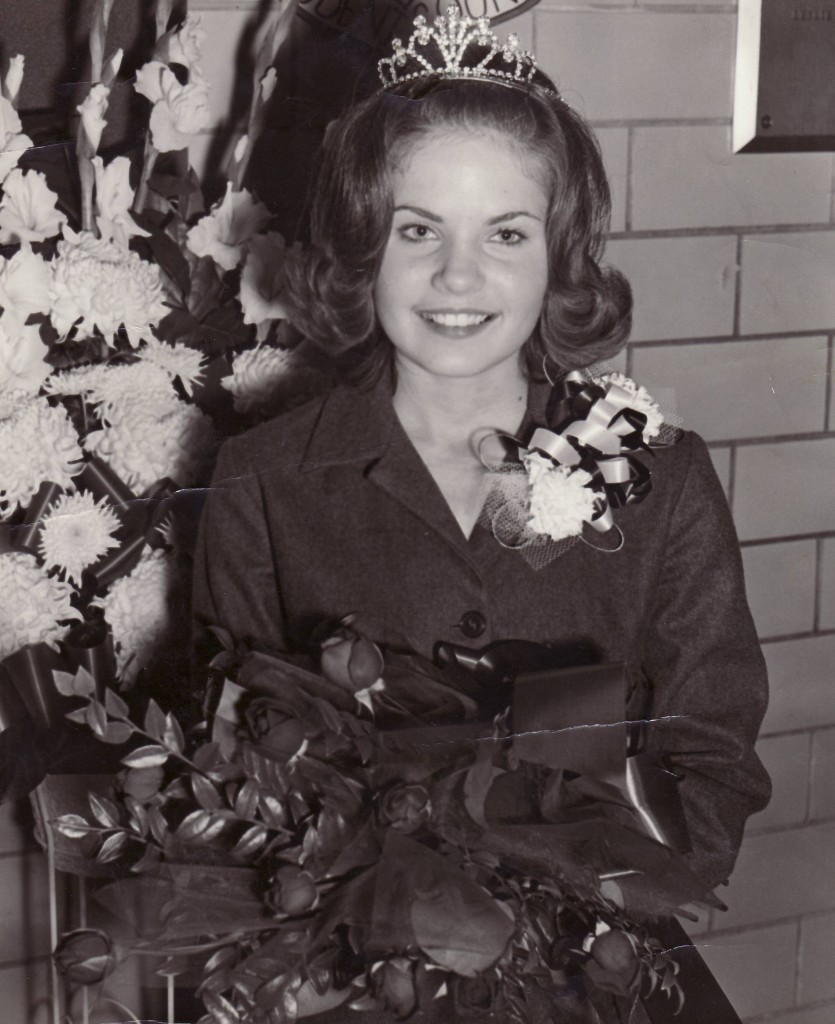
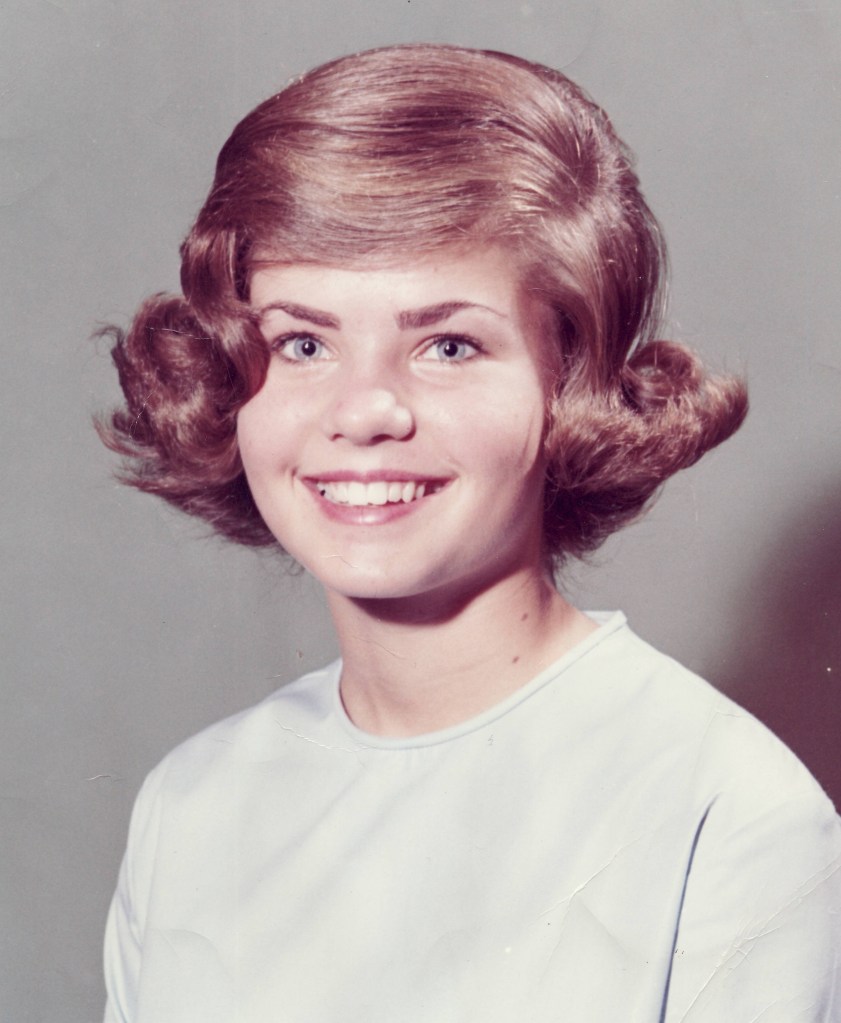
The author’s mother-in-law Kathy Hudson.

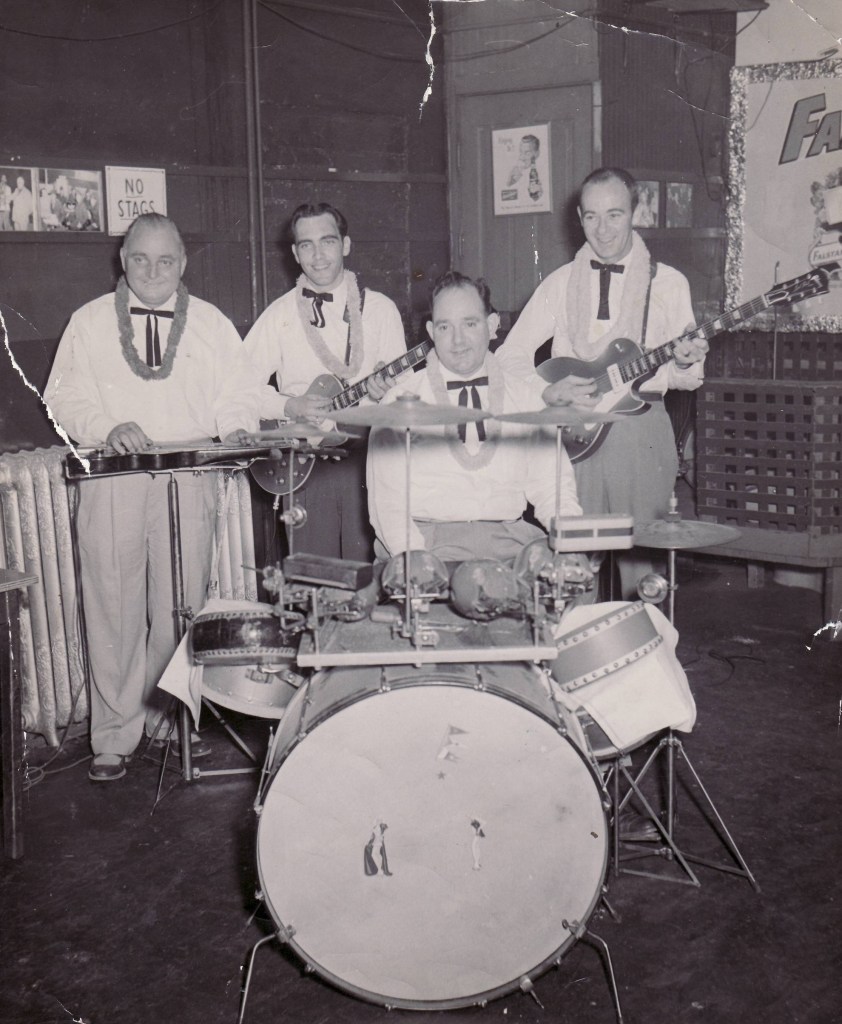
After lunch, we sat down with Al and Holly and explained the reason for our visit. Turns out that the restaurant has a family connection. My mother-in-law, Kathy Hudson, worked at the restaurant in 1968 at a time when it was being managed by my wife’s great-grandfather, Virgil Edgar Musick. Rhonda’s dad, Ron Musick, has told us for years about his grandfather and his restaurant and recalled helping with the bookkeeping when he was in high school. “The restaurant was called Musick’s Airport Restaurant back then. Granddad was a musician. He played slide guitar in a band along with running the restaurant.” Ronnie said, “Seemed like he was playing on the radio every weekend on WOWO up in Fort Wayne. He backed up some pretty big-name musicians in his day.”

Virgil Musick on slide guitar standing at left.

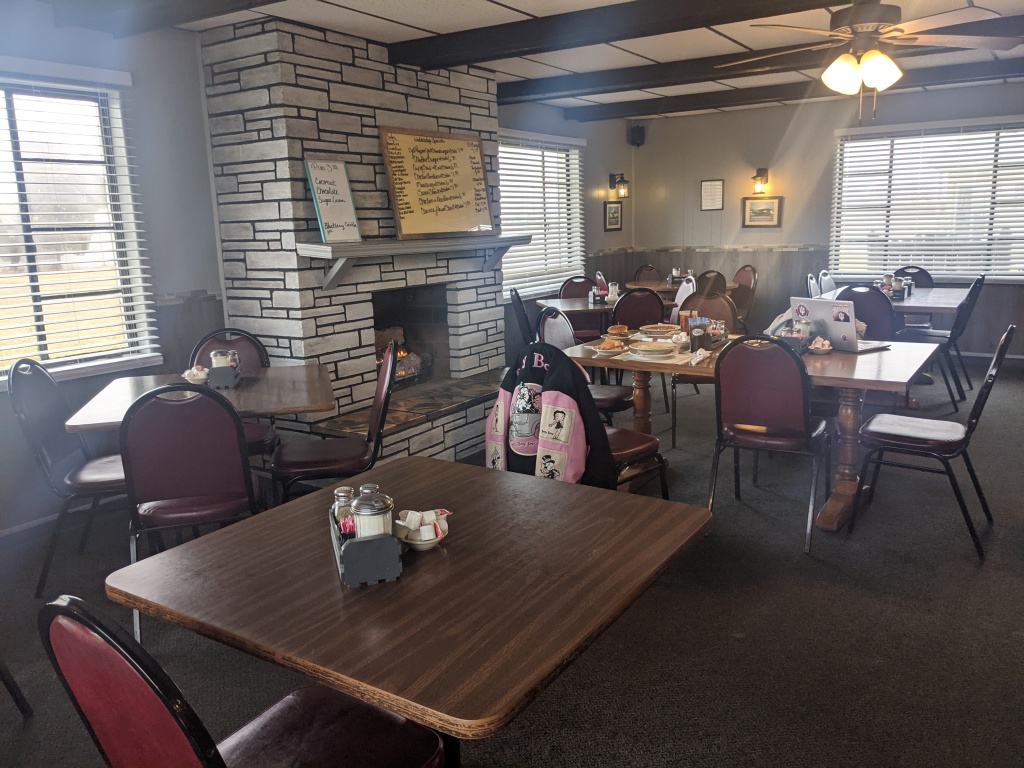
Kathy told us that she was working as a waitress there when Bobby Kennedy’s campaign flew into Elwood in May of 1968. “I don’t remember Bobby being there, but his advance guys were there, all dressed up in suits and dark sunglasses. They asked me if I wanted to go for an airplane ride and I told them, ‘Well, only if my husband can come along.’ The advance men told her, ‘Sure, he can sit on the wing.’ Did I mention that Kathy, former homecoming queen at Anderson Highland High School back in 1964, is quite the looker? The fireplace table was important because Rhonda’s only memory of the restaurant centers around a photo of her and grandmother Nina Pace standing in front of it. Rhonda told Al, “But I remember it as red brick, not white.” Al explained, “Yes it was red but we painted it white when we remodeled the place several years ago.”

The author’s father-in-law Ron Musick at left.

The planes don’t come here anymore and the runways were plowed over years ago. However, evidence of the airport survives in the many pictures of planes, parked on the grassy runways, taken back in the 1960s and 70s that now line the walls of the restaurant. My father-in-law, Keith Hudson, remembered tooling around Elwood back when it was a working airport. “We used to cut through here by driving up the runway back then. I still eat there from time to time.” When I mentioned Hud’s name to Al, he said, “Oh yeah, I know Keith from Bernie’s bar in Frankton.” Turns out that before he ran the Airport Restaurant, Virgil Musick ran the 128-club in Frankton. Seems like Al Swineforth knows everyone in Madison County. And as for those shortcuts through a working airport runway, don’t worry Hud, I think the statute of limitations has run on that by now.

Looking at Kathy, it is easy to understand how she drew the attention of RFK’s security detail in 1968.
The dining room of the Airport Restaurant in Elwood, Indiana as it appears today.

Creepy history, Criminals, Homosexuality, Museums

Leopold & Loeb A Hundred Years On.

Original publish date June 6, 2024. https://weeklyview.net/2024/06/06/leopold-and-loeb-a-hundred-years-on/

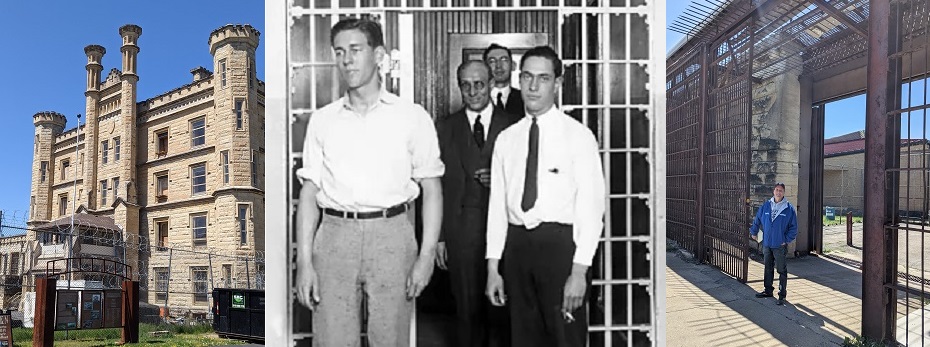
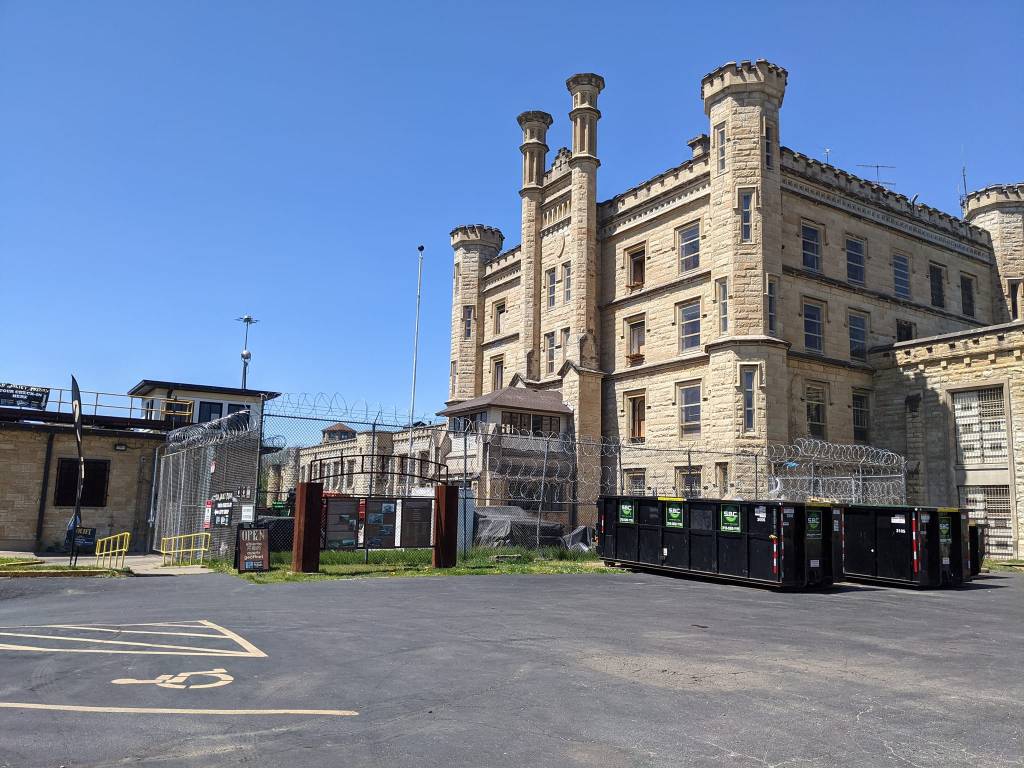
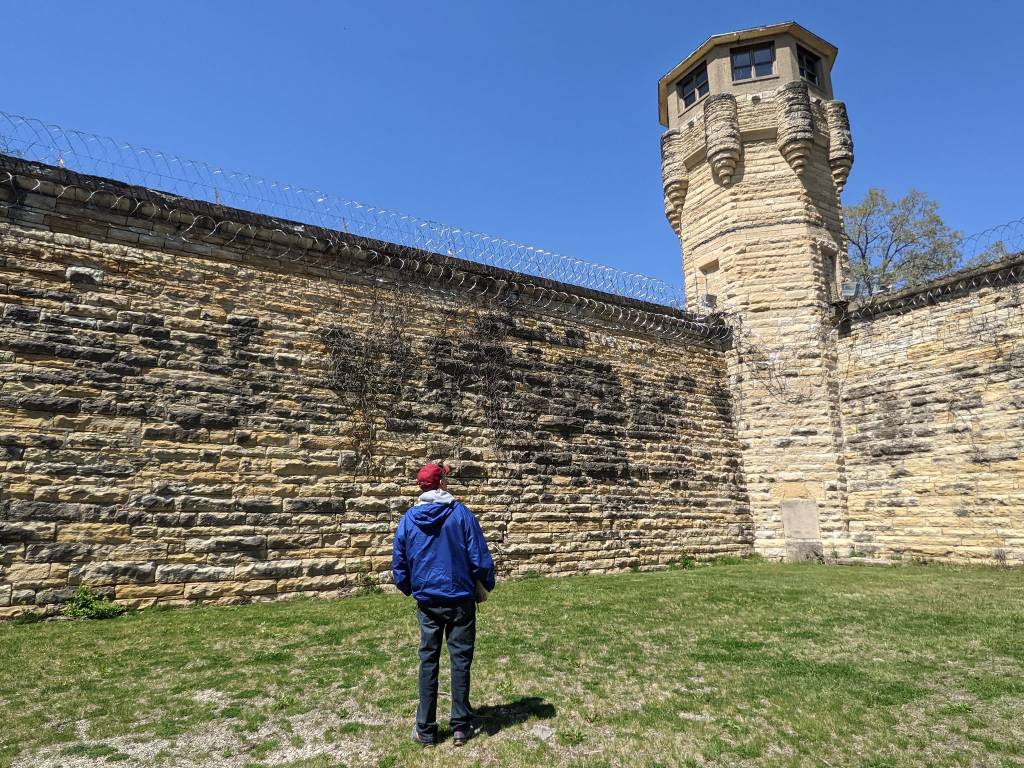
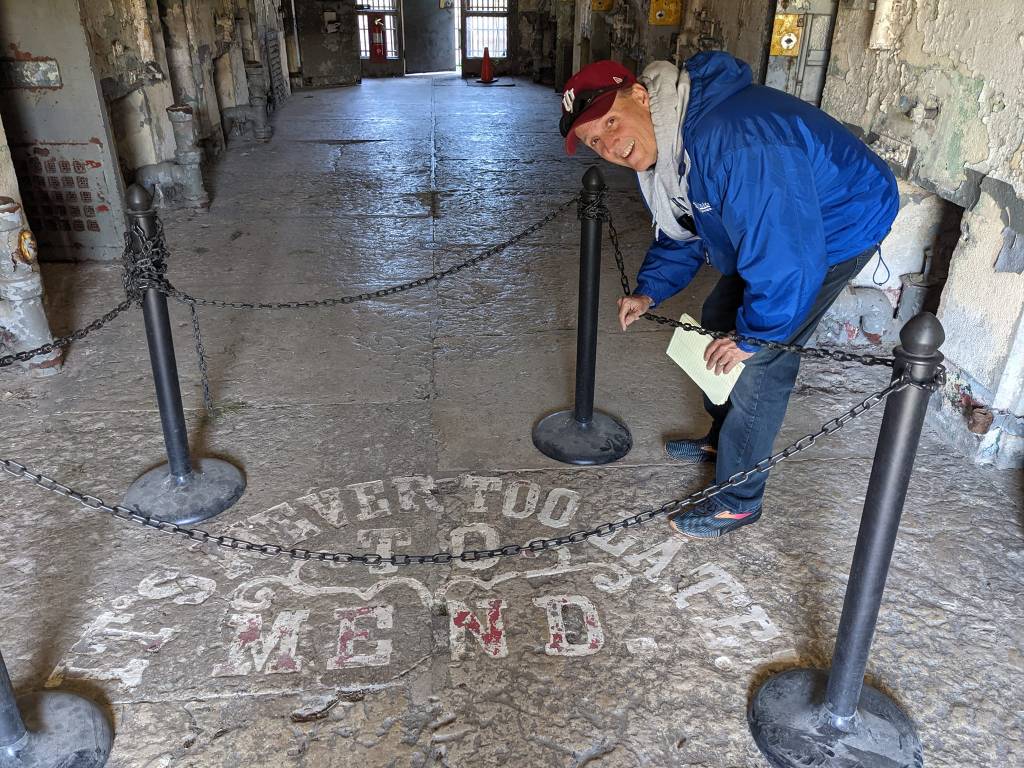
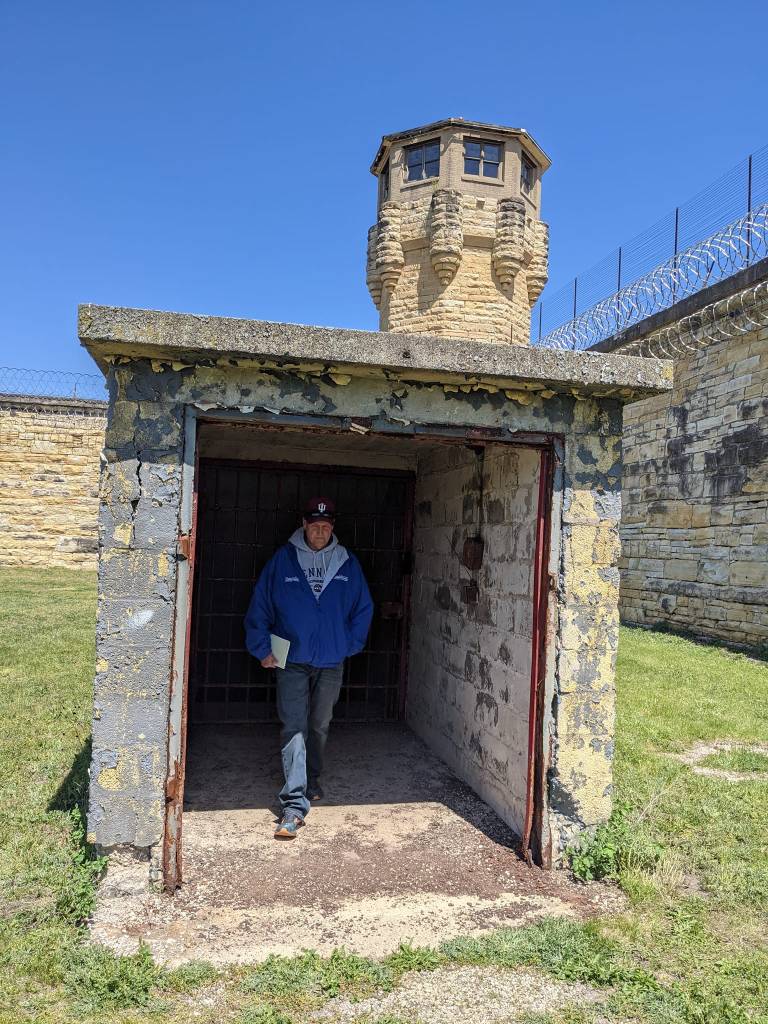
Old Joliet Penitentiary, Leopold & Loeb, and the author at the Blues Brothers gate.

Last month, Rhonda and I drove to the outskirts of Chicago to visit Joliet Prison in Illinois. Like many ancient jails, prisons, and penitentiaries, Joliet has experienced a second life as a tourist attraction. It opened back in 2018. During the summer months (June to September) Joliet is open daily for tours until 6 p.m. For $20 you can go visit the old stomping grounds of notorious inmates like Richard Speck, John Wayne Gacy, James Earl Ray, and Baby Face Nelson. In my case, I was interested in the place because of Leopold and Loeb. Okay, okay, I was also there thinking of the Blues Brothers, but mostly Leopold and Loeb.

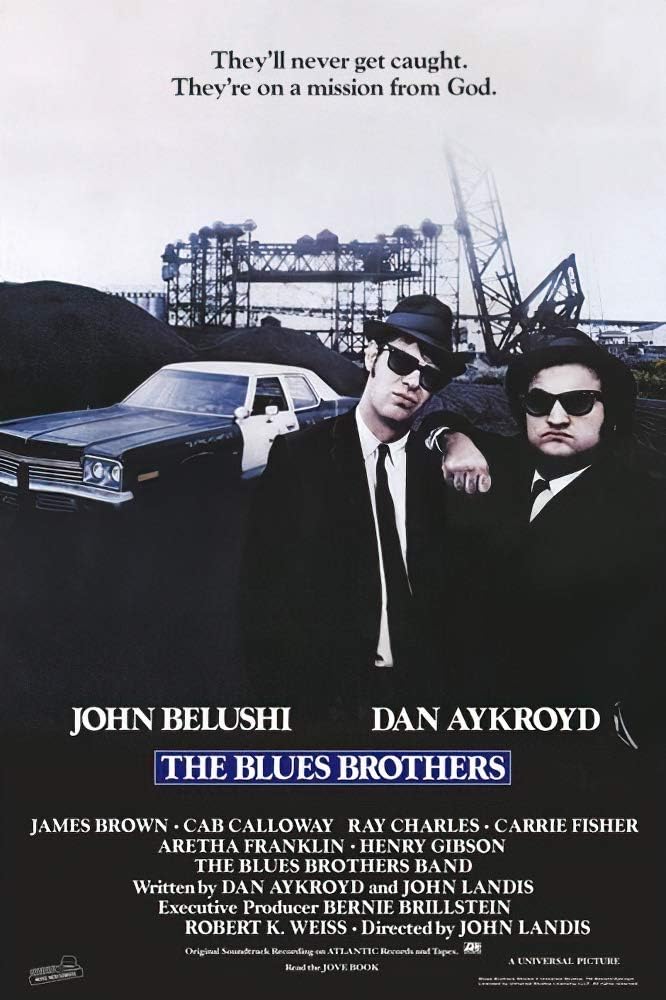
Old Joliet Penitentiary (originally known as Illinois State Penitentiary) opened in 1858 and was a working prison until 2002. In “The Blues Brothers” movie, Dan Aykroyd (Elwood J. Blues) awaits outside the prison gate for the release of John Belushi’s character (“Joliet Jake” Blues). Guests enter through the same gate Belushi exits. If you are sly, you can sneak over and crank the gate open or closed on your own. The prison was also used in the cult classic James Cagney film “White Heat” and the 1957 movie “Baby Face Nelson.”

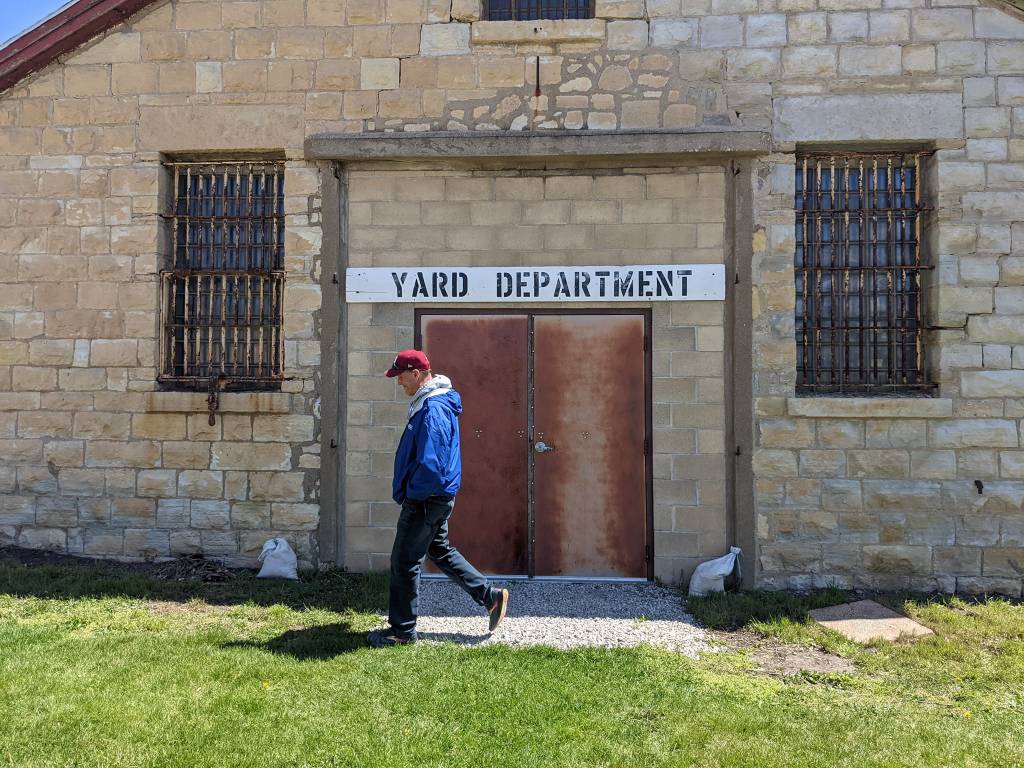
Like many of these incarceration-as-entertainment venues, Joliet is in a perpetual state of arrested decay. The tours are entirely self-guided and for a double sawbuck, you are handed a map and told to go explore “any door that is open.” We followed instructions and were only chased out of one building: the maintenance building. Which begged the question, “Then why did you leave the door open?” Visitors are warned not to shut the cell doors because they don’t have the keys and, oh, look out for rats. (For the record we saw none.) The women’s prison is still in place across the street but is only used nowadays for Halloween seasonal haunted houses and ghost tours.

Why, you ask, Leopold and Loeb? Well, because it was the 100th anniversary date of a crime that is mostly forgotten today but was the first “Crime of the Century”, the first “Trial of the Century” and the first “Media Circus” this “country-as-world-superpower” ever experienced. Fresh off the victory in World War I and smack dab in the middle of the Jazz Age, everything was bigger, faster, and more important in the US at the time. The crime hit the USA like a Jack Dempsey knockout punch to the jaw.

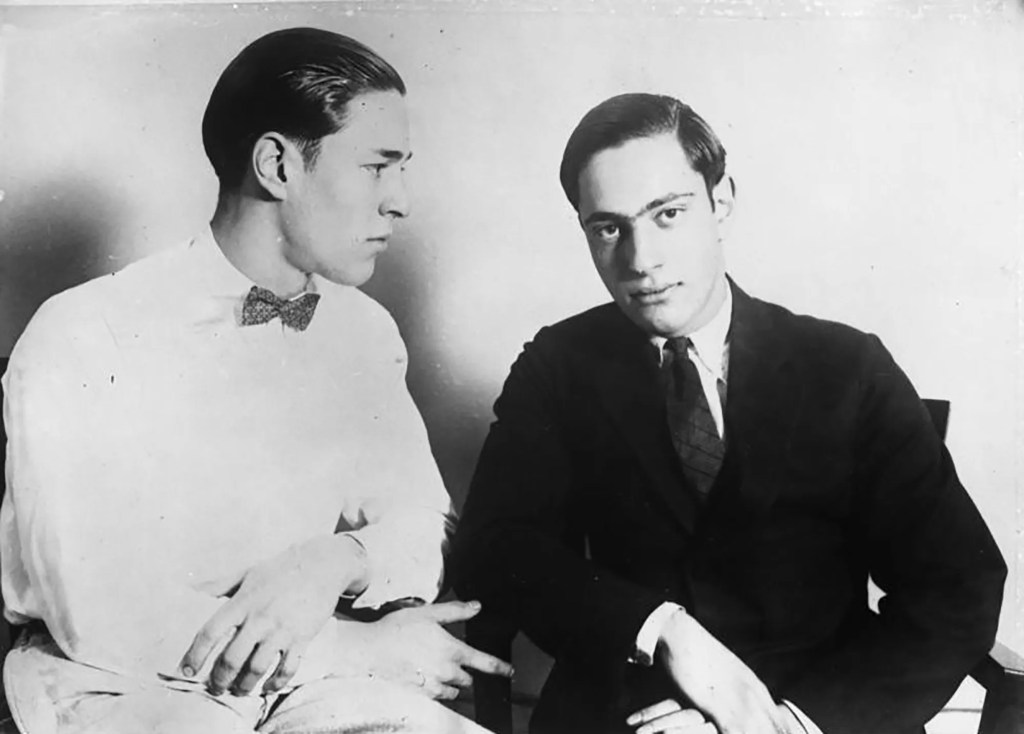
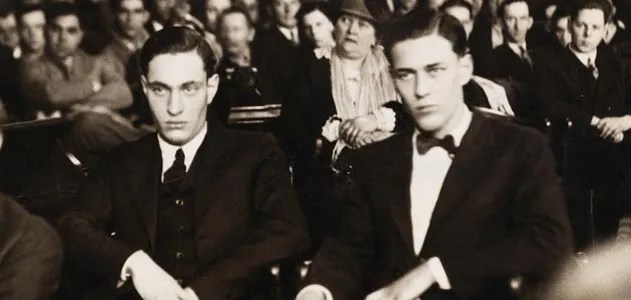
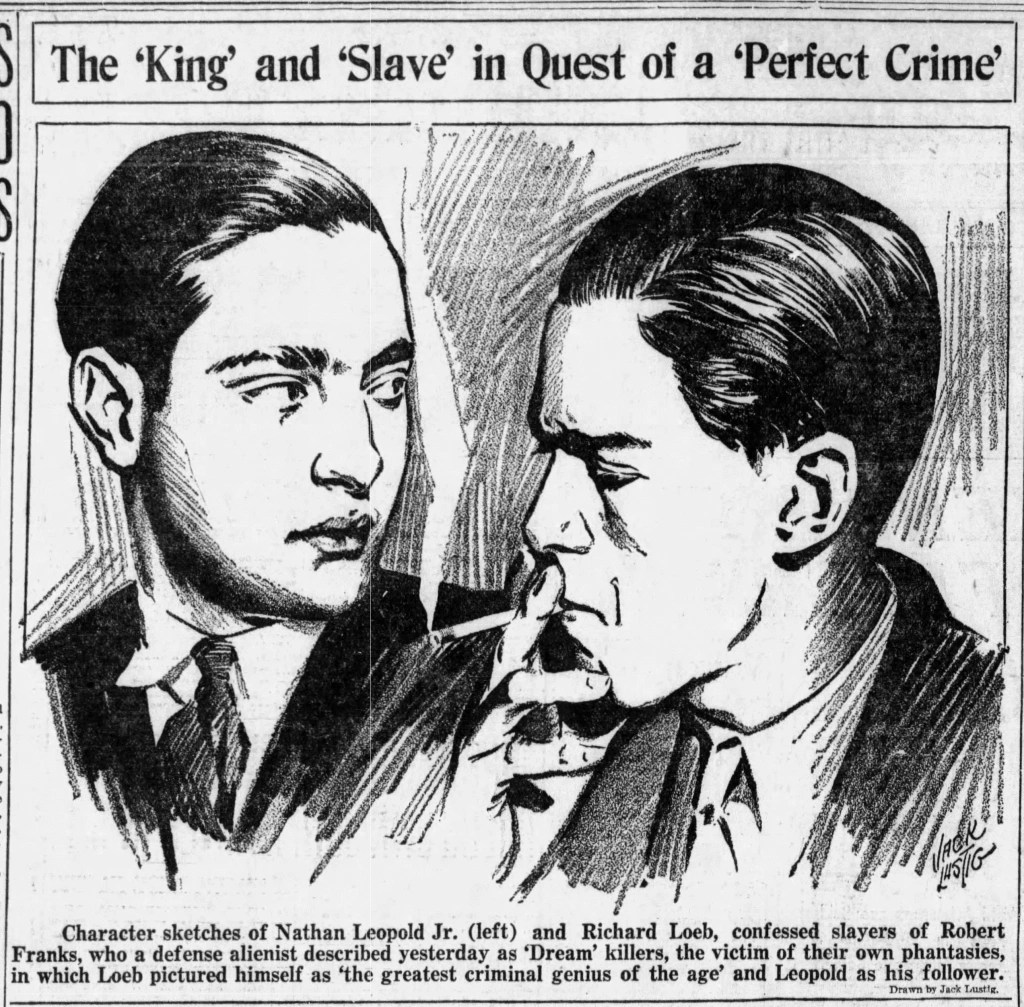
Nathan Freudenthal Leopold Jr. (November 19, 1904 – August 29, 1971) and Richard Albert Loeb (June 11, 1905 – January 28, 1936), were two affluent students at the University of Chicago who kidnapped and murdered a Chicago boy named Bobby Franks on May 21, 1924. They disposed of the schoolboy’s body in a culvert along the muddy shore of Wolf Lake in Hammond, Indiana. The duo committed the country’s first “thrill kill” as a demonstration of their superior intellect, believing it to be the perfect crime without possible consequences.

Richard Loeb (1905-1936) & Nathan Leopold (1904-1971).

Leopold (19) and Loeb (18) settled on identifying, kidnapping, and murdering a younger adolescent as their perfect crime. They spent seven months planning everything, from the method of abduction to purchasing rope and a heavy chisel to use as weapons, and to the disposal of the body. To make sure each of them was equally culpable in the murder, they agreed to wrap the rope around their victim’s neck and then each would pull equally on their end, strangling him to death. To hide the casual nature of their “thrill kill” motive, they decided that they had to make a ransom demand, even though neither teenager needed the money.

Bobby Franks (1909-1924)

After a lengthy search in the Kenwood area, on the shore of Lake Michigan on the South Side of Chicago, they found a suitable victim on the grounds of the Harvard School for Boys where Leopold had been educated. (Today, Kenwood has received national attention as the home of former President Barack Obama and his family.) The duo decided on 14-year-old Robert “Bobby” Franks, the son of wealthy Chicago watch manufacturer Jacob Franks. Bobby lived across the street from Loeb and had played tennis at the Loeb residence many times before.

Around 5:15 on the evening of May 21, 1924, using a rented automobile, Leopold and Loeb offered Franks a ride as he walked home from school after a baseball game. Since Bobby was hesitant, being less than two blocks from his home (which still stands at 5052 S. Ellis), Loeb told the victim he wanted to talk to Bobby about a tennis racket that he had been using. While the exact details of the crime are in dispute, it is believed that Leopold was behind the wheel of the car with Bobby in the passenger seat while Loeb sat in the back seat with the chisel. Loeb struck Franks in the head from behind several times with the chisel, then dragged him into the back seat and gagged him, where he died.

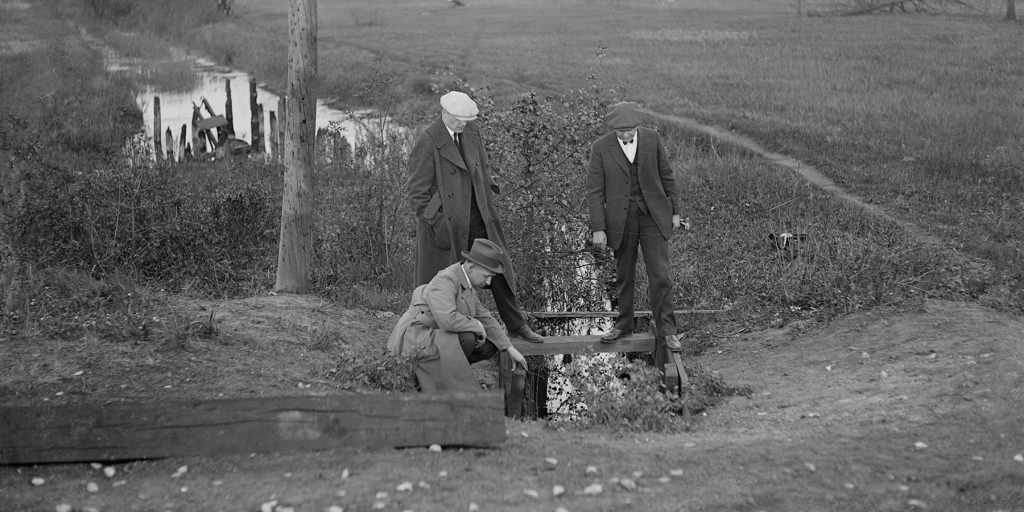
The culvert where Bobby Franks’s body was found. Chicago Daily News collection Chicago History Museum

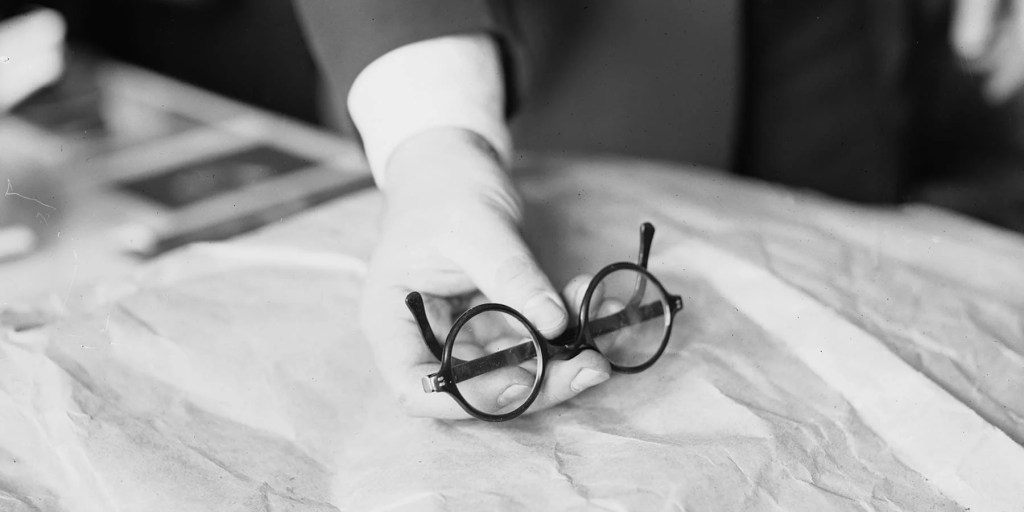
Loeb stuffed the boy’s body into the floorboards and scrambled over the back of the passenger seat. There is little doubt that the deadly duo’s demeanor was joyous as they exchanged smiles below bulging eyes accentuated with anxious breathing and giggles of laughter. The men drove to their predetermined body-dumping spot near Wolf Lake in Hammond, 25 miles south of Chicago. They concealed the body in a culvert along the Pennsylvania Railroad tracks north of the lake. To hinder identification, they poured hydrochloric acid on the face and body. When they returned to Chicago, they typed a ransom note, burnt their blood-stained clothing, and cleaned the blood stains from the rented vehicle’s upholstery. After which, they spent the remainder of the evening playing cards. They didn’t know that police had found a pair of Leopold’s prescription eyeglasses (one of only three such pairs in the entire city) near Franks’ body.

Leopold & Loeb.

Their plan unraveled quickly. When Roby, Indiana, (a now non-existent neighborhood west of Hammond) resident Tony Minke discovered the bundled-up body of Bobby Franks along the shore of Wolf Lake, the gig was up. The thrill killers destroyed the typewriter and burned the lap blanket used to cover the body and then casually resumed their lives as if nothing ever happened. Both of these demented little rich boys enjoyed chatting with friends and family members about the murder. Leopold discussed the case with his professor and a girlfriend, joking that he would confess and give her the reward money. Loeb, when asked to describe Bobby by a reporter, replied: “If I were to murder anybody, it would be just such a cocky little S.O.B. as Bobby Franks.” When asked to explain how the eyeglasses got there, Leopold said that they might have fallen out of his pocket during a bird-watching trip the weekend before. Leopold and Loeb were summoned for formal questioning on May 29. Loeb was the first to crack. He said Leopold had planned everything and had killed Franks in the back seat of the car while he drove. Once informed of Loeb’s confession, Leopold insisted that he was the driver and Loeb the murderer. The confessions were announced by the state’s attorney on May 31, 1924.

The glasses found near Bobby Franks’s body. Chicago Daily News collection, Chicago History Museum.

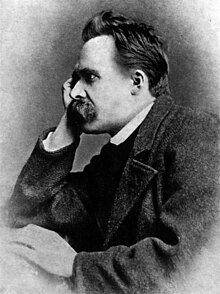
Later, both admitted that they were driven to commit a “perfect crime” by Übermenschen (supermen) delusions, and their thrill-seeking mentalities drove a warped interest to learn what it would feel like to be a murderer. While it is true that Leopold and Loeb knew each other only casually while growing up, their relationship flourished at the University of Chicago. Their sexual relationship began in February 1921 and continued until the pair were arrested. Leopold was particularly fascinated by Friedrich Nietzsche’s concept of Übermenschen, interpreting themselves as transcendent individuals possessing extraordinary, superhuman capabilities whose superior intellects would allow them to rise above the laws and rules that bound the unimportant, average populace.

Philosopher Friedrich Nietzsche (1844-1900).

Early in their relationship, Leopold convinced Loeb that if they simply adhered to Nietzsche’s doctrines, they would not be bound by any of society’s normal ethics or rules. In a letter to Loeb, he wrote, “A superman … is, on account of certain superior qualities inherent in him, exempted from the ordinary laws which govern men. He is not liable for anything he may do.” The duo first tested their theory of perceived exemption from normal restrictions with acts of petty theft and vandalism including breaking into a University of Michigan fraternity house to steal penknives, a camera, and the typewriter later used to type the ransom note. Emboldened, they progressed to arson, but no one seemed to notice. Disappointed with the lack of media coverage of their crimes, they began to plan and execute a sensational “perfect crime” to grab the public’s attention and cement their self-perceived status as “supermen”.

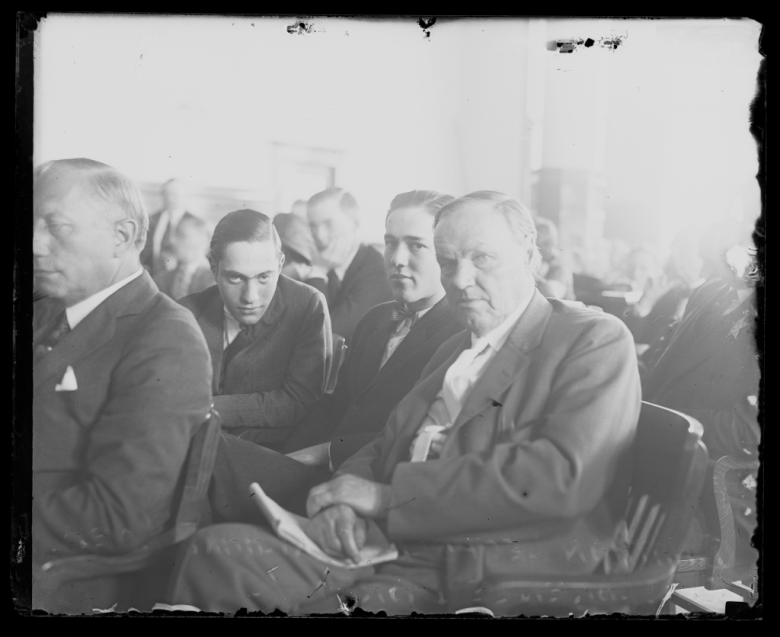
Lawyer Clarence Darrow in court with Leopold & Loeb.

After the two men were arrested, Loeb’s family retained Clarence Darrow as lead counsel for their defense. Clarence Seward Darrow (April 18, 1857 – March 13, 1938) was perhaps the most famous lawyer of the late 19th / early 20th centuries. He was known for his strenuous defense of women, Civil Rights, early trade unions, and the Scopes “monkey” trial. Darrow was also a well-known public speaker, debater, and writer. He took the case because he was a staunch opponent of capital punishment. Darrow’s father was an ardent abolitionist and his mother was an early supporter of female suffrage and women’s rights.

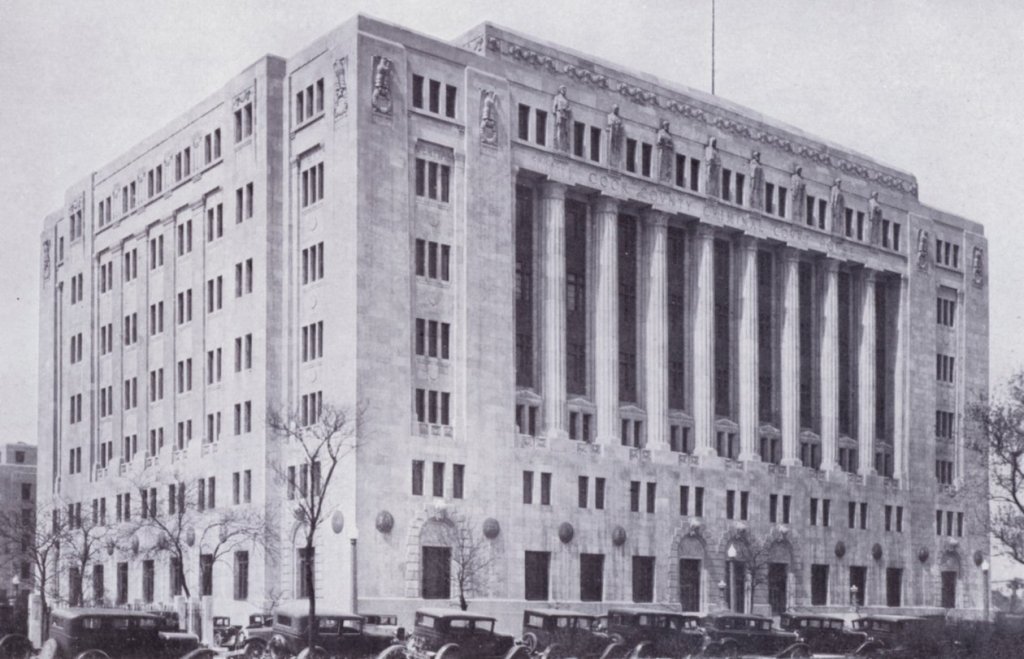
Chicago’s Cook County Criminal Courthouse.

The trial took place at Chicago’s Cook County Criminal Courthouse. For his efforts, Darrow was paid $65,000 (equivalent to $1,200,000 today). Everyone expected the defense would be not guilty because of insanity, but Darrow believed that a jury trial would convict his clients and impose the death penalty regardless of the plea. So Darrow entered a plea of guilty and appealed to Judge John R. Caverly to impose life sentences instead. The sentencing hearing ran for 32 days. The state presented over 100 witnesses, meticulously documenting the crime. The defense presented extensive psychiatric testimony to establish mitigating circumstances, including childhood neglect in the form of absent parenting, and in Leopold’s case, sexual abuse by a governess. But it was Darrow’s impassioned, eight-hour-long “masterful plea” after the hearing (called the finest speech of his career) that saved Leopold and Loeb’s lives. Darrow argued that the methods and punishments of the American justice system were inhumane, and the youth and immaturity of the accused should be considered in their sentencing.

Darrow’s speech, at least in part, is worth revisiting here. “Is any blame attached because somebody took Nietzsche’s philosophy seriously and fashioned his life upon it? It is hardly fair to hang a 19-year-old boy for the philosophy that was taught him at the university…Your Honor knows that in this very court crimes of violence have increased growing out of the war. Not necessarily by those who fought but by those that learned that blood was cheap, and human life was cheap, and if the State could take it lightly why not the boy?…The easy thing and the popular thing to do is to hang my clients. I know it. Men and women who do not think will applaud…(I) would ask that the shedding of blood be stopped, and that the normal feelings of man resume their sway. Your Honor stands between the past and the future. You may hang these boys; you may hang them by the neck until they are dead. But in doing it you will turn your face toward the past. In doing it you are making it harder for every other boy who in ignorance and darkness must grope his way through the mazes which only childhood knows. In doing it you will make it harder for unborn children. You may save them and make it easier for every child that sometime may stand where these boys stand. You will make it easier for every human being with an aspiration and a vision and a hope and a fate. I am pleading for the future; I am pleading for a time when hatred and cruelty will not control the hearts of men. When we can learn by reason and judgment and understanding and faith that all life is worth saving, and that mercy is the highest attribute of man.”

Old Joliet Penitentiary, Joliet, Illinois.

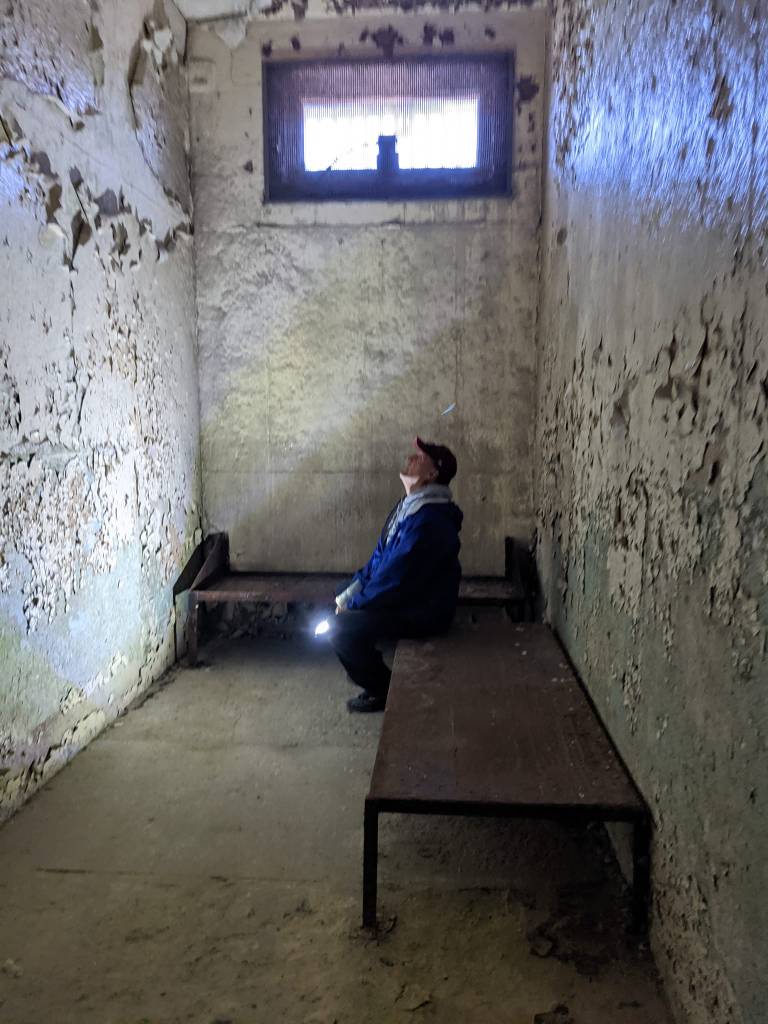
Both men were sentenced to life plus 99 years. During Darrow’s month-long courtroom argument to save their lives, Leopold and Loeb’s families greased the guards with bribes to soften their stay at the Cook County Jail. That abruptly ended when they reached Joliet. The Illinois State Penitentiary was already out of date and seriously overcrowded when they arrived. It had been condemned as unfit for habitation twenty years prior, yet, was still open. According to the Joliet Prison website, “Built in 1858 of limestone quarried on the site by prisoners to house 900 inmates; by 1924 over 1,800 prisoners were incarcerated there. The cells, four feet by eight, were damp, had narrow slits for windows, and possessed no plumbing: prisoners were given a jug of water each morning and made do with a bucket to use as a toilet. Every aspect of life at Joliet was regulated. Prisoners were given two changes of underwear, blue shirts, pants, socks, and heavy shoes to use each week. Contact with the outside world was limited. Inmates could send a single letter and receive visitors every second week. Using funds from their prison accounts, they could purchase tobacco, rolling papers, chewing gum, and candy from the prison commissary. There were no other privileges. A bell awoke prisoners at 6:30 AM and the cell blocks filled with sounds of locks opening, doors slamming shut, and boots marching along the steel flooring. After dressing, inmates grabbed the buckets and carried them into the courtyard, emptying their refuse into a rancid trough. Meals were served in a large dining hall; twice a week prisoners had beef stew for breakfast; other days hash was served. The food was cold and unappealing, sitting in pools of congealed fat on aluminum trays.”

As the Medieval prison loomed before them, its towers bathed in the glow of arc lights shadowing what lay behind the walls, the two convicted killers surely swallowed hard in fear. Thanks to the specialized skills of attorney Darrow, they had escaped the death penalty only to find themselves condemned to life imprisonment in this foreboding fortress. Leopold and Loeb were introduced to their new life at the Illinois State Penitentiary at Joliet on the night of September 11, 1924. Bound in ankle chains tethered by a chain to their handcuffs, the duo shuffled through the front gates of the inmate reception area. By the next day, their heads were shaved; they were photographed and fingerprinted; authorities assigned them prison numbers: Leopold was Inmate No. 9305, and Loeb No. 9306. After processing, they were led to separate cells, disappearing into the penitentiary population. Once they entered regular prison life, they were kept in solitary cells for several months, both because of the publicity of their crime and also because they were among the youngest inmates of the prison. Although kept apart as much as possible, the two managed to maintain their friendship. Leopold and Loeb spent most of their days working in prison shops: Leopold wove rattan chair bottoms in the prison’s Fibre Shop, while Loeb constructed furniture. Between meals, they were allowed two fifteen-minute breaks in which to walk or smoke. After dinner at four, they returned to their cells. At nine, lights out.

The author in the death house at Joliet.
Indianapolis, Indy 500

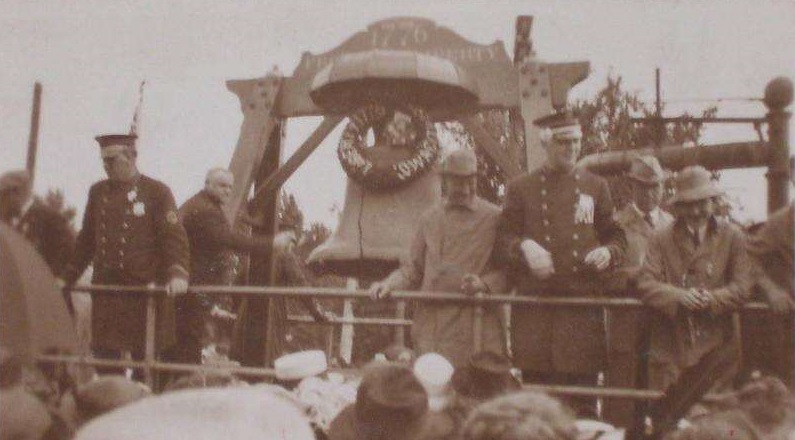
The Liberty Bell In Indianapolis.

Original publish date July 3, 2024. https://weeklyview.net/2024/07/03/the-liberty-bell-in-indianapolis/

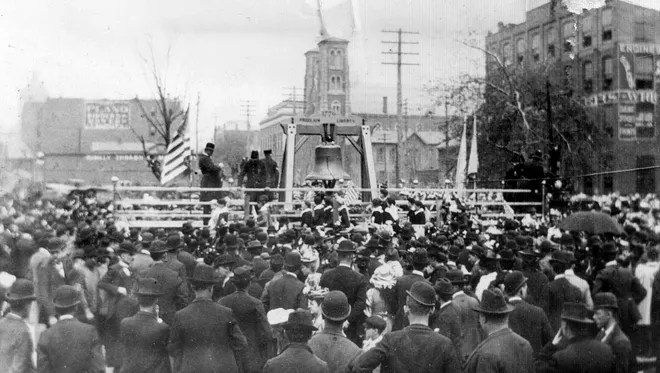
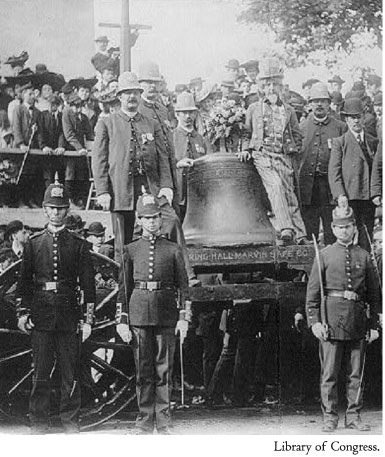
The Liberty Bell in Indianapolis 1893. Courtesy Bass Photo Collection.

The Liberty Bell is believed to have been brought to Pennsylvania by William Penn, arriving in Philadelphia on September 1, 1752. Its original use was to announce the opening of the Courts of Justice to the people and to call members of the Pennsylvania Provincial Assembly together. Surprisingly, the main purpose of the Liberty Bell was to announce the accession of a member of the British royal family to the throne, and the proclamation of treaties of peace and declarations of war. Ironically, the bell rang out loudly when the Declaration of Independence was publicly read for the first time in Philadelphia, on July 8, 1776. Contrary to legend, the bell did not crack at that time. It cracked exactly fifty-nine years to the day later during ceremonies honoring the death of John Marshall, Chief Justice of the U.S. Supreme Court who died two days prior on July 6, 1835.

The train carrying the Liberty Bell arriving in Indianapolis. Courtesy Indianapolis Star.

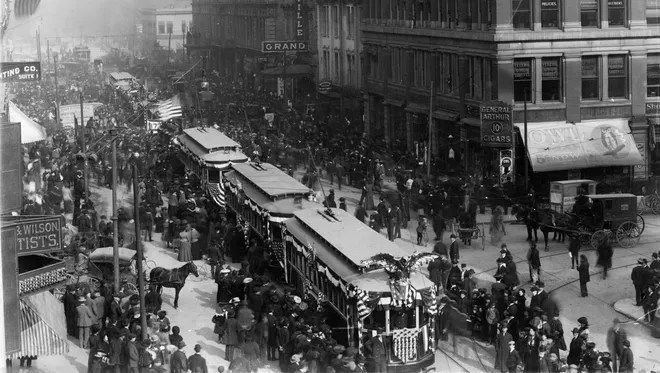
Since the time of American Independence, no other inanimate symbol has come to represent the United States more than The Liberty Bell. Although inextricably associated with the city of Philadelphia, The Liberty Bell has traveled through Indianapolis on three separate occasions. The first visit came to our city on Friday, April 28, 1893, on its way to the World’s Fair in Chicago. It was traveling over the Pennsylvania rail lines which sent it directly through the heart of Irvington. America’s most famous relic to freedom arrived at 5 a.m. and was placed on a sidetrack at Tennessee Street (present-day Capitol Avenue) at downtown Union Station. By the time Mayor Thomas Sullivan and Chief of Police Thomas Colbert arrived with a squad of eight guards, the street was already choked full of people anxious to see The Liberty Bell. Nervous carpenters worked feverishly building wooden ramps to access the bed of the converted passenger coach upon which the flag-draped relic was fastened.

Indianapolis Mayor Thomas Lennox Sullivan (1846-1936) Courtesy Indiana Historical Society

The Indianapolis News reported, “Patriots came with such a rush to see the ‘Voice of Freedom’ that the ropes stretched around the car and along the street were incapable of holding the throng in check. Captain Charles Dawson began shouting at the top of his voice: ‘Get your tickets ready. Be sure and buy your tickets before you get in line!’ Of course, no tickets were necessary, but the cry had the desired effect. Hundreds fell out of the jam to make inquiries regarding tickets, and the police were then able to get the line properly formed.” The article details a strange phenomenon that swept that crowd. “When the crush was at its worst, a man passed up his matchbox to one of the policemen and asked that he touch the bell with the box. He felt that the mere touching of the bell would hallow the matchbox. Instantly, the policemen on guard were besieged with requests that they touch the bell with rings, ribbons, watches, canes, handkerchiefs, and a hundred other things.” Mothers and fathers handed babies up to the policemen for a rub against the bell. One child fainted amid the confusion. It resulted in a panic or sorts and “the touching incident had to be closed by the police for the sake of safety.”

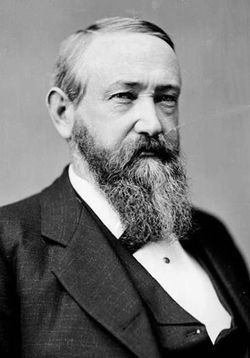
That 1893 visit culminated with a viewing at the Indiana State House where former President Benjamin Harrison delivered a speech honoring the bell. During the celebration, children from the Indianapolis Blind School were permitted to “get the sense of sight through the joy of touch. They fingered the beloved relic and went back to school fully satisfied.” The second visit of the Liberty Bell came on November 17, 1904, on its way back to Philly from the Louisiana Purchase Exposition aka the St. Louis World’s Fair. Sadly, the bell’s 6 p.m. arrival at the intersection of West and Washington Streets occurred the same day that the historic landmark Meridian Street Methodist Episcopal Church burnt to the ground nearby. The poet James Whitcomb Riley was among the official greeters for that 1904 visit. The Liberty Bell was on display at the interurban train sheds and Ohio Street traction station through the night, leaving the next morning. The culmination was a parade of all Indianapolis Public School children to the interurban station where they marched in front of the cherished relic to music provided by the Indianapolis News Newsboys Band. The Indianapolis News reported that the scene “moved grownups to tears and brought a full realization of the patriotic value of The Liberty Bell.” The bell was removed to the train station and sent on its way back to Philadelphia “almost buried under chrysanthemums that had been provided by patriotic citizens. As the car passed westward on Washington Street, the school children strewed the track with flowers.”

Hoosier President Benjamin Harison.

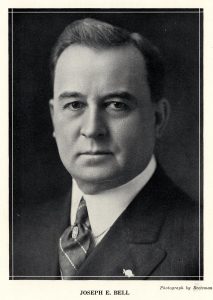
On July 5, 1915 (109 years ago this Friday) The Liberty Bell left Philadelphia for the last time on its way to the Panama-Pacific International Exposition World’s Fair in San Francisco, California. The bell debuted in the city by the bay on “Liberty Bell Day” on July 17. It was displayed in the Pennsylvania Building at the Fair for four months, every evening it was rolled and stored securely in a vault. Finally, on November 11, the bell left the Fairgrounds accompanied by cheers, church bells, and tearful smiles of farewell from those present. During the trip home, the bell made its final visit to Indianapolis. The event was planned (perhaps fittingly) by an Indianapolis Mayor named Joseph E. Bell, an interesting but long-forgotten figure in Indianapolis history. Bell, a Democrat and former law partner of John W. Kern, served from 1914 to 1918. Bell is notable for establishing the first police vice squad in the city and for his many public improvements including the the transformation of Pogue’s Run from an open sewer to an immense covered drain and a flood levee along the west bank of the White River and railroad track elevation permitting street and the development of the boulevard system. He also authorized the construction of the sunken gardens at Garfield Park. During Bell’s administration, 281 miles of streets, sidewalks, and sewers were built. Bell, a founder of the Indiana Democratic Club, died from an accidental, self-inflicted shotgun wound suffered at the Indianapolis Gun Club.

Mayor Joseph E. Bell.

Just as in 1904, The Liberty Bell narrowly escaped disaster during that 1915 visit when a warehouse fire in Louisville swept two large warehouses, coming within a thousand feet of the relic. No wonder Philly hasn’t let the bell out of its sight since that trip. The Liberty Bell was greeted upon its 7:45 p.m. arrival in the Circle City by 5,000 flag-waving citizens lining East Washington Street. The relic bell visited over 400 cities during its trip home. The Liberty Bell welcoming parade was led by a contingent of GAR Civil War Veterans, mounted Policemen, and cars containing Teddy Roosevelt’s former Vice-President Charles W. Fairbanks, Governor Sam Ralston, Butler President Thomas Carr Howe, & Poet James Whitcomb Riley. The Nov. 22, 1915, Indianapolis News reported, “Impressive features of the occasion marked the stopping of the bell at the statehouse and courthouse where school choruses from the Manual Training and Technical High Schools led by the teachers of those schools, sang ‘America’ and other patriotic songs.

Indianapolis Motor Speedway Pioneer Carl G. Fisher.

An interesting side note occurred when Indianapolis Motor Speedway’s founding father Carl Fisher volunteered to repair the crack in the Liberty Bell. The Nov. 20, 1915, News reported, “Practical-minded Carl F. Fisher is going to propose that they leave the bell and its celebrated crack in Indianapolis so that by processes now in use at the Prest-O-Lite plant, near the motor speedway, the long silence of The Liberty Bell may be broken and its voice again proclaim the sweetness of American freedom.” Fisher, perhaps the greatest huckster the Hoosier state ever saw, told the News, “Philadelphia has been living off that crack long enough. We have had at our plant in the last two years bells that are older than the Liberty Bell. They were on old Spanish men-of-war and merchant vessels that represented ports older than Philadelphia itself. Unless Philadelphia wakes up and has some repair work done pretty soon they’ll have a total wreck of their famous relic. We can patch that crack up as easily as a shoemaker half-soles a shoe. Expansion and contraction are making the bell’s crack wider, and something must be done to heal that wound. If they will just let Indianapolis play surgeon for their beloved patient we will show them that we can do it.” The News further reported, “It was learned that the Philadelphia people have a pride in the crack and do not wish it mended.” The train carrying the Liberty Bell left Indianapolis at 12:30 a.m. en route to Columbus, Indiana. On Thanksgiving day in 1915, Philadelphians welcomed the Liberty back to Independence Hall at nightfall after its cross-country tour. Although the bell has been “tapped” many times for historic events after that 1915 homecoming, on September 25, 1920, it was rung for the last time in ceremonies in Independence Hall celebrating the ratification of the 19th Amendment giving women the right to vote.