Indianapolis, Museums

Feast & Famine-Henry Flagler and the last Indianapolis Street car. Part II

ITM train 2
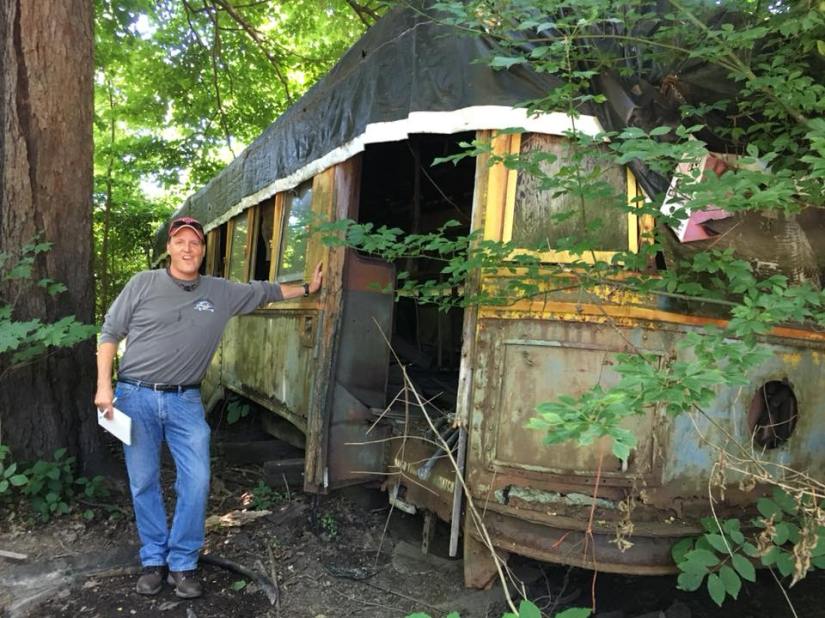
Alan E. Hunter on the last Indianapolis Street Car, Photo by Rhonda Hunter.

Original publish date:  July 23, 2018

At 11:59 pm on Thursday July 12, 2018, the Indiana Transportation Museum (ITM) in Noblesville, Indiana ceased to exist when the Hamilton County Sheriff’s Office swarmed the grounds at Forest Park and sealed the property. The closing, although known by all parties involved, still came as a shock to the system for the dedicated volunteers working furiously to save the engines, railcars and equipment they have so lovingly cared for over the past half-century. Even though everyone knew it was coming, no one really expected it to happen.
As an intensely interested (but uninvested) observer of what happened that week after Independence Day, I immediately recognized the politics involved on both sides. There can be no doubt there were strong opinions on both sides of the issue. Like all parties involved, I have my own opinion. However, I am neither a train-guy nor an investigative journalist. I have a background in historic preservation, particularly when it comes to my birth state of Indiana, and I write about Hoosier history. I don’t think it’s my place to take sides in this debate. What’s done is done, what’s right is right and in the words of Buffalo Springfield, “Nobody’s right if everybody’s wrong.”
From the moment that I walked into that chaotic scene one week before it’s closing, I was struck by the dedication of the people working on those trains. Whether talking about on-site volunteers from the ITM or those from neighboring rail museums, one thing was clear from the start, when it comes to trains, these people are passionate about preservation. The people I’m talking about don’t have PhD’s, don’t serve on boards of directors and don’t give a damn about self-promotion or the politics involved. They love trains, period. So when I heard the news of the ITM’s closing, I felt it would be best to honor these folks rather than add to the chatter of discontent.
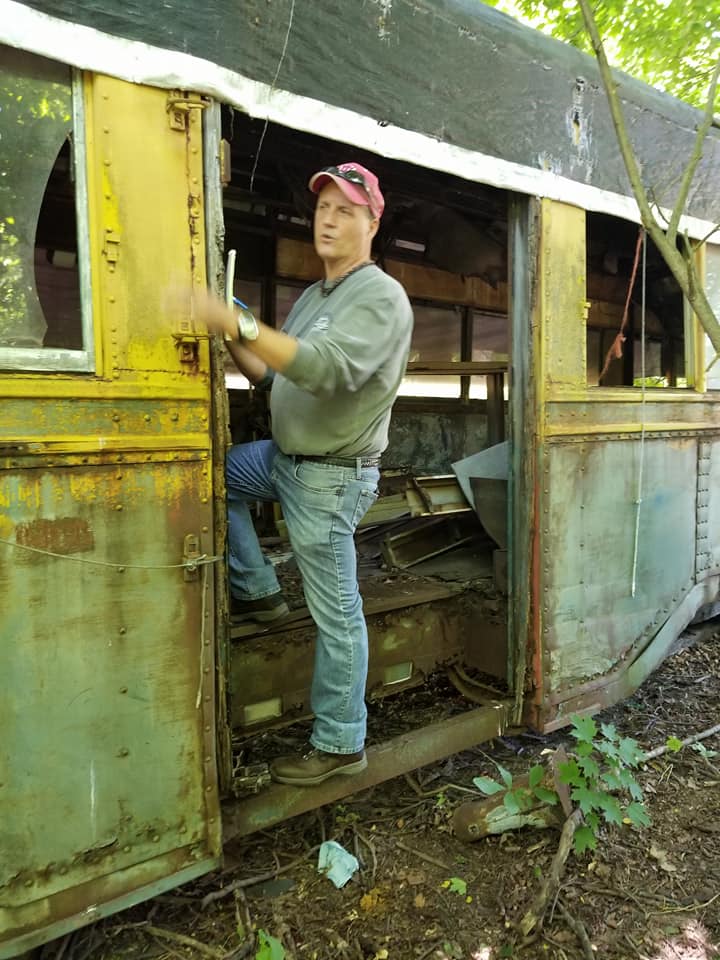
Kris Branch streetcar photo 1
The last Indianapolis Street Car. Photo by Kris Branch.

In part one of this article, I detailed the quest that brought me to the ITM in the first place: the search for the last surviving Indianapolis streetcar. I had been tipped off to the car’s presence at ITM by Meg Purnsley, friend and dedicated Indianapolis preservationist. My first inquiries about the fate of car # 153 were met with puzzled looks on the greased streaked faces of the first few people I encountered. Finally I was directed to the trolley barn just east of the Hobbs station depot where I found Craig Presler hovering over a couple wooden trolley cars located there. As it turned out, locating Craig was my first good find of the day, but certainly not my last.
When I asked Craig about the fate of Indy streetcar 1-5-3, he answered, “Well I can take you to where it was but it was crushed some time ago.” What? I was gobsmacked by the news and immediately sick to my stomach. Thank goodness my wife Rhonda was there to prop me up else I may have fainted dead away on the spot. Craig walked us a couple hundred yards past another trolley barn and pointed to a train car parked near the tree line. “The car you’re looking for was located right behind this one,” said Craig. “But it was crushed some time ago.” I’m no Indiana Jones, but as I looked into the trees several yards past the wood line, I saw the gleam of a window. “What’s that? Is that it?” I asked Craig. Then, time slowed down like a scene from a Quentin Tarantino movie as Craig said, “Maybe, I guess it didn’t get crushed after all.”
In a flash, Rhonda and I found ourselves blazing a trail through the thick overgrowth towards that window. With each step, the shadowy silhouette of car 153 emerged from the wilderness. It was in pretty bad shape, but it was there. Knowing that time was not on my side, my every thought went to getting this car out of these woods before it was too late. As I said before, I am not a train guy and have no idea what it would take to get this relic out of these woods. Craig assured me that it could be done and pledged to help in any way that he could. Meantime, the hour was getting late and I needed to try and find a home for this historic streetcar. I arranged to meet Craig the next day to talk more about saving the car.
Once home, I fired up the lines of communication to anyone I thought might be able to help save this car. I updated former Indiana National Road Association Presidents Meg Purnsley and Ron Sanders on the dire situation. Both assured me that INRA might be a suitable home. I contacted Stevi Stoesz Kersh, Executive Director of Indianapolis City Market, who enlisted her help and counsel. I even contacted Dale Harkins of the Irving theater for his advice. The Facebook community chimed in with concern and caring comments. The support was there, no doubt, but we were running out of time.
The next day Rhonda & I returned to the ITM. Once again I sought out Craig Presler. As detailed in part one of ths story, Craig directed me towards Laddie Vitek of the Illinois Railway Museum and William Whitmer of the “Hoosier Heartland Trolley Co.” who met us at the car in the woods. Both agreed that the car could (and should) be saved. The only question was, how could we do it?
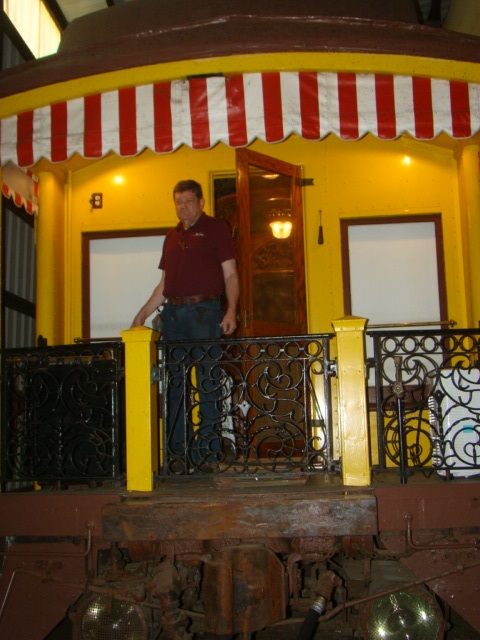
shDSC08391
Craig Presler on back of the Flagler Car, Photo by Steve Hunt.

We spent the rest of that second day walking and talking with Craig Presler. Although my focus was on the last surviving Indy streetcar and how to save it, I could plainly see that news of the museum’s closing was devastating Craig. Turns out Craig Presler’s history with the ITM is nearly as old as the museum itself. He came to Noblesville in the early 1970s and worked at Firestone for over three decades while volunteering his time to the ITM on nights and weekends. He lives within walking distance of the museum and when he retired last year he made plans to devote the lion’s share of his time guiding visitors through the train cars at the ITM. In particular the lavish railcar known as “The Flagler Car.”
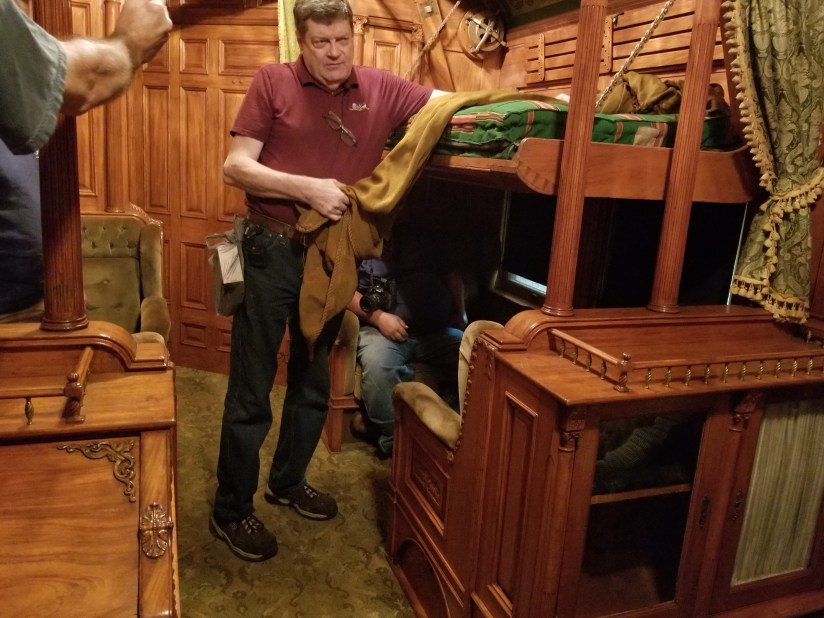
kb20180707_125205
Craig Presler inside the Flagler Car, Photo by Kris Branch.

Craig Presler knows every square inch of Henry Flagler’s 1898 private railcar. The name Flagler is familiar to anyone who has spent any time visiting St. Augustine Florida but really, Flagler is second only to Walt Disney when it comes to the state of Florida’s prominence as a tourist mecca. Henry Morrison Flagler (January 2, 1830 – May 20, 1913) was a founder of Standard Oil and an early partner of John D Rockefeller in Ohio. He almost singlehandedly developed the Atlantic coast of Florida and he founded Florida’s East Coast Railway. Today, he is known as the father of Miami and Palm Beach, Florida.
“Indianapolis Motor Speedway owner Tony Holman bought this car for his wife’s birthday in 1968 and in turn we got it several years ago,” says Craig. “The wood is all Canarium which is a blonde mahogany native to the Canary Islands. Henry Flagler pretty
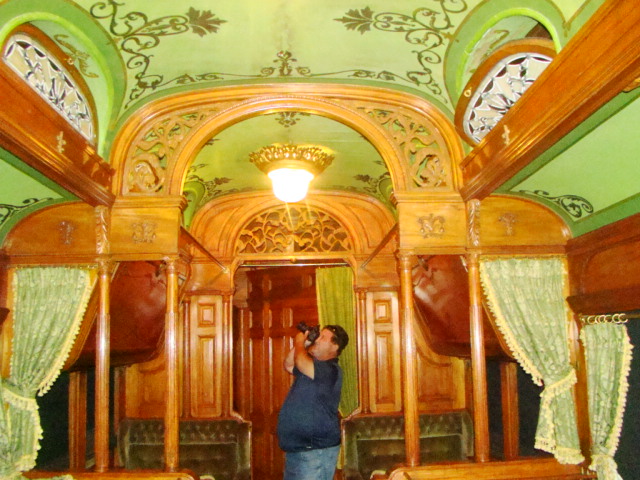
shDSC08392
Tim Poynter inside of the Flagler Car, Photo by Steve Hunt.

much owned the whole east coast of Florida and he told the builders of the car that he wanted it to look sunny like Florida. The rail line continued to operate the car until about 1951 – 52 when it was purchased by a man from Anderson named Ike Duffy who managed a meatpacking plant but who, more importantly, is remembered today as a founding father of the NBA. He started one of the inaugural franchises known as the Anderson Packers. Ike use the train to promote his business and rode it around to all his meatpacking plants in Noblesville, Lebanon, Anderson, Muncie and Brazil. He would serve his employees lunch that he actually cooked in the kitchen of this car. When Ike Duffy died in 1968, Tony Hulman bought it. I’m told that he took it to Chicago twice and that Mrs. Hulman never rode in it.”
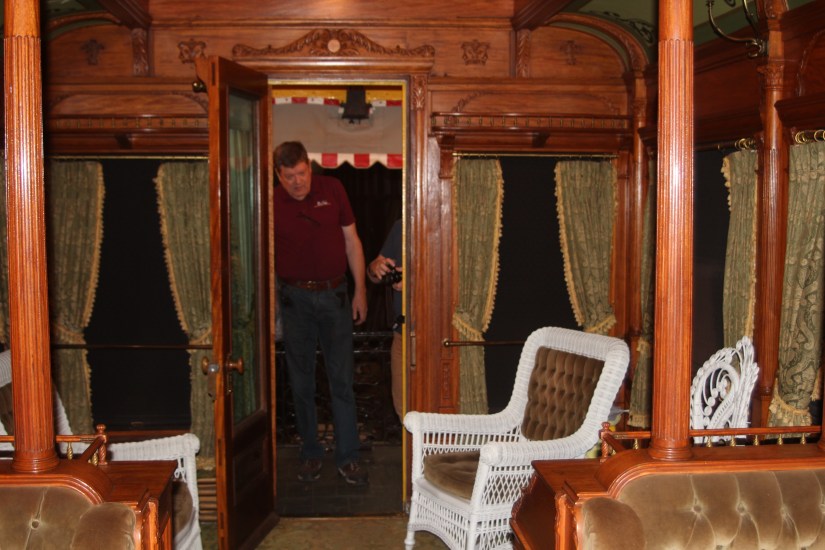
tpIMG_8037
Craig Presler on back of the Flagler Car, Photo by Tim Poynter.

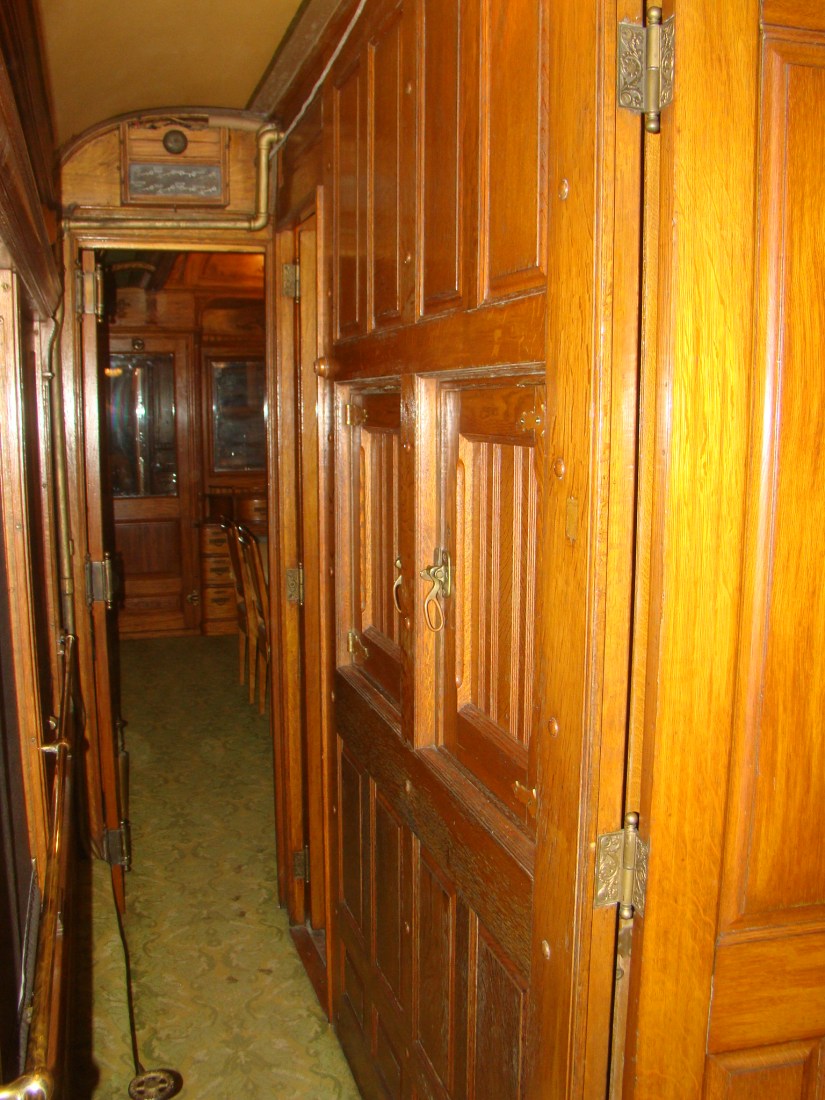
Craig delighted showing visitors (like us) all of the secret compartments and high-end accouterments that were found all over the Flagler car. It had self-closing windows, drawers and beds all over the place. Zinc lined compartments to hold and chill champagne bottles and the finest blinds, carpeting, curtains and Persian rug styled monogrammed blankets money could buy. It was easy to see that this car was a large part of Craig Presler’s life. When I asked him what would become of the car after the museum closed, he said, “I’m told the car is being moved to our affiliate in Logansport and that I will be able to go up on the weekends and continue to give tours.”
As Rhonda and I exited the the railcar following Craig’s impromptu tour, two officials I had been talking to previously about the ITM’s closure pulled me aside and informed me that while we were touring the car, it had been sold. It was going to be moved to a museum in Monon Indiana some 90 miles away. They finished by saying, “Don’t tell Craig, he does not know yet.” Knowing how much Craig loved this car, I knew this was going to be devastating news. As we left that day we arranged to meet Craig the next morning.
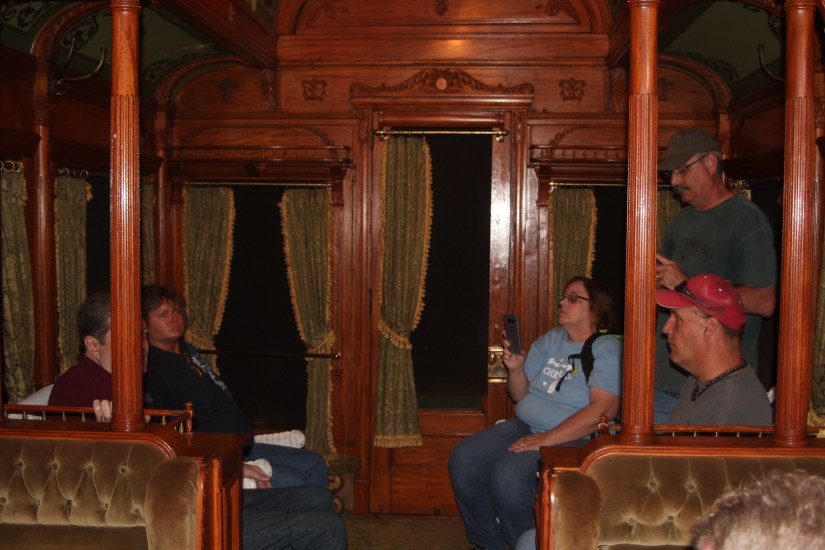
tpIMG_8046
Craig Presler, Rhonda Hunter, Kris & Roger Branch & Alan E. Hunter  in the Flagler Car, Photo by Tim Poynter

We showed up on Saturday, but this time with reinforcements: Kris and Roger Branch, Tim Poynter and Steve Hunt. One way or another we were going to save this car. I noticed that Craig had a plastic bag hooked on his belt loop. It contained a spray can of adhesive and some specialty tools. Craig said he brought them to fix a small piece of woodwork in the Flagler car he had pointed out to us the day before. The damaged area was so small as to be indiscernible to anyone else but Craig. The sad part is that the sight of that bag made me realize instantly that no one had yet told Craig his beloved Flagler car had been sold. He insisted on showing the Flagler car to the new additions in our group. That was Craig’s last tour. (the Flagler car made it out at 11:45. It was the last train out before the gate were locked.)
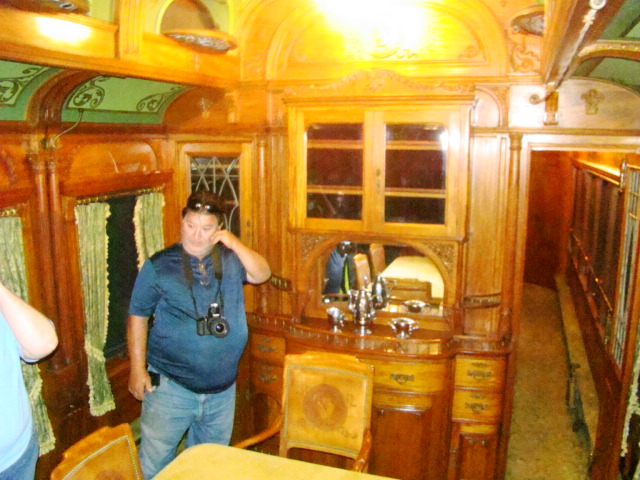
shDSC08423
Tim Poynter in the Flagler Car, Photo by Steve Hunt.

The realization was all the more ironic because the object of my quest, the dilapidated shell of the last surviving Indianapolis streetcar was moldering away in the woods not 20 yards away from that opulent Flagler car. Before I could ponder the dichotomy of the situation any further, I received a text message from William Whitmer telling me that the streetcar had been saved. We met at the streetcar and William delivered the good news.
William explained how he had stepped up and bought the car just in the nick of time. William had arrived at the streetcar, receipt in hand, just as the wrecker was creeping slowly towards it. “I couldn’t believe it,” William said, “I literally had to stand in front of the streetcar and wave my arms to get them to stop. They had been told the streetcar was scrap and that they were there to break it up. Five more minutes and the streetcar would have been crushed. The driver didn’t want to believe me until I showed him the receipt.”
William said that after our discussion the day before, “We did a very preliminary examination on the car body. The frame and car bolster (where the truck/wheels attach) is in solid shape. The actual structural steel is not too rotted. Side bracing is acceptable, and a lot of the upright steel frame is acceptable. The car is in overall better condition than we thought originally, making restoration far more likely.”
Then he shocked me by saying, “If it hadn’t been for you Al, this car would have been lost.” I was unprepared for that statement. Although humbled, I had to admit that it was not entirely my doing. First, I was there on a story for the Weekly View. Secondly, I was acting on a tip from Meg Purnsley. So without the paper and the heads up from Meg, this story would never have happened. And most importantly, without the quick action by William Whitmer and his Hoosier Heartland Trolley Group , the last surviving Indianapolis streetcar would have been lost forever. Will informs me that it may take up to 10 years to restore the car. He insists that he will keep us updated on the progress.
The streetcar has been saved but the museum is lost forever. While I no longer worry about the fate of the engines and cars, I do worry about the people. In particular my new friend Craig Presler. What is to become of him? His baby, the Flagler car, now resides nearly two hours away. The museum that was his passion is no more. The site will undoubtedly be plowed under and a swing set, waterpark or zip line will take its place in a year or so. All of the sabre rattling by the city of Noblesville about the ITM’s chemical hazards will be forgotten and no environmental cleanup will take place. Because none was needed. Another historical treasure lost to the temporal winds of political folly.
Luckily, William Whitmer assures me that his group has a place for Craig Presler and any other displaced ITM volunteer looking for a place to land. One thing can be sure, after the dust settles in the woods of Forest Park, much soul searching will be needed in the preservation community. In my opinion, it certainly smacks of just another backdoor “eminent domain” situation in Hamilton County. What I can say for sure is that I met many hardworking volunteers during the last days and hours of the Indiana Transportation Museum in Noblesville. Their individual flames burned bright. Some were warmed by the flame. Others were burnt by it. And although the flame of the ITM has burned out, that of the last surviving Indianapolis streetcar burns on.
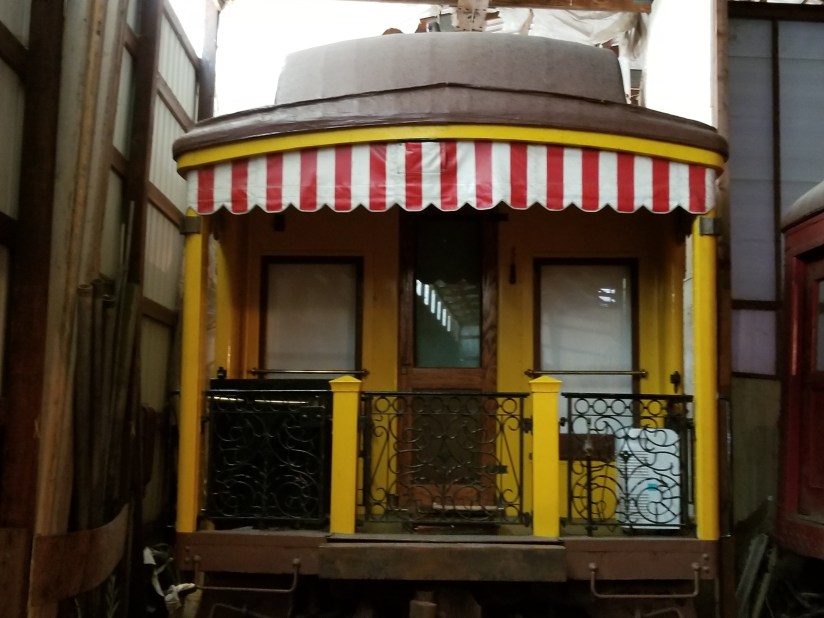
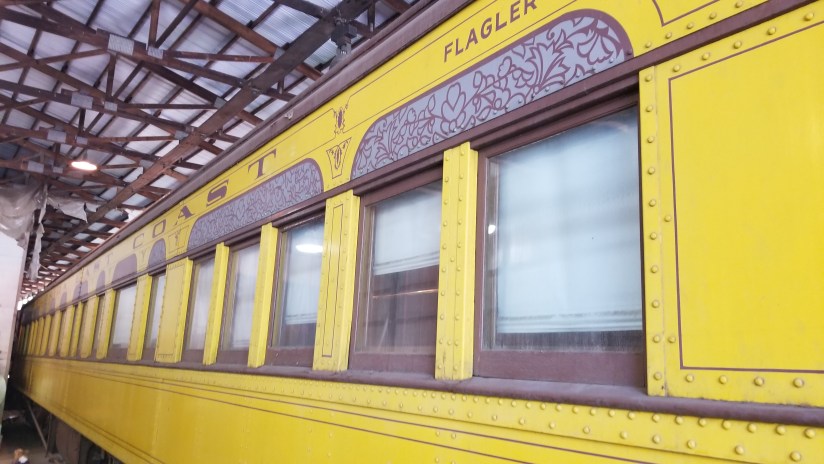
 

kb20180707_122702
Back of the Flagler Car, Photo by Kris Branch.
kb20180707_133015
The Flagler Car, Photo by Kris Branch.
shDSC08413
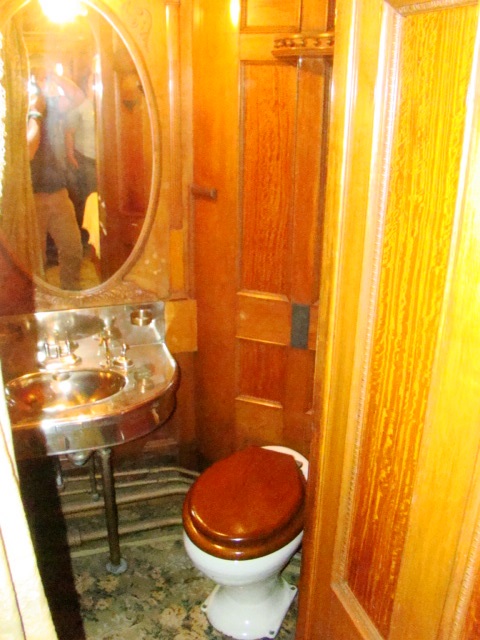
The washroom of the Flagler Car, Photo by Steve Hunt.
shDSC08421
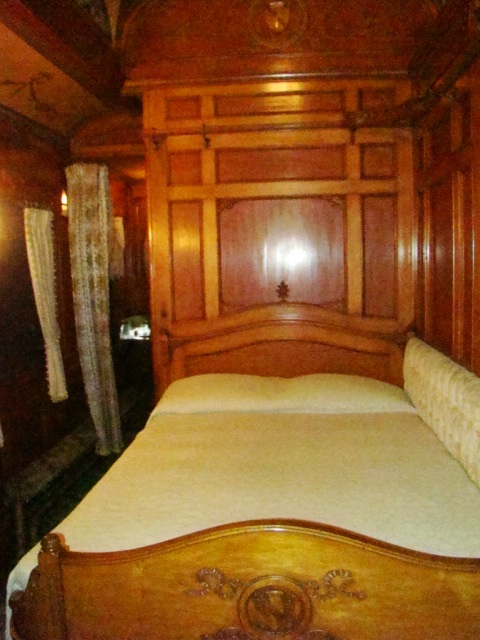
Bedroom in the Flagler Car, Photo by Steve Hunt.
shDSC08427
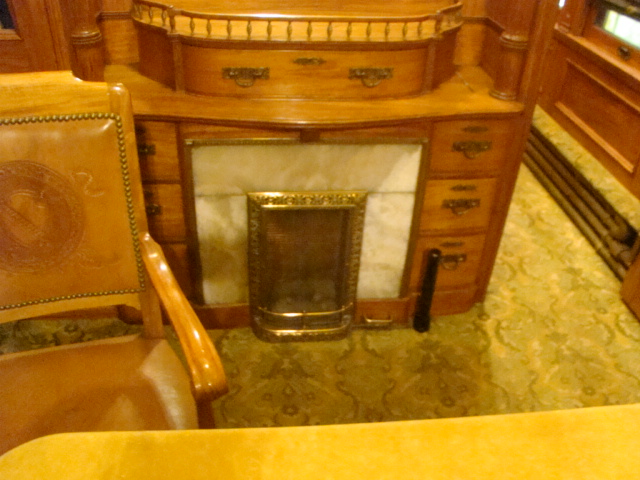
Fireplace inside of the Flagler Car, Photo by Steve Hunt.
tpIMG_8036
Interior of the Flagler Car, Photo by Tim Poynter.
tpshDSC08442
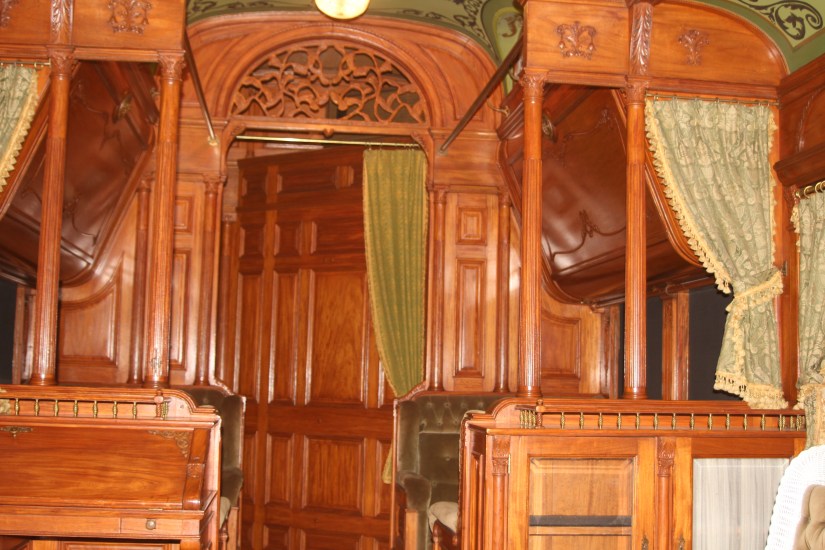
Hallway of the Flagler Car, Photo by Tim Poynter.


Indianapolis, Museums

Feast & Famine-Henry Flagler and the last Indianapolis Street car. Part I


ITM train

Original publish date:  July 16, 2018

By the time you read this, the Indiana Transportation Museum (ITM) in Noblesville will be gone. If you are a fan of trains, or a lover of history in general, no doubt you’ve been keeping tabs on the sad demise of this central Indiana institution. Reports of problems at the ITM have been circulating for quite some time now. Over two years ago, the port authority ordered the museum to halt one of its most popular excursions, the Indiana State Fair train from Noblesville to the fairgrounds, deeming the tracks unsound.
Before the issue could be addressed, Fishers, Noblesville and Hamilton County leaders announced plans to remove a 9-mile section of the tracks and turn the rail bed into a walking trail. Soon after that, the port authority and the Noblesville Parks Board terminated its 50+ year lease agreement with the ITM at Forest Park. In early 2018, the City of Noblesville accused the ITM of contaminating the site. The city reportedly based their accusations on unfounded complaints about leaking oil drums, which turned out to be trash cans used by the Forest Park garage, not belonging to the ITM. By late June, the ITM had been given two weeks to vacate the property. The decision was signed off on by Mayor John Ditslear, who was the chief critic of the way the museum had maintained the property.
“The ITM has not shown good stewardship with the resources entrusted to them for more than fifty years,” Ditslear said in a statement. “The City of Noblesville is taking these proactive measures now to protect our residents and our heritage, to ensure Forest Park is cleaned up and to bring the trains back to our community with a new operator.” Former museum Chairman John McNichols claimed the move was part of a strategy by the city to bankrupt the museum and seize its equipment. It should be noted that McNichols resigned the day of my initial visit.

kb20180707_121717
Photo by Kris Branch.

I was contacted Friday morning July 6th by my former President Meg Purnsley, late of the Indiana National Road Association. I seved as Meg’s INRA Vice-President some time ago and we have kept in touch in the years since. Meg sent me a message informing me that the museum was closing and inventory was being liquidated, and in some cases, destroyed. A tragedy to be sure, but what made Meg’s message most disturbing was the revelation that the ITM was home to the last surviving Indianapolis streetcar. Within minutes, I was in my car and on my way to the museum.
When I arrived at the ITM, located at the back of Forest Park, the site was a frenzy of activity. Paver bricks were being pried up in front of the Hobbs Station depot, the sign was being removed, massive cranes were crawling into position and workers in hardhats were scurrying about the grounds in a controlled panic. Workmen armed with acetylene torches and driving backhoes grimly stalked the yard. Everyone was doing something. The scene must have resembled a busy rail yard from the turn of the last century. Train cars of every type and era littered the rails like silent sentinels over last stand hill. In short, it was a sad sight. If there ever was a railroad triage, this was surely it.
Before we go any further, I think it is important to understand just what was lost here.The Indiana Transportation Museum dates back to 1960. It began as an all-volunteer effort to preserve the state’s history of railroads. The museum signed its first lease with the city of Noblesville on Jan.1,1965. The group operated over the former Nickel Plate Road line stretching over a distance of about 38-miles from Indianapolis and Tipton originally built for the Indianapolis and Peru Railroad. The rail line originally connected to the Norfolk Southern railroad in Tipton, the CSX railroad in Indianapolis, and the Belt Railroad owned by Eli Lilly and Company. The rail line operated as a freight railroad hauling coal to the Cicero power generating plant until 2003.

kb20180707_150414
Photo by Kris Branch.

Today it is the property of the Hoosier Heritage Port Authority which is owned by the cities of Fishers, Indianapolis, and Noblesville. Aside from the ITM’s excursion trips (State Fair train, corporate outings & the seasonal Polar Bear Express) they also ostensibly operated a working museum of engines, railcars and trolleys for interested tourists and school groups for decades. The ITM’s all-volunteer not-for-profit facility was dedicated to preserving, protecting and restoring the railroads of Indiana. The ITM’s charter was to inform and educate the public by operating trains to demonstrate how people traveled in the past. The ITM’s train yard stored around $3 million in equipment on site, tallying 100 pieces on it’s roles, including eight locomotives, innumerable box cars. historic tolleys and countless historical artifacts. About 30,000 people visit the museum each year.
The museum is home to many pieces of railroading history, with an emphasis on locomotives and equipment connected to the Nickel Plate Railroad. As of this date, the fate of many of those pieces remains uncertain. A number of pieces in the ITM collection have been cut up, as the museum struggles to obey a local circuit judge’s order to vacate the property by July 12. Technically, anything left on the site after that deadline is considered abandoned and, according to the court order, would become the property of the city of Noblesville.

kb20180707_134951
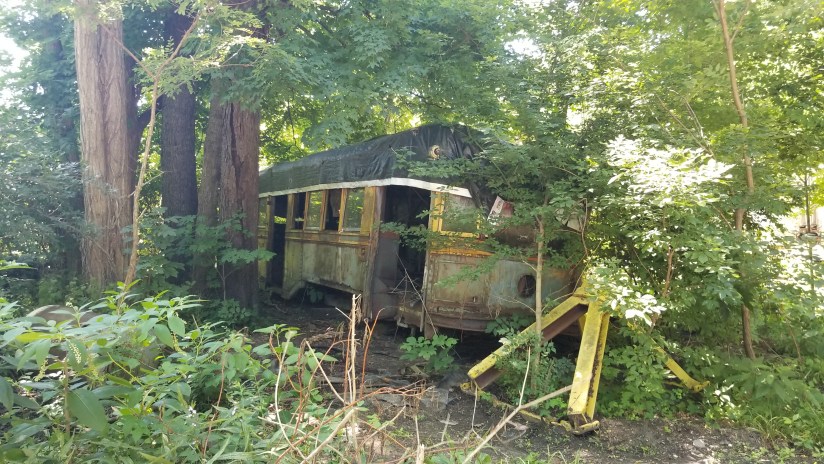
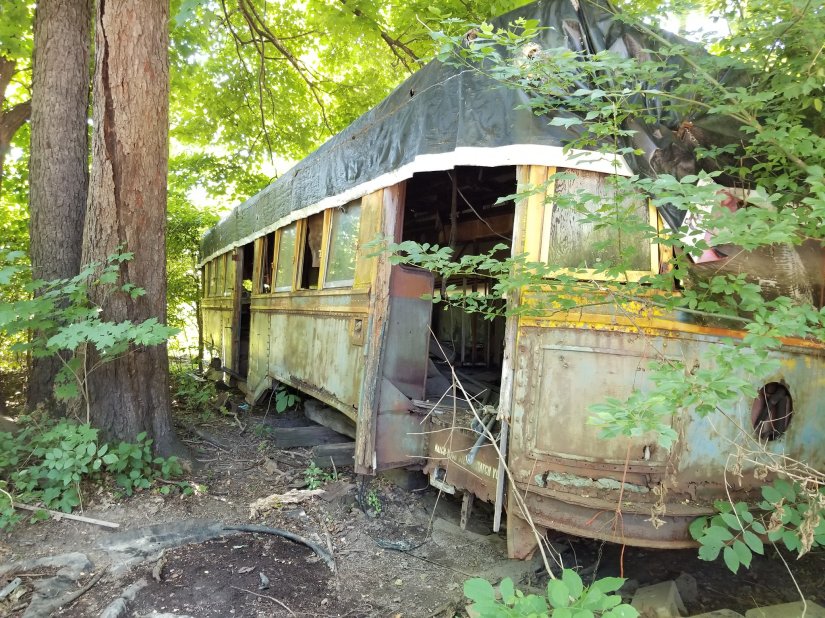
The last Indiana Streetcar as found in the woods. Photo by Kris Branch.

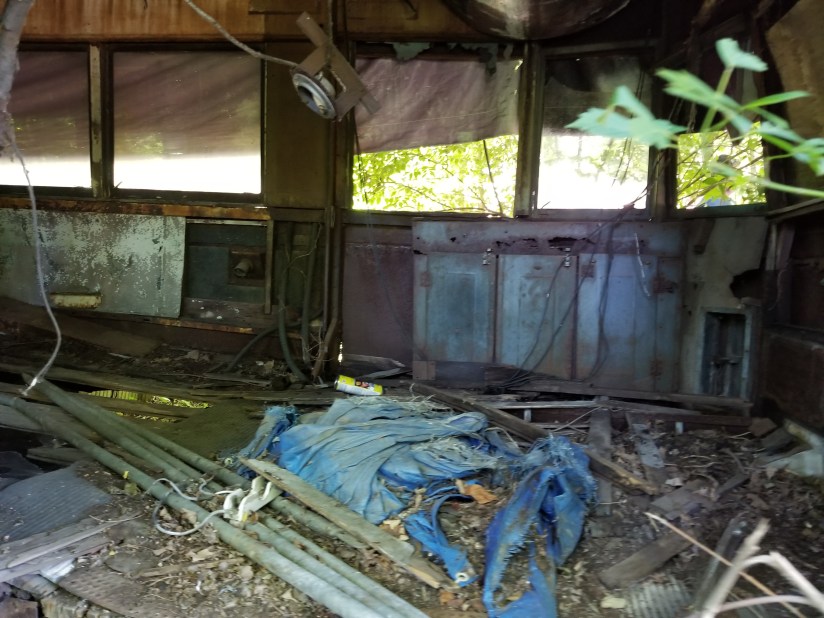
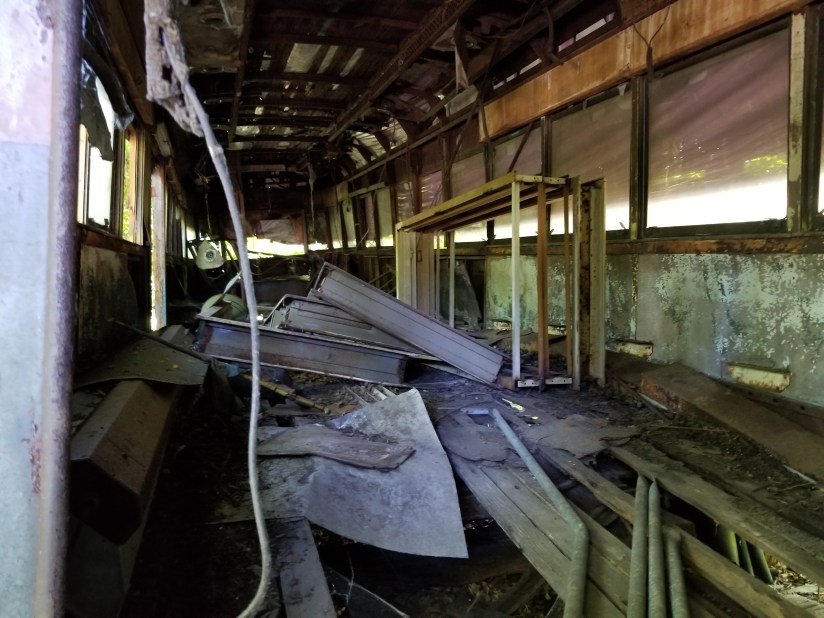
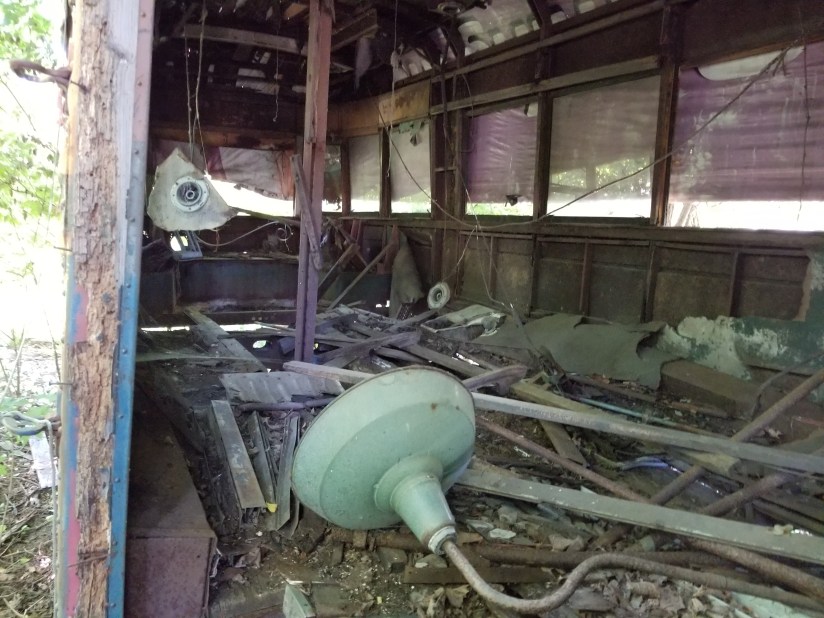
Knowing this, it can be easy to understand the depth of my concern for the streetcar that brought me here, the last survivor: Indianapolis Street Railway car # 153. During my visit, I was fortunate to run into Laddie Vitek of the Illinois Railway Museum who generously shared his wealth of streetcar knowledge with me. It should be noted that the old car is in pretty rough shape. The seats are gone, as are the wheels, doors, steering wheel, many of the windows and just about anything else that would make it track worthy. But the shell is there and it is easy to see the ghost of the old trolley hidden in the leafy environs of Forest Park.
Thankfully, the roof of the streetcar was tarped by some forward-thinking ITM volunteer, undoubtedly saving what was left of the old trolley. I noticed what appeared to be two gas tanks, one on each side. Laddie corrects me by saying, “Those aren’t gas tanks, they’re sand tanks. The conductor could release sand onto the rails for traction when needed. After all, it was an electric streetcar.” Did I mention I’m a preservation minded amateur historian, not a train guy? Laddie crawls under the trolley and slaps his hand on a massive steel plate. “Plate’s solid, the wheels could still attach here.” he says.
Laddie informs me that this was a Peter Witt design front entrance, center exit car made by the Brill Company out of Philadelphia in 1935. “This was a 600 roll PCC Dynamic Friction car, wooden tongue-in-groove and brass window sashes. Very sturdy and very restorable.” he explains. In laymen’s terms that means it ran on 600 volts of electricity, using a dynamic friction brake system and the ceiling was made of intricate wood parquet fitted tightly together. Brass window sashes, I understood. “It could be saved.” said Laddie.
It should be noted that while the fate of this particular car is still in limbo, a number of important cars and locomotives have been saved. While perusing car 153, I was joined by William Whitmer, a longtime museum volunteer and dedicated train enthusiast, who understood the importance of saving this car. He explained that he and his group, “Hoosier Heartland Trolley Co.” are already in the process of saving three other historic trolley cars in the museum’s collection.
William reports, “Cars # 429 and # 437 are both cars built by the St. Louis Car Company in 1925. They are both considered to be standard coach interurban cars. # 437 is known as the Marion and car # 429 is known as the Noblesville. # 81 is a car built by Jewett for the Indianapolis & Martinsville in 1902. Also a coach interurban.” William is not sure whether the last surviving Indianapolis streetcar was built in 1932 or 1935 but confirms that is was built by Brill for the Indianapolis Street Railway. “If we find out that it was built in 1932, that would make it even more important historically.” Regardless, the importance of saving this particular car cannot be understated.
However, the crown jewel of the museum is the 1898 private railcar of Henry Morrison Flagler’s Florida East Coast Railroad (FEC) #90. Fortunately, I had the good fortune to have Craig Presler as my tour guide for the Flagler car that day. I met Craig in the trolley barn where he introduced himself kindly, “That’s Presler, like Elvis with an r instead of a y.” he said. Craig knows as much about the ITM and these rail cars as anyone else on the property. Most importantly, Craig knows more about the Flagler car than anyone else at the ITM. And fortunately for you, Craig will tell us all about that car and the current situation at the ITM next week, in part two of this article.

kb20180707_135910kb20180707_135915kb20180707_135927

Photos of the interior of the last Indiana Streetcar as found in the woods.

Photos by Kris Branch.

Baseball, Criminals, Pop Culture

The real story of “The Natural.”

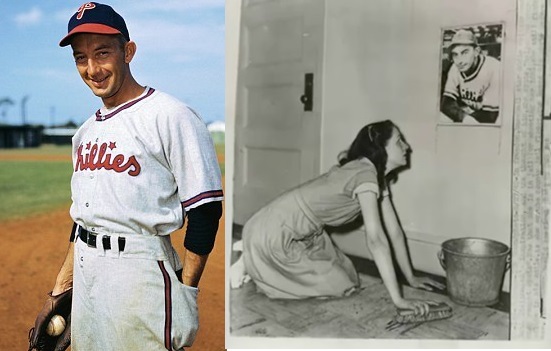
Eddie Waitkus
Eddie Waitkus & Ruth Ann Steinhagen 

Original publish date:  June 24, 2013

The Major League All-Star break is over and once again regular season baseball games are in full swing. Off hours are filled with baseball themed like Major League, Field of Dreams, A League of their own, Eight Men Out and, of course, The Natural. But did you ever stop to think, is Robert Redford’s character in The Natural based on a real life player? Well, the answer is yes. And no.
It would be more accurate to say that the film is based on an event, rather than an z waitkus-52tindividual player. On June 14, 1949 Philadelphia Phillies “Whiz Kids” (and former Chicago Cub) first baseman Eddie Waitkus was shot by an obsessed fan named Ruth Ann Steinhagen in a Chicago Hotel Room. The comparison between Waitkus and the movie character pretty much ends there. But it is a Helluva story.
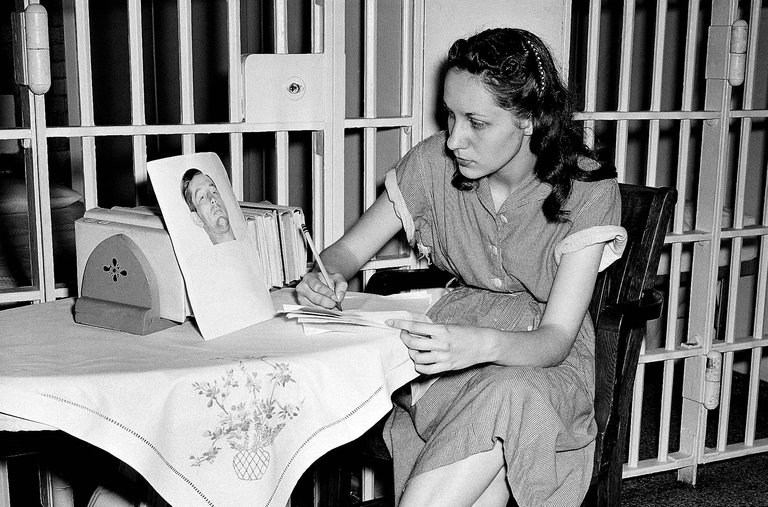
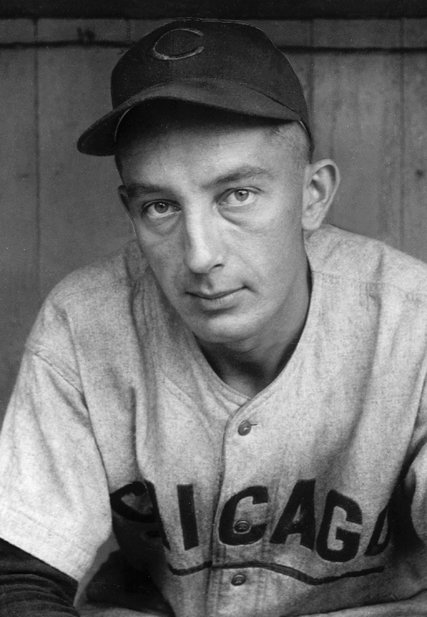
Just a few years into the start of what seemed a very promising career, Waitkus was shot in the chest at the Edgewater Beach Hotel in Chicago. A 19-year-old typist at the time of the incident, shooter Steinhagen became infatuated with Eddie when he was a Cub and seeing him play every day fed her obsession. However, once he was traded to the Phillies, Ruth Ann’s sanity snapped when she realized that her “crush” would only be in Chicago 11 games that season.

z dog-STEINHAGEN2-obit-videoLarge
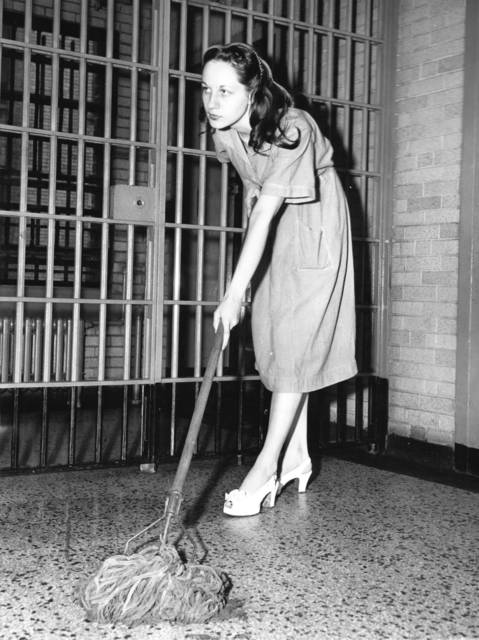
Ruth Catherine Steinhagen

Born two days before Christmas in 1929, Ruth was the daughter of immigrant parents from Berlin, Germany. Born Ruth Catherine Steinhagen, she adopted the middle name Ann at some point in her youth. While she never actually met Waitkus before she shot him, she created a ‘shrine’ to him inside her bedroom with hundreds of photographs and newspaper clippings – sometimes spreading them out and looking at them for hours, according to her mother. She would often set an empty place across from her at the dinner table reserved for Waitkus. She told her doctors, after the incident, “I used to go to all the ball games to watch him. We used to wait for them to come out of the clubhouse after the game, and all the time I was watching I was building in my mind that idea of killing him.”
In 1948, Steinhagen’s family sent her to a psychiatrist, but her obsession didn’t diminish, even after Waitkus was traded to Philadelphia. After the shooting, police found extensive clippings in her suitcase and even pictures papering the ceiling of her bedroom at home. On June 14, 1949, the Phillies came to Chicago for a game against the Cubs. After the game, which she attended, Steinhagen sent Waitkus a handwritten note through a bellboy, inviting him to visit her in her 12th floor room in the Edgewater Beach Hotel where they were both registered.
Claiming to be Ruth Anne Burns, the note began: “Mr. Waitkus–It’s extremely important that I see you as soon as possible. We’re not acquainted, but I have something of importance to speak to you about I think it would be to your advantage to let me explain to you.” After insisting that she was leaving the hotel the next day and stressing the urgency of the request, she concluded: “I realize this is a little out of the ordinary, but as I said, it’s rather important. Please, come soon. I won’t take up much of your time, I promise.”

z dog-STEINHAGEN3-obit-blog427
Waitkus

According to Waitkus’ friend and roommate, Russ Meyer, Waitkus received the note, which was attached to the door of their 9th floor room after returning from dinner with Meyer’s family and fiancé past 11:00 p.m. Waitkus called the room but the woman would not discuss the details over the phone. The Sunday Gazette Mail says Waitkus knew some people named Burns. Waitkus’s son later speculated that his father may have “thought he had a hot honey on the line.” For whatever reason, he went to meet her in the room.
The details of what happened in the room are a little sketchy. According to the Associated Press report day after the shooting, Steinhagen told police that as Waitkus entered the room, she greeted him by saying, “I have a surprise for you”. After which she retrieved a .22 rifle from the closet and shot him in the chest. Meyer said that Waitkus told him that when he entered the room, the woman claimed to be “Mary Brown.” He said that Waitkus claimed Steinhagen’s words after retrieving the gun from the closet were “If I can’t have you, nobody else can.” Another account claimed that Steinhagen said, “You’re not going to bother me anymore.” Waitkus, who later said he believed the woman was joking, stood his ground and was shot. He said he asked her, as she knelt beside his prone body with her hand on his, “Oh baby, what did you do that for?”

z chi-aj-4-steinhagen-waitkus--19490618
Ruth Steinhagen

Steinhagen later told police that she had originally planned to stab Eddie, and use the gun to shoot herself, but changed her plans when Waitkus walked into the room and sat down. Steinhagen still intended to shoot herself, but evidently could not find another bullet. While Waitkus was lying on the floor bleeding from the chest, Steinhagen called down to the front desk of the hotel and told them “I just shot a man….” After the shooting, she went to wait for the authorities on the benches near the elevator, although she later claimed that she stayed with the wounded man and held his head in her lap until help arrived. The phone call, which brought quick medical attention as well as police, saved Waitkus’ life.
Steinhagen was arrested and then arraigned on June 30, 1949. Questioned about the shooting, she told police she did not know why she had done it, explaining that she wanted “to do something exciting in my life.” Strangely, when taken to Waitkus’ hospital room the day after the shooting, she told Eddie that she didn’t know for sure why she had done it. She told a psychiatrist before she went to court that “I didn’t want to be nervous all my life”, and explained to reporters that “the tension had been building up within me, and I thought killing someone would relieve it.” She said she had first seen Waitkus three years before, and that he reminded her “of everybody, especially my father.”
Steinhagen’s counsel presented a petition to the court saying that their client was “unable to cooperate with counsel in the defense of her cause” and did not “understand the nature of the charge against her.” The petition requested a sanity hearing. At the ensuing sanity hearing (which also occurred on June 30, 1949), Dr. William Haines, a court-appointed psychiatrist, testified that Steinhagen was suffering from “schizophrenia in an immature individual” and was insane. Chief Judge James McDermott of the Criminal Court of Cook County then directed the jury to find her insane, and ordered her committed to Kankakee State Hospital. The judge also struck “with leave to reinstate” the grand jury’s indictment of Steinhagen on a charge of assault with intent to commit murder, meaning that prosecutors could refile the charge if Steinhagen recovered her sanity.
Steinhagen never stood trial, but instead was confined to a mental institution until 1952, when she was declared cured and released. Waitkus did not press charges against Steinhagen after she was released, telling an assistant state’s attorney that he wanted to forget the incident. After her release, Steinhagen moved back home to live with her parents and her younger sister in her parents’ small apartment on Chicago’s North Side. She shunned publicity in the ensuing decades, and remained a recluse for the rest of her life. In 1970, she and her family purchased a home in a crowded, racially mixed neighborhood on Chicago’s Northwest Side. She lived in the home with her parents and sister and, after their parents died in the early 1990s, continued to live there even after her sister died in 2007. She employed full-time caregivers in her final years.
She lived a quiet and secluded life, steadfastly maintaining her privacy, avoiding reporters, and refusing to comment publicly on her shooting of Waitkus. She never married and worked an office job for 35 years, her neighbors and coworkers never knew of her place in infamy. Court records and routine background checks reveal no information about her career. On December 29, 2012, Steinhagen died in a Chicago hospital of a subdural hematoma that she suffered as a result of an accidental fall in her home. She was 83 years and six days old, and left no immediate survivors.

z e19ca3075b537e229c063318d0bf9b4d
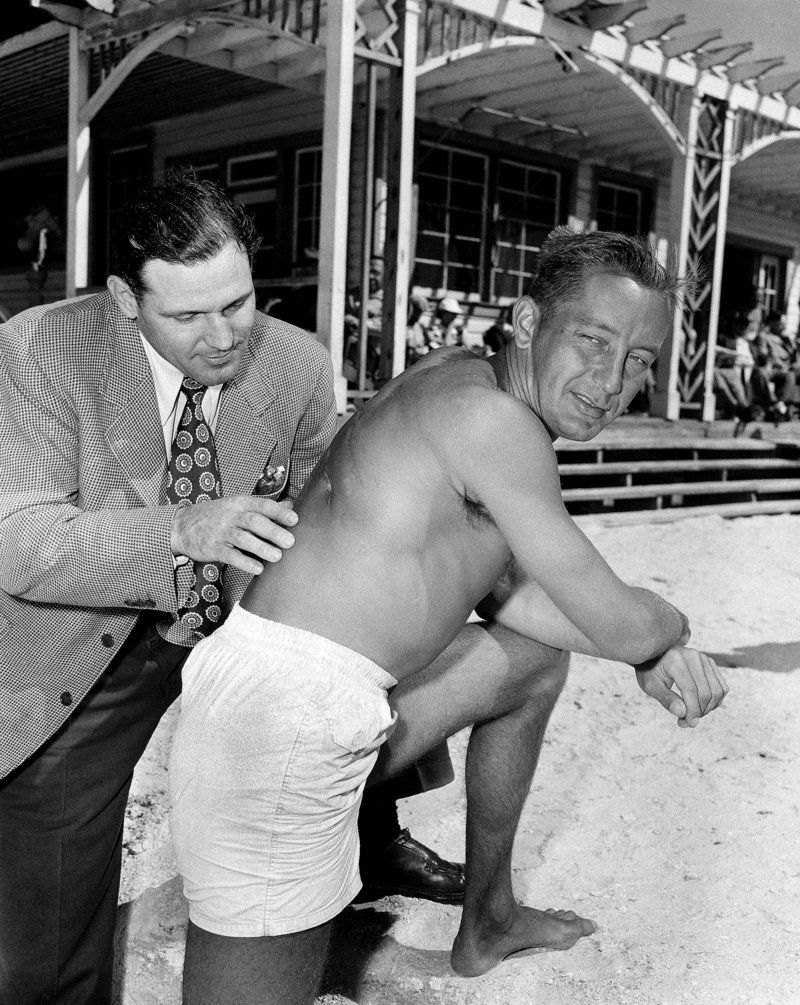
Bill “Swish” Nicholson examines his teammate’s scar.

The bullet that struck Waitkus lodged in a lung, barely missed his heart, required four surgeries and prevented his return to baseball for the rest of that 1949 season. Eddie nearly died several times on the operating table before the bullet was successfully removed. The incident profoundly influenced Waitkus’ career and personal life as well; he was never the same player after the shooting. Eddie developed somewhat of a phobia worrying that others might not understand why he had visited Steinhagen’s room. He also, according to roommate Meyer, developed a drinking problem after the incident.
On August 19, 1949, the Phillies held “Eddie Waitkus Night” at Shibe Park and showered their wounded first baseman with gifts. Waitkus appeared at the stadium in uniform for the first time since he was shot in Chicago. Although the shooting left Waitkus knocking on death’s door, he was back in the Phillies’ Opening Day lineup the next year, going 3-for-5. After the 1950 season, Waitkus was named the Associated Press Comeback Player of the Year.
Eddie Waitkus, Stephen WaitkusThe Waitkus shooting is regarded as the inspiration for Bernard Malamud’s 1952 baseball book The Natural, which was made into a film by Barry Levinson in 1984. Other than the shooting, its hard to make a comparison between Eddie Waitkus and Roy Hobbs, the character played by Robert Redford in the film. In The Natural, Hobbs was shot as a teenage phenom before ever reaching the majors and the shooting kept him from reaching the big leagues until the age of 34, at which point he immediately started hitting like Babe Ruth with his miracle bat “Wonder Boy”. When shot, Waitkus was a 29-year-old veteran of both World War II and 448 major league games.
z The_NatrualMiraculous comeback aside, Waitkus, who died in 1972, was no Hobbs at the bat. Though he was enjoying his finest season when he was shot, he had just one home run in 246 plate appearances, and when he retired in 1955 at age 35, he had just 24 home runs in 4,681 at bats. Waitkus hit for respectable averages (.304 in 1946, .306 in 1949 before the shooting, .285 for his career), but they were empty. He hit for little power and drew only an average number of walks. He did make a pair of All-Star teams and drew some low-ballot MVP votes in two seasons, but was by no means a Hall of Fame candidate.
Whether it was the seasons’ lost to World War II, his advancing age or the shooting, Eddie Waitkus never really lived up to the Roy Hobbs hype. Turns out that author Malamud built his iconic character around what was by far the most interesting thing about Waitkus’s career; the shooting. The similarities between fact and fiction end with the echo of that gunshot.

Creepy history, Criminals, Indianapolis, Irvington Ghost Tours, Medicine

Grave Robbing in Indiana. John Scott Harrison-The Unquiet Corpse. Part II.


Grave robbers part II

Original publish date: August 5, 2011

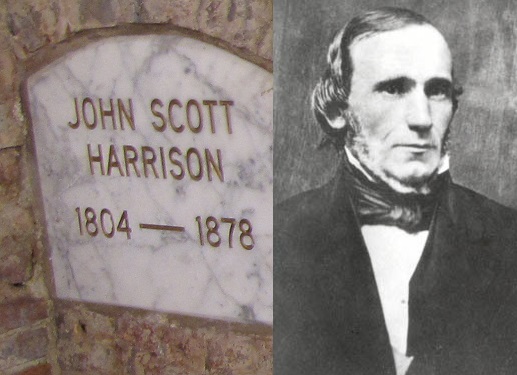
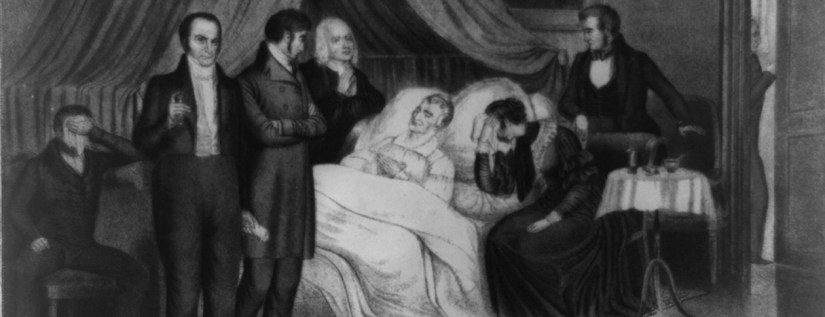
Last week, I told you a little about the macabre grave robbing profession and subsequent black market medical cadaver trade that once flourished in our capital city. What most Hoosiers don’t know is that Indianapolis has a Presidential connection to the dark art of body snatching. Former Ohio Congressman John Scott Harrison (October 4, 1804 – May 25, 1878) is the only man in American History whose father and son both became President of the United States. A former United States Senator in his own right, John Scott Harrison’s father was our nation’s ninth President William Henry Harrison and his son Benjamin Harrison became the 23rd President of the United States. Harrison was also the grandson of Benjamin Harrison V signer of the Declaration of Independence. Sadly, hardly anyone alive today has ever heard of John Scott Harrison or is aware of the story of his unquiet corpse.


z Death_of_Harrison_April_4_A.D._1841
Death of President William Henry Harrison.

On May 25th, 1878 John Scott Harrison died suddenly at his Point Farm estate located near North Bend, Ohio, about 16 miles west of Cincinnati. He was 73 years old. Funeral services were held at the Presbyterian Church in Cleves, Ohio on May 29th. His body was interred in the William Henry Harrison Tomb State Memorial in North Bend with his parents and other family members. The Harrison family plot was located on a hill in the Congress Green Cemetery that featured a commanding, panoramic view of the Ohio River Valley below.

The bereaved family filed past the open coffin to cast a last glance upon the man who had so frequently and so successfully influenced their lives. Among them was his highly successful lawyer / US Senate candidate son from Indianapolis Benjamin Harrison, who was already at the helm of the State’s Republican party and just 19 years away from becoming President.

But far from resting in peace, his corpse became the central figure in one of the most widely heralded and distressing examples of grave-robbery in the history of the United States. During Senator Harrison’s memorial service, as the funeral party walked to John Scott’s grave they could not help but notice that the nearby grave of 23-year-old Augustus Devin, a nephew of Benjamin Harrison who had died suddenly and been buried there just a week before, had been disturbed. Though placed in his grave only the Saturday before, it appeared that young Devin’s grave had been robbed by body snatchers. At first, family members thought that wild hogs had been at work uprooting the earth. However upon closer examination, it was revealed that indeed there had been a theft of the corpse.

z McConnellJGraverobThe first order of business was to hide the fact from Devin’s widowed mother until the body could be recovered, and the second was to take precautions for safeguarding John Scott Harrison’s remains. Benjamin Harrison and his younger brother John carefully supervised the lowering of his father’s body into an eight-foot-long grave. At the bottom, they placed the state-of-the-art metallic casket into a secure brick vault with thick walls and a solid stone bottom. Three flat stones, eight or more inches thick were procured for a cover. With great difficulty the stones were lowered over the casket, the largest at the upper end and the two smaller slabs crosswise at the foot. All three of these slabs were carefully cemented together. The brothers waited patiently beside the open hole for several hours as the cement dried. Finally, with their father’s remains still under guard, a massive amount of dirt was shoveled into the hole and the brothers departed secure in the notion that their father would rest in peace for all eternity.

Benjamin Harrison took a train back to Indianapolis late that day so that he might have a few days to finish his address which would open the Republican State Convention on Wednesday, June 5th. The Harrison family saw Benjamin and his wife off at the depot and then all returned to North Bend except for the younger brother John. He remained in Cincinnati in order that he might begin a search in the morning for Augustus Devin’s body.

In the morning, John Harrison, his cousin George Eaton, and a couple of Cincinnati policemen began their search at the Ohio Medical College on 6th Street between Vine and Race on the city’s south side. It was common knowledge that “Resurrectionists” (the name the public gave to grave robbers) were in collusion with the medical school and routinely supplied research cadavers. A close search of the college was begun led by an obnoxious protesting janitor named A.Q. Marshall who toured the group around the building assuring them that they would find no bodies there. Thrusting their lantern into every dark corner of the building, true to the cranky janitor’s predictions, they found no trace of any body. As they were preparing to exit, one of the policemen noticed a rope stretched tight into a darkened well hole. Immediately he began to haul it up and it soon became evident that there was a heavy weight attached to the end of the rope. The tug-of-war continued until at last there emerged from the darkness a lifeless body with a cloth covering the head and shoulders of what was obviously the body of a very old man.

z grave_robbingJohn Harrison shrugged off the discovery knowing that his cousin Augustus Devin, the subject of their search, was a very young man. Still, the body was lain flat on the floor and the cloth was cast aside with the aid of a nearby stick. As the dead man’s face was revealed, John Harrison gasped in horror that the dead body was none other than that of his father, John Scott Harrison.

The terrible sight sickened him physically and tortured him emotionally. He had came looking for a widow’s son, and found instead the corpse of his own father, whom he had personally entombed less than twenty-four hours before. The scene was surreal, his illustrious father’s body hung by a rope around his neck swaying back-and-forth in a black hole in the Medical College of Ohio right in downtown Cincinnati. In his daze the youngest of the Harrison’s thought only of the family and how, above all else, this must be kept secret.

Secrecy proved impossible, then as now, when an event like this took place, word was bound to get out. A Cincinnati Commercial newspaper reporter heard the story from the members of the fire department located next to the medical college. The reporter tracked down Harrison, Eaton, and the two policemen, but they weren’t talking. The undertakers had been sworn to silence and would not even admit that a corpse had been discovered. However, before long the news leaked out from three relatives from North Bend who had visited the Harrison tomb and found that the grave had been disturbed. Apparently, the ghouls had broken the glass seal and unceremoniously dragged the body from the box out feet first.

z 451_127716239087
Benjamin Harrison

Benjamin Harrison had just arrived in Indianapolis when he was urgently called back to Cincinnati. Before “Lil’ Ben” arrived, his brother Carter swore out a warrant for the arrest of A.Q. Marshall the surly janitor at the Ohio Medical College. The janitor was arrested on the charge of receiving, concealing, and secreting John Scott Harrison’s body which had been unlawfully and maliciously removed from its grave. The medical school posted the $5,000.00 bond for the janitor’s release, andering the citizens of Cincinnati even more. Things went from bad to worse when the Medical College took the position that the adverse attention was hurting the school’s chances of obtaining additional cadavers for dissection. All of which made fantastic headlines for the local press.

Reports of the horrific crime brought out curious crowds who milled about the alley behind the medical school hoping to peer into the macabre cadaver chute. Local reporters interviewed as many people as possible quickly fueling the hysteria among Queen City citizens who wondered, “If this can happen to such an illustrious hero as John Scott Harriosn, what is to become of our loved ones?

Above all else, what became of Augustis Devin’s body? That question would go unanswered for another three weeks. On June 14th a janitor from the nearby Miami Medical School confessed that a notorious resurrectionist named Charles Morton (alias Dr. Gabriel, alias Dr. Morton, alias Dr. Christian, and alias Dr. Gordon) had bribed him to use the medical building basement as headquarters for preparing and shipping bodies to nearby cities. It was an excellent hiding place, for except for two hours each day, no member of the faculty was ever near the school. This veil of secrecy allowed Dr. Morton to work unmolested for nearly a month and in that time Augustus Devin and John Scott Harrison were two of his victims. The janitor’s confession basically indicted the entire medical profession across the United States.

The janitor revealed that most of the misappropriated bodies were shipped from Cincinnati to the Medical College at Ann Arbor, Michigan in barrels reading: “Quimby and Co.” The police left for Ann Arbor immediately and found a vat of brine containing several bodies already prepared for use in the fall and winter school sessions. Soon, the police identified one of the cadaver’s as that of Augustus Devin and a telegram was sent immediately to the family in North Bend. Young Devin’s remains were sent home and the body was reburied. The Harrison’s, including Benjamin, were counted among the one hundred and fifty prominent citizens assembled to pay final tribute to young Devin four weeks to the day after it was buried the first time.

Hiolmes
Herman Webster Mudgett aka H.H. Holmes (far left)

In December, 1879 the body of John Scott Harrison was reburied without fanfare in the Harrison family tomb where he rests peacefully to this very day. Benjamin Harrison never publicly spoke of the incident. However, an interesting footnote to the story with yet another tie-in to Irvington? Remember those bodies packed in pickle barrels from “Quimby & Co.” sent to the University of Michigan Medical School mentioned earlier? One of those Michigan students who undoubtedly participated in the dissection of those wayward cadavers was non-other than Herman Webster Mudgett, a graduate of the school in 1873. You might know Mudgett better by his alias, Dr. H.H. Holmes, America’s first serial killer.

Creepy history, Criminals, Ghosts, Indianapolis, Medicine

Grave Robbing in Indiana. Part I.

z grave_robber2-e1482411781598

Original publish date:  July 29, 2011

I speak often about America’s first serial killer, the evil Dr. H.H.Holmes, and his demonic doings in 1894 Irvington including his habit of selling the cadavers of his victims to Chicago area universities for $ 75.00 each. Today, these stories elicit gasps and disbelief from all who hear them. However, there was a time when grave robbing in our capital city was a very real threat indeed.
The act of grave robbing was so common that perpetrators began to look upon themselves as businessmen providing a much needed service rather than the night creeping, gutter crawling slags of humanity that they truly were. Often these ghouls ruled the nightlife scene holding court in local bars and taverns while regaling customers with their tales of dread from the boneyards of our dear city, with no real fear of retribution, much less prosecution, for their dastardly deeds. After all, their skill and services were in demand by uber-educated medical school professors, upper-crust physicians and high-bred college students from all four corners of the city, no questions asked.

z louisville-medical-students-with-cadaver-1024x811-750x594-750x375
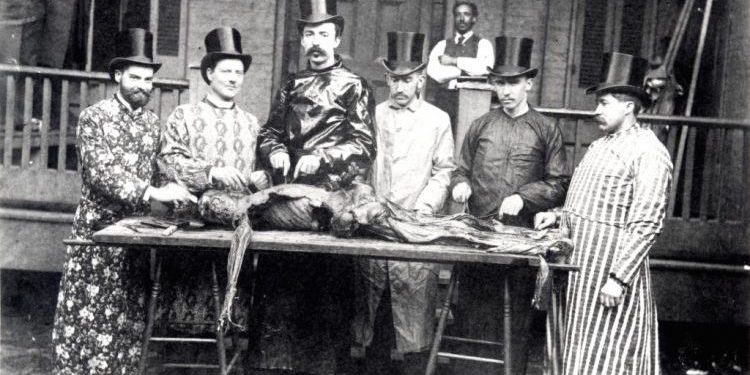
University students working on a cadaver.

In January 1875, a reporter for the Indianapolis Herald newspaper interviewed one such ghoul for an article on grave robbing titled, “How the Business is Managed at Indianapolis. Twelve ‘Resurrectionists’ engaged in it.” Sadly, the name of the intrepid reporter is lost to history, but his words live on and are offered here as proof that this gruesome occupation did in fact exist. Here is the article as it appeared almost a century-and-a-half ago.
A reporter for the Indianapolis Herald recently fell in with a resurrectionist, or body snatcher, who relates the following story: “Yes, I know it’s a shameful business. But I have no longer any capacity for shame. This (holding up his glass) has done the business for me. It has made me what you see me. Once I was a reputable physician with a diploma from ——– College, and a fair practice, and now I am a body snatcher, sneaking through the graveyards by night, and spending the proceeds of grave robbery in low down thief kennels by day. You don’t often see me here. Hunger-hunger for whiskey brought me here tonight, because I am more apt to sponge a drink or two among such tipplers as you than I would be among ruffians of my own sort. As I said, I have no shame, but I know how low it is. I know that a man capable of grave robbing for gain is cutthroat enough at heart to do murder if he were not too cowardly. Why don’t I reform? That’s a good joke. I look like it don’t I? I tell you it’s impossible. There’s no retreat for me. The only road open to me is in front, and it ends in hell. Another drink …..and a big one, to settle these grinning devils that have been dancing around me all night, and I will tell you all about the business. As the season is over and Dr.——– has promised to buy me a ticket to Memphis, I don’t care.”

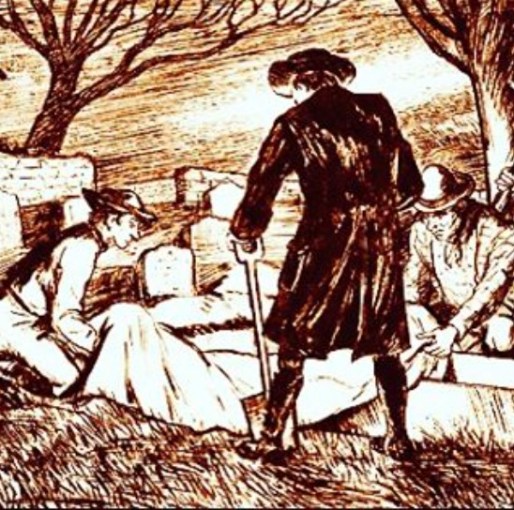
HOW STIFFS ARE RAISED: “A ressurectionist’s kit is not very expensive, sir. All he needsz Grave_Robber is a rope with a hook at one end, a short crowbar, and a spade and a pick. He generally has a “pard,” as it is easier to hunt in couples. He is notified of the “plant” (body), and by personal inspection makes himself familiar with all the surroundings, before the attempt is made. The pick and spade remove the earth from the grave as far as the widest part of the coffin, and with the crowbar, the coffin is shattered, and the rope with the hook end fastened around the cadaver’s neck, when it is drawn out through the hole without disturbing the earth elsewhere. As soon as the cadaver is sacked, the earth replaced, and the grave made to look as near like it was as possible. There are some bunglers however, who have been guilty of leaving the grave open, with fragments of the cadaver’s clothing lying around. They are a disgrace to the profession, and have done much to foster an unfriendly public sentiment in this city.”
HOW A SALE IS NEGOTIATED: “No, there’s not as much difficulty in negotiating the sale of a stiff as you would imagine. The resurrectionist has no dealings with any member of the colleges. They are too smart for that. The janitor does the business. A wagon with two men in it drives up in front of a college. Maybe the streets are full of people….maybe not. It makes no difference any way. The wagon barely stops a moment, and one man shoulders the sack containing the stiff and shoots into the college basement, and the wagon drives off. Police? (The resurrectionist here shook like a mass of jelly with inward chuckles.) Why, bless your simple soul, there is no more danger of being interrupted by the police than there is of me dying a sober man. The police on the college beats are friendly to science. They wouldn’t, for two dollars a stiff, make a row about it, you bet. So all the digger has to do is put a mask on his face and slip in to see the janitor, who is provided with funds, and shells out without being too particular about identification.”
THE NUMBER OF RESURRECTIONIST: “There are at least a dozen diggers engaged in anticipating the tooting of Gabriel’s horn in this city. Some of them are working for other cities. There is Mr. ——-, a tall man, with long, dark hair, seedy clothes, and a sinister expression of countenance. He’s a man of education, and has respectable connections in the city. What brought him to it? What brings us all to it? Whiskey, of course. He works with Mr. ——-, a lanky, long haired fellow, with rebel looking clothes, and long, light, lousy looking hair, mustache, and goatee. Yes, it was him that was kicked out of the boarding house for talking “stiff” at the table. Then there is the brother of a well-known doctor, and a doctor out in the country, and others too tedious to mention. Some of the students, too, raise their own stiffs as a matter of economics. Material is getting costlier every year.”
z Milwaukee-Journal-August-3-1903THE MOST FRUITFUL FIELDS: “The most of the stiffs are raised at Greenlawn cemetery (in Franklin, south of the city), at the Mt. Jackson cemetery (on the grounds of Central State hospital), and at the Poor Farm cemetery (Northwest of the city). So far as I know Crown Hill has never been troubled. Many of the village cemeteries in the neighboring counties are also visited, however, and made to contribute their quota to the cause of science. Some of these village cadavers are those of people who moved in the best society, and besides their value in material for dissection, are rich in jewelry, laces, velvets, etc. The hair of a female subject is alone worth $25. Nothing is wasted, you may be sure. Even the ornaments on the coffin lids are used again..”
SMART ALECKS: “There is a good joke on the Marion County Commissioners. You may remember that, on account of so many complaints against body snatchers, these Smart Alecks had a vault built, in which to deposit bodies, and put a padlock on the door. You may believe the resurrectionist didn’t stop long for a common padlock. It didn’t take long to get an impression with a piece of wax, and any darn fool can make a key that will unlock a padlock. And the vault business saves a heap of hard digging. Many a stiff has been cut up in our colleges without having been buried at all. I know of one case where it came pretty near making a rumpus, and there was lively skirmishing for a time, I tell you.”
FURTHUR (sic) PROSPECTS: “Allred? Him? Why he could not stop a worm. He is devoted to science, and if he wasn’t, all we’d have to do would be to get him a bottle of Rolling Mill rot gut, and he would neither see nor hear. Do you s’pose that there could have been so much resurrection in Greenlawn, right in the heart of the city almost, if somebody hadn’t been fixed? I don’t know. Do you?” (Allred was apparently the superindendent of Greenlawn cemetery)
A MEAN TRICK: “Now I’m goin’ to tell you about what I call a mean trick. A stiff had been raised out of grounds supposed to be the peculiar property of one of the colleges, and sold to another. It wasn’t much of a stiff, a poor, miserable, emaciated Negro, that didn’t weigh more’n ninety pounds……but it made the faculty of ——– college madder’n hornets to think that a stiff out of their ground had been sold to a rival college. You know they hate each other like pizen anyhow. Well, Tuesday night of this week they broke into the college vault and stole the stiff, and the next day a Professor of the rival college lectured over it. Go to the law about it? Not much. They know how to leave well enough alone. But they were not about it, you better believe. Goin’, are you? Well, good night. The chances are that we’ll never meet again, an there’s nothing doing here, and I want to get to a warmer climate. Good night, Sir.”
z PhotoDeskThe night was a graverobber’s best friend. He lived in it, worked in it, played in it and hid in it. Late at night, these ghouls would steal into cemeteries where a burial had just taken place. In general, fresh graves were best, since the earth had not yet settled and digging was easy work. Laying a sheet or tarp beside the grave, the dirt was shoveled on top of it so the nearby grounds were undisturbed. Most body snatchers could remove the body in less time than it took most people to saddle a horse. They would carefully cover the telltale hole with dirt again, making sure the grave looked the same as it had before they came. Then hurriedly take the body away via the alleyways and sewers of the city, finally delivering the anonymous dearly departed to the back door of a medical school. In time, several of these ghouls began to furnish fresh corpses for sale by murdering the poor, homeless citizens of the city who once stood silent vigil in the alleys as the graverobbers crept past with their macabre cargo in tow.
Many tactics were employed to protect the bodies of relatives, mostly to no avail. Police were engaged to watch the burying grounds but were often bribed or made drunk. Spring guns, or “booby-traps” were set in the coffins but was an option available only to the wealthier citizens. Poorer families would leave items like a stone or a blade of grass or a shell at the head of the grave to show whether it had been tampered with or not. During this era, “Burglar proof grave vaults made of steel” were sold with the promise that loved ones’ remains would not be one of the 40,000 bodies “mutilated every year on dissecting tables in medical colleges in the United States.” Despite these efforts, body snatchers persisted.
Grave robbers part IIn the late 1800s in Indiana, it has been estimated that between 80 to 120 bodies each year were purchased from grave robbers to be used for medical instruction at medical schools and teaching facilities in Indianapolis. An end to the “big business” of grave robbing came as a result of twentieth-century legislation in Indiana which allowed individuals to donate their bodies for this purpose. In 1903, the Indiana General Assembly enacted legislation that created the state anatomical board that was empowered to receive unclaimed bodies from throughout the state and distribute them to medical schools. The act was “for the promotion of anatomical science and to prevent grave desecration.”
Before that landmark 1903 legislation, Indiana medical schools had access to only one type of corpse for dissection — the bodies of executed criminals, which provided a fairly small pool of available subjects. Only 9 people were executed in Indiana from 1897 to 1903, not nearly enough to supply the medical schools of the city. Strangely, there were 41 lynchings over the same period (26 whites and 15 blacks). As the number of medical students in Indiana grew, the demand for bodies for dissection became greater. As there were simply not enough bodies legally available, medical schools resorted to back door arrangements with resurrectionists. Occasionally, the grave robber was a doctor, teacher or medical student. For the most part, the medical community wrestled with the morality issues surrounding the procurement of corpses for dissection purposes, but it cannot be denied that the practice yielded dividends. During the 19th and 20th centuries, the United States led the world in advances made by anatomical studies through the use of the cadaver appropriation system.
By the way, on special occasions during the Irvington ghost tours, I sometimes bring along a battered, faded sepia-toned cabinet photo from the 1880s. In this photo, several University of Michigan medical students are posed standing around an emaciated, nearly naked corpse splayed out on a wooden table. The students pose somberly for the camera but one of them, a handsome derby hat wearing young man with a large walrus style mustache, stands with one hand behind his back and the other with fingers resting on the table surface near a pocket knife that he has obviously just pulled from his pocket. His expression seems to say, “Hurry up and snap that photo so I can cut into this body.” The subject, Michigan medical student Herman Mudget, better known as H.H. Holmes, America’s first serial killer.
Next week: An Indiana body snatching connection to the United States Presidency and Irvington.