food, Pop Culture

Willard Scott Retired (and why you should care).

Willard Scott McDonaldsOriginal publish date:  September 11, 2015

Ten days before Christmas Willard Scott announced his retirement after a 65 year career. Yes, SIXTY-FIVE years! To be perfectly honest, I thought he retired decades ago but that probably says more about me than it does the indefatigable Mr. Scott. So, what’s the big deal about a TV weatherman retiring you ask? Well, not only was Willard Scott the weatherman for The Today Show for 35 years, he was Bozo the clown from 1959 to 1962 and he created the very first Ronald McDonald in 1963.
Scott was born in Alexandria, Virginia, on March 7, 1934. He began his career as a 16-year-old, working in 1950 as an NBC page at WRC-AM, NBC’s owned-and-operated radio station in Washington, D.C. Scott attended American University, where he met Ed Walker at the school’s radio station. From 1955 to 1972, Scott and Walker formed the Joy Boys show on WRC-AM Radio. For nearly two decades, the Joy Boys were DC’s version of the Bob & Tom show. From Ike to JFK to LBJ to Nixon, everyone listened to the Joy Boys. Scott spent his spare time balancing his night-time radio career with a daytime job as the host of WRC children’s television programs playing characters such as Commander Retro and Bozo the Clown.
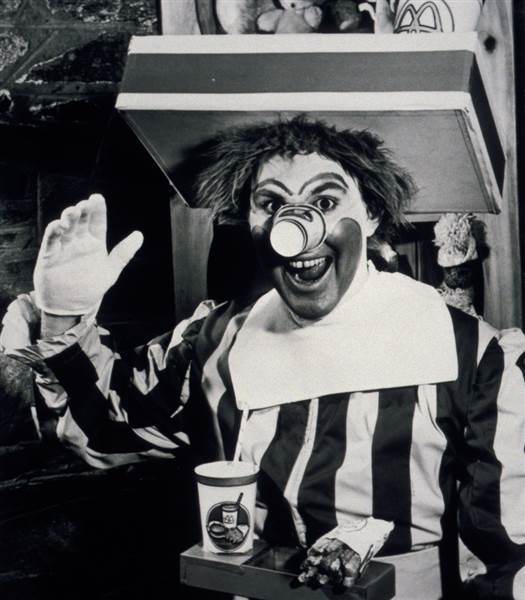
From August 1959 to August 1962 Scott portrayed Bozo the Clown at WRC. When the TV station dropped the Bozo character, Scott wanted to keep his clown gig going. Willard thought that a clown bearing hamburgers would be irresistible to children. So he morphed his Bozo character into a clown he named Ronald McDonald for two locally owned DC area McDonald’s franchises. In 1963, he appeared in 3 DC area TV commercials using the catch phrase, “Ronald McDonald, the Hamburger-Happy Clown.” Scott’s character wore a a red and yellow striped suit, could magically pull as many as 3 hamburgers at a time out of his belt, and wears a nose made out of a McDonald’s cup. His hat, made of a tray holding a Styrofoam hamburger, a bag of fries and a milkshake, covered a shock of spaghetti-like hair .
Even though Willard Scott’s original Ronald more closely resembled a scarecrow than a clown, Ray Kroc liked the idea. So, in typical “Kroc-style”, he usurped the idea and hired another actor to portray the hamburger clown for his own national commercials. Scott wasn’t selected as spokesclown for the company’s ads because the agency thought Willard was too fat for the role of an “extremely active” Ronald McDonald. In time, Willard Scott’s brainchild would become one of the world’s best-known advertising icons. But Willard never missed a beat.
In 1970, Scott began appearing on WRC-TV as a weekday weatherman. In 1980, NBC asked Willard to become its weatherman for The Today Show. He soon became the archetype of all “wacky” weathermen to follow. Scott routinely did weather reports on the road, interviewing locals at community festivals and landmarks, a forerunner of today’s weather channel programming. NBC executives once insisted that the bald-headed Scott wear a hairpiece. He complied when in New York, but refused when outside of the studio, resulting in a strange dichotomy on the air. His toupee occasionally tilted or fell off on the air, ensuring Scott an eternal place in the TV blooper hall of fame.
In 1989, an internal memo from Today Show co-host Bryant Gumbel was leaked to the media. In the memo, Gumbel said Scott “holds the show hostage to his assortment of whims, wishes, birthdays and bad taste…This guy is killing us and no one’s even trying to rein him in.” The public backlash against Gumbel, battling a difficult and aloof label already, became a media firestorm. The next time they appeared on camera together Scott kissed Gumbel on the cheek to show he’d forgiven him, and also later said he hoped the whole thing would go away. One thing was certain, Willard, like the Ronald McDonald character he created, would change but not go away.
As Willard became the face of NBC Today Show weather, Ronald McDonald became the primary mascot of the McDonald’s fast-food restaurant chain. According to one survey found on stunning-stuff.com, 96% of all schoolchildren in the United States recognize Ronald. The character and costume evolved drastically over the years and continues to be a cornerstone of the McDonald’s corporation marketing campaigns to this day. Ray Kroc’s Ronald ditched the food tray hat and cup nose in favor of a painted white face and a bright red wig. He is dressed in yellow clothes, red and white striped shirt, yellow gloves, and red clown shoes with yellow laces to mirror the official McDonald’s colors.
In television commercials of the 1960s, ’70s and ’80s, Ronald inhabited a fantasy world called McDonaldland where he had adventures with friends Mayor McCheese, the Hamburglar, Grimace, Birdie the Early Bird, and The Fry Kids. In recent years, McDonaldland has been largely phased out, and Ronald is portrayed interacting with families in their everyday lives.
In 1971, Ronald got a major makeover that found him wearing a yellow jumpsuit, red and white striped shirt and legs, yellow gloves, red shoes, red hair, whiteface makeup and a big red smile. The suit had three french fry bags for pockets, all of which read “McDonald’s”. That look would last for more than 40 years with only a few subtle changes to his hair style, sleeve length and pocket design. In 1998 the french fry pockets on Ronald’s jumpsuit were replaced with red seamed pockets, the stripes on the shirt became thicker, and the back of the suit featured the name “Ronald” like a sports jersey (the name would be removed by 2000).
In early 2014, Ronald’s jumpsuit was dropped in favor of a more athletic looking costume of yellow cargo pants, a vest and a red-and-white striped rugby shirt. His classic clown shoes remain part of the official uniform. The new look was designed to more favorably appeal to social media sites like Facebook and Twitter.
Over the decades, Willard’s Hamburger-Happy clown has been played by at least ten different actors, whose names are recalled by only the most fervent of Ronald McDonald fans. Today, many people work full-time making appearances in the Ronald McDonald costume, visiting children in hospitals, attending restaurant grand openings and charity events.
From the late 1980s until the early 1990s, Scott served as spokesperson alongside Pat Summerall for True Value Hardware Stores. In 1992, Scott ironically recorded a TV commercial for McDonald’s arch-rival Burger King. (Take that Ray Kroc!) Scott left his daily gig as The Today Show weatherman in 1996 and was succeeded by Al Roker. Willard continued to substitute for Roker for the next decade until NBC acquired The Weather Channel in 2009. Weather channel meteorologists served as substitutes but Willard continued to appear twice a week on the morning program to wish centenarians a happy birthday. He remains the commercial voice of Smucker’s jellies, which sponsors his birthday tributes on Today.
True, to most, Willard Scott was that annoying weather guy on The Today Show endlessly wishing old folks well on their 100th birthday. In fact, Willard Scott himself once said, “I got more mail than anybody in the history of The Today Show, but half of it was to get me off the air.” But now you know, despite his NFL lineman size, there’s more than meets the eye when you’re talking about Willard Scott. Well, I guess you really can’t judge a book by the cover.
food, Pop Culture

A Gunfight With Colonel Sanders.

Col. Sanders_HarlandOriginal publish date:  September 10, 2015
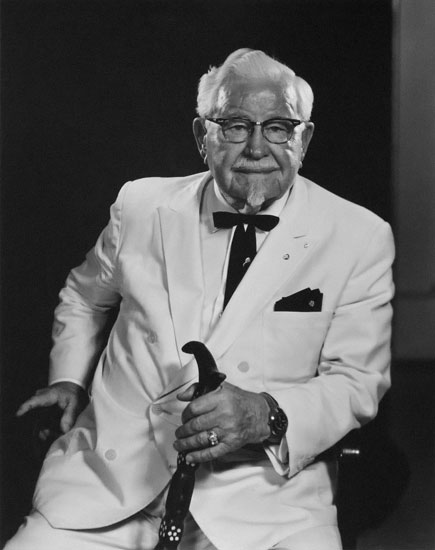
Colonel Harland Sanders died 35 years ago this week (December 16, 1980) but lately he’s been getting more TV face time than Abe Vigoda, Kirk Douglas and Zsa Zsa Gabor combined (who are all still alive, at least at the time of this writing). The Colonel has proven so popular in fact, that two former Saturday Night Lives are battling over who will portray him in the flesh in Kentucky Fried Chicken commercials. My wife and I love those TV ads; our kids think they are creepy. Colonel Sanders is perhaps the best known recurring fast food namesake our country has ever known. He is also a lot more complicated than he looks.
For example, did you know that Colonel Sanders, founder of KENTUCKY Fried Chicken was born in Indiana? Yep, Sanders was born on September 9, 1890 in a four-room house located 3 miles east of Henryville, Indiana. His father died when Harland was only 5 years old and by the age of seven Sanders was a skilled cook out of necessity. Sanders’ mother remarried in 1902, and the family moved to Greenwood, Indiana. Young Harland didn’t get along very well with his new stepfather. In 1903 he dropped out of seventh grade and soon he was working full time painting horse carriages in Indianapolis. When he was 14 he moved to southern Indiana and worked on a farm for a couple of years. In 1905, he moved in with an uncle in New Albany.
After leaving New Albany in late 1906, he joined the United States Army in Alabama (where another of his uncles lived) and was trained as a teamster / mule minder for a few months. He then became a blacksmith, then ash-pan cleaner, then steam engine stoker for the Northern Alabama Railroad. He married, moved to Jackson Tennessee and went to work as a fireman for the Illinois Central railroad while going to law school at night. He got in a fight with a co-worker and lost his job. The family moved to Little Rock Arkansas and Harland went to work for the Rock Island Railroad while he finished up his law degree. He practiced law in Little Rock for three years before he lost that gig after he got in a fight in the courtroom-with his own client! From there, it was back to Henryville where the Sanders clan moved in with Harland’s mother. Sanders went to work as a laborer on the Pennsylvania Railroad.
In 1916, the Sanders family moved to Jeffersonville, where Sanders got a job selling life insurance for Prudential. Sanders was eventually fired for insubordination. He moved to Louisville and got a sales job with Mutual Benefit Life of New Jersey. During this time, Sanders was sort of an ad-hoc doctor which contemporaries described as a “Helpful but technically unlicensed” obstetrician, delivering babies with rudimentary supplies like lard and Vaseline. In 1920, Sanders established a ferry boat company on the Ohio River between Jeffersonville and Louisville. The ferry was an instant success. In around 1922 he took a job as secretary at the Chamber of Commerce in Columbus, Indiana. He admitted to not being very good at the job, and resigned after less than a year. Sanders cashed in his ferry boat company shares for $22,000 and used the money to establish a company manufacturing acetylene lamps for automobiles. The venture failed after Delco introduced an electric lamp that they sold on credit.
Sanders moved to Winchester, Kentucky, to work as a salesman for the Michelin Tire Company. He lost his job in 1924 due in large part to his fiery temper. In 1924, by chance, he met the general manager of Standard Oil of Kentucky, who asked him to run a service station in Nicholasville. In 1930, the station closed as a result of the Great Depression. That same year, the Shell Oil Company offered Sanders a service station in North Corbin, Kentucky rent free, in return for paying them a percentage of sales.
It was here that Sanders began to serve chicken dishes and other meals such as country ham and steaks to weary travelers. Initially he served the customers in his adjacent living quarters before opening a restaurant. Oh, and if his bio hasn’t grabbed you by now, maybe your ears will prick up when I tell you that it was while working at his Shell station / restaurant combo where Colonel Harland Sanders, American icon, once shot a man.
The stretch of road where Sanders’ first restaurant was located in Corbin, Kentucky was on a nasty stretch of highway known as “Hell’s Half-Acre.” The region was full of bootleggers, and there were plenty of gunfights to keep things lively. Sanders kept a gun beneath his cash register and a shotgun near his bed to protect his family and his business. Turns out, Sanders didn’t need to worry about desperadoes, he had enough trouble just dealing with the competition. Sanders had his hands full just keeping an eye on his rival down the street, a man named Matt Stewart. Stewart ran a competing Standard Oil gas station down the road from Sanders, and the two men just didn’t exactly get along.
The ever enterprising Sanders decided to advertise his “Sanders Superior Gas Station” by painting a sign on a nearby railroad wall. Stewart didn’t like this move and promptly painted over Sanders’ sign. Furious, Sanders threatened to shoot off Stewart’s head and proceeded to repaint his billboard. But Matt Stewart was a stubborn fellow, so he grabbed a brush and started slapping paint on Sanders’ new sign.
Sanders was in the middle of a meeting with two Shell officials named Robert Gibson and H.D. Shelburne when the news of Stewart’s whitewash reached him. Determined to put a stop to Stewart’s shenanigans once and for all, the trio grabbed their loaded guns, jumped in a car, and drove off to settle the issue. They found Stewart perched on a ladder, paintbrush in hand. Sanders jumped out of the car and yelled, “Well, you son-of-a—–, I see you done it again.” Stewart jumped down from the ladder, pulled out his pistol and promptly fired five shots, three of which went directly into Robert Gibson’s heart, killing him instantly.
The Colonel said he grabbed the fallen man’s gun and started shooting back (even though he was carrying a pistol of his own). Stewart ducked behind the disputed railroad wall and for a moment appeared to be winning the gunfight. The Colonel went one way and Shelburne the other and the duo soon had Matt Stewart in a crossfire. Shelburne shot Stewart in the hip and Sanders shot him in the shoulder. A local newspaper article described Sanders’ actions as: “he jumped into the breach and under withering fire grabbed his fallen comrade’s gun . . . [and] the future Colonel unloaded with true aim and hurled hot lead into Stewart’s shoulder.” Bleeding and in pain, Stewart shouted, “Don’t shoot, Sanders! You’ve killed me!” The Colonel was a hothead but he was no murderer. The two men backed off and Stewart’s life was spared.
Ironically, Stewart was arrested in the hospital, tried and sentenced to 18 years in prison. Sanders and Shelburne were found not guilty. Sanders felt true remorse for his part in the incident and later went to Stewart’s daughter Ona May, apologized, and offered his help if she ever needed it. Local legend claims that the Colonel took care of Ona May for the rest of her life.
Sanders went back to his Shell station where he continued to serve steak, ham, biscuits, and his special recipe fried chicken to hungry customers. It was not fancy, served family style with bowls of food from which the diners served themselves, but by all accounts, it was “finger lickin’ good.” As the business grew into a motel/cafe, Sanders began wearing a black suit, growing a goatee that he would dye white and calling himself “Colonel.” Soon, he was running a full-fledged restaurant across the street, and his food was so popular that Governor Ruby Laffoon gave Sanders the honorary title of Kentucky Colonel. And the rest is history.
By the time of his death in 1980, there were an estimated 6,000 KFC outlets in 48 countries worldwide, with $2 billion of sales annually. As for Matt Stewart, well, after two years behind bars, he was shot to death by a deputy sheriff. No one knows for sure, but rumors has it the deputy was a paid gunman, hired to assassinate Stewart by Robert Gibson’s family. The deputy sheriff was never charged.
For many of this generation, Colonel Sanders is little more than a cartoon of an old guy on a KFC bucket. The real Colonel cussed like a sailor, was an unashamed flirt and an astute businessman with a proven record of eliminating the competition; one way or another. He was nothing like the aw-shucks version that history has handed down to us. He ate fried chicken, mashed potatoes, gravy and biscuits every single day, which added an extra 50 pounds on his 5-foot, 11-inch frame. In short, the Hoosier born Kentucky Colonel lived a life every bit as worthy as his secret recipe.

Baseball, Pop Culture

Chicago Cubs: The Curse of Billy Goat Sianis.

SPT BILLGOAT A  Original publish date:          February 27, 2017
Its not often these days that goats make the news. You may have heard recently that a severed goat’s head mysteriously appeared outside of Wrigley Field, home of the Chicago Cubs baseball team. To the uninitiated observer, the news of a blood soaked box containing the mortal remains of a Capra aegagrus hircus (domestic goat) might sound like some Medievel relic or a scene out of a Wes Craven film. However, diehard Cubs fans will immediately recognize the significance of such a macabre offering.
On April 10, 2013, a box arrived at the friendly confines addressed to the club’s owner Thomas S. Ricketts. Ricketts has been making noise recently with threats to move the team out of Wrigley Field unless the ballpark is updated and a newer larger mega-video screen is installed above the Ivy covered walls of the National League’s oldest baseball park. Ricketts is currently embroiled in heated negotiations with city officials and neighborhood business people about the proposed $300 million renovation. Cubs staff discovered the package and immediately called police. Chicago police responded to a call about an “intimidating package” around 2:30 p.m. By why a goat’s head? What did it mean?
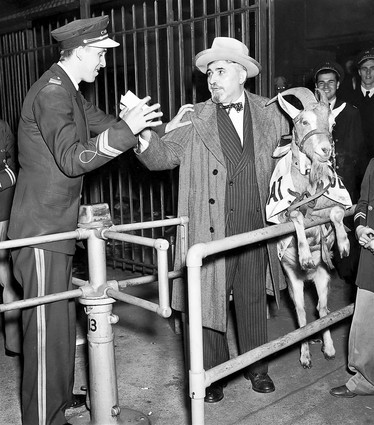
Well, Cubs lore says Chicago tavern owner Billy Sianis cursed the Cubs when they wouldn’t let his pet goat into Wrigley Field on October 6, 1945. Sianis purchased 2 box seat tickets for $ 7.20 for he and his pet goat, Murphy. He arrived with the goat wearing a sign stating “We Got Detroit’s Goat”. The legend claims that Sianis was asked to leave a World Series game against the Detroit Tigers at Wrigley because his pet goat’s odor was bothering other fans. He was outraged and declared, “Them Cubs, they ain’t gonna win no more,” which has been interpreted to mean that there would never be another World Series game won at Wrigley Field. Of course, it helps feed the legend that the Cubs have not won a National League pennant since that World War II Era incident. Making matters worse, the Cubs have not won a World Series in 105 years.
Since then, there have been countless renditions of the fabled incident, so many in fact that it has become hard to separate fact from fiction. Most renditions state that Sianis declared that no World Series games would ever again be played at Wrigley Field, still others say that his ban was on the Cubs appearing in any World Series, regardless of venue. The Sianis’ family claimed that “Billy” (ironically the most popular name for American domestic goats) sent a telegram to then team owner Philip K. Wrigley reading, “You are going to lose this World Series and you are never going to win another World Series again because you insulted my goat.” Whatever the truth, the Cubs were up two games to one in that 1945 series but ended up losing Game 4 as well as the best-of-seven series four games to three.
Newspapermen all over Chicago knew a good story when they “smelled” one, so the curse was quickly immortalized in columns and has spread like wildfire for decades hence. Legendary Chicago Daily News, Sun-Times and Tribune syndicated columnist Mike Royko popularized the goat legend when, during the 2003 postseason, Fox television commentators played it up during the Cubs-Marlins match-up in the 2003 National League Championship Series.
In an apparent mea culpa by the team, the curse was “lifted” in 1969 by Sianis himself. It didn’t take, as the 1969 Cubs finished with a record of 92-70, 8 games behind the New York Mets. That star crossed season saw the Cubs in first place for 155 days, until mid-September when they lost 17 out of 25 games. The “Miracle Mets” went on to win the World Series. Later, Billy Sianis’ nephew Sam, was brought out onto Wrigley Field with a goat multiple times in attempts to break the curse: on Opening Day in 1984 and 1989 (in both years, the Cubs went on to win their division), in 1994 to stop a home losing streak, and in 1998 for the wild card game (which the Cubs won).
In 2003, the Chinese zodiac’s Year of the Goat, a group of Cubs fans headed to Houston with a billy goat named “Virgil Homer” and attempted to gain entrance to Minute Maid Park, home of their division rivals the Astros. After they were denied entrance, they unfurled a scroll, read a verse and proclaimed they were “reversing the curse.” The ploy seemed to be working as the Cubs won the division that year, but then came the “Bartman incident”.
In the eighth inning of Game 6 of the NLCS, with Chicago ahead 3–0 and holding a 3 games to 2 lead in the best of 7 series, Marlins’ second baseman Luis Castillo hit a ball down the left field line. As the ball hovered in limbo between fair and foul, several spectators attempted to catch it. One of those fans, Steve Bartman, reached for the ball, deflecting it out of the reach of Cubs outfielder Moisés Alou. Had Alou caught the ball, it would have been the second out in the inning, and the Cubs would have been just four outs away from playing in the World Series. Instead, the Cubs lost the lead and ultimately the game, by giving up eight runs in the inning. Bartman, a lifelong Cubs fan, had to be escorted from the stadium by security guards, and received police protection for a time when his name and address were made public on MLB message boards.
In another bizarre incident on October 3, 2007, a goat carcass was found hanging from the statue of beloved broadcaster Harry Caray. While the Cubs did win the NL Central Division title in 2007 and 2008, they were swept in the first round of the playoffs in both years. Yet another dead goat (this time just the head) was found hanging on the Caray statue on Opening day of 2009. At 2:40 a.m. police responded to a 911 call at the intersection of Clark and Addison streets. Police took the goat down and disposed of the remains. No arrests were made in either incident.
More recently, Cubs fans have sought reversal via a more spiritual course by bringing in Catholic priests to bless the field, stadium, and dugout. On April Fool’s Day of 2011, a group calling itself “Reverse The Curse” was born. This social enterprise is dedicated to squaring the deal with Billy Sianis’ ghost by giving goats to families in developing countries to combat worldwide poverty. These goats provide the family with milk, cheese, and alternative income to help lift them out of poverty. Reverse The Curse further expanded into reversing the curses that afflict the world’s children in Education and Obesity.
Some Cubs fans further chart the curse’s effect by the number of players who won World Series titles after leaving the Cubs. They include Lou Brock, Bill Madlock, Manny Trillo, Bruce Sutter, Dennis Eckersley, Joe Carter, Greg Maddux, Joe Girardi (as both a player and a manager), and Mark Grace to name but a few. More recently, Tim Lincecum, the San Francisco Giant pitcher known as “The Freak”, was originally drafted by the Cubs.
But what about that original goat and it’s owner? Billy Sianis was born in 1895 in Greece. In 1912 he immigrated to the United States, where he became a prominent, yet crafty, Chicago bar owner. In early 1934, two months after the repeal of Prohibition, Sianis purchased the Lincoln Tavern, a bar across the street from Chicago Stadium, for $205 with a bounced check (he made good on it with the proceeds from the first weekend they were open). That summer a baby goat fell off the back of a truck into the street outside the tavern. Sianis nursed the goat to health and named it “Murphy”. To honor his favorite pet, Sianis renamed his bar the “Billy Goat Tavern” . The bar became a popular hangout for celebrities in the 1940s.
When the 1944 Republican National Convention came to town, he posted a sign saying “No Republicans allowed” causing the place to be packed with Republicans demanding to be served. Of course, a great deal of publicity followed and Sianis took advantage of it. Sianis used his goat to draw attention to his bar; he began wearing a goatee, nicknamed himself “Billy Goat”, and began to sneak the goat into unusual locations for publicity stunts. That explains the Wrigley Field fiasco huh?
In 1964, it moved to its current location under Michigan Avenue. It’s new location, situated between the offices of the Chicago Tribune and the old Chicago Sun-Times building, led to the tavern’s popularity among newspaper columnists, particularly Mike Royko. In 1969, Sianis petitioned powerful Chicago mayor Richard J. Daley to issue him the first liquor license for the moon. His hope, according to the letter displayed on the bar’s wall, was to “best serve his country by serving delicious cheeseburgers to wayfaring astronauts as well as raising moon-goats”.
Sianis died on October 22, 1970, at the St. Clair Hotel where he made his home. Billy Goat Sianis is linked to pop culture and sports trivia for the “Goat Curse”, but that is by no means his only claim to fame. Another sign on the wall reads: “Cheezborger, Cheezborger, Cheezborger. No Pepsi. Coke,” These words, with Pepsi and Coke in reverse order, were originally spoken and immortalized by John Belushi in, “Olympia Cafe,” an early Saturday Night Live sketch that was inspired by the Billy Goat tavern and it’s Greek owner. Although Belushi himself never set foot inside the Billy Goat, SNL stars Bill Murray and Don Novello (Father Guido Sarducci) were regulars.
Nevertheless, although Billy Goat Sianis’ life resonates through the pages of pop culture history far beyond the reaches of the Wrigley Field Goat Curse, many Cub fans are convinced that some residual aspect of that original 1945 curse persists. Since the Cubs are entering Spring training 2017 as defending World Champions, hopefully this is the last we’ll ever hear about a Cubs curse.

Indianapolis, Music, Pop Culture

The Beatles, Paul Newman and the Speedway Motel.

Beatles on the greenOriginal publish date:  August 7, 2014

On February 19, 2009, demolition crews knocked down the final wall of the 96 room Indianapolis Motor Speedway Motel aka Brickyard Crossing Inn, which was closed by the Indianapolis Motor Speedway in December of 2008. They knocked it down so fast that race fans and historians didn’t have a chance to notice, much less complain, until it was gone. On February 19, 2009, demolition crews knocked down the final wall of the 96 room Indianapolis Motor Speedway Motel aka Brickyard Crossing Inn, which was closed by the Indianapolis Motor Speedway in December of 2008. They knocked it down so fast that race fans and historians didn’t have a chance to notice, much less complain, until it was gone.

The modern style motel opened in 1963 to much fanfare. Located just off of Turn 2 of the legendary 2-1/2-mile oval, at the time, no other racing facility in the country could boast its own motel located on property. The opening of the motel 54 years ago filled a void in lodging on the near-west side of Indianapolis; long before the growth associated with the construction of Interstate 465. The Speedway Motel’s location assured that only the elite of racing stayed in the convenient confines. Some of the greatest names in auto racing history stayed at the motel, not to mention movie stars, politicians, and music legends.

Like the Speedway, the Brickyard Crossing Inn had a famous history. Besides being the home for several Indianapolis 500 drivers, personalities and owners during the month of May, scenes from Paul Newman’s movie “Winning” were filmed in rooms of the motel. Who knows how many 500 race winners have stayed there prior to the days of million-dollar motorhomes? NASCAR legend Jeff Gordon celebrated his win in the 1994 inaugural Allstate 400 at the Brickyard by eating a pizza in his room at the motel. Oh, the stories those rooms could’ve told. Every West sider should remember the distinctive sign out front welcoming fans before the race, and congratulating the winner afterwards.

When the Speedway Motel opened, John F. Kennedy was President, Alcatraz was still a working prison, the Beatles released their first record and there wasn’t another hotel in sight. Today there are 30,000 hotel rooms in the vicinity and the Speedway Motel lost it’s identity in this modern world. Speedway management  decided that bringing the old Motel up to modern standards would simply cost too much, so the hotel was closed and its 15 workers were sent home for good. After all, by today’s standards, the IMS Motel wasn’t exactly an architectural masterpiece.

The Speedway Motel’s guest list? It was something else. Just about every celebrity that attended the Indianapolis 500 over the Motel’s 45 year lifetime stayed at the IMS Motel. Names like James Garner, Jim Nabors, Paul Newman and Jayne Mansfield made it their home while in town for the Greatest Spectacle in Racing. At one time or another, nearly every Indy 500 driver lived there during the entire month of May. It was the preferred residence of 4-time Indy 500 winner AJ Foyt. Same is true of car owner Roger Penske, who typically passed on the luxury motor homes and condos for a comfortable room at the motel.

However, by the mid-1980s, the old motel was beginning to show its age. By then, it had taken on the appearance of an old roadside movie motel. Glasses were wrapped in paper sleeves and housekeeping staff still put the strip of paper across the toilet seat that said “Sanitized for your protection.” By the late 1990s, the rooms were dank and musty-smelling, and in the wintertime the rooms were intolerably hot. As the years passed, it became apparent that IMS officials had to come to a decision, the motel had to either be renovated or razed. Nowadays, the only evidence remaining of this once glorious Motel can be found in the memorable scene from the movie “Winning” when Newman’s character, Frank Capua, returned to the motel after leaving Gasoline Alley and catches Joanne Woodward (Ironically Newman’s real life wife) and co-star Robert Wagner “in the act” in Room 212 of the IMS Motel.

Newman was a fixture at the speedway for decades as a car owner for Mario Andretti in the 1980′s. During those years Newman would give his guests tours of the Speedway, he would always point out the room where the film scene took place. Newman recalled in a 2007 interview, “I always used to take a golf cart and drive the sponsors to the back of the Speedway Motel, and I would stop for a minute and point to a room and say, ‘And that’s where my wife shacked up with Robert Wagner,'” Newman continued, “I’d let that comment sit there, and deep silence and embarrassment would fall over everybody. Then 10 minutes later I’d say, ‘Oh, in the movie I meant.'” He made his final appearance at the speedway during qualifications for the 2008 Indianapolis 500, just four months before losing his battle with cancer.

It was renamed the Brickyard Crossing Inn after the race track became home to NASCAR’s Brickyard 400 race in 1994 and for awhile, the motel added NASCAR stars to its famous guest list, including the winner of the Inaugural Brickyard 400 in 1994, Jeff Gordon. After all the pictures, media interviews and celebratory appearances were over, Gordon and his first wife, Brooke, went back to their room at the motel and called Domino’s to order a ham and pineapple pizza. The unsuspecting employee on the other end said, “It’s going to take about two hours to get the pizza delivered because there was a race there today.” to which Gordon responded, “I know. I’m the driver who won the race.” After convincing the Domino’s employee that he was indeed Jeff Gordon, the pizza arrived much sooner than two hours.

The most famous non-racing related guests to stay at the motel were “The Beatles” who stayed in the Motel during their 1964 tour appearance in Indianapolis. Legend has it that during their stay in Indianapolis, fans were tipped off they were staying downtown at the Essex House Hotel. To mislead frenzied fans who might rush the motel, the Beatles’ managers let it leak out that the “Fab Four” would be staying at the swanky downtown hotel. To further add to the ruse, they put the crew traveling with the Beatles at the Essex.

Their manager then put all four in one room  at the IMS Motel. The Beatles enjoyed a quiet refuge there for one weekend in September 1964 while playing two shows at the Indiana State Fairgrounds. That night after the show, the band returned to the Speedway Motel to relax before heading to Milwaukee, Wisconsin, the next stop on their franticly-paced 1964 North American Tour. Ringo could not sleep and asked his police escort if they could drive him around the city and grab a late night bite to eat. The policeman in charge took Ringo to a restaurant known as “Charlie’s Steakhouse” on the north edge of Carmel, located at the point where Meridian Street (U.S. highway 31) and Range Line Road (Indiana highway 431) come together. Old timers will remember it as “Ben’s Island”, a bar located within the old Carmel Motel. Ringo had eggs and coffee before returning to the Speedway Motel in the wee hours of the morning. The policeman received a reprimand for this impromptu tour but Ringo later sent a thank-you note to the State trooper and his family for the opportunity to escape the tour for a little while.

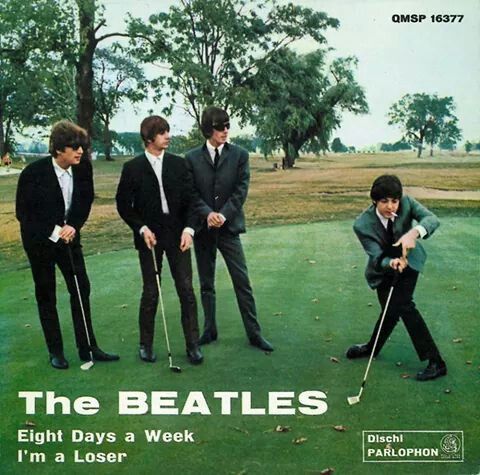
The next day, a photographer arrived to snap a few pictures of the Beatles at their Indy Motel. There were pictures of the Fab Four talking with their police escort on the balcony. Photos of the boys playing with remote control slot cars on an oval track set up on the floor of their room. The most famous image from that shoot was that of all four lads playing golf on one of the Speedway golf course greens. Afterwards, the State Police security detail took them for a lap around the track before finally heading for the airport. In the book, “The Beatles Anthology”, George Harrison remembered it this way: “Indianapolis was good. As we were leaving, on the way to the airport, they took us round the Indy circuit….It was fantastic.”

When I found out the motel was going to be torn down, I was hoping to be able to get access to the room for some photo memories to compare to the movie. Life and the Indiana Winter got in the way and delayed my trips to the Motel until I received a phone call from friends Steve and Kim Hunt telling me that, “I’m driving past it and they’re  tearing it down right now.”

Thank goodness the old motel’s main building will continue to house its popular restaurant, a conference center, pro shop of the Brickyard Crossing Golf Course and the legendary “Flag Room” pub. All will continue operation. The Flag Room bar remains a popular watering hole with regular patrons whose colorful nicknames like “Tires” and “Jonesy” hearken back to the golden days of Indy motorsports. In May, and especially during race week, The Flag Room is a prime gathering spot for former 500 winners like Jim Rathmann and Parnelli Jones to sit and talk about the good old days of their glorious racing careers. Other drivers, such as Al Unser, Bobby Unser, Johnny Rutherford and Mario Andretti, occasionally stop by for lunch or dinner.

“The motel and the restaurant were places where you could stand any day during May and just see everybody. It would have been an autograph-hunters paradise but I don’t think that word ever really got out,” Davidson said. “Who wouldn’t want to hear the lunch conversation among former Indiana basketball coach Bob Knight, four-time Indy winner A.J. Foyt and Speedway owner Tony George”, Davidson chuckled. “They were golfing buddies.”

The razing of the Indianapolis Motor Speedway Motel closed a chapter on a piece of the history of the century old Indy 500 Mile Race. They say that all good things must come to an end, but I can’t help but feel that we lost a symbol of Indianapolis sports and pop culture history with the destruction of the old motel. It was a time when a normal Hoosier kid could venture to West 16th street in the off season to sleep in the same beds as the heroes of their youth…and dream.

Creepy history, Medicine

The last of the Radium Girls.

Radium girls             Original publish date:  January 2, 2015

2014 has come and gone and along with it, the passing of many notables whose time on this earth has run out. Lost among them is a woman you may have never heard of. Mae Keane died this year. She was the last of the radium girls.
On December 21, 1898, Marie and Pierre Curie discovered the radioactive element radium after extracting it from uraninite. Five years after that, they won a Nobel Prize in physics for their discovery, making her the first woman to win one. She went on to win a second Nobel Prize in 1911; this time in chemistry, for isolating radium, making her the first person to win two.
Radium was soon all the rage: bottled radium water was used as a health tonic, radium filled facial creams were used to “rejuvenate the skin”; the Radium Institute in New York City was giving radium injections to all who could pay for them; some toothpastes started to include Radium; high-end spas began adding radium to the water of their pools and some hospitals were using radium as a treatment for those who had cancer after it was observed that exposing tumors to radium salts would shrink them. Although the latter sounds admirably feasible, the former should sound shocking when you consider that radium is highly radioactive.
Additionally, it was found that when radium salts were mixed with zinc sulfide and a glue agent, the result was a glow-in-the-dark paint. During World War I the advent of trench warfare necessitated the invention of many things. Trenches were dark, damp and dirty. A single match lit by a soldier hunkered down in a pitch dark trench might be the spark to draw enough enemy fire to wipe out an entire company of soldiers. Time dragged on endlessly; when you couldn’t see your own hand in front of your face, you had no hope of seeing the hands of a clock face.
Not only were soldiers crawling and wading around in the mud unable to see their watch dials at night, their pocket watches weren’t suitable for this environment. Soon, watchmakers created men’s watches with straps designed to be worn on a wrist rather than placed in a pocket. Before the great war, wrist watches were primarily worn only by women, with men favoring pocket watches. By November of 1915, British soldiers were putting dots of radium paint next to the hour numerals to make them visible at night. The dimness of the glow was beneficial as they could tell the time without giving away their position.
Of course, at this time, the dangers of radioactivity were not fully understood. Enter Mary “Mae” O’Donnell Keane and the radium girls. In the early 1920s, the hot new gadget was a wristwatch with a glow-in-the-dark dial. Their ads extolled “the magic of radium!” And according to some, radium was magic. Salesmen promised that it could extend your life, pump up your sex drive and make women more beautiful. Doctors used it to treat everything from colds to cancer. In the Roaring Twenties, women earned the right to vote, got the urge to smoke and marched to work in factories alongside their male counterparts.
Young women ranging in age from the mid teens to the early 20’s were employed to apply the paint to clock dials and watch faces. The job was promoted as ideally suited for delicate female hands. The work was easy, the wages high and most dial painters were typically single and living with their parents. Over the first 10 years about 4000 women were employed at 3 locations: Orange, NJ, Waterbury, CT and Ottawa, IL.
The first dial painters came from the china painting industry. These seasoned workers used a technique called lip-pointing which involved wetting their camel hair paintbrushes between the lips to bring it to a sharper point. The practice was passed on to the radium painting industry whose products required fine brush work. In 1924, 18-year-old Mae Keane was hired at the U.S. Radium Corporation factory in Waterbury Connecticut. The pay was $18 a week for a 40-hour work week, and 8 cents a dial. A pretty good salary for a woman back then.
Twelve numbers per watch, 200 watches per day-and with every glowing digit, the radium girls swallowed a little bit more poison. Mae said that on her very first day, she decided that she didn’t like the taste of the gritty radium paint. “I wouldn’t put the brush in my mouth,” she recalled years later. During breaks and at lunchtime, it was a popular pastime of the radium girls to paint comic faces on each other, then turn out the lights for a laugh. “The girls sneaked the radium out of the factory to paint their toe nails and teeth to make them glow,” Keane said.
Mae couldn’t remember what led her to work at the watch & clock factory but did remember that she disliked the work more than she liked the paycheck. Luckily, she was not as fast as her supervisor wanted her to be. “I made 62 cents one day,” Keane once said, which translates to a high of 8 watches in a day. “That’s when my boss came to me and said I better find another job.” That poor performance probably saved her life. She worked in the dial painting room for eight to nine weeks, then transferred to another job at the company. “I often wish I had met him after to thank him,” Keane said, “because I would have been like the rest of them.”
The dial painters would become some of the earliest victims of radioactive poisoning. By the late-1920s, they were falling ill by the dozens, afflicted with horrific diseases. The radium they had swallowed was now slowly eating their bones away from the inside out. “We were young,” Mae told The Hartford Courant in 2004. “We didn’t know anything about the paint. I don’t think the bosses even knew it was poison. The foreman would tell us it was very expensive, and to be careful. We had no idea. But when they did find out, they hid it.”
Reports of maladies afflicting the radium girls began to bubble up to the surface. Dial painters began to suffer from a variety of illnesses, often crippling and frequently fatal as a result of ingesting radium paint. One account describes a woman (Frances Splettstocher) visiting her dentist to have a tooth pulled only to have her entire jaw yanked out in the process. Soon, her gums and cheek rotted away, ultimately resulting in a hole in her cheek. Her health continued to deteriorate and she was dead within the month.
Other radium girls had their legs snap underneath them and more still had their spines collapse. Dozens of women died, many while still in their 20s. Ingested radium is known to deposit permanently in bone structures damaging bone marrow. In all, by 1927, more than 50 women had died as a result of radium paint poisoning. Many of them developed cancerous tumors, honeycombed and fragile bones, and suffered painful amputations. At a factory in New Jersey, 5 of the women sued the U.S. Radium Corporation for poisoning. The trial would have a profound impact on workplace regulations.
Ironically, many in these factory towns blamed the women for the loss of jobs during the Great Depression. Furthermore, it would be discovered that U.S. Radium had paid off doctors and dentists to claim the girls were suffering from the sexually transmitted disease syphilis (often having this listed as the cause of death when the girls died), with the hope that it would not only shield the corporation from litigation, but also sully the girls’ reputations.
At every turn U.S. Radium sought to delay the trial as much as possible with the hope that all the women in the case would die before an outcome could be reached (in fact all five of the original radium girls were dead by the mid-1930s). With the company asking for delay after delay, the trial crawled along at a painful pace. Marie Curie herself chimed in on the issue, but had little comfort to give the radium girls by stating, “I would be only too happy to give any aid that I could, [but] there is absolutely no means of destroying the substance once it enters the human body.” Curie herself would die on July 4th, 1934 from leukemia; likely caused by her long term exposure to radium.
By the time the girls finally got a chance to testify in January of 1928, none of them were able to raise their arms to take the oath, and two were bedridden. After their testimonies, the case was once again postponed for a few months for no good reason. The case was settled in the fall of 1928, before it could be deliberated by the jury, and the settlement for each of the radium girls was $10,000 ($135,000 in 2014 dollars) and a $600 per year annuity while they lived, and all medical and legal expenses would also be paid by the company. Many of the victims would ultimately end up using the money to pay for their own funerals. The lawsuit and resulting publicity was a factor in the establishment of occupational disease labor law. Most importantly, the trial proved that the injuries suffered by the radium girls were completely preventable.
As part of the settlement, the girls agreed not to hold U.S. Radium liable for their health problems. So what was U.S. Radium’s official position in the aftermath? They stated they didn’t settle because they were wrong, but rather because the public was biased against them and they couldn’t have received a fair trial. U.S. Radium’s president, Clarence Lee, stated: “We unfortunately gave work to a great many people who were physically unfit to procure employment in other lines of industry. Cripples and persons similarly incapacitated were engaged. What was then considered an act of kindness on our part has since been turned against us.”
But these radium town’s plight didn’t end when the case was settled in court. The chemical element found its way into the soil and groundwater, contaminating residential and commercial properties around the towns. The dangers of radium no longer was isolated to those who worked in the radium dial plant, it now threatened the populace. The factory sites became EPA Superfund cleanup sites in the 1980s. The plight of the radium girls was now known to, and shared by, everyone.
But Mae Keane was a proud survivor. Over the years, she had some health problems: she developed numerous skin ailments and eye problems, suffered from migraines and had two bouts with cancer. “The doctor wanted to give me chemotherapy,” Keane said. “I told him ‘no.'” Keane lost all of her teeth in her 30s and suffered pain in her gums until the day she died. “I was left with different things, but I lived through them. You just don’t know what to blame,” she said. The only prescription medication she ever took was to control her blood pressure. Despite her ailments, Mae admitted, “I was one of the fortunate ones.”
Keane, a Red Sox fan, was once asked about her secret to longevity. “I’m lazy,” Keane said, adding she never smoked, loved to walk and dance, and enjoyed caramel candy, chocolate and an occasional apricot sour or Bailey’s Irish Cream. “I didn’t get old until I was 98,” she once said.” She was 107 when she died on March 1 in Middlebury, CT.; the last living participant in one of the darkest moments in American industrial history.