Music, Pop Culture, The Beatles

Close Encounters: The Beatles John Lennon and UFO’s.

lennonnyc-ufoOriginal publish date:                August 18, 2013

If you haven’t noticed, I like trivia. In my lifetime, I’ve watched as trivia has leapt from the pages of obscure library books to become popular board games and highly rated TV game shows. I try hard not to replace or confuse trivia for history, but I think trivia has a place in our history books nonetheless. Sometimes, trivia about a historical person or event helps rationalize or humanize that person, place or thing allowing us to relate to it in a more down-to-earth fashion. So, since I can’t find anything else to write about this week, I’ll share with you a trivial story that I’m betting you’ve never heard of before.
39 years ago this Friday (August 23, 1974) was a typical hot summer night in New York City. Beatle-gone-solo John Lennon was on what he would later call his “Lost Weekend”, an 18-month-long fling with former assistant May Pang during his break-up with Yoko Ono lasting from the summer of 1973 to the winter of 1975. John and May had just returned home to their East 52nd street apartment, after spending the day at the Record Plant East recording studio, where John was in the final stages of his Walls and Bridges album. Lennon loved the location of the 52nd street address as it was only one building away from the East River. The view from his top floor apartment, overlooking Brooklyn’s navy shipyard docks, reminded him of Liverpool. Another draw for Lennon was the fact that reclusive actress Greta Garbo also lived on the block and he counted himself among the legion of her fans who tried daily to catch glimpse of her.
Lennon-PangThat August night began no differently from any other evening for John and May. John made and received phone calls, watched TV and listened to the day’s recorded studio work while making notes. The 52nd Street apartment was hot that night, but by 8 O’ Clock the air had cooled off enough for May to turn off the air conditioner and open the windows to catch the breeze coming off the river. Just a few feet off the apartment’s living room was the building’s roof, accessible through a side window. This rooftop acted as the couple’s private observation deck, offering a million dollar view of New York’s Eastside. The haze had now cleared over the cityscape and around 8:30 p.m., May decided to take a shower, leaving Lennon alone in the living room reviewing mock-ups of his new record’s cover. The cover art on the final product would be a painting by a 12-year-old John Lennon.
As May was drying off, she heard John yell from the outside roof, “May come here right now!” Startled, she ran out to find him completely nude standing on the roof and pointing wildly at the southeastern sky. May wasn’t surprised by finding John naked on the roof, (John was a closet nudist: if you need proof, Google “Two Virgins” and you’ll understand), what surprised her was what he was pointing at. Just south of the building was a brightly lit “textbook” circular UFO, hovering silently less than 100 feet away from the couple.
As John Lennon would later describe, “I wasn’t surprised to see the UFO really, as it looked just like the spaceships we’ve all seen on the cinema growing up, but then I realized this thing was real and so close, that I could almost touch it!”. As they watched in astonishment, the UFO glided silently out of sight. May later told a reporter, “the lighting on the thing left us awe-struck, as it would change its configuration with every rotation”. According to May, the object made no sound and the main structure of the craft could be clearly seen for the duration of the event; lit by the dying rays of the setting sun. May ran back into the apartment and grabbed her ever-present 35mm camera (Her mountain of photos of John Lennon and their “lost weekend” are legendary).
Once back on the roof both she and John took numerous pictures of the craft. May recalls how John stood screaming at the UFO, arms outstretched, to come back and take him away. She said, “He was very serious and I believe he really wanted that thing to take him with it back to wherever it came from, but then that was John Lennon, always looking for the next big adventure”. The couple watched as the object glided past the United Nations building and slowly veered left, crossing over the East River, then over Brooklyn before simply blending in with the heavy commercial air traffic found over southern Long Island. The couple climbed back into the apartment and John picked up the phone to call his friend, noted rock photographer Bob Gruen. Lennon told Gruen to get over there as soon as possible as he had some film he needed developed immediately. As they waited for Gruen to arrive, John began drawing sketches of what he had seen, noting its size and distance. John then called Yoko Ono at the Dakota apartment to tell her about the UFO. May remembers that Yoko became upset at John because she hadn’t seen it too and felt that he had “left her out of all the excitement”.
1280x720-z7RBob Gruen arrived and John excitedly told the photographer what had transpired. Gruen later recalled “I took the film home and put John’s roll between two rolls of film I’d taken earlier that day and developed them”. “My two rolls of film came out perfectly but John’s roll was blank. Later I asked him ” did you call the newspaper?” and he said “I’m not going to call up the newspaper and say, This is John Lennon and I saw a flying saucer last night”… So Bob Gruen called up the local police precinct and asked if anyone had reported a UFO or flying saucer. The police responded with “Where? Up on the East Side? You’re the third call on it”. Then Bob called the Daily News and they said, “On the East Side? Five people reported it”. Finally, Gruen called the ultra-conservative New York Times and asked a reporter if anybody had reported a flying saucer? The reporter hung up on him.
Neither John Lennon nor May Pang would ever forget their UFO experience. John even mentions the encounter in the booklet that accompanied the Walls & Bridges album released in the autumn of 1974. On the bottom right of the back cover it reads “On 23 August 1974, I saw a UFO J.L.”. May Pang has an audio tape of John, recorded just a few weeks after their experience, where Lennon discusses his thoughts on UFO’s in general. Lennon states that he had “no doubt that the craft he saw was from another world” and nixed the idea that it could have been a “secret government test plane”. John Lennon believed the craft he saw was part of a much larger fleet stationed just north of New York City, near the Indian Point nuclear power plant.
In the tape, Lennon expressed his personal theory of how these craft use the earth’s gravitational field and take energy from our nuclear plants to counter the earth’s gravity. John also voiced his opinion and suspicion of a high level conspiracy to cover up verifiable UFO sightings and close encounters with aliens. He continued that “if the masses started to accept UFO’s, it would profoundly affect their attitudes towards life, politics, everything”. He added, “It would threaten the status quo…Whenever people come to realize that there are larger considerations than their own petty little lives, they are ripe to make radical changes on a personal level, which would eventually lead to a political revolution in society as a whole”.6-25-2015-4-15-07-PMHand drawn, autographed UFO sketch by John Lennon.

However, John Lennon was not a newcomer to the “UFO Phenomenon”. He was a known subscriber to the British UFO journal “Flying Saucer Review”, aka “FSR”, as far back as his years with The Beatles in the late 1960s. Several copies of “FSR” have been found, and subsequently auctioned off, addressed to John Lennon. May Pang reports, “Oh no, 74 wasn’t John’s first sighting… In fact he told me that more than once he suspected he had been “abducted” as a child back in Liverpool!…She continues, “And he felt that experience was responsible for making him feel different from other people for the rest of his life”. Yes, according to May Pang, John Lennon believed he had been “Abducted” by aliens as a lad in Liverpool, but he didn’t like to talk about it.
The more you know about John Lennon, the less you understand. He was a walking contradiction. He was fiercely anti-Capitalism but lorded over nearly every “Beatle” mass marketing scheme during his early days with the Fab Four. He was deeply spiritual, but averse to organized religion. He was an intensely private person, yet readily greeted and signed autographs for fans outside his Dakota apartment. Those last two contradictions contributed to his untimely assassination by a crazed, mentally disturbed fan in December of 1980. Knowing this, can it come as any real surprise that John Lennon believed he had seen a UFO 39 years ago? I suspect not. When dealing with John Lennon, one need only refer to John’s own words, spoken only hours before his death, to San Francisco DJ David Sholin of RKO radio, “Who knows what’s going to happen next?”

o-LENNONFULLUFOALBUMSLEEVE-570

A drawing of that 1974 sighting, sketched for his “Walls and Bridges” album, depicts what appears to be a classic flying saucer with the word “UFOer” written on the bottom of the object. On the album’s liner notes, the famed musician wrote: “On the 23rd Aug. 1974 at 9 o’clock I saw a U.F.O. J.L.” Drawing was auctioned on March 21, 2017 by CooperOwen Auctions of London. The album sleeve was originally expected to bring in between $1600 to $2500, but ended up selling for just over $16,600.
animals, Disney, Pop Culture

The Feral Cats of Disneyland.

disney cats       Original publish date:  December 7, 2013
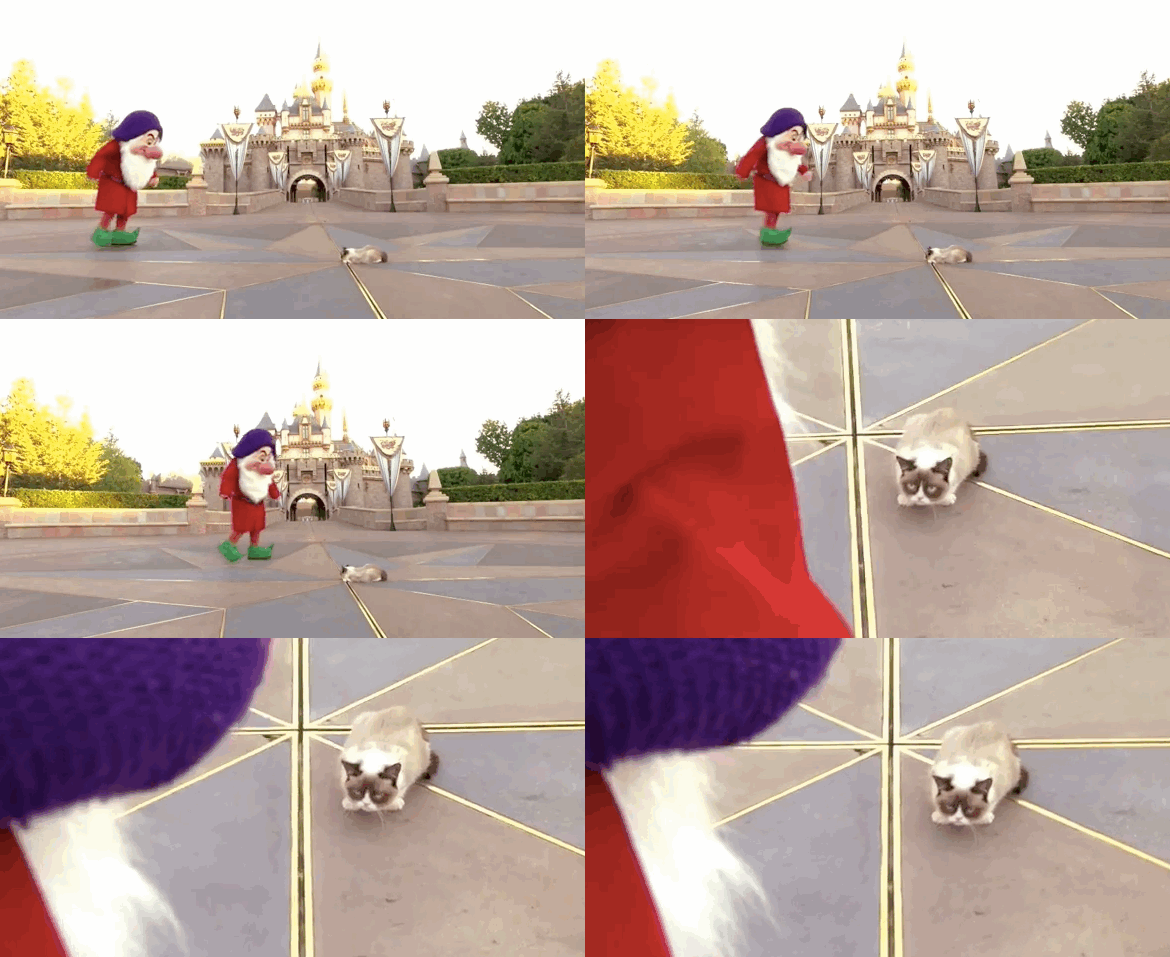
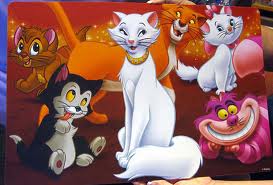
At last count, there were 35 official Walt Disney cats. Figaro, Lucifer, Cheshire, Bagheera, Shere Khan, Thomas O’Malley, Duchess, Tigger, Rufus, Oliver, Dinah, Mufasa, Simba, Nala, Scar, all of those Aristocats and who can forget Si and Am from Lady and the Tramp? “We are Siamese if you please.” There’s an ear-worm for the rest of your day. No doubt, some of those cat names sound familiar while others ring silent in your mind. But do you know about the feral cats of Disneyland?
Every night at the California Disneyland theme park, after the bedraggled parents head for the exits with their sunburned children in tow, after the exhausted employees (Disneyland calls them “cast members”) have headed for home, the park fills up again, this time, with some 200 hundred feral cats. Never heard of a feral cat? A feral cat is a domestic cat that has returned to the wild. A feral cat is different from a stray cat, which is defined as a cat that has been lost or abandoned, while feral cats are born in the wild. Although the offspring of a stray cat can be considered feral if born in the wild.
When Disneyland opened over a half century ago in 1955, the location was then a rural suburb of Los Angeles called Anaheim. An area best known for producing oranges for juice and grapes for wine with a population under 15,000 people. It quickly grew to over 100,000 by 1960 and today it’s population numbers over 350,000. As the town quickly became a city the pet population grew accordingly. Almost from the start, feral cats began to gather behind the gates of the Magic Kingdom. Many factors contributed to this frenzied feline phenomenon; safety, shelter, community, but mostly food.
In the earliest days of the park, things were quite different than they are today. True, the park employed dozens of “cast members” to pick up trash back in the day, but the emphasis was on ride cleanliness back then rather than the meticulous state of grounds keeping we can see today. During renovation of the Sleeping Beauty castle two years after Disneyland opened, more than 100 cats were found living in the unused portion. Worse yet, a colony of fleas permeated the area as well.
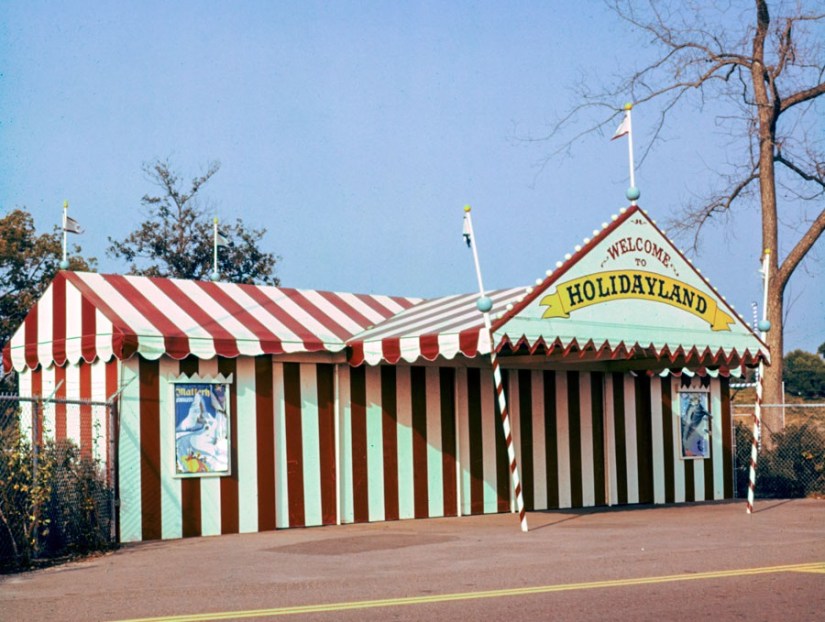
No doubt, these feral cats were first drawn to Disneyland by the discarded scraps of food left behind on park grounds by guests, but the cat population stayed for another reason: Mice. Ironic when you consider the entire Walt Disney juggernaut was built around a mouse. While Mickey Mouse may have put Disneyland on the map, a colony of feral cats helps keep the famous theme park rodent-free. The cats were first drawn to a long forgotten “lost” land of Disneyland known as “Holidayland.” Operating from 1957 to 1961, Holidayland was a 9-acre grassy picnic area located along the western edge of Disneyland, near the area that is now New Orleans Square.
SteveC_LgT_Holiday1Holidayland had its own admission gate into Disneyland and could hold up to 7,000 guests for large events. It featured playgrounds, horseshoes, a baseball diamond, volleyball courts and other activities. The centerpiece was billed as “the world’s largest candy-striped circus tent” which had previously been used by the short-lived.Mickey Mouse Club Circus and Keller’s Jungle Killers attractions inside the original Disneyland theme park. Food and concessions were available for purchase in Holidayland including beer, which was not available inside the gates of Disneyland.
Despite providing alcohol for the relief of sun-scorched adults, Holidayland floundered, and eventually failed, after only 4 years due to its lack of shade, absence of nighttime lighting and the unsettling thought that it had no restrooms. Did I mention they sold beer? Today, the former location of Holidayland houses part of the Haunted Mansion and Pirates of the Caribbean rides. But back then, when the picnickers left, the feral cats were now left to meander new regions of the Magic Kingdom.
Holidayland1  At first, the cats were considered to be a bit of a nuisance and a possible threat to the guests. Attempts to control, cajole or coax the cats proved futile. After all, these were non-paying guests and Uncle Walt was simply not going to stand for that. So, rather than try to evict them, Disneyland decided to employ them. Soon, the cats became an integral part of the park’s everyday operations.
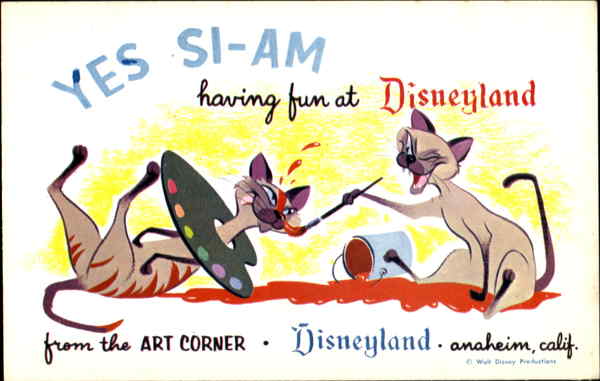
But don’t expect to spot one on your next visit as they hide during the daytime. The cats are free to come and go as they please, but only at night. The cats join the 600 custodians, painters, gardeners and decorators who work through the night to ensure that the world’s best known theme park meets the squeaky-clean ideals that Walt Disney himself extolled so many years ago. The cats work alongside a human crew that works 365 nights a year, toiling under portable floodlights sprucing, fixing and adjusting this city that never sleeps.
Siamese Cats             Just as the feral cats of Disneyland have their own specific job, every nighttime worker has his own specific task. Three workers are responsible solely for repairing and replacing the 800 umbrellas, 25,000 chairs and about 7,000 tables in the restaurants and snack bars in Disneyland and neighboring California Adventure Park. Four certified divers collect submerged trash and make repairs on water attractions like Finding Nemo and the Jungle Cruise. The work can often be tedious and occasionally bizarre.
All of the recorded music and sounds heard in the rides and throughout the park runs continuously on a loop. Seems that it is more costly for Disneyland to shut the sound off then to restart the system every day. The only time the sound is shut off is when there is an Emergency such as a massive power loss or emergency shut downs. For example, in “It’s a small world” the dolls stop moving, but the music plays on. Inside the Haunted Mansion, the doom buggies stop but the animatronics still move and the voice-over continues. Luckily the cleaning and maintenance crews can turn it down so they won’t go mad, but the feral cats don’t seem to mind.
Seven years ago, reportedly at the urging of former “Price is Right” host Bob Barker, animal care staff at the park took it upon themselves to do right by their feline employees by instituting a preventative health program of Trap-Neuter-Return”. Aided by local organizations including FixNation, Disneyland developed a lasting protocol for the humane care of the resort’s cats. Although Disneyland doesn’t monitor the total number of cats, the program has been quite successful at adopting out kittens and maintaining a balance between cat population and their Disneyland environment.
After the cats are neutered and returned to the park grounds, they receive continuing managed care. Its a pretty good gig to be a Disney-employed mouser. During the day, the feral cats of Disneyland lounge around and dine at five discreet feeding stations hidden throughout the resort strategically situated to minimize interaction with resort guests. During orientation Disney cast members are instructed to never pet the cats.
It’s nice to see such a high-profile park treating all its visitors and employees humanely-not just the human ones. California Disneyland’s “TNR” program proves that organizations and feral cat colonies can not only peacefully share the same property, but also work together in a mutually beneficial relationship to improve conditions for both parties. You may wonder, does Disneyworld in Orlando, Florida have the same problem? Well, although there have been occasional cat sightings at the Sunshine State’s Magic Kingdom, Disney Orlando has one thing Disney California doesn’t: alligators.
A story circulates that Disneyland changed its stance on the interloping cats based on an incident from those first couple years of operation. Those first original Disneyland feral cats supposedly migrated from an adjacent trailer park. During this time there was a sweet cat that hung out at the ranch in Frontierland. Employees nicknamed the female cat “Roofie” as she often hung out on the roof and surrounding landscape of the “Crockett and Russel Hat Co.” storefront. Employees would routinely bring canned cat food for her and she would come out of the tall grass, sometimes even dropping a mouse she had caught since she liked the canned food more. One day employees noticed that roofie was very ill. After work, they placed her in a box and rushed her to a nearby vet’s office. She died on the way. The vet examined her and said she died from eating poisoned mice. Word got back to Uncle Walt and the policy was changed.
Finally, proof that feral cats can be useful and worthy of life; not simply un-tamable animals for our overtaxed shelters to destroy. Many shelters in the Western US give them to ranchers and farmers for use as barn cats and back in the day police stations and college campuses kept a few around to keep their rodent population down without resorting to the use of chemicals and rodent traps everywhere. Maybe in 2014, the world will take the lead of Walt Disney and his feral cats of Disneyland.
If you would like more information on the feral cats of Indianapolis, please contact the good folks at Indy Feral. Give them a call at (317) 638-3223 or check out their website at http://www.indyferal.org/. Their Mission is to reduce the stray and feral cat overpopulation of our fair city through the non-lethal Trap-Neuter-Return (TNR) method. They could use your help and support, or they would just love to hear from you.DisneyCats

Abe Lincoln, Auctions, Gettysburg, Pop Culture

The Gettysburg Wax Museum Auction.

Wax MuseumOriginal publish date:  March 20, 2014

Seeking escape from the coldest, harshest winter in recent memory, I sought escape by attending a liquidation auction at an iconic baby boomer tourist landmark on the site of America’s greatest battlefield; The Gettysburg Wax Museum in Pennsylvania. Aware of my penchant for tourist traps and knowing that the museum was built the year I was born (1962), despite my reservations, she decreed “You’re going.”
Known as “The National Civil War Wax Museum”, the site at 297 Steinwehr Avenue opened April 19, 1962. That week Walter Cronkite took over as CBS anchorman, Bob Dylan performed “Blowin’ in the Wind” for the first time in Greenwich Village, the Boston Celtics won their fourth straight NBA championship, the Seattle World’s Fair opened and Indy 500 champion Al Unser Jr. was born (on the museum’s opening day). The original Museum featured 35 scenes containing over 150 individual figures highlighting the Civil War and Gettysburg. The museum’s purpose was not only to entertain but to educate.
IMG_0520On Saturday, March 15th the museum’s contents were sold to the public at auction. The sale included 95 Civil War wax figures and the accouterments used to illustrate each scene. In it’s half century of service the museum saw over 8 million visitors walk through the turnstiles, now lot # 265 in this very special auction.
Although I had been in the museum many times over the past 25 years, it was a shock to now see the building gutted and lain bare. Most of the auction lots were arranged in the scenes where they had “lived” for the past half-century. It seemed strange to now step into the scenes to get a closer view of the lifelike depictions from the pages of history. These forms thast were gazed upon by untold generations of visitors including presidents, diplomats, dignitaries and just plain folk from every walk of life.
I met 19-year wax museum employee Stephanie Lightner while walking the halls among the ghostly figures. She is the manager of the new museum that will soon be open there. Stephanie says the building was purchased by a New Jersey man who had grown up in Gettysburg and that the facility was being retooled to better accommodate a new generation of visitors. “We’ll be keeping some of the exhibits to display in the new museum,” said Stephanie. She said that the new owner kept all of the staff from the Wax Museum, always a good thing. The new museum, known as the “Gettysburg Heritage Center”, is set to open in late April but as Stephanie smilingly admits, “It might be Memorial Day at this point.”
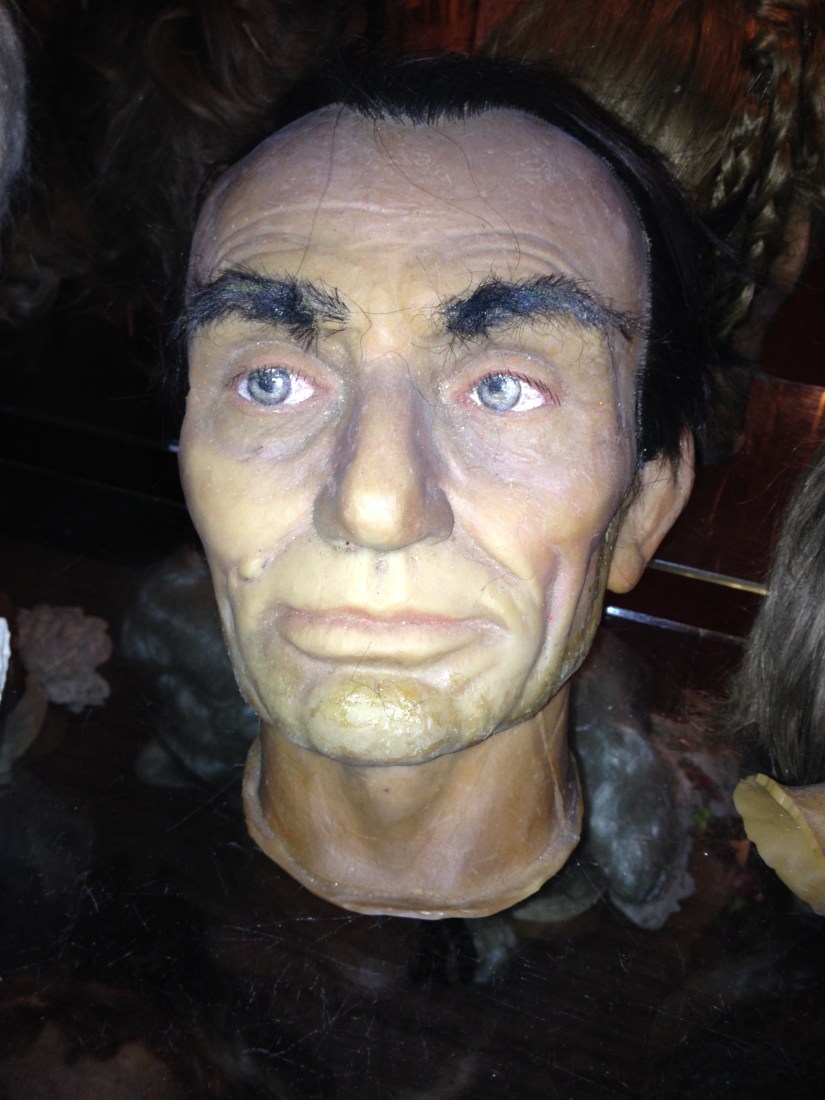
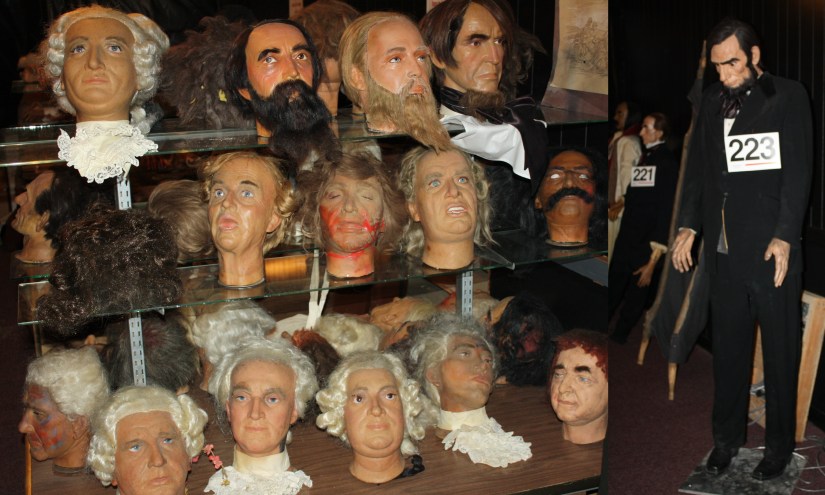
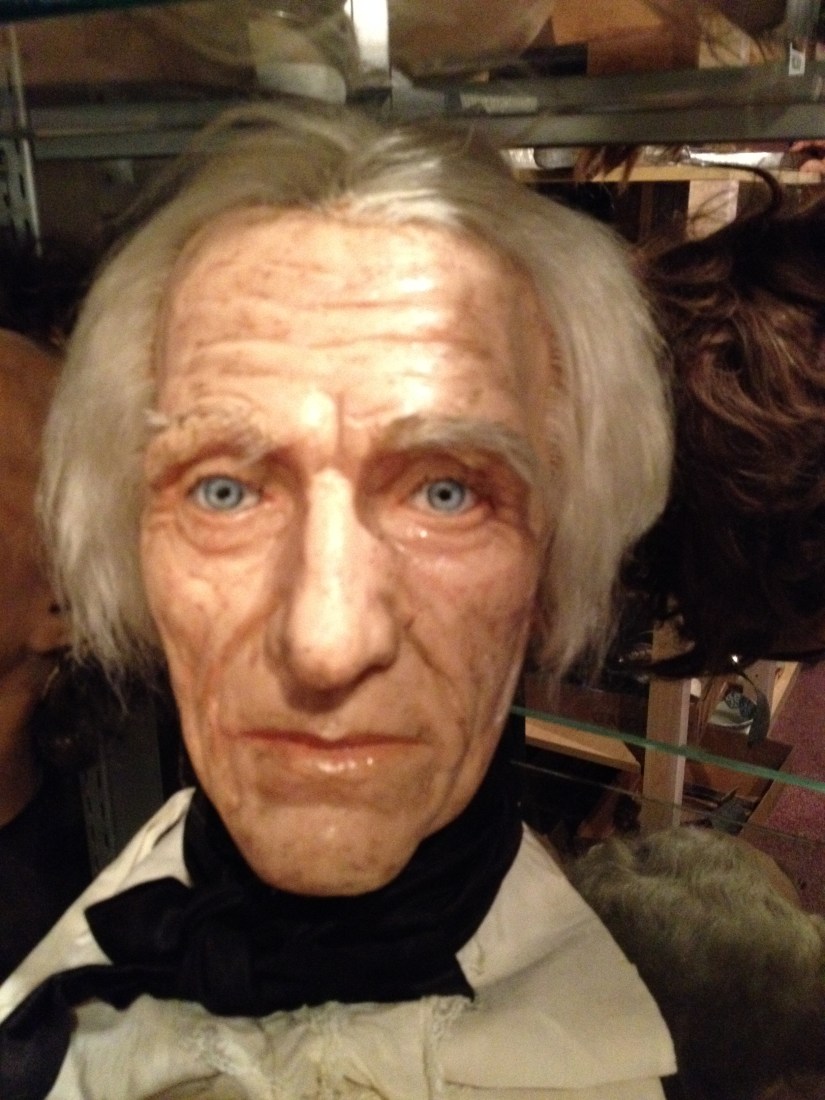
IMG_0521As I finished perusing the auction lots, I halted at an area tucked away in a back corner of the hall. This dimly lit crook featured tiered shelves upon which rested approximately 40 disembodied heads. Some of the heads were recognizable to me; Abraham Lincoln, Andrew Jackson. On a shelf nearby lay a pile of arms, legs and hands. Some of these body parts, in keeping with the brutality of the Civil War, were spattered with blood stains. Seeing these, I turned to my wife and said “Now these have the potential to go sky high.”
Officially, the auction featured 335 official lots but that number would balloon to over 400 by close of sale. The crowd quickly ballooned to standing room only. It was a strange mix of Civil War re-enactors, Harley dude’s and local Pennsylvania Dutchmen. I spotted a few ghost hunter types in the crowd as well, no doubt hoping to score a disembodied head, bloodstained arm or broken hand should the opportunity arise. I saw some familiar faces, among them Gettysburg’s former Abe Lincoln, Bill Ciampo, who told me, “I just came to see if there was a market for this stuff. When I sold my Lincoln wax statue, I sold it for $500 just to get rid of it.” Ciampo walked up to the Lincoln figures (the museum had three full Lincoln figures and one head) and said, “See, their chins are already drooping, that’s why I got rid of mine.”
IMG_0523The synchronicity of the moment was not lost on me as, outside just yards away, bulldozers busily cleared out the massive football field sized blacktop parking lot. It had once served the old visitor’s center (torn down in 2008) and Cyclorama building, built the same year as the wax museum and torn down in March 2013. In the past 25 years I watched as other tourist landmarks disappeared from the borough including the Lincoln Room Museum, The National Tower, and now, the Wax Museum.
Also among the crowd was Erik L. Dorr, curator and owner of “The Gettysburg Museum of History” at 219 Baltimore Street. Erik painstakingly maintains his fantastic personal collection of relics from the Battle and the pages of American history within the walls of his ancestral family home. “The house was built in the 1850s and has been in my family for four generations. It was extensively remodeled in 1867 and again in the early 1900s.” said Dorr.
On this day, Mr. Dorr was searching for additions to his massive collection. “I’m running out of room at my Museum now. I actually tried to buy the whole Wax Museum, including the contents, land and building. I thought it would be a fun experiment and I was getting financing in order but it didn’t fall into place fast enough and the museum sold.” says Dorr, “I would have kept the wax museum intact as much as possible while adding my collection to it.” Among the items he bid on and won were the Jenny Wade, George Armstrong Custer and John Wilkes Booth wax statues. He also bought many of the signs including the iconic interior entryway sign that lit up to indicate when the next group should enter.
“I bought most of the Jenny Wade booth with the idea of recreating it in my museum.” Dorr remarked. “As it stands now, I’ll have to display the statues one at a time because of space limitations.” Mr. Dorr reports that he is actively looking for a new space to house his collection, “I could get a place just outside of the town limits, but I want it to stay in the borough of Gettysburg.” Currently Dorr, the consummate historian, is busy making plans to attend the 70th anniversary of the D-Day invasion at Normandy in early June as an invited guest. “They’re calling this the last reunion.” he says, “The trip is pretty brutal and most of the vets won’t make it to the 75th.” But that’s a story for a future column.
Seated nearby were a young couple whom I met by taking a photo of them proudly displaying their bidder number. Turns out this couple was Scott and Lori Hilts from Arcade New York. They live on an 1850s dairy farm and Scott has converted the barn into a museum dedicated to the battle of Gettysburg. In a familiar refrain, Scott admits, “I’m running out of room. It’s 40’by 80′, but I might have to expand.”
Scott, owner and operator of 2 funeral homes, proudly traces his roots back to Corp. John Christ of Co. E 136th New York State volunteer infantry who was wounded on the mystical third day at Gettysburg. “I bought the (Robert E.) Lee and (George) Meade figures because I felt they were the ones most identified with Gettysburg,” Hilts said, “but I bought some paintings and signs too. Since I bought the Lee-Longstreet conference painting, I went ahead and bought the General James Longstreet figure too.” He also bought a colorful Zouave soldier to represent the many ethnic troops that fought at Gettysburg and to honor his home state.
I asked Lori about Scott’s Gettysburg obsession and she explained that she was “fine with it and it keeps him out of trouble.” She admitted that when Scott told her of his plans to purchase a wax figure or two, she thought the idea was “strange” and her biggest fear was running into one of them in the middle of the night. “As long as they stay in his man cave, then I guess it’s all right.” Besides, Lori reports that she found a Steiff “center stitched teddy bear” the next day at an antique show in nearby New Oxford so, “It was a good tip for me too.”
Scott, an arduous collector whose specialty is images, letters and diaries of soldiers killed, wounded or held as POWs at Gettysburg, loves nothing better than researching every item he adds to his collection. Over the years I have found that it is often collectors like Scott who are most dedicated to the preservation, protection and promotion of history. Scott Hilts is one of those new breed “collector as curator / preservationists.”
By my count the auction grossed just over $ 100,000, a figure that does not reflect the 10% buyers premium. There were over 350 registered bidders from as far away as Los Angeles. You might think it would be one of the statues that brought the most money at the sale. But the top lot was # 317, a rare Singer sewing machine made in 1846, that brought $5775 and a round of applause from the crowd. The famous General figures, and those of Jennie Wade and Jesus Christ, all landed in the $1000 neighborhood. The Lincoln figures sold for upwards of $2000 each. But many of the lots receiving spirited bidding included the furniture, wall hangings, and artwork that adorned the scenes. Items that went largely unnoticed by museum visitors focused solely on the statues. Civil War military equipment and uniforms used to adorn the wax figures (swords, belts, hats, saddles, and bayonets) all sold well.
A personal favorite was the larger-than-life animated figure of Abraham Lincoln, for years the closing scene for the Museum. This figure moved ever so slightly to the cadence of The Gettysburg Address, or at least it used to. Now the figure looked rather sad, more resembling the Addams family Lurch character than our 16th President. The $ 2200 winning bid came via phone. I couldn’t help but wonder if the bidder would’ve been half as exuberant had they been there to view the statue in person. Oh, and that turnstile I mentioned before, it sold for $ 495. A pittance when you consider the aggregate humanity that hip-checked their way past its mechanical tentacles.
After the last lot was hammered down, I asked Erik Dorr if there were any surprises or regrets at the auction. “I thought most stuff went as expected, but some lots went higher than I would’ve guessed. I knew the Gettysburg lots would go high and recognized many local collectors in the crowd. But it seemed like they waited, bid on the lot they wanted, and left, which might’ve actually helped me.” Dorr said “I wanted to bid on one of the paintings or the Lincolns, but couldn’t justify the high price. I noticed that after the sale, all of the Lincoln statues were grouped together waiting for shipment. I suspect that they were all sold to the same bidder and that they might have actually sold for more had bidding continued.”
When I posed the same question to Scott Hilts, he responded, “I thought things went very reasonably, not cheap, but lower than I expected.” As for regrets, he says, “I wish I’d have bought the George Pickett figure. It only sold for $ 700. I should have bought more of the paintings too.” Scott offers perhaps the most touching observations of the day by saying, “I first came to this museum when I was 8-years-old. I brought my son Derron here when he was the same age. (Scott has 3 daughters too). Now Derron is graduating from Fredonia State University this June. My Great-Great-Grandfather was wounded where those bulldozers are working right now. In fact, he may well have received his wound right here where the museum sits. He was here that’s for sure.” Scott Hilts love for Gettysburg is deeply rooted.
IMG_0519Undoubtedly the happiest person in the room that day was a young woman named Kim Yates. She was hard to miss. Towards the end of the auction she bid on, and won, the last wax figure in the catalog. Suddenly, the previously sedate young lady began to scream wildly and jump around the room. One of the ringmen sidled over to me, after noting the look of obvious surprise on my face, and whispered, “She’s never bid in an auction before.”
Within moments, that same ringman rolled out those uncatalogued body parts. The Lincoln head sold for $330, then Andy Jackson’s head brought $275, followed by several more disembodied heads sporting powdered wigs sold for $ 250 each. Then it was down to the bloodied heads. Suddenly Kim Yates sprang to the front of the room and began bidding on the grisly remains faster than the ringmen could keep up with. After all was finished and the last lot hammered down, Kim told me, “I bought 6 heads, 4 torsos, a sword and a whole bunch of hands and arms.” Turns out that Kim runs a haunted attraction near Baltimore known as “Kim’s Krypt”, scheduled to open that very night. “My only worry is getting them back in time to display them tonight.” Who knew that props from one of Gettysburg’s most esteemed museums would someday end up in a haunted house? I told you those body parts would go crazy.

As you can see in this clip, I nearly owned this sign (the ring-man is pointing at me). Instead, it went to Eric Dorr’s museum in Gettysburg. A suitable place.

Creepy history, Ghosts, Witches

Witch Marks.

w1Original publish date:  July 14, 2010

In the spirit of the approaching Halloween season, I’d like to share a story with you that combines many of the elements that peak my curiosity and fuel my passion for history and folklore. Recently, transplanted British antique dealer and collector Rick McMullen traveled back to his motherland in search of merchandise to sell in his shop or add to his home, which he describes as “virtually architecturally antique.”

Rick journeyed to an antique fair near Lincolnshire County in the Midlands of Great Britain where he found a curious large hand-carved oak panel. The 200 pound panel stood over 7 feet tall and was over 4 feet wide and was made in the “Carolean” style dating to sometime in the 1600’s. He had the panel shipped back to the states along with a Gothic-Victorian Era staircase and a 16th century oak timber frame with the intentions of incorporating all of them into his Virginia home.

However, it was that panel that made Rick’s mind race. What was it? What would he do with it? Where did it come from? When Rick’s wife saw the panel, she thought it might make a good headboard for a bed, but Rick quickly nixed that idea. Instead, the panel was set aside for future consideration while ongoing remodeling projects took precedence. There it would rest in peace until one fateful October evening when Rick was watching the history Channel and he saw something that seemed “hauntingly” familiar.

w2He was watching a documentary about witches and soon a segment flashed across the screen that told about the superstitious markings made by ancient people used to ward off witchcraft. The program talked about an English estate called “Kew Palace”, built in 1631. The owners were particularly superstitious, and believed that evil influences or witches could enter the house disguised as cats or frogs and cast spells on people while they slept. To ward this off, the original carpenters who made the roof carved special secret signs near windows, doors, fireplaces and other vulnerable places, to protect themselves from evil. ( Other ways of protecting a house included hiding old shoes, mummified cats and kittens under the floorboards, or ‘urine bottles’ filled with hair and nail-clippings in special, secret cavities.)
Rick immediately realized that he’d seen these very same markings before but couldn’t remember where. He searched his home and inventory looking for something that might jog his memory. He was about to give up when it came to him. It was the panel.

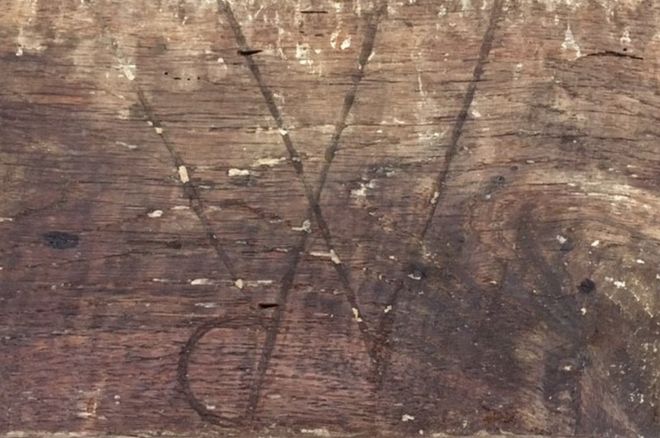
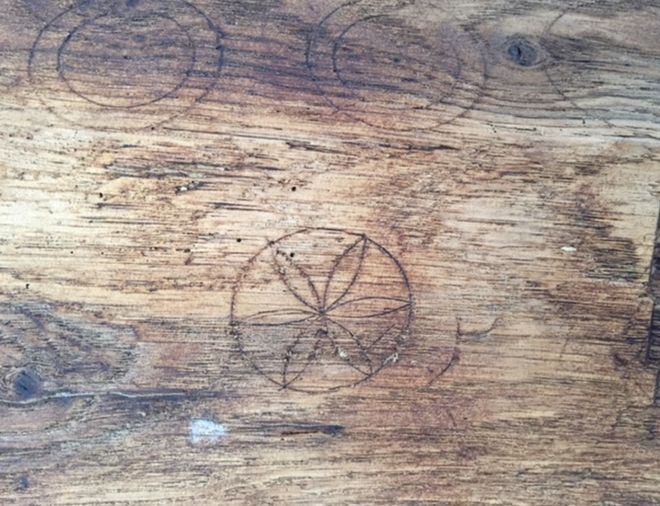
He turned the panel around and discovered about 40 hand carved figures and markings. These hand-cut marks varied in design and structure from interlaced V’s that more closely resemble fancy old English W’s to numerour carved daisy wheels. McMullen learned that these marks were called “ritual marks” or “apotropais”, a Greek word meaning “Intended to ward off evil” and were an important part of the folklore of Great Britain from the 15th to the 17th centuries. They were designed to keep witches, evil spirits and things that go bump in the night out of the home.

Among the Ancient Greeks the doorways and windows of buildings were felt to be particularly vulnerable to evil. On churches and castles, gargoyles or other grotesque faces and figures would be carved to frighten away witches and other malign influences. Those other openings, fireplaces or chimneys, may also have been carved. Rather than figural carvings, these seem to have been random simple geometric or letter carvings.

Contrary to what you may think, these ritual marks were not displayed prominently in the British Isles. It might make sense to put them over doors and above windows, but they were most often secreted away in hidden places to prevent a witch seeing and combating them. There is evidence of these “witches signs” appearing in churches, homes and other stone buildings all over the British Isles dating back to the late Medieval, Jacobean and Carolean Eras.

w3Rick has no idea where the panel originally came from but he suspects that the symbols were cut into the item by the resident family before being affixed as a softening decoration to an ancient stone wall. That way the marks would be unseen by the casual observer, presumed witch or evil spirit, but still provide protection for the family at the same time. Rick quickly discovered that there has been little formal study of these “witches signs” and historians have offered little support to his theories, choosing instead to dismiss them as silly superstitions.
Rick McMullen surmises that the two sets of deeply carved double V’s invoke the protection of holy Mary, “Virgin os Virgins” and mother of Jesus Christ. He believes that the carved daisy wheels, one of which is 18 inches in diameter, represent the “circle of life” with the petals overlapping each other to effectively become one.

McMullen admits that his theories are based on the scant available research and conjecture on the subject. “It’s quite bizarre,” he says. “But I believe it’s the only one in America…to my knowledge, these ritual marks predate Jamestown (1607, the first English settlement in the United States) and by the 17th century, it’s believed the marks were no longer used.”

However, the tradition can still be found in the often grotesque exaggerated faces carved into pumpkin jack-o-lanterns displayed each Halloween on porches and in windows of houses all over central Indiana. These cute childish symbols of Halloween were originally designed to avert evil and ward off the souls of the dead and other dangerous spirits walking the earth at that time.  Today, carved pumpkins are considered to be a wholesome part of the Halloween season shared by children and their parents in kitchens all over the state. A far cry from the origin of the mysterious ancient cravings known as “witch marks.”

Ghosts, Hollywood, Pop Culture

Clifton Webb’s Ghost-Forgotten Hoosier Hollywood Icon

webb1Original publish date:  November 9, 2008

If you’re a fan of the Golden Age of Hollywood, then you should recognize the name Clifton Webb. If you’ve never heard of him, but consider yourself a fan of old Hollywood movies, don’t despair as you’ve probably seen Webb in one of his many old movies or television appearances made during his long career in Tinseltown. He’s one of those great character actors whose face is very familiar but whose name escapes us. So great in fact that he was nominated for 3 Academy Awards and 2 Golden Globe awards ( winning one in 1946) during his career. His story is sadly sweet.

If you’re a fan of the Golden Age of Hollywood, then you should recognize the name Clifton Webb. If you’ve never heard of him, but consider yourself a fan of old Hollywood movies, don’t despair as you’ve probably seen Webb in one of his many old movies or television appearances made during his long career in Tinseltown. He’s one of those great character actors whose face is very familiar but whose name escapes us. So great in fact that he was nominated for 3 Academy Awards and 2 Golden Globe awards ( winning one in 1946) during his career. His story is sadly sweet.  Clifton Webb was born Webb Parmelee Hollenbeck to a multi-generational Hoosier farming family in Marion County on November 19, 1889. If you find a biography on Mr. Webb, it will most likely claim that he was born in Beech Grove. However that information proves faulty when you realize that Beech Grove wasn’t formed as a community until after he was born. Beech Grove as we know it was not formed until 1906. Before that time it was known as a region known for the many Beech trees that populated the area. The town of Beech Grove was formed when the Big Four railroad began to use it as a hub during the early 1900s.

It’s much more accurate to say that Clifton Webb was born nearer to Brookville Road in the South eastern area of Marion County. So it’s accurate to say that Webb started life as an east-sider. However, he did not stay long. Webb’s father, Jacob Grant Hollenbeck (1867-1939) , was an Indiana farmer and sometime green grocer. His domineering mother, Maybelle A. Parmelee (1869-1960) was the daughter of a railroad conductor. Maybelle insisted that her “Little Webb” keep her family name along with that of Webb’s father. She moved with her “little Webb” to New York City after her husband’s job as a ticket taker did not suit her plans for her son’s career advancement in the theater.

Maybelle was known to tell anyone she came in contact with the “We never speak of him. He didn’t care for the theater.” Maybelle had “little Webb” enrolled in singing, dancing, & acting classes in New York City by the age of 5. Maybelle was an effective and aggressive stage mother who managed to get “little Webb” his stage debut at Carnegie Hall at the age of only 7 in a play called “The Brownies”. Webb was so effective in this first role that he was signed up to tour with a traveling vaudeville acting troupe. Shortly afterwards he was tapped for lead roles as Tom Sawyer and Oliver Twist. Maybelle kept “little Webb” busy between performances with painting and opera lessons. Webb quite school by the age of 13. He was performing opera solos on stage by the age of 17.

By the age of 19, Webb had dropped both the Parmelee and Hollenbeck names and adopted the stage name we know as “Clifton Webb”. He was performing regularly on Broadway and it was not unusual to find his mother Maybelle’s name listed in the playbill along with her “little Webb” as a minor scene player or extra. During this period, Webb co-starred with legends like Will Rogers and Al Jolson in plays and musicals written by luminaries like Cole Porter, Irving Berlin, Oscar Wilde, Noel Coward, the Gershwins and Jerome Kern. Webb received billing above Humphrey Bogart in Bogie’s first stage performance. Although he appeared in a few silent films in the 1920s, he stuck to Broadway until 1944.

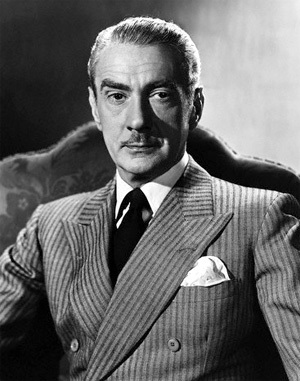
webbclifton01Webb was tapped by director Otto Preminger to appear in the classic “Laura” alongside Gene Tierney. He would receive his first Oscar nomination for this appearance, even though he was relatively unknown to movie fans. 2 years later in 1946 he again starred with Tierney in the cult classic film “The Razor’s Edge”. He received his second Oscar nomination for this role. Webb’s created the lasting character “Mr. Belvedere” in 1949 for the film “Sitting Pretty” and would reprise the role 2 more times. This character would earn him his third and final Academy Award nomination. This same “Mr. Belvedere” character would be retooled as a TV show and played by 4 different actors from the 1950s thru the 1980s.
Some of Webb’s other films (He made 25 films in all) include: “The Dark Corner” in 1946, “Cheaper by the Dozen” with Myrna Loy in 1950, “For Heaven’s Sake” in 1950, “Dreamboat” in 1952, “Woman’s World” in 1954, “Titanic” in 1954 (He played Barbara Stanwyck’s doomed husband), “Three Coins in a Fountain” (1954), “The Man Who Never Was” in 1956, “Boy on a Dolphin” (1957), and “The Remarkable Mr. Pennypacker” in 1959. It’s been claimed that Webb’s real life persona was most like that of his “Mr. Belvedere” character, described as being somewhat of a “Sophisticated, stuffy, effete snob” by some who knew him. It was no secret that Clifton Webb was gay. This at a time in Hollywood when it was an unwritten rule in Tinseltown to “Don’t ask, don’t tell”.

Clifton Webb’s elegant style landed him on Hollywood’s best dressed list for decades. Webb was the subject of many great stories and quotes in Hollywood. One of comic Bob Newhart’s favorite stories is to relate how while he was a young & naive star in Hollywood at one of his first exclusive parties, Clifton Webb approached this wide eyed newcomer and startled Newhart by asking him if he wanted to dance. Despite this obvious frankness, Clifton Webb managed to keep his personal life out of the Hollywood tabloids. Although the rumor in late 1950’s Hollywood was that Webb was once romantically linked with fellow Hoosier icon James Dean. It was widely known that Webb openly flirted with young, good looking men at parties in Hollywood, taking satisfaction in garnering more attention from them than the women in the room.

However, this is all unsubstantiated Hollywood gossip. Webb was never seriously linked to anyone in Hollywood, male or female. He never married. This is at least due in part to his abnormally close relationship with his mother, who seemed to be the sole object of Webb’s tenderness and love. She lived with her son until her death at age 91 in 1960. Webb was distraught. So much so that his friend Noel Coward tried to get him to snap out of the deep depression months after her death by telling Webb, “It must be difficult to be orphaned at 70, Clifton.” As for trivia, cartoonist Jay Ward claimed that he modeled the “Peabody” character from the Rocky & Bullwinkle show on Clifton Webb.

Direct quotes attributed to Webb include, when speaking of his alternative lifestyle, he said “It’s never morals, it’s manners.” and “You can be rich and dull or poor and amusing–but you must always contribute something to the community.” On the subject of wearing a partially exposed handkerchief in a suit jacket pocket, Webb said “Never pointed, never square…it should always be, of course, pear shaped.”

Clifton Webb never really recovered from the loss of his mother and his health began to suffer for it. He reportedly locked her room and refused to remove her belongings, choosing instead to leave everything just as he left it. He spent the last 5 years of his life as a sad, lonely recluse in his Beverly Hills home. Sadly, upon her death he slipped into a prolonged period of denial and depression going so far as to contact dozens of clairvoyants and spirit mediums in an effort to contact the spirit of his dead mother. One of these mediums was the former Blonde Bombshell star Mae West, who was herself known for a powerful spiritually intuitive gift of communicating with the spirits of the dead.

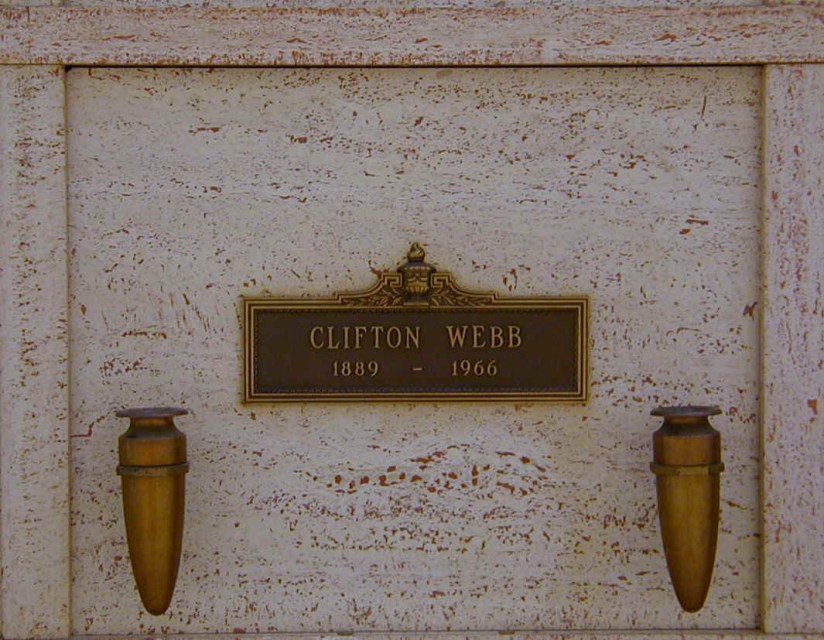
Clifton Webb died of a heart attack on October  13, 1966 at the age of 76. He was awarded his own star on the Hollywood walk of fame. It’s located at 6840 Hollywood Blvd. He was interred in a burial vault at Hollywood Forever Cemetery. His is crypt 2350, Corridor G-6 in the Abbey of Psalms. Why so much detail about Webb’s burial spot? Because it’s rumored to be haunted by Webb himself.

Rarely will you find accounts of ghosts “haunting” their gravesites, but Clifton Webb is the exception to this general rule. Clifton Webb’s restless spirit has been seen haunting the crypt in the section known as “The Sanctuary of Peace” where his mortal remains were laid to rest. Mr. Webb is always seen fastidiously dressed in his dapper suit and sometimes has been known to startle visitors by yelling at them in his distinctive voice. There are even a few accounts of Mr. Webb haunting his old house at 1005 Rexford Drive in Beverly Hills before it was torn down many years ago. It has been claimed that the reason for his haunting is his reluctance to relinquish his fame and the fear that his legacy might be forgotten. The precursor for these ghostly visits by Webb in his burial vaults is the unnerving sound of the marble slab that covers the opening shifting back and forth.

Clifton_Webb1I can tell you from first hand experience, this slab does indeed move to and fro within the slot that covers the burial cavity. I had heard these legends and visited the Hollywood Forever cemetery 9 years ago to test the theory. I will tell you that it’s an eerie feeling and an even stranger sound. If I were alone in that vault and heard that sound without explanation as to whom or what was causing it, I would not stick around to see if it was my famous fellow Hoosier, Clifton Webb!