Pop Culture

Plunk Your Magic Twanger Froggy!

6260-2      Original publish date:  February 22, 2016

To say that my dad’s sense of humor was dry would be like saying water is wet. Every Saturday morning for a half dozen years or so, I met my dad at Pleasant Run golf course for 18 holes of golf. Robert Eugene Hunter was an Arsenal Technical Graduate and all-city center on the Tech Titans football team in the early 1950s. 1954 maybe? I’m surprised I can’t remember the year date because he never lost an opportunity to tell me all about. Now that I’m older and a parent myself, I know that dad’s do that sort of thing. Seems he was always getting things wrong: tv & movie titles, people and place names, year dates, directions. After awhile, I learned to tune most of that stuff out. He died in 1997.
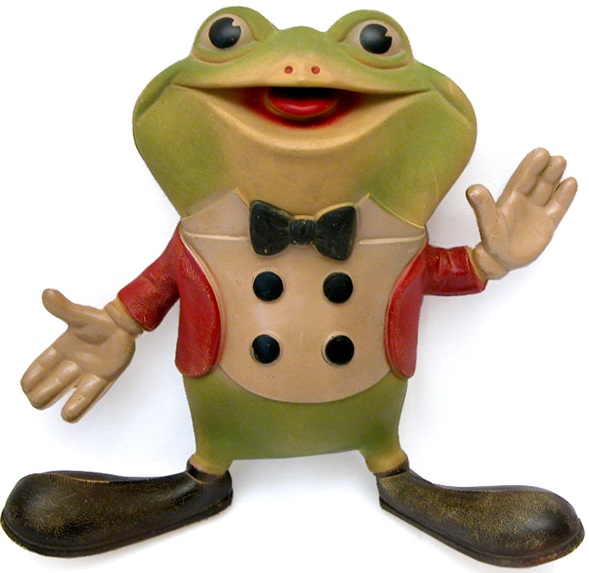
Last week, my wife and I were out searching an antique mall on a cabin fever diversion when we came upon something that looked very familiar to me. It was a little 6″ tall soft rubber frog in a waist coat and bow tie posed with his arms outstretched and his mouth agape. I turned it over and saw that it was dated 1948 and made by the Rempel rubber company out of Akron, Ohio. It also had the trademark of J. Ed McDonnell on the back. I held it up turned to my wife and exclaimed, “Hey Rhonda, its froggy!”
During those Saturday golf outings, whenever I made an extraordinary shot (which was in my opinion more often than not wink, wink) my dad would yell out “Plunk yer magic twanger froggy”. I recall once, while hitting my second fairway shot on the par 4 hole number 4, I hit the metal guardrail that runs alongside Arlington Avenue on the fly and the ball miraculously back towards the green about a foot from the hole. Sure enough, dad yelled out that line and I finally asked him what the heck he was talking about.
Just so happens, we were stacked up on the hole 5 tee waiting for the fairway to clear, so he explained what the saying meant. He told me that it was a line uttered on the “Smilin’ Ed’s show” children’s radio (and later TV) show by a character named “Froggy the Gremlin.” Dad said Froggy was terrifying. “He would appear in a puff of smoke, and grumble in a low, gravely voice, ‘Hiya kids, Hiya! Hiya! Hiya!'” Apparently Froggy was a trouble-maker with no respect for adults known for pulling pranks, practical jokes and generally disrupting the show and presentations of other guests. Dad said that Smilin’ Ed would always call out “Plunk your magic twanger, Froggy” to make him appear.
I really hadn’t thought much about those days until I found Froggy in that antique mall. Although I often found myself using the expression whenever I thought it appropriate to do so, which always elicited quizzical looks from my wife and kids. Knowing my dad’s penchant for getting things wrong, I went home and googled Froggy the Gremlin and was astonished to find that my dad’s recollection was bang on.
According to Wikipedia, “Froggy the Gremlin was a character created by Smilin’ Ed McConnell and brought to radio in the 1940s and television in 1950s on the Smilin’ Ed’s Gang show. Froggy was a troublemaker. Disrespectful of adult authority figures, Froggy played practical jokes and disrupted the presentations of other guests. If a guest were to demonstrate how to paint a wall, they might say, “And now I’m going to take this can of paint…” Froggy would chime in, “And dump it over my head.” And the confused guest would proceed to do so. On radio and the early TV shows, Froggy’s voice was frequently supplied by Arch (“Archie”) Presby, who was also the program’s announcer.”
Smilin’ Ed was born James McConnell in Atlanta, Georgia in 1882. The son of a minister, McConnell began to sing at age three and soon learned how to play drums and the piano before he started school. He was an athletic teenager and later became a professional boxer before enlisting in the US Army during World War I. According to an NBC press release, “A troop train on which he was traveling was wrecked in Arkansas by a German sympathizer and Ed wound up in a river. When he was pulled out, an Army surgeon pronounced him dead, but a buddy finally revived Ed with artificial respiration.”
After leaving the Army, McConnell was a barnstorming gospel singer and sometime evangelist. He got his big break on an Atlanta radio station in 1922 when the scheduled performer failed to show up. He married in 1928, and four years later joined the CBS network. In 1936, McConnell starred on the Acme Sunshine Melodies radio show on WMAQ in Chicago. The Sunday afternoon program was sponsored by Acme White Lead and Color Works. In 1937, he moved to NBC as their “Sunshine Melody Man,” offering hymns and uplifting messages in his rich, distinctive baritone voice.
But McDonnell’s biggest break came in 1944 when he invented Froggy and became known as “Smilin’ Ed” and hooked Buster Brown shoes as his title sponsor. By 1948, 145 ABC stations were subscribing to his “Smilin’ Ed’s Buster Brown Gang” program. Smilin’ Ed’s humor, songs, and music transformed Buster Brown from a dated comic strip character into one of the most widely recognized advertising mascots in the country. The show aired on NBC radio every Saturday morning at 11:30 through April 11, 1953.
The show opened with an adventure story and was peppered throughout by ads for Buster Brown shoes. In between songs and stories, Froggy would magically appear, laughing, hopping from side to side, to sing a song in his low, gruff, Popeye-like croak or annoy regular guests like Shortfellow the Poet or Alkali Pete the Cowboy.
A character named Midnight the Cat spoke a few lines every show and Smilin’ Ed would sing a novelty song or two. Midnight was voiced by the legendary June Foray whose name might not ring a bell, but the characters she supplied voices for surely do. They include Rocket J. Squirrel, Natasha Fatale and Sweet Nell (Bullwinkle & Friends), Cindy Lou Who (The Grinch), Betty Rubble (Flintstones), Jokey Smurf, Granny (Tweety Bird) and the voice of Mattel’s original Chatty Cathy doll. Smilin’ Ed not only promoted Buster Brown shoes but also the comic books that featured little storie involving the “Buster Brown Gang” of Midnight, Squeaky and Froggy.
In 1950, Smilin’ Ed brought Froggy and the whole gang to television in shows that were some of the earliest to be filmed in color. He cut the mold for a long line of children’s television’s jolly fat men to follow; six feet tall and weighing over 250 pounds. Smilin’ Ed McConnell died of a heart attack on July 23, 1954 at Newport Beach, California. King of the cowboys Roy Rogers’ sidekick Andy Devine took over the show. Ironically it is “Andy’s Gang” that most people now remember.
But who was Froggy the Gremlin? Was he a ghost, a creature from outer space, a leprechaun or maybe a short human with an oversized frog’s head? He was dressed in a smart looking red jacket, white shirt and black tie, but he wore no pants. Was he a frog that became a gremlin? A gremlin that had become a frog? And where exactly was his “twanger” and how did he “plunk” it? Nobody really knew much about the magical, mysterious Froggy the Gremlin, but he managed to make my dad shudder a full generation after he left the air. So, Plunk Your Magic Twanger, Froggy and rock on!
food, Pop Culture

Piggly Wiggly.

676030070cd7dd24fd9fe2d2ab789ec2Original publish date:  November 15, 2017
It’s Thanksgiving week in Indianapolis and all over the Circle City, Hoosiers are heading to grocery stores to buy turkey and all the trimmings. No doubt families will be bouncing words back-and-forth to each other off their big screen TVs with belts loosened and feet propped up on recliner footrests all over town. The TV will most likely be tuned to either the news or to football. This holiday, I decided to write about an eccentric American businessman who covers both subjects. Clarence Saunders, the man who brought us the Piggly Wiggly grocery store chain, might be the most interesting man you’ve never heard of.
Clarence Saunders was born on August 9, 1881 to an impoverished family in Amherst County Virginia. An area located inside the birthplace triangle of Jack Daniels, the Confederacy, and Thomas Jefferson. Saunders would absorb the ideas of that region: the good, the bad, and the ugly. One of those ideas would change the world, another would banish him from the hall of immortals and the last would ruin him.
Saunders left school at 14 to clerk in a Clarksville, Tennessee grocery store. By the age of 19, he had graduated to salesman for a wholesale grocer. In 1902 he moved to Memphis where he formed a grocery wholesale cooperative. On September 6, 1916, Saunders launched the self-service revolution in the United States by opening the first self-service Piggly Wiggly store, at 79 Jefferson Street in Memphis, Tennessee. With its characteristic entrance turnstile, customers selected goods for themselves right off the shelves and paid in cash. Before the Piggly Wiggly, products were placed on shelves behind glass counters, dry goods were weighed out from large barrels by store employees and bills were settled with credit or barter arrangements. The concept of the “Self-Serving Store” was patented by Saunders in 1917.
Saunders’ simple plan revolutionized the idea of the common supermarket. His Piggly Wiggly store removed unnecessary clerks, created elaborate aisle displays and rearranged the store requiring customers to view all of the merchandise. Just like today, a shopper picked up a basket (though Piggly Wiggly’s were made of wood, not plastic) and went through the store to purchase everything. Ever wonder why bread, meat, milk and eggs are always in the BACK of the store? You can thank Clarence Saunders and Piggly Wiggly for adding those extra steps to your fit bits. And then, after customers walked to the back of the store to check off their shopping lists, the cash registers are located at the front of the store. Brilliant.
To say that Clarence Saunders was unconventional would be like saying water is wet. For the store’s openings, Saunders held a beauty contest that he advertised in local newspapers. At the door, Saunders shook hands and gave flowers and balloons to the children as they entered to the raucous sounds of a Dixieland band. Newspaper reporters posed as contest judges by awarding five and ten dollar gold coins to every woman, while supplies lasted. Saunders was quoted at that first store opening as saying, “One day Memphis shall be proud of Piggly Wiggly… And it shall be said by all men… That the Piggly Wigglies shall multiply and replenish the earth with more and cleaner things to eat.”
As for the name Piggly Wiggly, nobody knows for sure and Clarence Saunders never explained its origin. One story says that, while riding a train, he looked out his window and saw several little pigs struggling to get under a fence, which prompted him to think of the catchy name. Another explanation states that when Saunders was once asked why he had chosen such an unusual name, he slyly replied, ‘So people will ask that very question.’”
The store’s format was drastically different from its competitors but soon became the standard for the modern supermarket. By 1922, six years after opening the first store, Piggly Wiggly had grown into 1,200 stores in 29 states. Around this same time, Saunders began construction of a pink marble mansion in Memphis that could make Elvis Presley blush. Saunders franchised his concept and soon listed Piggly Wiggly on the New York Stock Exchange. It was heady air for a poor kid from the backwoods of Virginia. Though his model quickly took off, he wasn’t at the helm for very long.
Then, in early 1923, a group of franchised Piggly Wiggly stores in New York State failed. Merrill Lynch and other Wall Street speculators viewed the failure as an opportunity and attempted a hostile takeover on Piggly Wiggly stock. With a loan of $10 million from a number of Southern bankers, plus a bit of his own money, Saunders counteracted by buying a large amount of his company’s stock in hopes of driving up the price. He flamboyantly declared his intent in newspaper ads. Saunders bought Piggly Wiggly stock until he had orders for 196,000 of the 200,000 outstanding shares. The firm’s share price went from $39 in late 1922 to $124 by March 20, 1923. The New York Stock Exchange declared that Saunders had cornered the market and the price was ultimately driven back down. Saunders had to sell his stock at a loss, costing him $3 million and forcing him into bankruptcy. Saunders’ financial woes meant that he had no further association with his Piggly Wiggly brainchild.
Because of this financial reversal, Saunders was forced to sell his unfinished Memphis mansion, nicknamed the Pink Palace, to the city. It eventually became the city’s historical and natural history museum. Today, the Pink Palace includes a scale model of that first Piggly Wiggly store inside, complete with 2¢ packets of Kellogg’s Cornflakes and 8¢ cans of Campbell’s Soup.
Although no longer at the helm of Piggly Wiggly, Saunders wasn’t done redesigning the grocery store business. He went on to create a new grocery store chain, which he named the “Clarence Saunders Sole Owner of My Name Stores” chain in 1928. The chain, known by locals as “Sole Owner” stores, flourished. Within a year there were 675 stores operating with annual sales of $60 million in 1929. It was during this last year of the Roaring Twenties when Saunders saw perhaps his greatest opportunity slip through his hands.
In 1929, to promote his newest grocery venture, Saunders purchased a professional football team. The team practices must have been quite a sight with the team owner dressed in his business suit catching punts alongside his players on the gridiron. He named his new team “The Clarence Saunders Sole Owner of My Name Tigers”, but fans just called them “The Tigers.” In 1929, the National Football League was in its 10th year and consisted of 12 teams, including the Chicago Bears and Green Bay Packers. Although the NFL played a regular season capped by a championship game, they were also free to play teams outside of the league. These games earned the individual NFL teams much needed extra money.
The Tigers played a 12 game season with all but one game in Memphis. During the 1929 season, the Tigers played pro teams like the Nashvile O. Geny Greenies, St. Louis Trojans and Hominy Indians (who were all Native Americans from Oklahoma). One of the teams Saunders brought to Memphis was a team called the Notre Dame All Stars. The four players photographed on horseback were not part of Knute Rockne’s Notre Dame Fighting Irish, but it didn’t matter to Saunders, they added pizzazz to the game and made an eye catching promotional photo. Saunders used his newspaper grocery store ads to promote his football team. Newspaper stories about his team brought more attention to his grocery business.
In addition, Saunders lured two NFL teams to play in Memphis. The Chicago Bears were first to appear, followed by the World Champion Green Bay Packers. On November 23, Saunders hosted the Chicago Bears who were led by their Hall of Fame player/coach George Halas and superstar Red Grange. A crowd of 6,500 crammed into Hodges stadium to watch the game. At one point in the third quarter, the Tigers closed to within 1 point, but the Bears scored three touchdowns in the fourth quarter to win 39-19.
On December 15, the week after the NFL season ended, the Green Bay Packers, undefeated NFL champions, came to town for what they expected to be an easy exhibition game. After all, opponents had scored only three touchdowns against the Pack all season. The 12-0-1 Packers were led by their Hall of Fame player/coach Curly Lambeau, Johnny “Blood” McNally, Cal Hubbard, and Mike Michalske. 8000 fans jammed Hodges stadium and the sidelines. The Memphis fans watched the Tigers manhandle the Packers with a 20 -0 lead going into the fourth quarter. The Packers avoided total humiliation by scoring in the final minutes but were shocked by a 20-6 loss.
Saunders’ Tigers were no slackers. The team included many players who had some prior success on college teams. He increased the talent level with Larry Bettencourt and Ken Strong both members of the College Football Hall of Fame. The next year the NFL extended an invitation to Saunders to join the league. Saunders, a brilliant but highly eccentric micromanager, insisted that all team decisions pass through him even though the team had a business manager and a coach. One of the decisions included putting his oldest son into one of the games during the 1929 season. Legend states that Saunders didn’t join the NFL because he did not like to travel to other cities for away games.
Saunders promised an even better season for 1930. However the Sole Owner chain went into bankruptcy in 1930, a victim of The Great Depression and the football team folded. Conversely, Piggly Wiggly rolled on and by 1932, the chain had grown to 2,660 stores earning over $180 million annually. Today the Green Bay Packers are worth over $ 2 billion and the Bears are worth $ 1.5 billion. However, Grocery Store innovator and would be NFL-owner Clarence Saunders was not done yet.
In 1937 Saunders designed and constructed a prototype of a fully automated store he called the “Keedoozle” (pronounced “Key Does All”). His automated store’s design contained very large vending machines with merchandise displayed as single units within a glass cabinet with a keyhole beneath. Customers entering the store were given a small pistol-like key that they placed in the keyhole below the goods they wished to buy. The quantity desired was determined by the number of times they pulled the key’s trigger. This action, recorded on punched tape, activated back office machinery to assemble the order, which was then dispatched to the checkout on a conveyor belt. On reaching the checkout, the customer’s tape was run through a reader to produce the bill, their groceries were boxed and waiting. This system eliminated the need for shopping carts, decreased space requirements, reduced labor needed to stock shelves, and cut customers’ time at checkout.
Saunders Keedoozle was abandoned after the US entered World War II. In 1948, a new and improved version of the self service store opened at twelve locations but the Keedoozle closed forever in 1949. Right up until the time of his death on September 23, 1953, Saunders was developing plans for another automatic store system called the “Foodelectric.” The concept is a clear predecessor to today’s self checkout lanes. Saunders described it as follows: “The store operates so automatically that the customer can collect her groceries herself, wrap them and act as her own cashier. It eliminates the checkout crush, cuts overhead expenses and enables a small staff to handle a tremendous volume… I can handle a $2 million volume with only eight employees.” The store, which was to be located two blocks from the first Piggly Wiggly store in downtown Memphis, never opened.
Saunders had a reputation for brilliance, contrariness, and eccentricity. His death came just as the full impact of his “better idea” for grocery merchandising was becoming apparent; his creative genius was decades ahead of his time. However, his innovations were not only limited to grocery stores and football. Although Saunders never ran for public office, he was one of the first to use his position as a business owner to campaign for a political candidate. He stumped for Tennessee candidates through his grocery store’s newspaper ads. His ads swayed Tennessee Senatorial and Gubernatorial campaigns for at least 4 cycles in the 1920-30s Era.
One last innovation goes mostly uncredited and is often misidentified. It is the Piggy Wiggly logo. For generations, people wondered why Warner Brothers never sued Piggly Wiggly for their logo. After all, it seems to be an obvious rip-off of Porky Pig. Well, truth is, Piggly Wiggly opened their first store in 1916, and they have used their anthropomorphic pig with a sales cap logo right from the beginning. Porky Pig wasn’t drawn till 1935.
Clarence Saunders’ Piggly Wiggly Self-serve grocery store concept saved shoppers time, money and made the trip to the grocery more enjoyable for generations to come. Today, according to its website, the Piggly Wiggly chain has more than 530 stores serving 17 states. Its founding is one of the stranger stories in the history of retail. And its founder, Clarence Saunders, was clearly something out of the ordinary.

Baseball, Indianapolis, Weekly Column

The Day Babe Ruth Came To Indianapolis.

Babe Ruth - Older  Original publish date:        August 24, 2015

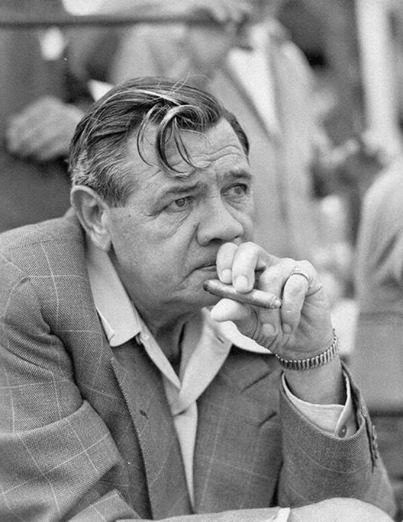
All through the summer of 1946, the mighty Babe Ruth had a severe pain over his left eye that would not go away. At first he thought it was a sinus infection, then a toothache. Whatever it was, it wasn’t getting any better. It eventually caused so much pain that Ruth admitted himself to a New York hospital on November 26. By then the entire left side of his face was swollen, his left eye closed shut, and he couldn’t eat solid food. Doctors removed three bad teeth, then pumped the Bambino full of penicillin and other drugs. By Christmas, Ruth was still in pain and back in the hospital.
Babe Ruth had cancer but the doctors never told him. They had discovered a malignant growth wrapped like a vine around a major artery in the left side of his neck. In the operation that followed, nerves were cut and the artery tied off. Not all of the cancer could be removed. Babe’s wife Claire said she was eventually told, but Babe remained in the dark until the very end. The surgery was on January 5, 1947. In the month that followed, Babe remained confined to the hospital in a state of near constant pain and depression. His hair began to fall out and he lost a lot of weight (estimated at between 80 to 128 pounds). It seemed that the Babe was just waiting to die.
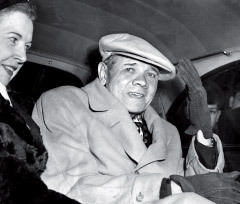
Thousands of telegrams poured in every week from former teammates , sports luminaries (Connie Mack and Jack Dempsey among them), and average everyday fans. Claire read as many of letters as she could out loud to the Babe. On February 6 he celebrated his 52nd birthday in the hospital with Claire, Julia, and their dog, Pal. On February 15, Ruth left the hospital and wept unashamedly as he saw the throngs of admirers gathered outside as he was led to a waiting car. His natty camel’s hair overcoat and matching cap couldn’t hide the fact that Babe Ruth was a shadow of his former self.
Although weak and sickly, Ruth instinctively knew that he was back in the public eye. Extremely conscious of his debt to the “kids of America,” to whose loyal support he attributed his success, Ruth decided to apply himself to child welfare programs after his discharge from the hospital. He was engaged by the Ford Motor Company as a consultant in connection with its participation in the American Legion junior baseball program. In May, 1947, he established and made the first contribution to the Babe Ruth Foundation. Inc., an organization whose name soon became synonymous with youth baseball.
The ravages of his illness left little of Ruth’s once robust physique. The Babe now appeared gaunt, bent and vulnerable. His once resonant voice reduced to only a rasping whisper. The Mighty Ruth continued to astound his physicians by tackling his new job with all his old-time vigor. “They call me a consultant,” said Ruth, “but I want to tell you that I plan to work hard at this job-just as hard as my health permits. The possibilities are unlimited and I won’t be happy until we have every boy in America between the ages of 6 and 16 wearing a glove and swinging a bat.” He logged more then 50,000 miles in support of the program, appearing on diamonds all over the USA in front of thousands of youths.
Treatment with an experimental drug beginning in late June improved Ruth’s health tremendously. Throughout that summer of 1947 Ruth became the official ambassador of the American Legion baseball program. One of his stops while on the “American Legion Goodwill Tour” that summer was at the original Victory Field home of the Indianapolis Indians on 16th Street. Ruth appeared at the August 5, 1947 American Legion Junior All-Star game. The Sultan of Swat appeared on the field, shook hands with players and coaches and posed with local youngsters. He signed autographs for the fans and each All-Star player received an autographed baseball from Ruth. Two of the players in that game were future big leaguers Don Zimmer and Jim Frey representing the Robert E. Bentley Post # 50 out of Cincinnati.
The Indianapolis news reported: “Ruth thrilled the crowd when he was introduced during the intermission between the Legion game and the Indianapolis Indians’ game with Milwaukee. Ruth sat through the Legion game and several innings of the Indians game, but his ill health began to take its toll and he had to leave. Earlier in the day, he conducted an hour-long press conference, a pair of radio broadcasts and attended a luncheon in his honor. Once a hefty 278 pounds, Ruth’s weight had dropped to 193. He was coming off an illness that almost cost him his life and had just undergone a blood transfusion three days prior.”
The news spoke to one of the kids after the game about meeting the Babe, “His voice was deep and raspy, he coughed quite a bit, but it was the thrill of a lifetime.” said the unnamed player. The young athlete was surprised to see the once robust Ruth in such failing health, but impressed that he would spend time with them. Babe Ruth breezed through Indianapolis like an aging movie star unveiling their star on the Hollywood walk-of-fame. He was gone as fast as he came. It would be nearly 40 years after Ruth’s visit before my dad, Robert E. Hunter Arsenal Tech class of 1954, sat beside me at old Victory Field and dreamily stated, “You know I was here when Babe Ruth came through in 1947. I was selling peanuts here in the grandstands.” Strangely, he could rattle off the names of all those Pittsburgh Pirates minor league players on that team but couldn’t recall much about the Babe’s visit that day.
Ford renewed Ruth’s contract in early 1948, “not only because he was an inspiration to every American boy but because of the excellent results of his efforts last season.” The ex-slugger’s salary was not revealed but Ford announced that it “ranks him high on the list of baseball’s top money-earners.” As long as his strength permitted, Ruth continued to make appearances on behalf of the Junior Baseball program. It was to be only a momentary reprieve. At his last appearance in June 1948, before 16,000 youngsters in St. Louis, he was too weak to wave a bat for photographers.
The remaining piece of the tumor was growing, and soon morphine was the only thing that could stop the discomfort. Babe still tried to live his normal life of golf outings and devouring steaks, but now the drives fell far short off the tee and the meat had to be served chopped up for him. Soon even biting down on the white of an egg caused excruciating pain for the once mighty “Sultan of Swat.” Despite the pain, Babe wrote in the closing of his autobiography “The Babe Ruth Story” that hopeful summer of 1947: “I’ve got to stick around a long, long time. For above everything else, I want to be a part of and help the development of the greatest game God ever saw fit to let men invent-Baseball.”
Ruth bravely attended the Dodgers-Yankees World Series that fall and in December dressed up as Santa Claus to entertain young polio victims. Babe may not have known or wanted to believe it, but his own time was growing short. On July 26, the Ruth’s went to the New York City premiere of “The Babe Ruth Story”, but as his daughter Julia Ruth Stevens recalled, “he was so sick and so medicated that I’m not even sure he knew where he was.”
Babe Ruth -Babe and Claire left shortly after the picture started and checked into Memorial Hospital for the last time. Babe Ruth struggled to answer letters and meet with visitors right up until August 15, 1948, barely a year after he graced the diamond of Victory Field in Indianapolis. Babe Ruth died in his sleep at 8:01 p.m. on the evening of on Aug. 16,1948. His last conscious act was to autograph a copy of his autobiography for one of his nurses. It was only after the great man’s death that the newspapers announced the cause of death as “throat cancer”.
A long line of mourners encircled Yankee Stadium to pay their respects as Ruth’s body lay in state. During the next two-days, more than 100,000 passed his open casket inside the ballpark. They were men, women, and children of all races and ages; from uniformed Little Leaguers to old men in derby hats. The crowd of worshipful mourners rivaled only the display of grief for President Franklin D. Roosevelt in 1945. Vendors sold hot dogs and photographs of the Babe to those waiting their turn in line. As crass as that might sound, the Babe would have loved it.

Health & Medicine

Robert Rayford America’s First Aids Victim.

AIDS hiv-ribbonOriginal publish date:  May 12, 2014

45 years ago this week, May 16,1969, the face of modern medicine changed forever when 15-year-old Robert Rayford, sometimes identified as “Robert R.” due to his age, died in a St. Louis, Missouri hospital. He was a slender, uncommunicative street kid whose condition left doctors distressed, perplexed and…scared. Although no-one knew it at the time, Robert R’s was the earliest confirmed case of HIV/AIDS in North America. Rayford’s death was a mystery to doctors, who could not account for his symptoms. The true cause of his death remained unidentified until 1987.
Like the disease itself, this young man’s story is one of tragedy. He spent all fifteen or sixteen years of his life (some sources list his birth date as February 3, 1953 but no one knows for sure) in a poor African American ghetto in St. Louis. Of his enigmatic life, little else is known. Described by medical personnel as being “mildly retarded”, Bobby Rayford first checked himself into Barnes Hospital in St. Louis in the early Spring of 1968. His doctors were baffled by his symptoms. His swollen loins were covered with open, infected sores. He struggled while breathing, was razor thin and pale as a ghost.
Doctors suspected some form of cancer at first, but subsequent tests revealed the patient had herpes, genital warts, and a severe case of chlamydia. The infection spread, in the form of purple colored lesions, to his legs, causing a misdiagnosis of lymphedema, an infection of the lymph nodes. He said that he had been suffering from these symptoms for at least two years, or since he was about thirteen years old. When doctors suggested a routine rectal exam, Rayford steadfastly refused. The doctors, like most of America at that time, did not think to ask about homosexual contact. It wasn’t until later that the doctors noted in Robert’s medical charts that that he was likely gay and speculated that the young man refused the exam for fear of confirmational “evidence” being found therein.
When asked about his sexual history, Rayford became dodgy, at first calling himself “the stud of all time” and later claiming absolute celibacy. Still later he claimed to have had sex just once, “with a neighborhood girl,” and that he started to feel sick shortly after that encounter. Strangely, although doctors suspected that Robert was highly promiscuous, they never considered the possibility that he had been molested. All moral judgments aside, clinicians were helpless as they watched the teenager slowly waste away before their eyes from a disease they were unable to diagnose and powerless to treat. During his first months in the hospital, doctors tried everything they could think of to stop the spread of this mysterious malady. They cut back on his water and salt intake, administered drugs to promote water loss, wrapped and elevated his legs, all intended to reduce the swelling. Nothing worked, and the inflammation moved up his body and into his lungs. Finally they tried powerful antibiotics and were cheered in late 1968 when Rayford’s condition seemed to be stabilizing.
By March 1969 the patient’s symptoms returned with a vengeance and his condition steadily deteriorated. He had increased difficulty breathing, and his white blood cell count plummeted. The doctors determined that his immune system was shutting down. By all accounts, this uneducated street kid maintained his dignity in the face of inevitable demise. In the words of Dr. Memory Elvin-Lewis, who attended to him during his final days, “He barely said ‘boo.’ Finally, he developed a raging fever and at 11:20 pm on May 15, 1969 Robert Rayford died, never knowing of his place his history.
For lack of a more precise diagnosis, Robert’s death was attributed to loss of vitality, intractable fluid imbalance and lung disease. An autopsy revealed numerous other problems, including evidence of a rarely seen cancer called Kaposi’s Sarcoma. In this case, “KS” manifested itself in the form of small purplish lesions discovered on Rayford’s left thigh and within his soft tissue. Doctors concluded that the lesions were Kaposi’s sarcoma, a rare type of cancer most often found in elderly men of Mediterranean or Ashkenazi Jewish ancestry. Today KS is taken as almost certain proof of AIDS, but in 1969, its significance was not understood.
For the next 18 years, doctors and researchers continued to search for a solution to the mystery of Bobby Rayford. So mystified were they that they saved samples of Robert’s tissues and blood for nearly two decades, hoping that future advances in medical science and technology would help them solve this puzzle. Finally in October of 1987 , the riddle of Robert R.’s illness was solved, and the answer was nothing short of astonishing. New tests of the dead boy’s preserved blood, brain and organ tissue samples led to a grim conclusion: Robert R. almost certainly died of AIDS, making his the earliest case of the killer disease ever discovered in the United States.
However, as you may imagine, Bobby Rayford’s most awful claim to fame is not without controversy. Although a review of the case was eventually published in the medical journal “Lymphology” in 1973, many believe that the perceived immorality of the disease’s alleged contraction stifled the search for a cause, treatment and a cure. After the autopsy, blood and tissue samples were kept in cold storage at the University of Arizona but after the October 1987 revelation there was no further follow-up, in part because the samples disappeared.
Robert R’s case is the classic chicken or the egg argument. After all, his illness had to come from somewhere. Rayford said he never traveled outside the Midwest and had never received a blood transfusion. Since doctors concluded that Rayford’s AIDS infection was contracted through sexual contact, it must be presumed that AIDS was present in the US before Rayford’s symptoms arose in 1966. Rayford told doctors he had never visited big cities such as New York, Los Angeles, or San Francisco, where the HIV-AIDS epidemic was first observed in the United States. The commonly accepted trajectory of HIV / Aids epidemic is Africa to Haiti to US to Europe and finally to the rest of the Americas. But Robert never left the region, much less the country.
Doctors, investigating the case in the early 1980s, speculated that Rayford may have been a male prostitute. That assumption was made when the medical community believed the progression from initial infection to the diagnosis of AIDS took only two and a half years. Ironically, researchers believe that it was precisely because the St. Louis gay population was small in number by comparison that enabled the Bobby Rayford strain of HIV / Aids to die out. Therefore, St. Louis did not become a hotbed of Aids activity.
The saddest aspect of this entire story is that all of this happened before anyone had ever heard the term “AIDS” (which stands for “Acquired Immunodeficiency Syndrome” by the way). Robert Rayford has been described variously by history as mildly retarded, sexually promiscuous or as a male prostitute. I have yet to find any account, and believe me I have read many, that calls him a man. In his case, the medical community is operating under the same social mores society was slogging through in the Nixon years. Modern day scientists have found the same telltale “KS” evidence in African children as young as three years old. If we accept this scientific fact, could it be possible that Robert R. was born with it, rather than contracting it through nefarious means?
In one of his rare communicative moments, Rayford told the doctors that his grandfather “had the same symptoms.” This might suggest a congenital “immunodeficiency”, and that other factors may have exacerbated this problem rather than caused his illness and eventual death. So even if Robert were lying about his sexual history, there is little else to suggest that he contracted his KS lesions from gay sex. Instead, based on his statement about his grandfather’s similar symptoms, Robert’s lesions may well have developed from the inside outward.
There is one final theory about this first Aids case in America that I will put forth for all of those who love to sink their teeth into a good conspiracy theory. In the book “The River” a theory is advanced that Robert became vulnerable to the illnesses during the 1950’s when the Army Chemical Corps conducted open-air chemical warfare tests in American cities. These included thirty-five aerosol releases in and around St. Louis. Most of those tests were conducted in low-income neighborhoods, allegedly to minimize public resistance to such tests. One of those test areas was only half a block from the house in which Robert was born. These tests, conducted at the height of the Cold War, were explained away to local officials as being simple smoke screen experiments designed to shield US cities in the event of a Soviet attack.
Decades later it was revealed that those tests involved zinc cadmium sulfide, a mixture of zinc sulfide and cadmium sulfide. It’s frequently referred to as a fluorescent particle because it glows in ultraviolet light. This quality makes it easy to trace for efficacy after the fact. However, cadmium is a highly toxic metal that is even more pernicious when spread through the air. Because the kidneys absorb it quickly, it is commonly associated with kidney failure, leads to cirrhosis of the liver and causes severe damage to the lungs and body cavities. All of these conditions were noted in Robert R’s report. Also, the effects can be passed by a mother to her fetus, so it’s entirely possible that Robert may have developed the seeds of his illness while still in the womb.
We’ll most likely never know the whole truth about the death of Robert Rayford. In part because we weren’t looking for the answers in the Aids context we’re so familiar with today. We are content to label him as the first victim of a terrible epidemic that ran unchecked through our nation during the Moral Majority driven Reagan Revolution. Most of the knowledge gained about Aids in the two decades between Robert Rayford’s death and ultimate diagnosis came from research and development, not from doctors and hospitals, but from the victims themselves. We Americans owe a great debt of gratitude for our understanding of this dread disease to those who have suffered, and often died, while searching for a cure. Robert Rayford, a mere medical footnote in history, among them.

candy, Pop Culture

Bubble Yum, Spider Eggs and Leonardo DiCaprio.

leonardo-dicaprio-bubble yum spiderOriginal publish date:  September 12, 2016

I began working on this article Sunday night. It was the 15th anniversary of 9/11 and I’d been watching stories about our shared national tragedy all day long. While cloaked in that veil of sadness I realized my article deadline was already 3 days past and I couldn’t think of anything to write about. I needed a smile. So I thought I’d try and dig up something that was borderline nonsense, certainly not news, but might just make you smile.
40 years ago, Bubble Yum officially made it’s Hoosier debut. Some websites claim it came out in 1975, but 1976 is the first year I recall being able to buy it in Indianapolis, so I’m going with that. Just in case you forgot, Bubble Yum (created by LifeSavers) was the very first soft bubble gum ever created. It was an instant hit and sales quickly shot through the roof. Before 1976, bubble gum was hard and often took jaws of steel to work it into bubble-blowing shape. Before 1976, we didn’t question the laws of the gum universe. Bazooka, Wrigley’s, Fruit Stripe, Dubble Bubble, Dentyne, Chiclets, Beechies, Trident, Razzles, Juicy Fruit, Joe Blo, Topps baseball card gum; we didn’t care, we just chewed away in blissful ignorance.
What is bubble gum, how does it work and how the heck did it ever catch on? Well, the bubble part should be pretty self explanatory. The gum base is what gives it that bounce-back texture that makes it fun to chew. Gum base often contains polyethylene, a long molecule that’s also used to make plastic bottles and plastic bags. As you can imagine, each company keeps their special recipe a secret. What we do know is that all gum bases are made of three main ingredients : Resin is the main substance you chew, wax softens the gum and Elastomer adds flexibility. Elastomer is a big fancy word for “rubber”.
Don’t let those three ingredients scare you, despite what you might’ve been told growing up, if you swallow a piece of gum it’s highly unlikely to end up stuck in your stomach for seven years. Even though gum base is indigestible, it passes through the digestive system harmlessly and is eliminated from the body alongside other foods.
The best chewing gum brands infuse sweetener and flavoring into the gum base so that the flavor is released more slowly. As you chew, the sweetener and flavoring dissolve in your saliva and spreads over your tongue. Eventually most of the sweetener and flavoring disappear and the flavor fades away. Gum base does not dissolve in saliva, so you lose the flavor, but not the gum. But why do we chew gum? Bubble gum satisfies the natural human impulse to chew. Some people chew to relieve stress, others to combat bad breath or aid digestion, but most do it just because they enjoy the taste.
Northern Europeans were chewing birch bark tar 9,000 years ago, not only for enjoyment but also for medicinal purposes and to relieve toothaches. The ancient Maya chewed sap from the sapodilla tree, a substance called chicle, as a way to quench thirst or fight hunger. The Aztecs also chewed chicle but only kids and single women were allowed to chew it in public. Married women and widows could chew it privately to freshen their breath, while men could chew it in secret to clean their teeth. In North America, the Indians chewed spruce tree resin and passed the habit along to the European settlers who followed.
Bubble Yum represented a real breakthrough, a gum that was ready for bubble blowing almost immediately after you popped it in your mouth. Each package contained five individually wrapped rectangular pieces of gum, each piece contains about 25 calories. At first, Bubble Yum was available in both the original variety and a luscious grape version. Both versions were a huge success right out of the gate, and naturally, they spawned more and more flavors over the years: Orange, Wild Cherry, Spearmint, Wild Strawberry, Sour Apple Berry, Rockin’ Rasberry, Yellin’ Melons, Bananaberry Split, Wet N’ Wild Watermelon, Hawaiian Fruit Punch, Cotton Candy, Checker Mint, Sour Cherry and Chocolate among others.
300 million packs were sold in its first 15 months on the market, so much that production couldn’t keep up with demand. Bubble Yum became an instant sensation. The standard pre-mastication routine among early Bubble Yum users was to squish a block of Bubble Yum between your fingers before chewing. Hey, in pre-microchip days, we had to take our fun wherever we could find it. “Why is it so chewy?” was the question of the day during that Bicentennial year. It didn’t take long for kids to invent a nefarious answer.
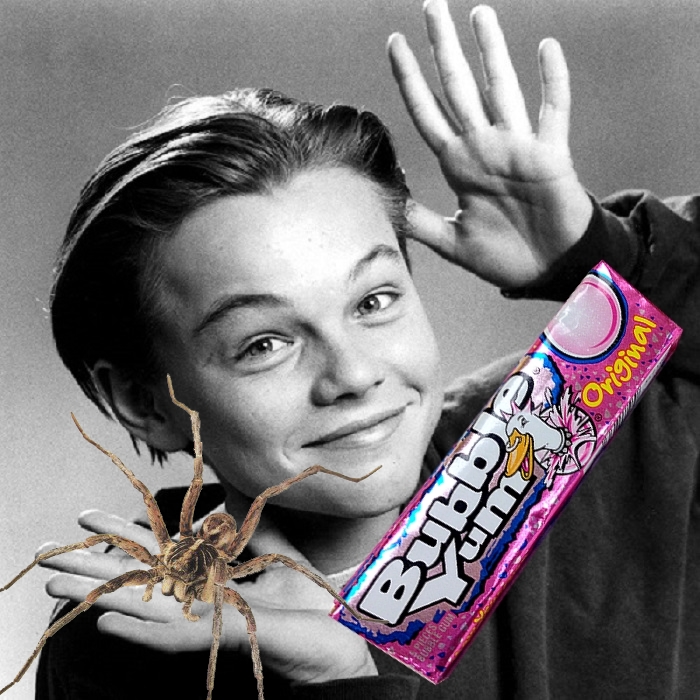
In the Spring of 1977, rumors began to spread that the gum’s soft, chewable secret was that the gum was made out of spider eggs. Soon, the urban legend was the viral topic in classrooms and playgrounds nationwide.

A less well-circulated rumor dating from the same period claimed that Bubble Yum also caused cancer. Tall tales about a girl waking up with webs all over her face or nine youngsters dying after swallowing the gum spread quickly among kids and were naturally taken as gospel. The fact that there were little granules of sugar that you could feel with your tongue didn’t help quell the rumors.
To combat the panic and halt the dive in Bubble Yum sales, the Life Savers Company embarked on a $100,000 advertising campaign of full-page rebuttal ads printed in prominent U.S. newspapers from coast-to-coast. Each ad began with the headline “Somebody is Telling Very Bad Lies About a Very Good Product.” Life Savers’ president William Mack Morris told People Magazine that, “Fighting the rumor was like punching air.”
Within 10 days of that first public whisper, company surveys showed that “well over half” of the children in the New York area had heard the rumor. It spread like wildfire from bus stop to lunchroom among schoolkids of all ages. Of course it wasn’t true. So despite quick efforts by the folks at Life Savers to dispel the myth, the story still took awhile to die. After all, it made for great sandlot conversation guaranteed to make any girl’s pigtails curl. Eventually, the story faded away and sales again began to soar. Bubble Yum sales soon surpassed the venerated Life Savers candy to become the most popular bubble gum brand on the market.
Although still a closely guarded corporate secret, speculation persists that Bubble Yum’s secret softening ingredient is lanolin, a waxy substance derived from sheep wool. While not necessarily dangerous to your health, chewing on lanolin does not exactly sound appetizing. Bubble Yum chose Floyd D. Duck, an anthropomorphic punk-style duck character, as their official mascot, which somehow doesn’t help subdue that unsavory image. Nabisco bought Life Savers in 1981, and The Hershey Company acquired the brand in 2000.
Bubble Yum quickly spawned other versions of soft bubble gum. By 1977, Bubblicious, made by Cadbury, hit store shelves, followed by Hubba Bubba in 1979, and Big League Chew in 1980. The era of soft bubble gum had arrived and we owe it all to Bubble Yum’s successful war against the imaginary reproductive habits of spiders through colorful urban legends. Today, soft & chewy gum is sold in a variety of shapes and flavors. Although, sadly, Willy Wonka’s three-course dinner chewing gum, said to taste like tomato soup, roast beef and blueberry pie, is unlikely to become a reality in our lifetime. Bubble Yum is not likely to disappear from store shelves anytime soon.
The United States is among the top three countries with the highest rates of chewing gum consumption worldwide. In the US, 59 percent of people chew gum, surpassed only by Iran (82 percent) and Saudi Arabia (79 percent). A primary reason why the Middle East has more gum chewers than the US is because chewing gum is often given out by merchants in place of small change. Seems like Bubble Yum’s appeal is not limited to our shores alone. Perhaps that is why an original first-generation unopened pack of Strawberry Stripe Bubble Yum from 1976 sold for $ 482 on eBay a few years ago. So check those telephone drawers, tackle boxes and catch-all bins, your pack-rat tendencies might actually pay off for a change.
One last tidbit from the way-back machine before I close. How many of you remember the Hollywood heart throb who started his career as a TV commercial pitchman for Bubble Yum? Today he’s a Hollywood A-lister and recent Oscar winner, but in 1988 Leonardo DiCaprio was a fresh-faced 14-year-old teenager pitchin’ Bubble Yum to the masses. Leo, then sporting a thick mop of blonde hair, wears a tie and checkered shirt as he blows pink bubbles for the camera. Little Leo dances to a giant Boom Box and touts “Big Mouth Bustin’ Bubble Yum” to a generation of teeny-boppers on the small screen. Those teeny-boppers undoubtedly have teeny-boppers of their own now. Google it and you’ll see, it’s worth a giggle.