ABA-American Basketball Association

Whatever Happened to John Brisker? Part I

john-brisker-part IIOriginal publish date:  January 25, 2016

I was an ABA fanatic when I was a kid. Of course, it didn’t hurt that I was growing up in the greatest basketball state in the nation and the hometown of the American Basketball Association’s greatest team. My parents did not necessarily share my rabid enthusiasm for the Pacers. Oh, they were fans but they simply didn’t feel the need to indulge me by buying tickets to every Pacers home game as I often begged them to do. Instead, they humored me by taking me down to the Indiana State Fairgrounds Coliseum about an hour before Pacers home games. Then they would drop me off near the player’s entrance where I would stand and get autographs of my heroes as they filtered in while they killed time with coffee and pie at the TeePee restaurant until tip-off.
During those years, I think I met every player from every team. Dr. J Julius Erving, Big Mac George McGinnis, The Rocket Rick Mount, The Beast Mel Daniels, Iceman George Gervin, Skywalker David Thompson, The Kangaroo Kid Billy Cunningham, Dr. Dunk Darnell Hillman, The Whopper Billy Paultz, Marvin Bad News Barnes, Little Louie Dampier, and Big Z Zelmo Beaty. They were always quick with a smile, friendly hello and quick autograph for a skinny little buck-toothed kid sporting a Hollywood Burr. Yep, that was me. I still have all of those signed cards and during this frigid Indiana winter, I took a walk through them the other night. My eyes filled with stars just like the old days. I stopped suddenly when I saw one signed card in particular: John Brisker.
John Brisker never played for the Pacers, but he first shot to prominence here as a rookie with the 1969-70 Pipers during a game where he replaced injured veteran Tom Washington in the line-up, scoring 42 points, while grabbing 12 rebounds. Brisker became one of the first true unknown talent discoveries ever made by the ABA. He was one of the Motor City Marauder imports from Detroit that included fellow ABA All-stars Mel Daniels, Spencer Haywood, Ralph Simpson and George Gervin. He too had a nickname: “the heavyweight champion of the ABA.” At 6’5″ and 210, he wasn’t the biggest guy in the league and he was certainly not the strongest, but he was the most feared.
Brisker enjoyed a short but stellar career at the University of Toledo. Well, stellar athletically at least. Brisker joined future NBA star Steve Mix to lead the 23-2 Rockets to the 1966-67 MAC championship. Although on scholarship, he remained academically ineligible for his first 3 years at TU. In the fall of 1966, he joined the Toledo marching band to raise his GPA so he could play basketball. He proved to be an A student and a pretty fair musician mastering the sousaphone, a scaled down tuba that fits around the body like Rambo’s bullet belt.
Brisker was drafted by the ABA Pittsburgh Condors, the league’s first champions. He was built like a linebacker with 40+ inch vertical leap and the shooting touch of a swingman, but played more like a power forward-bruising, tough, and even violent, at times. Brisker averaged 21 points per game as a rookie. By season two, he was up to 29 points a game. Whether it was shooting a 3-pointer or posting his man down low, Brisker could score at will. He could also rebound and defend when he wanted to, but make no mistake, Brisker was there to score. He established himself as a two-time All-Star, one of the best players in the early years of the ABA.
Brisker quickly earned a reputation as one of the most volatile players in the league, ejected from more games for fighting than any other player during those early years. According to his Condors teammate Charlie Williams, “He was an excellent player, but say something wrong to the guy and you had this feeling he would reach into his bag, take out a gun and shoot you.” Rather than shunning his bullying image, the Condors capitalized on Brisker’s reputation as an enforcer. Their 1970-71 media guide featured Brisker in a Mexican sombrero with a pair of six-shooters holstered to his hips. The Condors’ PR man, Fred Cranwell, got the idea based on Brisker’s routine of bringing a loaded gun with him to practice and games.
Brisker’s most infamous incident came during a game on December 5th 1971 against the Denver Rockets. He was ejected two minutes after tip-off for a vicious elbow on the Rockets’ (and former Pacer) Art Becker. Brisker was sent to the showers early but charged back onto the court after Becker three more times. Police finally ushered Brisker to the locker room for good under threat of arrest. After the game rumors swirled league-wide that the Dallas Chaparrals head coach put up a $500 bounty on Brisker. During that 1970-71 season, Brisker was involved in bloody fistfights on the court with Wendell Ladner of the Memphis Pros, Joe Caldwell of the Carolina Cougars, and Ron Boone of the Texas Chaparrals. The latter two fights requiring facial reconstructive surgery due to Brisker’s punishment.
His Pittsburgh teammate and roomie George Thompson once said everyone in the ABA had been terrified of him and Brisker cultivated that image. Brisker once racked up 56 points in a game without shooting a single free-throw. Guys were afraid to guard him, let alone foul him. Around the league, Brisker had a justified reputation for provoking fights and drawing blood. Early during the 1971-72 season, the Utah Stars visited the Condors at Pittsburgh’s Civic Arena. The Stars’ Willie Wise held Brisker to just four points in the first half. A frustrated Brisker scuffled with several Utah players, and tempers flared before the game was over. Brisker was held in check and thankfully no blood was spilled.
On November 4, 1971, the Condors visited Salt Lake City, and Stars’ management dreamed up “John Brisker Intimidation Night.” The Stars put pro boxer Ron Lyle on the cover (A heavyweight who fought Muhammad Ali for the title and was the only man to ever knock George Foreman down in the ring). The Stars added to the spectacle by lining the courtside with boxing stars both past and present including Lyle, Don and Gene Fullmer, Rex Layne, Tony Doyle and more. The ploy worked and Brisker behaved himself that night.
Even in a league defined by a multi-colored ball, 3-point shots and on court fist fights without suspensions or fines, Brisker’s transgressions stood out. One legend claims that Brisker’s teammates were so worried about guarding him during practice (particularly the day after a loss) that Pittsburgh Execs brought in a brawny ex-football player whose only job was to watch Brisker and flatten him the first time he got out of line. Reportedly, the practice was halted after the football player warned the surly Brisker that he was going to the locker room to get his gun. Brisker said he was fine with that, since that gave him time to go to his locker and get his gun.
Another story claims that immediately after the ABA All-Star game at Greensboro, North Carolina In 1971, Brisker walked up to league commissioner Jack Dolph and demanded his All-Star bonus right then and there. Brisker had scored 15 points and grabbed 17 rebounds in his team’s win. Knowing the fearsome reputation of the man standing before him, Dolph reached into his own wallet and paid Brisker $ 300 cash on the spot. By the next season, both men were out of the league.
Music, Pop Culture

Bruce Springsteen meets Elvis Presley. Well, sort of.

bornToRun            Original publish date:  May 8, 2016

A couple of weeks ago we passed another one of those anniversaries that always seem to fascinate me. My favorites are those events that involve history colliding with pop culture and celebrity. 16-year-old Bill Clinton photographed meeting John F. Kennedy at the White House, 6-year-old Teddy Roosevelt photographed watching the funeral cortege of Abraham Lincoln from the second story window of his family mansion in New York City, Elvis Presley photographed shaking hands with Richard Nixon in the Oval Office just before Christmas in 1970. I LOVE stuff like that!
There are no photos from this event, at least none that I’m aware of, but this story does have Elvis. In the wee hours of the morning on April 30, 1976, Bruce Springsteen jumped the fence at Elvis Presley’s estate. The E-Street Band was touring Memphis, Tennessee, the birthplace of Rock ‘n Roll, in support of their Born to Run album. After the show, 26-year-old Springsteen and guitarist Little Steven (aka Steve Van Zandt) hailed a taxicab and decided to pay a 3 a.m. visit to Graceland. When Springsteen saw lights on in the mansion, he climbed over the stone wall and ran through the grass, jumped up on the porch and rushed to the front door; just as he was about to ring the doorbell, he was nabbed by security.
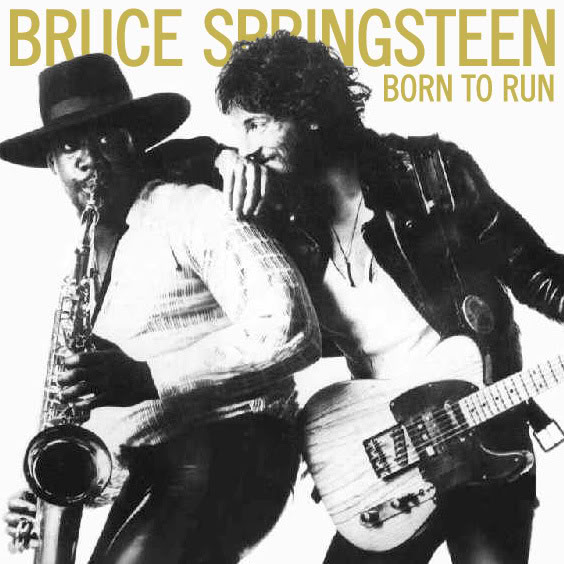
‘Is Elvis home?’ Springsteen asked. ‘No, Elvis isn’t home, he’s in Lake Tahoe’ came the answer from the unamused guards. As ‘The Boss’ was brusquely led away from the mansion and back towards the front gate, Springsteen attempted to wow them by telling them that he was himself a performer and had recently made the covers of Time and Newsweek. They were not impressed. Springsteen poured on the charm and begged to be let inside – but he was instead escorted promptly through the gate and out onto the sidewalk. Elvis died at Graceland the very next year. Ironically, if you look closely at the cover of Born to Run, Springsteen’s guitar strap proudly bears an Elvis fan club button.
Bruce Springsteen was seven when he first saw Elvis on The Ed Sullivan Show. It was The King’s third and final appearance on January 6, 1957. According to one reviewer: ‘On that Sunday night in 1957, Elvis smiled, smirked and played with the audience. Breaking from his usual attire, Presley came out wearing a bloused shirt and vest, with makeup painted around his eyes. That night Elvis sang hits like Don’t Be Cruel, Love Me Tender, and Hound Dog, shaking his hips and standing on his toes while girls screamed in the audience. And that guitar: it was a weapon and it was armor. This was the dream.’
Watching the show, Springsteen was hooked: ‘I couldn’t imagine anyone not wanting to be Elvis Presley’, he recalled. His mother eventually bought him a guitar and paid for private lessons, but young Brucey’s hands were too small. He didn’t like structured instruction so he put the guitar in the closet and started playing sports. Meantime, Elvis was on the way to stardom and legend.
Elvis purchased Graceland for his mom and dad on March 19, 1957 for the amount of $102,500. The 17,552 square foot mansion has a total of 23 rooms, including eight bedrooms and bathrooms. Located at 3764 Elvis Presley Boulevard, the 13.8-acre estate is located in the vast Whitehaven community about 9 miles from Downtown Memphis and less than four miles north of the Mississippi border.
During the years that Elvis lived at Graceland the front gate area was a gathering place for fans. After all, there was always the chance that he might drive through in one of his cars or on a motorcycle, or ride down on a golf cart or on horseback and have an impromptu autograph session. They could also watch him and his ‘Memphis Mafia’ friends ride their horses and golf carts around the grounds. Even when Elvis out of town, fans gathered at the gates and chatted up the security guards (some of whom were Elvis’ relatives) while meeting other fans from around the nation and the world at the same time. When Elvis was away, sometimes the guards would let fans onto the grounds for photos, sometimes even driving them up to the front of the house. There was always a sense of warmth, welcome and camaraderie. Many lifelong friendships between Elvis fans began at the Graceland gates.
However, it wasn’t all that uncommon for fans and curiosity-seekers to climb over the stone wall or wood fence on a dare or, more often, with the misguided mission to meet Elvis. The security staff not only routinely escorted uninvited guests off the grounds, they sometimes had to coax them down from the trees. Legend states that on one occasion Elvis caught a couple of mischievous young guys who had jumped the fence and were taking a swim. Elvis is said to have nonchalantly suggested that they be careful, then went back in the house. Once, a fan made his way into the house and was found sitting in the den waiting for Elvis, hoping to interest him in some songs he had written, but the meeting never happened. I imagine the songwriting intruder was busy being arrested. It certainly was a different world back then.
Anyone who’s attended a Bruce Springsteen concert knows that the Boss loves to share stories with his fans. His legendary 3-hour sets are littered with songs punctuated by long anecdotes, and there’s no story he loves telling more than the time he got booted from Elvis Presley’s front porch.

“Later on, I used to wonder what I would have said if I had knocked on the door and if Elvis had come to the door. Because it really wasn’t Elvis I was goin’ to see, but it was like he came along and whispered some dream in everybody’s ear and somehow we all dreamed it. And maybe that’s why we’re here tonight, I don’t know.’ Bruce continues,’ I remember later when a friend of mine called to tell me that he’d died. It was so hard to understand how somebody whose music came in and took away so many people’s loneliness and gave so many people a reason and a sense of all the possibilities of living could have in the end died so tragically. And I guess when you’re alone, you ain’t nothin’ but alone’. Presley was only forty-two years old when his life tragically ended. “They found him slumped up against the drain,” Bruce Springsteen would later sing of his fallen idol, “with a whole lot of trouble running through his veins; Bye-bye, Johnny;
Johnny, bye-bye; You didn’t have to die; you didn’t have to die.”

13 months later, on May 28, 1977, Springsteen and Van Zandt attended an Elvis Presley concert in Philadelphia. It was not one of Elvis’ better performances according to reviews and fan accounts, including Bruce’s own account, ”that wasn’t a very good night.” After that disastrous show, Bruce apparently went home and wrote ‘Fire’ to assuage his disappointment. Springsteen envisioned “Fire” as a song which could be recorded by Elvis, his idol. The song is a superb tribute to the great early sixties recordings Presley made, in particular Suspicion and His Latest Flame. Springsteen later stated ‘I sent Elvis a demo of it but he died August 16, 1977 before it arrived.’
After Elvis died Bruce gave the demo to rockabilly singer Robert Gordon, who cut it in New York in December 1977 with Link Wray on lead guitar and Bruce himself playing (un-credited-at-the-time) piano. Later, the Pointer Sisters got a hold of the track and recorded their version which made it to #2 on the pop charts in 1979. Don’t remember the song? Do these lyrics ring a bell? ‘I’m ridin’ in your car. You turn on the radio. You’re pullin’ me close. I just say no. I say I don’t like it. But you know I’m a liar. ‘Cause when we kiss Ooooh, fire.” My wife might disagree, but Elvis Presley would have killed with that song.

Music, Pop Culture

Buddy Holly’s Glasses: Lost and Found.

Buddy HollyOriginal publish date:  February 17, 2017

Leap years generally go unnoticed by everyone except those who were born on one. Leap years are recognized every four years in the month of February by tacking an extra day onto the end. To most, leap years are just another event in a month of neglected holidays. After all, when is the last day you celebrated Ground hog day? Or President’s day? To make matters worse, leap years land on Presidential election years which tend to shrink the calendar as it is. Nobody ever remembers leap years. However, one event from a leap year 37 years ago (this week) struck a chord from beyond Rock ‘n Roll eternity.
On February 29, 1980, a pair of glasses were found in a filing cabinet of the Cerro Gordo County Sheriff’s office in Mason City, Iowa. The glasses had a peculiar government issued appearance that looked oddly out of place for the Disco Era discovery. Today that style could be spotted in every office, college campus or corner coffee shop. The glasses were found in a manila envelope marked simply, “Charles Hardin Holley received April 7, 1959”. Along with the glasses, four dice, a cigarette lighter and a watch belonging to one Jiles Perry Richardson were also in the envelope. The lenses of the glasses were missing but the watch still ran pretty well.
buddyhollyThe relics had been resting in sweet repose for nearly twenty-one years. They had been found at the scene of the February 3, 1959 plane crash that took the life of pop stars Richie Valens, the Big Bopper J.P. Richardson, Buddy Holly and pilot Roger Peterson. The charter plane’s wreckage was strewn across nearly 300 yards of snow-covered cornfields. The death certificate issued by the Cerro Gordo County Coroner noted the clothing Holly was wearing, the presence of a leather suitcase near his body and the following personal effects: Cash $193.00 less $11.65 coroner’s fees – $181.35, 2 Cuff links: silver 1/2 in. balls having jeweled band, Top portion of ball point pen. Notably missing from the list were Holly’s signature eyeglasses. Officially, the crash was caused by a combination of inclement weather and pilot error. To fans, it would forever be remembered as the day the music died.
The wristwatch and cigarette lighter belonged to Richardson and the horn rimmed glasses belonged to Buddy Holly. It is widely believed that the envelope had remained undiscovered because nobody recognized the innocuous plain sounding name Charles Hardin Holley written on the outside. The envelope was found while some records were being moved. Officials speculated that the leftover items had been found by a farmer two months later after the snow melted. The coroner’s office collected (and then misplaced) them in the process of moving to a new county courthouse.
The Big Bopper’s watch was inscribed with a legend for a 1957 disc-a-thon, an important milestone in his life. In May 1957, at the Jefferson Theatre in Beaumont Texas broadcasting from radio station KTRM, the Big Bopper beat the record for continuous broadcasting that had been set by a DJ in El Paso just months before. The disc-a-thon was a popular radio station gimmick where DJ’s would stay on air continuously playing records to the point of exhaustion. Kids would rush to the station, crowding the studio and parking lots, to see how long their local DJ could last.
Richardson had been awake for a little over 3 days before he began to show signs of severe sleep deprivation. Several breaks were taken to refresh JP. Cold Towels, Hot Coffee mixed with adrenaline were used to keep him awake. The record was broken at 122 hours and 8 minutes (a little over 5 days) during which the Big Bopper stayed on air and awake the entire time. At the tail end of the sleepless marathon, Richardson began to hallucinate. Exhausted, he was carried from the studio in an ambulance. Later, he recalled one hallucination that foretold his own death. Afterwards, he told a friend, “the other side wasn’t that bad.”
Buddy’s glasses had been thrown clear of the plane wreckage and buried in the snow. Those glasses were special, they were Buddy Holly’s trademark. The focal point of a carefully crafted look. They became the single item most remembered by his fans. However, they weren’t his first choice. The Texas-born singer had 20/800 vision and couldn’t read the top line of the eye chart as a boy. At first he performed spec-less, thinking glasses would hurt his image. According to Texas Monthly, that changed after an early show where he dropped his guitar pick and had to crawl around on stage searching for it. At first, Holly asked his Lubbock, Texas, optometrist, Dr. J. Davis Armistead to be fitted with contact lenses. Buddy was a patient of his since junior high after being referred by the school nurse, and remained his patient until his untimely death at the age of 22.
It was early 1956, and Holly was going to an audition in Tennessee. The contact lenses back then were thick and bulky and had to be floated over the cornea and sclera with saline solution, which would cloud up and needed to be frequently replaced. Holly was unable to wear his contacts for more than an hour or two at a time, so Buddy watched and waited offstage until just before his time to go on, he then ran to the bathroom and inserted the contacts. The judges called an unexpected break and by the time they returned, Buddy couldn’t see the audience. Ditching the contacts, he went home and switched back to a understated plastic and metal framed pair of eyeglasses, chosen precisely to blend in rather than stand out.
hollyBefore his June 2014 death, Dr. Armistead recalled. “Buddy was trying to wear the least conspicuous frames he could find. Personally, I was not happy with the frame styles we had been using. I did not think they contributed anything to a distinct personality that a performer needs.” Armistead was watching Phil Silvers play Sergeant Bilko on television one night when he realized what skillful use Silvers made of the black-rimmed glasses to define Bilko’s character. He thought that a heavier-rimmed pair would be perfect for Holly’s narrow face. While on vacation in Mexico City, Armistead found a pair of heavy plastic frames that he felt were perfect for Buddy. Made by a Mexican company named Faiosa, the frames featured angular, slightly up swept top corners that looked like tail fins on a 57 Chevy. He brought back two pairs, one black and one demi-amber, and fitted them with Holly’s prescription lenses. Holly chose the black pair. “Those heavy black frames achieved exactly what we wanted—they became a distinct part of him.”
Holly was rough on his glasses, breaking several pairs. He became a regular visitor to Armistead’s office in search of a new pair. “He always had a gang with him when he came by the clinic,” Armistead told a reporter in 2008. “I always knew when he was out front because I could hear them beating the time (to a song) on the corner table in the waiting room.” If Armistead could not get the Faiosa frames, he supplied Holly with similar Sidewinder or Freeway frames, made by an American company called Shuron. Much to the delight of bespectacled nerds everywhere, Holly managed to make wearing thick-framed glasses cool.
When Holly and his wife, the former María Elena Santiago, moved to New York in the summer of 1958, Buddy started buying his glasses from Courmettes and Gaul, a Manhattan optometry office that was able to obtain the Mexican frames for him. Those were the glasses that he was wearing when he was killed on that snowy February night in 1959.
When that envelope was discovered, Holly’s parents claimed the glasses, as did his widow, and on March 20, 1981, a judge awarded the eyeglasses to María Elena in the same Mason City courthouse where they were discovered. According to the book “The Day the Music Died…” by Larry Lehmer, the Cerro Gordo Sheriff’s office ignored a Holly fanatic from Delaware who offered his entire life savings ($502.37) for the glasses. Maria kept them until October 1998, when she sold them to Civic Lubbock, the nonprofit cultural organization that created the Buddy Holly Center. The price was $80,000. Today the glasses, visibly scarred from the plane crash, are on exhibit at the center, in a case near Holly’s Fender Strato-caster guitar. Other pieces in the collection include Buddy’s stage clothing, letters, photos, and a book containing handwritten song lyrics.
f264ad59003fe09c7db0320aa765fdb6

Buddy Holly’s thick black frames were rock ’n roll’s first great fashion statement and they became almost as iconic and influential as his music itself. Until Buddy came along, people wearing eyeglasses suffered a certain stigma in the fifties. Buddy Holly paved the way for Roy Orbison to perform wearing distinctive eye-wear (the very same style as Buddy’s). Another notable influence was on Paul McCartney and John Lennon. Both were huge fans of Holly, claiming it was him who inspired them to play, sing and write their own songs. They called their band The Beatles as a nod to Holly’s band The Crickets. In a 1986 interview, McCartney remarked that before Buddy rock stars couldn’t wear glasses on stage, and that seeing him perform in his thick black frames made them want to start a band too. John Lennon was extremely nearsighted, and surely Buddy had influenced John’s signature round spectacles. One thing is certain: Buddy Holly’s black frames spoke to a generation and that leap year discovery in a dusty filing cabinet 37 years ago this week gave the world one last look at a rock ‘n roll legend thru a storied pair of glasses.

animals, Dogs, Pop Culture

Bobbie the wonder dog.

Bobbie_Wonder_Dog_3Original publish date:  December 24, 2017

I can’t think of a better way to kick off 2018 than with a good old fashioned dog story. The story of Bobbie the wonder dog. Bobbie’s “tail” begins during a family visit to Wolcott, Indiana. This tiny town of 1,000 owes its genesis to being the last stop of the Pan Handle Route railroad back in 1861. Wolcott is located halfway between Indianapolis and Chicago on I-65, not far from Indiana Beach. Bobbie the wonder dog is by far the most famous subject to ever come out of Wolcott; literally.
Mr. and Mrs. Frank Brazier, along with their daughters Nova and Leona, were on a 2,500 mile family car trip from their Silverton, Oregon home to Wolcott in the summer of 1923. Joining the family was their 3-year-old bobtailed Scotch Collie / English Shepherd mix dog, whom the girls had named Bobbie. The dog made the cross country journey riding on the running board or atop the luggage of the family touring car.
The family had left Indiana and moved West to Oregon to work outdoors in the hop fields of the Beaver State. At the time, Oregon led the world in hops with more than 34,000 acres in production. Hops are responsible for the pleasing flavors in beer produced by the plant’s flower known as the hop cone. It looks like a pinecone, but is smaller with soft overlaying petals. Hops provide beer with it’s bitter flavor and distinctive aroma. The hop plants rise in mid-March, harvest begins in August and ends in October. The family planned to wrap up their trip and return home in time for harvest. Bobbie had other plans.
On August 15, 1923, Mr. Brazier headed down to the filling station to get the car “tanked up” with gas. As usual, Bobbie rode shotgun on the trip. As Frank went inside to pay, he heard the dog yelp. He rushed out just in time to see Bobbie, in Frank’s words, “run around the corner of the building with three or four snarling curs at his heels.” (Cur being an ancient term used to describe the lowest class of mixed-breed dog) Bobbie had a history of chasing after rabbits and squirrels but always found his way back home.
Thinking Bobbie would take care of himself as usual, Frank left for home expecting to find the dog there upon return. After a couple hours with no Bobbie, the Brazier’s began to get anxious. Bobbie always responded to the sound of the car horn so Frank drove slowly all around town, honking at frequent intervals. Bobbie never appeared. It was midnight before Frank gave up. The next morning, Frank got busy on the phone calling everyone in and around Wolcott, but no one had seen their beloved family pet. The weekly paper even ran an ad asking for information on the lost dog.
The Brazier family remained in Indiana for an additional three weeks looking for any sign of Bobbie, with no luck. Heartsick at their loss, the family gave up the search and headed toward home, leaving word that if the dog turned up the family would have him shipped back to Oregon. Fall turned to winter, the holidays came and went without beloved Bobbie to share the season. The family adjusted to life without the family dog, resigning themselves to the fact that they would never see Bobbie again.
Exactly six months passed. On February 15, 1924, little Nova and a friend were walking down a street in Silverton when she stopped dead in her tracks, gasped and seized her friend by the arm. She suddenly exclaimed, “Oh! look! Isn’t that Bobbie?” Nova was pointing at a shaggy, ragged looking dog as it walked out of a nearby woods in her direction. Nova screamed out “Bobbie” and in moments the dog began leaping up again and again to cover her face with kisses. Bobbie was making half-strangled, sobbing sounds of relief peppered with soft whimpers of joy. He was skinny, footsore, and wearing an unfamiliar collar, but it was Bobbie, sure enough, and his actions proved that he was happy to be home again.
The pads on Bobbie’s feet were worn to the bone causing the Brazier family to wonder, did he walk the entire 2,551 mile distance back to Silverton on his own? Yes indeed, Bobbie had traveled an average of 14 miles per day over plains, desert and mountain terrain to make it back home.
How did the family know that this mutt was truly their Bobbie? When only two months old, Bobbie was kicked in the head by a horse. This left a scar over the dog’s eye. On another occasion, the dog was asleep in the hops field when a passing tractor ran over his leg. The ground was soft and deeply cultivated, which fortunately kept him from serious injury, but the accident left another scar. His third identifiable scar came from an encounter with an angry gopher. While digging furiously in a hillside trying to get at the varmint, he broke off parts of two teeth. All of which helped the family identify the pooch as their beloved Bobbie.
According to Frank Brazier, “Poor Bob was almost all in. For three days he did little but eat and sleep. He would roll over on his back and hold up his pads, fixing us with his eyes to tell us how sore his feet were. His toe-nails were down to the quick, his eyes inflamed, his coat uneven and matted, and his whole bearing that of an animal which has been through a grilling experience. When he first came back he would eat little hut raw meat, showing that he had depended for sustenance chiefly on his own catches of rabbits or prairie fowl.”
After his return to Silverton, Bobbie experienced a meteoric rise to fame. The local paper, the Silverton Appeal, published the story of Bobbie’s cross-country trek, and it quickly spread to newspapers across the country. Soon Silverton was flooded with hundreds of letters from people simply addressed to “Bobbie, the Wonder Dog” or “Silverton’s Bobbie.”
He was the subject of newspaper articles including Ripley’s Believe It or Not!, books and a movie. Bobbie played himself in the 1924 silent film “The Call of the West”. He received more fan mail than President Calvin Coolidge and Harry Houdini combined. He was honored with a jewel-studded harness and collar, medals, ribbons and keys to cities. Frank said, “His dog sense and his love for us led him over three thousand miles, across river and prairie, through towns and wilderness, straight to his own folks…we have had many letters from persons who saw him at different stages of his journey. He would turn up at some house where we had stopped or some town we had passed through, his eyes half closed and red with strain, his feet bleeding, ravenously hungry, so tired he was ready to drop. Some friend of dogs would feed and doctor him and he would rest for a while, but just as soon as he could, he would be up and away again. We are told he was always looking for someone and always in a hurry.”
Mr. Brazier said, “He received presents almost daily, with requests for his picture; has had columns and columns of newspaper stories printed about him, and his photograph has appeared so many times that we have had to get a special scrapbook for all the articles and pictures.” The Oregon Humane Society, at first skeptical of the story, interviewed enough people along Bobbie’s route to confirm that the determined dog had indeed traveled a circuitous 2,800 mile route in the dead of winter to return home. He was the guest of honor at the Portland Realty Board’s Home Show where over 40,000 people stood in line to pet him, and where he received a deluxe dog house a special gift.
Bobbie’s miniature bungalow weighed 900 pounds, had eight glass windows shaded by silk curtains and featured every convenience a well-traveled dog could wish for. The house was on exhibition all week and the show concluded with a formal ceremony where Bobbie was presented with the deed to his domicile. Probably the best gift of all, from Bobbie’s perspective, was a local leash-law exemption that allowed him to roam Silverton freely for the rest of his days.
Upon his death in 1927, Bobbie was buried with honors at the Oregon Humane Society in Portland some 50 miles away from his hometown. Portland Mayor George Baker gave the eulogy. Rin Tin Tin, a German shepherd who was a Hollywood film star, laid a wreath at his grave. Bobbie’s grave is sheltered by the ornate red and white dog house he received at the Portland Home Show. Later, so many people visited the gravesite that the gravestone had to be moved outside of the house for better viewing. Officials feared that the prized doghouse would be destroyed by curious, well-meaning visitors.
Unlike other famous animals of that era, Bobbie was not stuffed after death. This initially limited his potential as a tourist attraction but is seen as a blessing by animal activists today. Later, the Humane Society Headquarters expanded and closed off the cemetery behind a fence, which meant that Bobbie’s grave could only be reached by walking through the building during regular business hours. It just didn’t seem right for the wayfaring dog turned populist hero to be fenced in forever.
In 2012, a grassroots movement was started by Silvertonian’s to remove Bobbie’s remains from Portland for reburial in Silverton. The movement failed and Bobbie’s bones remain nestled securely in the state’s largest city. Nevertheless, Silverton keeps Bobbie’s memory alive by hosting an annual Pet Parade. The first ever was led by his son, and current ones are led by winners of an annual Bobbie the wonder dog Lookalike contest.
Bobbie the wonder dog’s legend was seen as a perfect reason to visit Silverton and failure to move the loyal pup’s bones did not deter the grassroots effort to honor him. In Silverton, a 70-foot-long mural of his life was painted on a wall facing the busiest street in town. At one end, a life-size statue of Bobbie sits on a square of astroturf. Today, the spot has become THE picture spot for selfie lovers in Silverton. Next to the statue is a replica of Bobbie’s fancy dog house.
Bobbie the wonder dog’s story is a reminder of the special place animals and pets have in people’s lives. After all, where would we be without our pet’s?

food, Pop Culture

Tim Hortons.

Tim Horton imageOriginal publish date:  February 15, 2015

So, my fellow donut devotee, you say you’re tired of seeing the object of your desire maligned in the media? Tired of hearing about another donut shop biting the dust? Missing Saps, Roselyn, Krispy Kreme? Did you shed a tear when the bulldozers knocked down the old Crawford’s Bakery at 16th and Capitol last week? Cheer up, you’ve still got Dunkin Donuts to soothe your cravings. And there’s always the new kid on the block from up north, Tim Hortons. But what do we really know about this Canadian upstart dealer of dainty Danish dunker delicacies?
If you’re a hockey fan, you already know where I’m heading. But if you don’t know a hockey puck from a Hostess Ding-Dong, hang on and let me tell you about a man named Miles Gilbert Horton, better known as Tim. Born on January 12, 1930, Horton was one of the greatest Canadian hockey players to ever lace up the blades and take the ice. A defenseman for 24 seasons in the NHL, he played for the Toronto Maple Leafs, New York Rangers, Pittsburgh Penguins, and Buffalo Sabres. From 1950 to 1974, Horton was known by his peers as the strongest man in the game.
Horton was named as an NHL first team All-Star in 1964, 1968, and 1969 and as a second team All-Star in 1954, 1963, and 1967. He was on 4 Stanley Cup Championship teams in 1961–62, 1962–63, 1963–64 & 1966–67. He was inducted into the Hockey Hall of Fame in 1977, the Buffalo Sabres Hall of Fame in 1982 and the team retired his uniform number 2 in 1996. Horton was ranked number 43 on The Hockey News list of the 100 Greatest Hockey Players in 1998. Chicago Blackhawks winger Bobby Hull, himself a mountain of a man, declared, “There were defensemen you had to fear because they were vicious and would slam you into the boards from behind. But you respected Tim Horton because he didn’t need that type of intimidation. He used his tremendous strength and talent to keep you in check.” In a fight, Horton’s trademark move was to immobilize players with a crushing bear hug, which considering his tremendous strength, was probably a blessing in disguise.
Playing in his first NHL game on March 26, 1950, Horton remained a Leaf until 1970. Between February 11, 1961, and February 4, 1968, Horton appeared in 486 consecutive regular-season games; an NHL record for consecutive games by a defensemen for the next four decades. Horton was also a successful businessman whose business ventures included a hamburger restaurant and Studebaker auto dealership in Toronto. But today the bruising NHL defenseman is best known as the founder of the Tim Hortons donut chain. He opened his first Donut Shop in Hamilton, Ontario in 1964. By 1967, Tim Hortons had become a multi-million dollar franchise system. But Horton’s first love was hockey.
In spite of his age (42) and advancing nearsightedness, the Buffalo Sabres signed Horton to a contract in 1972. His superior play helped the Sabres to their first ever playoff appearance in 1973. As a reward, the team signed Horton to a contract extension in the off-season. Sabres GM, Punch Imlach, Horton’s former boss at the Toronto Maple Leafs, gave the aging defenseman a brand new 1974 Ford De Tomaso Pantera Italian-made sportscar as an enticement to return to the team for one more season.
Early in the morning of February 21, 1974 Horton was heading home to Buffalo after a game against his former team at Maple Leaf Gardens the night before. Although the Sabres usually traveled together by bus, Horton made the 100 mile trip alone in his Pantera. The day before the game, Horton had taken a puck in the jaw during practice. His face was swollen and bruised, but true to form, he still wanted to play. With his family and many friends in the crowd at the Gardens, he skated for two periods before leaving the game shortly into the third period. The Sabres lost the game 4-2, and despite sitting out the third period and playing with a jaw and ankle injury, Horton was selected one of the game’s three stars. After the game, Horton met up with his business partner, Ron Joyce, at the Donut company office in Oakville.
“Tim was sitting in our office, his coat on, an ice pack wrapped around his jaw, his driver’s gloves on,” Joyce recalled in 1994. “He was sitting in the dark with his feet up on the table, with a vodka and soda in his hand.” Joyce also claimed that his friend didn’t consume enough to get drunk. Around 3 a.m., Horton called his wife, Lori, and his brother, Gerry. Horton and Joyce talked until about 4 a.m., then Tim left. Joyce later claimed that he saw Horton take a handful of painkillers before he drove off in the Pantera.
Mr. Joyce wasn’t the only one to see the Pantera zoom off on the Queen Elizabeth Highway. A little after 4:00 a.m., a motorist alerted police to a sports car driving dangerously at a speed estimated at 110 miles per hour. Thirty minutes later, Ontario Police Officer Mike Gula observed a speeding vehicle traveling Niagara-bound on the QEW. Gula activated his siren and attempted to pursue Horton’s vehicle, but the office later told the media, “I was doing over 100, but I lost sight. I never got close. A few minutes later, I came on the accident scene.”
As Horton passed a curve at Ontario Street while approaching the Lake Street exit in St. Catharines, he lost control and drove into the center grass median. The tire caught a sewer drain and flipped several times before coming to a stop on its roof in the opposite lanes. Not wearing a seat-belt, Horton was ejected 200 feet away from the car. Mr. Horton’s body was found on the grass of the median according to the diagram included with the report. He was pronounced dead at St. Catharines General Hospital. While the EMT’s worked on the body, investigators combed the scene of the accident. Extra police cruisers were brought in to keep passing motorists from stopping to gawk or hunt for souvenirs.
The police report lists items found at the crash scene: six eight-track stereo cassettes, a set of keys, a package of Old Port Cigars, and a black suitcase with “Tim Horton” tooled into the leather. Police found more personal items, too, including a pair of horn-rimmed glasses, a wallet and a stack of credit cards, $205 in cash, a gold ring, a Waltham jewel watch and two Buffalo Sabres paychecks totaling $1,792.
The Pantera itself was totaled; its front hood crushed, tie rods snapped and tires deflated. Once valued at over $17,000, the vehicle was now worth about $500 as scrap. There was no official public inquiry, and his autopsy was not made public. Police would not state if Horton was driving drunk. Keep in mind that back in 1974, sadly, the stigma against drunk driving was not the same as it is today. The Canadian Transportation Department later launched an investigation to find out why the right front door opened during the crash, allowing for “ejection of the driver.” But the department never issued a report. It is widely believed that doctors eschewed an inquest in order to leave hockey hero Horton’s legacy untarnished.
Horton left behind a wife and four daughters. Following Horton’s death, Ron Joyce offered Horton’s widow Lori $1 million for her shares in the chain, which back then was 40 stores. Accepting his offer, Mr. Joyce became sole owner. Lori died in 2000 at the age of 68. By 2013, Mr. Joyce had expanded the chain to nearly 4,600 stores in Canada alone. Joyce’s son, Ron Joyce, Jr., is married to Horton’s eldest daughter.
On Feb. 21, 2004, 31 years after Horton’s death, the autopsy was made public (with witness statements redacted). The report revealed that Horton’s blood alcohol level was twice the legal limit, and that a 40-ounce bottle of Smirnoff Vodka, with its top broken off, was found among the crash debris. Somewhere at the scene, police also found six tablets: two orange and four green. Another green pill was found in Mr. Horton’s pocket. The drugs turned out to Dexedrine and Dexamyl. Traces of Dexamyl were later found in his blood. The autopsy report found no painkillers in Horton’s body. The car was found to be in good working order. There was nothing to suggest Horton was evading police, or that he even knew police were in pursuit.
The first page of the post mortem report notes that the body on the exam table was “the famous hockey player on the team of Buffalo Sabres.” The details of the paperwork contained statistics that read like a hockey card: length: 5’9″; weight: 210 lbs; and “apparent age,” 44. The report notes that Horton was wearing a brown checked topcoat, a yellow sports coat, a yellow shirt, brown boots and brown pants.
On the second page, the report revealed the grim injuries sustained by Horton as he was flung out of the car: “Extensive crush fractures of multiple bones at the vault of the skull and base of skull;” “fracture dislocation (neck);” “multiple fractures left ribs;” “internal bleeding chest,” and “bleeding on surface of brain and meninges (following head injury).” Ironically, though the report notes massive head injuries, the pathologist found no sign of a jaw fracture. Apparently, the puck that hit Mr. Horton and caused him such pain hadn’t broken the bone. But the report did reveal what killed the previously invincible hockey superstar; a broken neck and a crushed skull.
Tim Horton’s death certificate can be reduced to a single handwritten line: “lost control of car at high speed.” Horton was buried at York Cemetery in Toronto. It seemed that Horton had lived his life by the axium, “Live fast, die young and leave a good looking corpse.” His death must be viewed in the context of his Era. In 1974, drinking and driving was not subject to the kind of moral condemnation that quite rightly attaches to it today. The drugs found on him and in his system were quite common for athletes back in the day. Most likely the 44-year-old Horton was taking speed to stay competitive in the NHL. After all, he was playing against younger, faster players who weren’t even born his rookie year.
Many wondered why the bruising, muscular Horton would have been taking Dexamyl, a drug most commonly marketed in the 1970s to busy housewives trying to lose weight. It was briefly in vogue with celebrities like author Ayn Rand and pop artist Andy Warhol before its addictive qualities were fully known. The pills, called “purple hearts” on the street, turned up regularly on the party scene back in the day. In a 1977 lawsuit against the Toronto Argonauts and Ottawa Rough Riders football teams, a player claimed he was fed Dexamyl and other stimulants by team doctors to improve his performance. That case was settled out of court.
Most Tim Hortons customers have no idea that Horton was a bruising blue-liner in the last glory days of the Maple Leafs. If there is any irony in the premature end of Horton’s life on a dark Canadian highway, it is surely that the name of Canada’s most famous drunk driver now adorns hundreds of donut shops where so many late-night drivers stop for coffee to stay awake. But that doesn’t matter much for those seeking crullers, maple dips or an old fashioned. But when you think of it, a double chocolate donut does kind of resemble a hockey puck and might be a fitting tribute to the greatest defenseman to ever wear a Maple Leafs jersey. And you thought Tim Horton was just a donut.